Factoring polynomials is the process of breaking down a complex algebraic expression into a product of simpler expressions or "factors." While many students view it as a tedious classroom exercise, it is a foundational pillar of higher mathematics, physics, and computer science that remains essential for problem-solving in 2026.
As of 2026, educational standards and technological tools like symbolic AI have changed how we interact with algebra, yet the core logic of factoring remains misunderstood. Many learners fall into the trap of viewing factoring as a series of disconnected "tricks" rather than a coherent logical system. By debunking these common myths, we can better understand the utility and mechanics of polynomial manipulation in a modern technical context.
The Role of Factoring in Modern Mathematics
Before addressing the myths, it is necessary to establish why factoring remains relevant. In its simplest form, factoring is the reverse of multiplication. If multiplying $(x + 2)(x + 3)$ gives you $x^2 + 5x + 6$, then factoring $x^2 + 5x + 6$ returns it to the original components. This ability to "deconstruct" a mathematical object is vital for solving equations, identifying the roots (or zeros) of a function, and simplifying complex rational expressions.
In professional fields such as structural engineering and data cryptography, polynomials model everything from bridge stress to encrypted data packets. Understanding the factors of these models allows professionals to find equilibrium points and vulnerabilities. Despite the ubiquity of high-powered calculators, the underlying logic of factoring is what allows a technician to verify if a computer-generated model is theoretically sound.
Myth 1: Not All Polynomials Can Be Factored
One of the most persistent myths is that some polynomials are simply "unfactorable" and that the process ends there. This is a misunderstanding born from focusing exclusively on factoring over the set of integers. When a student says a polynomial like $x^2 + 1$ or $x^2 - 5$ cannot be factored, they are usually operating within a limited numerical domain.
Factoring Over Different Fields
In algebra, whether a polynomial can be factored depends entirely on the number field you are working within. A polynomial that is "prime" (irreducible) over the set of integers ($\mathbb{Z}$) might be perfectly factorable over the set of real numbers ($\mathbb{R}$) or complex numbers ($\mathbb{C}$).
- Factoring over Integers: $x^2 - 5$ cannot be factored into two binomials with integer coefficients.
- Factoring over Reals: Using the square root of 5, we can factor it as $(x - \sqrt{5})(x + \sqrt{5})$.
- Factoring over Complex Numbers: The expression $x^2 + 1$ seems irreducible, but in the complex plane, it factors beautifully into $(x - i)(x + i)$, where $i$ is the imaginary unit.
The Fundamental Theorem of Algebra
The Fundamental Theorem of Algebra states that every non-zero, single-variable polynomial of degree $n$ has exactly $n$ complex roots. This implies that, theoretically, every polynomial can be factored into $n$ linear factors, provided you are willing to use complex numbers. Therefore, no polynomial is truly "unfactorable"; it is only "irreducible over a specific set of numbers."
Myth 2: Factoring Is Just a Trial-and-Error Guessing Game
Many students are taught the "guess and check" method for trinomials, leading them to believe that factoring is a haphazard process. This myth discourages logical learners who prefer structured algorithms. In reality, factoring is a highly systematic process governed by specific theorems and procedures.
The AC Method and Its Logic
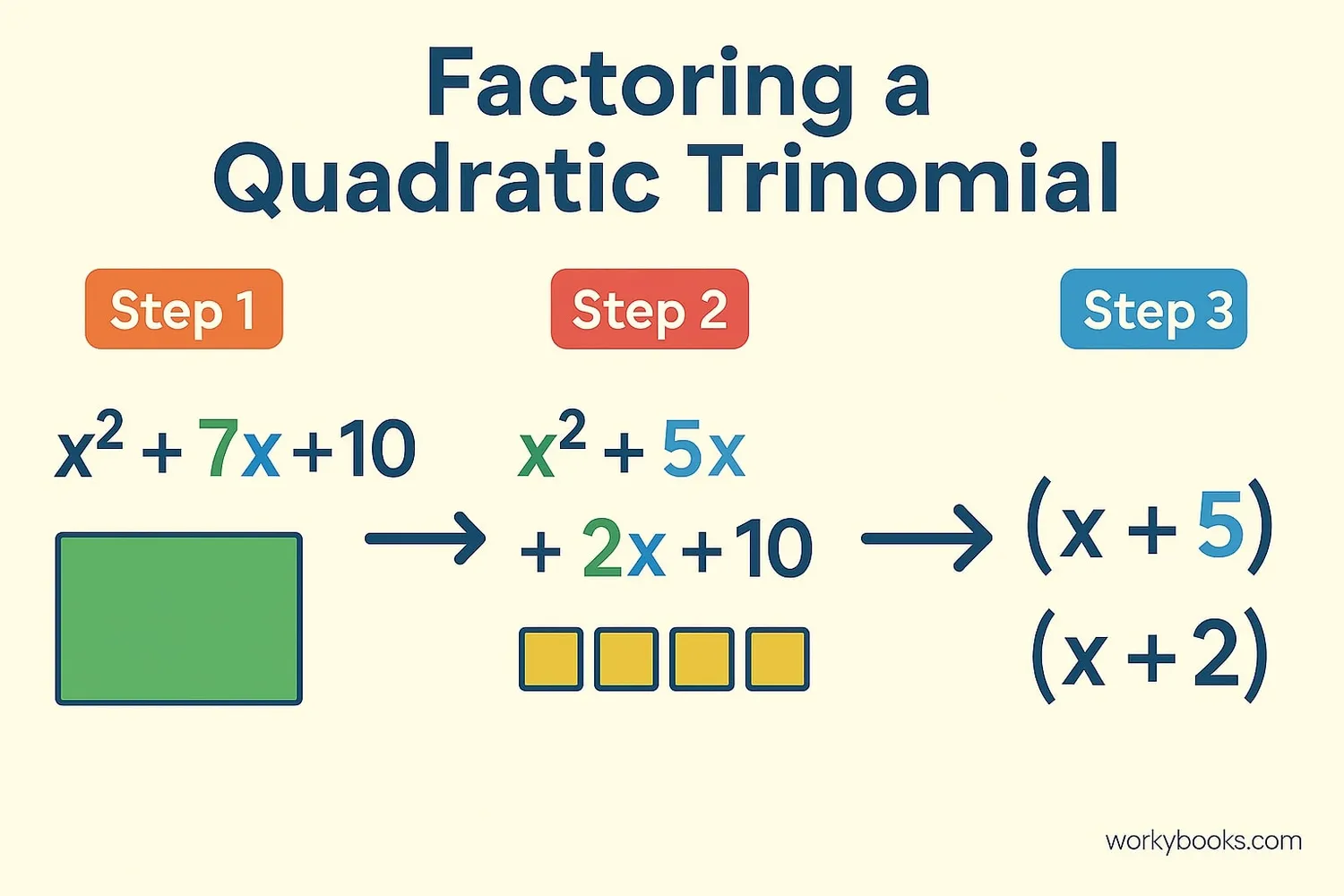
For a quadratic expression in the form $ax^2 + bx + c$, the AC Method provides a deterministic path to the solution. Instead of guessing factors of $c$ that add up to $b$, the AC method involves multiplying $a$ and $c$ together and finding two numbers that multiply to $ac$ and add to $b$. This transforms a trinomial into a four-term polynomial that can be factored by grouping. This is not a guess; it is a calculation based on the relationship between coefficients and roots.
The Rational Root Theorem
When dealing with higher-degree polynomials (cubic, quartic, etc.), the Rational Root Theorem offers a structured list of potential factors. By dividing the factors of the constant term by the factors of the leading coefficient, we create a finite "pool" of possible rational roots. Combined with Synthetic Division, this turns what looks like an infinite search into a targeted, step-by-step investigation.
Myth 3: There Is Only One "Right" Way to Factor a Polynomial
Mathematics is often taught as a rigid path to a single answer, but factoring is versatile. While the final factored form of a polynomial is unique (a concept known as the Unique Factorization of Polynomials), the methods used to reach that form are varied and interchangeable.
Multiplicity of Methods
Take the polynomial $x^4 - 16$. This can be approached in several ways:
- Difference of Squares (Level 1): Factor it as $(x^2 - 4)(x^2 + 4)$. Then, factor $(x^2 - 4)$ again into $(x - 2)(x + 2)$.
- Difference of Squares (Level 2): Some might recognize $x^4$ as $(x^2)^2$ and $16$ as $4^2$ immediately.
- Root Finding: A student might use the Factor Theorem to find that $f(2) = 0$ and $f(-2) = 0$, then use division to find the remaining quadratic factor.
The myth that there is only one "right" method often causes "math anxiety" when a student’s chosen method doesn't match the teacher's example. As long as the mathematical operations follow the laws of algebra—such as the distributive property and the exponent rules—any valid method will yield the same result.
Myth 4: Factoring Is Obsolete Due to AI and Modern Calculators
In 2026, it is tempting to believe that because software can factor any polynomial in milliseconds, humans no longer need to learn the skill. This is the equivalent of saying that because we have GPS, we no longer need to understand geography.
Conceptual Understanding vs. Computational Speed
Factoring is less about the "answer" and more about understanding the structure of functions. When a computer factors a polynomial for a data scientist, the scientist must understand what those factors represent. In calculus, factoring is used to identify discontinuities (like holes in a graph) or to perform partial fraction decomposition for integration. If you cannot factor by hand, you will struggle to understand the "why" behind the behaviors of the graphs and systems you are analyzing.
Debugging and Verification
Technological tools are only as good as the input they receive. "Garbage in, garbage out" remains a rule in 2026. Knowing the basics of factoring allows a user to perform a "sanity check" on computer output. For instance, if a calculator provides a factor of $(x - 5)$ for a polynomial with a constant term of $12$, a student with basic factoring knowledge will immediately recognize an error because $5$ is not a factor of $12$.
Myth 5: Factoring Only Works With Integers and Simple Variables
A common misconception is that factoring is limited to "clean" numbers and simple $x$ and $y$ variables. This leads to confusion when students encounter fractional coefficients, radical expressions, or trigonometric identities.
Factoring Complex Structures
Factoring is a structural logic, not just a numerical one. We can factor expressions that involve trigonometric functions, such as $\sin^2(x) - \cos^2(x)$, which follows the "Difference of Squares" pattern: $(\sin(x) - \cos(x))(\sin(x) + \cos(x))$.
Similarly, polynomials with fractional coefficients can be factored by first "clearing" the fraction through the extraction of a Greatest Common Factor (GCF). For example, $\frac{1}{2}x^2 - 2$ can be factored by pulling out $\frac{1}{2}$, leaving $\frac{1}{2}(x^2 - 4)$, which then becomes $\frac{1}{2}(x - 2)(x + 2)$. The logic remains identical regardless of how "messy" the numbers appear.
Comparison of Common Factoring Methods
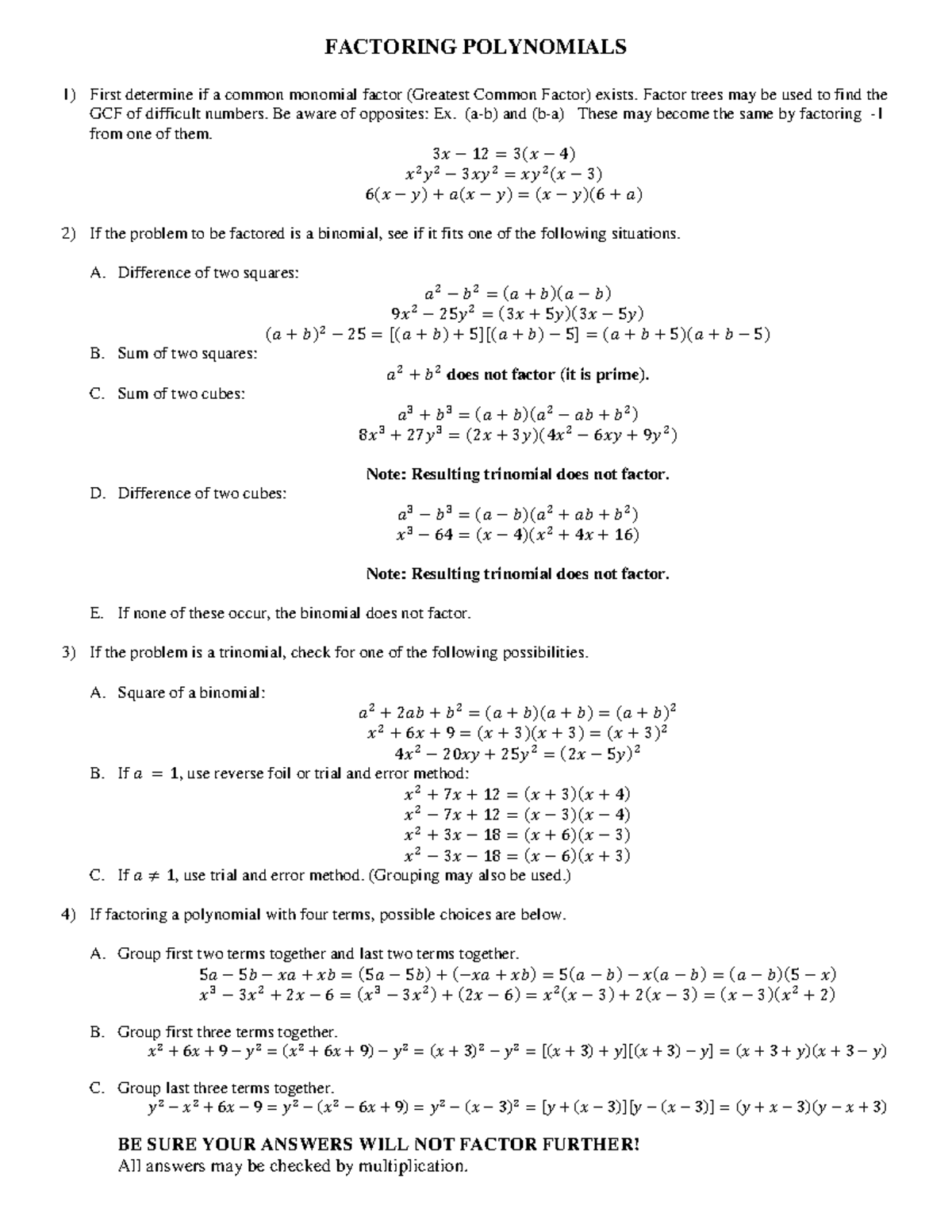
To successfully navigate polynomial factorization, it is helpful to know which tool to use for which scenario. The following table breaks down the primary methods used in 2026 mathematics.
| Method | Application | Complexity | Best For |
|---|---|---|---|
| Greatest Common Factor (GCF) | Any polynomial | Low | Every problem (always the first step) |
| Difference of Squares | $a^2 - b^2$ | Low | Binomials with two perfect squares |
| Grouping | 4 or more terms | Medium | Polynomials with proportional coefficients |
| AC Method / Trinomial Factoring | $ax^2 + bx + c$ | Medium | Standard quadratics and trinomials |
| Difference/Sum of Cubes | $a^3 \pm b^3$ | Medium | Binomials with perfect cube terms |
| Synthetic Division | Degree 3 or higher | High | Finding roots using the Factor Theorem |
Step-by-Step Troubleshooting for Factoring
When you encounter a polynomial that seems "impossible" to factor, follow this standardized 2026 troubleshooting protocol:
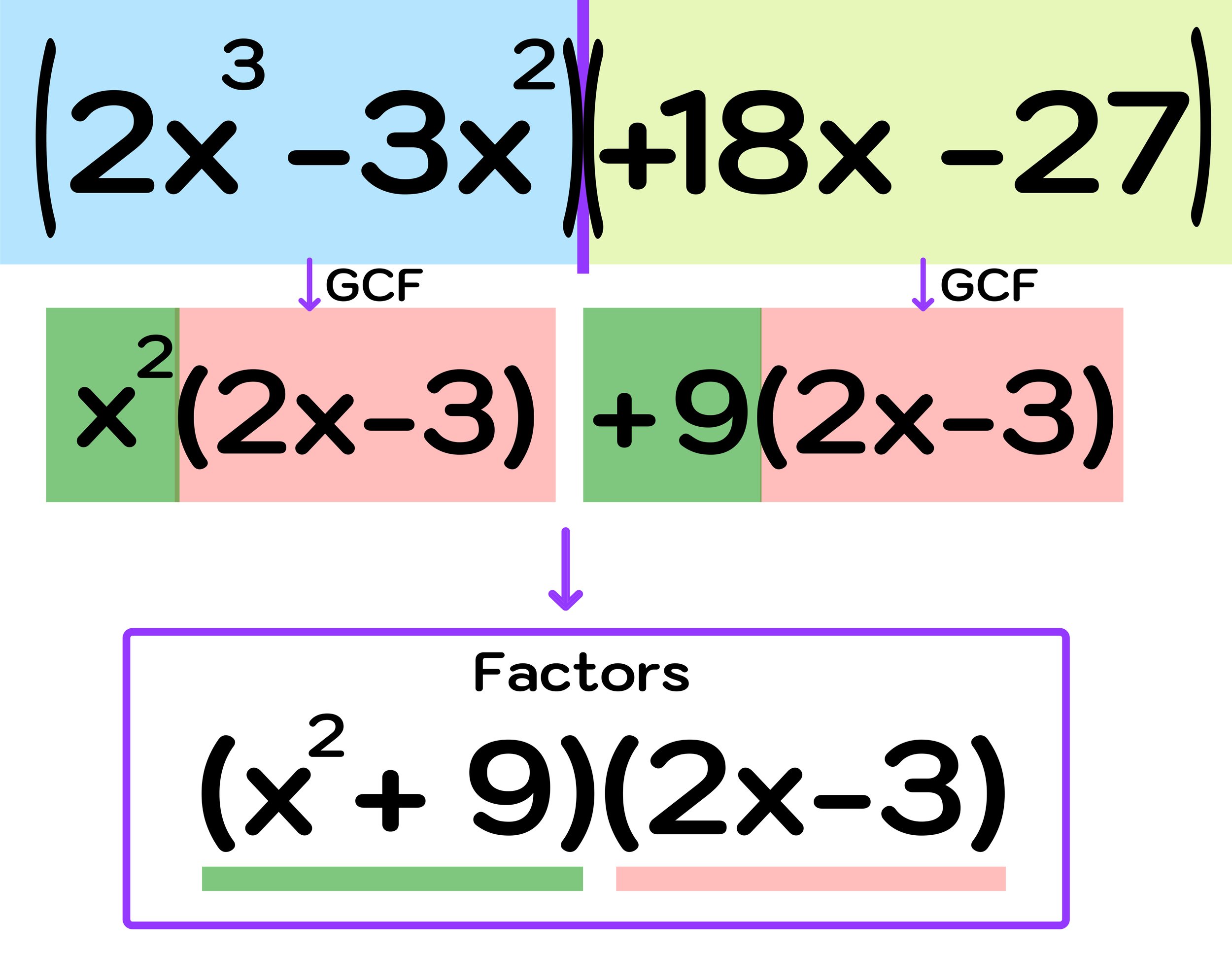
- Extract the GCF: This is the most skipped step. If you miss a common factor at the beginning, the numbers remain larger and more difficult to manage throughout the process.
- Count the Terms:
- 2 Terms: Check for Difference of Squares, Sum of Cubes, or Difference of Cubes.
- 3 Terms: Use the AC Method or look for Perfect Square Trinomials.
- 4 Terms: Attempt factoring by grouping.
- Check for "Hidden" Squares: Sometimes a term isn't a perfect square until you factor out a GCF. For example, $2x^2 - 18$ becomes $2(x^2 - 9)$, revealing the squares.
- The Discriminant Test: For quadratics ($ax^2 + bx + c$), calculate $b^2 - 4ac$. If the result is a perfect square, the quadratic is factorable over integers. If it is positive but not a perfect square, it is factorable over reals (using radicals). If it is negative, it requires complex numbers.
- Look for Patterns: In 2026, we emphasize "pattern recognition" over memorization. Look for structures that mimic simpler forms, such as $x^4 + 5x^2 + 6$, which is just a quadratic in terms of $x^2$.
Frequently Asked Questions
Why do I need to factor if I can just use the Quadratic Formula?
The Quadratic Formula only works for degree-2 polynomials (quadratics). Factoring is a broader skill applicable to polynomials of any degree. Furthermore, factoring reveals the structure of an expression, which is often more useful for simplifying large rational functions or solving inequalities than finding raw numerical roots.
What happens if a polynomial has no real factors?
If a polynomial has no real factors, it is considered "irreducible over the reals." However, according to the Fundamental Theorem of Algebra, it will still have factors in the complex number system. For example, $x^2 + 9$ factors into $(x + 3i)(x - 3i)$. In many advanced 2026 engineering contexts, these complex factors are essential for describing wave functions and electrical circuits.
Is factoring used in programming?
Yes. Polynomial factoring is a core component of symbolic computation libraries (like SymPy or Mathematica). Additionally, the logic of factoring—breaking a complex entity into its constituent parts—is a fundamental principle of modular programming and algorithm design. It is also used in computer graphics for defining Bézier curves.
Can factoring be used to solve real-world problems?
Absolutely. Factoring is used to find the maximum height of a projectile, the break-even point in business models, and the resonance frequencies in mechanical systems. Anytime a relationship is modeled by a polynomial, factoring helps identify the critical "tipping points" where the value of the function is zero.
How has factoring instruction changed in 2026?
Instruction has shifted toward conceptual modeling. While students still learn the mechanics, there is a greater emphasis on using visual tools like "Area Models" or "Algebra Tiles" (digitally) to understand that factoring is essentially finding the dimensions of a rectangle with a given area.
Practical Recommendation for Mastering Factoring
To truly master factoring polynomials, you should move away from memorizing specific problems and focus on structural recognition. Start every problem by looking for the Greatest Common Factor (GCF), as this simplifies the remaining terms and often reveals a recognizable pattern like the Difference of Squares.
Practice by "reverse-engineering" your own problems: multiply two random binomials together to see the resulting trinomial, then try to factor it back. This builds an intuitive sense of how coefficients interact. Finally, leverage visual software to see how the factors of a polynomial correspond to the x-intercepts on a graph—this visual connection is often the "lightbulb moment" for most learners.