Small businesses in 2026 achieve the highest return on investment by prioritizing Local SEO, Authority-Driven Content Marketing, and Technical Performance Optimization. These three services form a comprehensive digital strategy that ensures a business is discoverable in local map packs, authoritative enough for AI-driven search results, and technically sound for high mobile conversion rates.
The search landscape has shifted significantly. In 2026, search engines are no longer just lists of links; they are sophisticated generative engines that prioritize "helpful content" and verified local entities. For a small business with a limited budget, spreading resources too thin across every possible marketing channel is a recipe for mediocrity. Instead, focusing on the three pillars of modern search engine optimization (SEO) allows a brand to punch above its weight class, competing directly with larger corporations for high-intent traffic.
1. Local SEO: Dominating Proximity-Based Search
Local SEO remains the most critical service for any small business that serves a specific geographic area. Whether you are a law firm in Chicago, a boutique in London, or a plumbing service in Sydney, your primary customers are searching for you within a few miles of your physical location or service radius.
Google Business Profile and Map Pack Optimization
In 2026, the Google Business Profile (GBP) acts as a secondary homepage. It is often the first point of contact a customer has with your brand. SEO services specializing in Local SEO focus on the "Map Pack"—the top three local results that appear in a specific box on the search results page. Optimization involves more than just filling out a profile; it requires active management of "Business Attributes," high-frequency updates of local posts, and the integration of "Reserve with Google" or similar booking functionalities.
Effective local SEO services ensure that your NAP (Name, Address, Phone Number) data is 100% consistent across the web. Even a minor discrepancy, such as "Street" versus "St.," can dilute your local ranking signals. In the current 2026 environment, search engines use "Proximity, Prominence, and Relevance" as the three core pillars of local ranking. A dedicated service will help you maximize "Prominence" through local PR and "Relevance" by ensuring your service categories perfectly align with user intent.
Review Management and Social Proof
Reviews are the lifeblood of local search. Search algorithms in 2026 place immense weight on the velocity, diversity, and sentiment of customer reviews. A top-tier SEO service provides a system for ethical review acquisition, helping businesses prompt happy customers for feedback while managing negative experiences before they become public. Furthermore, the content of these reviews matters; when customers use specific keywords (like the name of a dish or a specific service provided), it reinforces the business’s relevance for those search terms.
2. Authority-Driven Content Marketing (E-E-A-T)
With the explosion of AI-generated content over the last few years, search engines have doubled down on E-E-A-T: Experience, Expertise, Authoritativeness, and Trustworthiness. For a small business, "content marketing" is no longer about churning out 500-word blog posts filled with keywords. It is about establishing the business owner or the brand as a definitive source of truth in their niche.
Topical Authority and Content Clusters
Instead of targeting random keywords, high-level SEO services now build "Topical Clusters." This involves creating a comprehensive "pillar page" about a core service or product, supported by numerous detailed articles that answer every possible question a customer might have. For example, a small financial planning firm wouldn't just target "retirement planning." They would build a cluster covering 401(k) rollovers, tax-advantaged accounts for small business owners, and estate planning for late-career professionals.
By covering a topic from every angle, you signal to search engines that you are an authority. In 2026, this is the only way to survive "Search Generative Experiences" (SGE), where the search engine summarizes the best information directly on the results page. If your content is the most authoritative, the AI is more likely to cite your business as the source, driving high-quality referral traffic.
The Role of Experience in 2026
Search engines now specifically look for "first-hand experience." SEO services for small businesses help translate the owner's real-world expertise into digital formats. This includes case studies, original photography of projects, video demonstrations, and unique insights that an AI cannot replicate. This "human-centric" content is what ultimately converts a visitor into a lead, as it builds the trust necessary for a transaction to occur.
3. Technical SEO and Performance Optimization
Technical SEO is the foundation upon which all other efforts are built. If a website is slow, broken, or confusing to search engine "crawlers," the best content in the world will not rank. For small businesses, technical SEO is often overlooked in favor of more visible marketing, but it is the "silent killer" of search rankings.
Core Web Vitals and User Experience (UX)
By 2026, Core Web Vitals (CWV) have become a standardized ranking factor that prioritizes the user's experience. This includes:
- Largest Contentful Paint (LCP): How fast the main content loads.
- Interaction to Next Paint (INP): How responsive the site is to user clicks.
- Cumulative Layout Shift (CLS): How stable the elements on the page are as it loads.
Small business SEO services focus on optimizing these metrics by compressing images, leveraging browser caching, and cleaning up bloated code. A fast site doesn't just rank better; it has a significantly higher conversion rate. Studies consistently show that every second of delay in mobile load times leads to a double-digit drop in sales.
Schema Markup and Semantic SEO
Technical SEO also involves "speaking the language" of search engines through Schema Markup (Structured Data). This is a specialized code added to a website that tells search engines exactly what a piece of data represents—whether it’s a price, an event date, a recipe, or a business’s physical address.
In 2026, Schema is vital for appearing in "Rich Results" (the snippets that show star ratings, prices, or FAQ dropdowns directly in search results). Small businesses that use Schema for "LocalBusiness," "Product," and "FAQ" see much higher click-through rates (CTR) than those that rely on standard blue links.
Comparison of Top SEO Services for Small Businesses
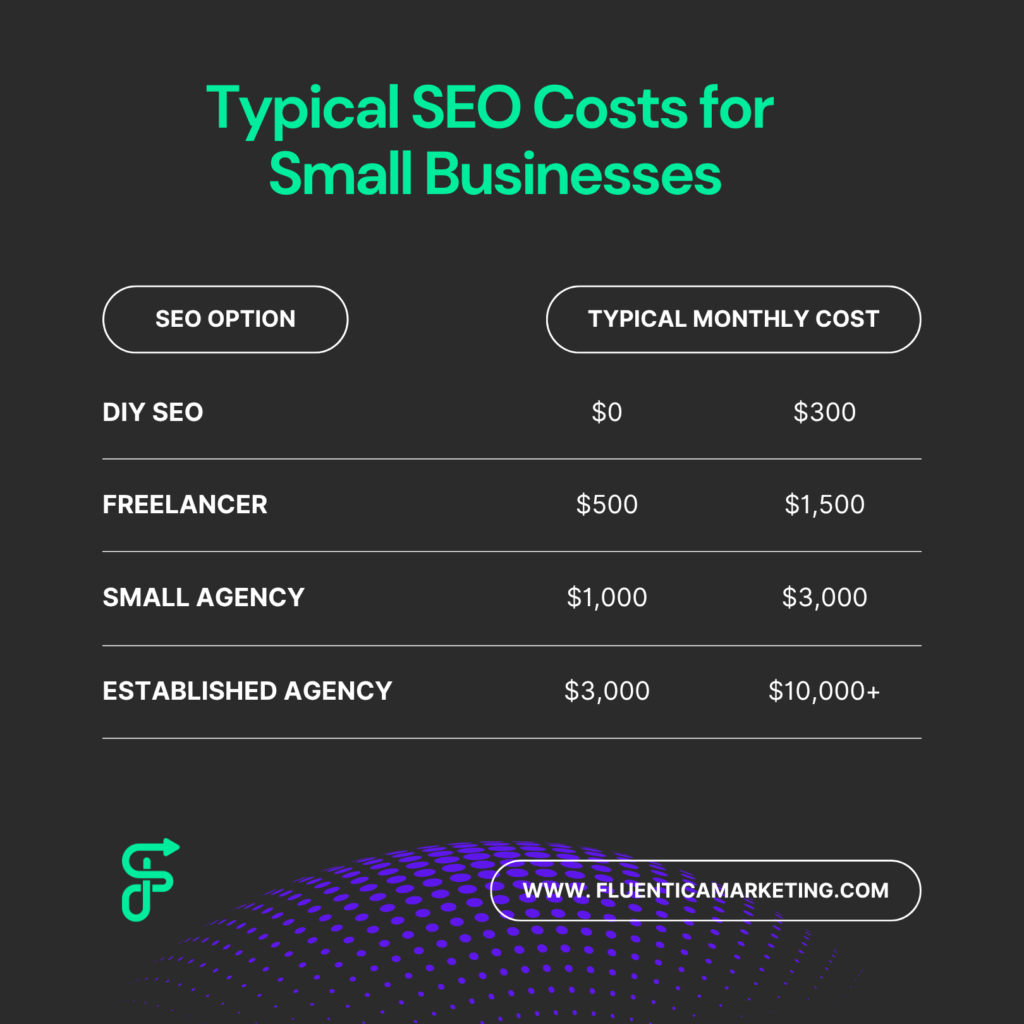
The following table summarizes the primary focus, cost expectations, and expected outcomes for these three essential services in 2026.
| Service Type | Primary Focus | Typical Monthly Cost (USD) | Time to See Results | Primary Benefit |
|---|---|---|---|---|
| Local SEO | GBP Optimization, Local Citations, Reviews | $500 – $1,500 | 2–4 Months | High-intent local leads & foot traffic. |
| Content Marketing | E-E-A-T, Topical Authority, Blogging | $1,000 – $3,000 | 6–12 Months | Long-term brand authority & organic reach. |
| Technical SEO | Site Speed, Schema, Mobile UX | $750 – $2,000 | 1–3 Months | Improved indexation & higher conversion rates. |
Determining the Best Starting Point for Your Business
Not every small business needs to invest heavily in all three services simultaneously. The right choice depends on your current digital maturity and your specific business goals.
- The New Business: If you just launched your website, start with Technical SEO. You must ensure your site is indexable and fast before you spend money on content or local promotion. A "Technical Audit" is the standard first step to identify critical errors that could hamper future growth.
- The Brick-and-Mortar Store: If you have a physical location, Local SEO is your non-negotiable priority. Being invisible on Google Maps is equivalent to not having a sign on your storefront.
- The Service Provider/Consultant: If you sell expertise (e.g., coaching, accounting, digital services), Content Marketing is your strongest lever. You need to prove your expertise to justify your rates and win clients from larger competitors.
Common Pitfalls to Avoid in 2026
When shopping for SEO services, small business owners must be wary of several "red flags" that have become common in the current market:
- Guaranteed Rankings: No reputable agency can guarantee a #1 spot on Google. Search algorithms are dynamic and influenced by competitor actions.
- Low-Cost Content Automation: Be cautious of agencies that use purely AI-generated content without human oversight. Google’s 2026 algorithms are highly adept at identifying and de-prioritizing low-effort automated content.
- Hidden Technical Debt: Some providers focus only on "backlinks" while ignoring a site that takes 10 seconds to load. A balanced approach is mandatory.
- Lack of Transparency: Always demand a clear reporting dashboard that tracks "Conversions" (calls, form fills, sales) rather than just "Traffic." Traffic that doesn't buy is a vanity metric.
For more information on the standards for web performance and structured data, business owners can consult the W3C Standards and the Schema.org Documentation.
Frequently Asked Questions
Is SEO still worth it for small businesses in the age of AI?
Yes. While AI (like ChatGPT or Google's SGE) provides answers, it gathers those answers from authoritative websites. SEO in 2026 is the process of ensuring your business is the one the AI trusts and cites. Furthermore, local "near me" searches still rely heavily on traditional local SEO signals that AI cannot bypass.
How much should a small business spend on SEO monthly?
In 2026, most effective small business SEO packages range from $1,500 to $5,000 per month. Anything significantly lower often indicates a lack of manual labor (e.g., using only automated tools), which rarely produces results in a competitive landscape.
Can I do SEO myself or do I need a service?
Small business owners can handle basic tasks like updating their Google Business Profile or writing occasional blog posts. However, the technical aspects (Schema, Core Web Vitals) and the strategic scaling of content usually require professional expertise to see a meaningful return on investment.
How do I measure the success of an SEO service?
The ultimate metric is "Cost Per Lead" or "Return on Ad Spend" (ROAS). Look for increases in organic phone calls, contact form submissions, and online sales. While keyword rankings are a helpful leading indicator, they do not pay the bills if they don't lead to customers.
How long does it take for SEO to work?
Generally, you should expect to see early indicators of success (like increased impressions in Search Console) within 3 months. Significant increases in leads and revenue typically take 6 to 12 months of consistent effort, especially for new domains or highly competitive industries.
Next Actions for Small Business Owners
To begin improving your search presence, perform a manual audit of your current status. Search for your primary service and your city (e.g., "HVAC repair Phoenix") and see where you land. If you aren't in the top three of the Map Pack, your first action should be to claim and optimize your Google Business Profile. Once that is established, look for a technical partner to run a Core Web Vitals report to ensure your website is not actively frustrating potential customers.