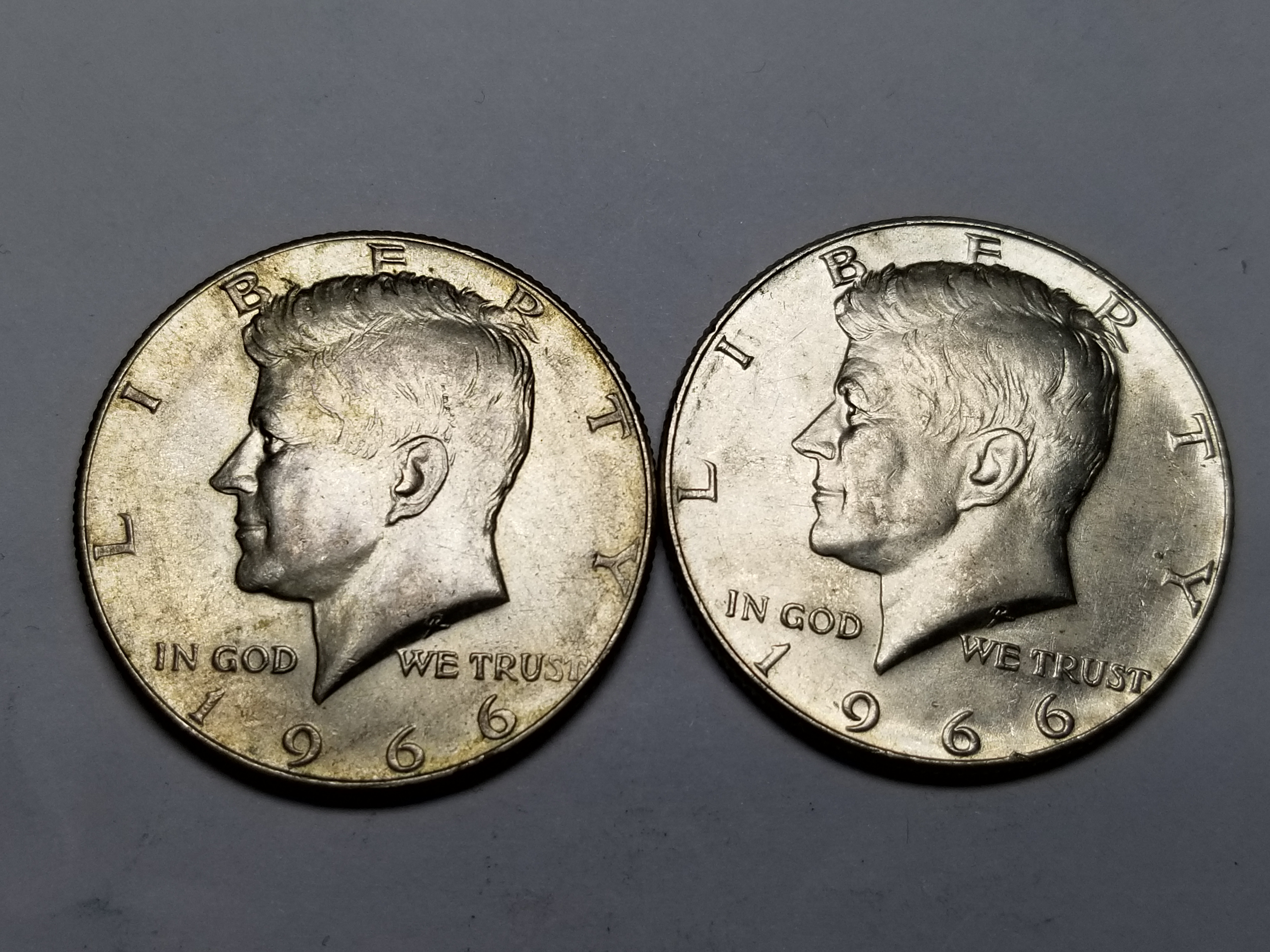
The 1966 Kennedy half dollar contains 40% silver, unlike the 90% silver composition used in 1964 or the copper-nickel clad composition adopted from 1971 onward. This specific alloy ratio was mandated by the Coinage Act of 1965 to address national silver shortages while maintaining a precious metal composition for circulating coinage.
Numismatists, coin collectors, and individuals sorting through inherited family collections frequently encounter the 1966 Kennedy half dollar and wonder about its precious metal value. Understanding the exact silver content of this coin requires a look into mid-1960s United States monetary policy, the mechanics of clad coinage, and the methods used to calculate intrinsic bullion value. This comprehensive guide explores the metallurgical makeup, historical context, identification techniques, and market valuation of the 1966 Kennedy half dollar.
Historical Context and the Coinage Act of 1965
To fully understand why the 1966 Kennedy half dollar contains a distinct 40% silver alloy, one must examine the economic climate of the mid-1960s. Following the assassination of President John F. Kennedy in late 1963, Congress authorized the Kennedy half dollar via Public Law 88-36 in March 1964. These initial 1964 coins were struck with a traditional 90% silver and 10% copper composition, matching the standard set by previous US circulating silver coins like the Franklin and Walking Liberty half dollars.
However, an unprecedented nationwide shortage of silver developed shortly thereafter. Private citizens, investors, and speculators began hoarding silver coins because the market price of silver bullion was rapidly approaching and threatening to exceed the face value of the currency ($1.38 per ounce of silver makes a 90% half dollar worth more than fifty cents in metal). To prevent the complete disappearance of circulating coinage from commerce, the United States Mint needed a radical solution.
President Lyndon B. Johnson signed the Coinage Act of 1965 on July 23, 1965. This legislation eliminated silver entirely from the dime and the quarter, replacing them with a copper-nickel clad composition over a pure copper core. For the half dollar, however, Congress made a political and economic compromise. Lawmakers decided to retain a reduced silver content of 40% to honor President Kennedy while conserving the nation's diminishing strategic silver reserves. This transitional composition was utilized for half dollars minted from 1965 through 1970.
Metallurgical Composition of the 1966 Half Dollar
The 1966 Kennedy half dollar is not a solid piece of 40% silver alloy. Instead, the United States Mint engineered a unique clad sandwich structure to ensure the coin maintained the appropriate weight, thickness, and external appearance of traditional silver currency while drastically reducing the overall precious metal mass.
The coin is constructed using a three-layer clad strip. The outer layers and the inner core possess entirely different metallurgical formulas:
- Outer Cladding: The exterior layers consist of an alloy containing 80% silver and 20% copper. This rich outer layer gives the coin its characteristic silver appearance and tarnishing characteristics.
- Inner Core: The central core consists of a copper-silver alloy containing approximately 20.9% silver and 79.1% copper (or more specifically, a matrix designed to balance the overall weight).
- Net Composition: When the outer cladding and the inner core are combined by weight across the entire coin, the final product yields an overall composition of 40% silver and 60% copper.
This technical design meant that a 1966 Kennedy half dollar weighed 11.50 grams, which was slightly heavier than the 1964 version (12.50 grams) due to the differing density requirements of the copper core, though the overall diameter of 30.61 millimeters remained identical.
| Coin Year | Composition | Total Weight | Silver Weight (ASW) | Copper Weight |
|---|---|---|---|---|
| 1964 | 90% Silver, 10% Copper | 12.50 grams | 0.36169 troy oz | 0.038 troy oz |
| 1965–1970 | 40% Silver, 60% Copper | 11.50 grams | 0.14790 troy oz | 0.222 troy oz |
| 1971–Present | Copper-Nickel Clad (No Silver) | 11.34 grams | 0.00000 troy oz | ~11.34 grams |
Calculating Actual Silver Weight (ASW)
For precious metal investors and collectors, understanding the "Actual Silver Weight" (ASW) is essential for determining intrinsic melt value. The ASW represents the exact amount of pure (99.9%) silver contained within a specific coin, independent of its total gross weight.
To find the ASW of a 1966 Kennedy half dollar, use the following formula:
- Take the total weight of the coin in grams: 11.50 grams.
- Multiply by the silver percentage (40%): $11.50 \times 0.40 = 4.60$ grams of pure silver.
- Convert grams to troy ounces (since precious metals are traded in troy ounces, where 1 troy oz equals 31.1035 grams): $4.60 \div 31.1035 \approx 0.1479$ troy ounces of pure silver.
Therefore, every circulating 1966 Kennedy half dollar contains approximately 0.1479 troy ounces of pure silver. To calculate the current melt value, multiply this ASW figure (0.1479) by the live spot price of silver per troy ounce. For example, if silver is trading at $30.00 per ounce, the base silver value of a 1966 half dollar is roughly $4.44.
How to Identify a 1966 Kennedy Half Dollar
Because the United States Mint produced billions of copper-nickel clad half dollars from 1971 onward that contain zero silver, proper identification is vital. Several visual and physical inspection methods allow you to distinguish a 1966 40% silver half dollar from a modern copper-nickel version.
1. Check the Date
The most straightforward method is checking the year stamped on the obverse (front) of the coin below the bust of President Kennedy. If the date reads 1966, the coin is part of the 1965–1970 40% silver window. (Note: Coins dated 1964 are 90% silver, while coins dated 1971 and later contain no silver for general circulation).
2. Examine the Edge (The Mint Mark / Layer Test)
If the date is worn or unreadable, inspect the reeded edge of the coin:
- Modern Copper-Nickel Clad (1971–present): The edge will typically show a distinct copper stripe sandwiched between two silvery outer layers.
- 1965–1970 40% Silver Clad: Because the inner core contains silver alloyed with copper rather than pure copper, the edge often exhibits a muted, dull grey or silver color rather than a bright, glaring copper stripe. While a faint copper line can sometimes be visible on worn specimens, it lacks the distinct reddish-orange contrast seen on post-1970 coins.
3. Weigh the Coin
Using a precise digital grain or gram scale provides definitive verification:
- A 1964 90% silver half dollar weighs 12.50 grams.
- A 1965–1970 40% silver half dollar weighs 11.50 grams.
- A 1971–present copper-nickel half dollar weighs 11.34 grams.
Mint Marks and Special Editions from 1966
The 1966 Kennedy half dollar was struck exclusively at the United States Mint facility in Denver, though during this era, mint marks were temporarily omitted from all US coinage (from 1965 to 1967) to discourage coin hoarding by collectors.
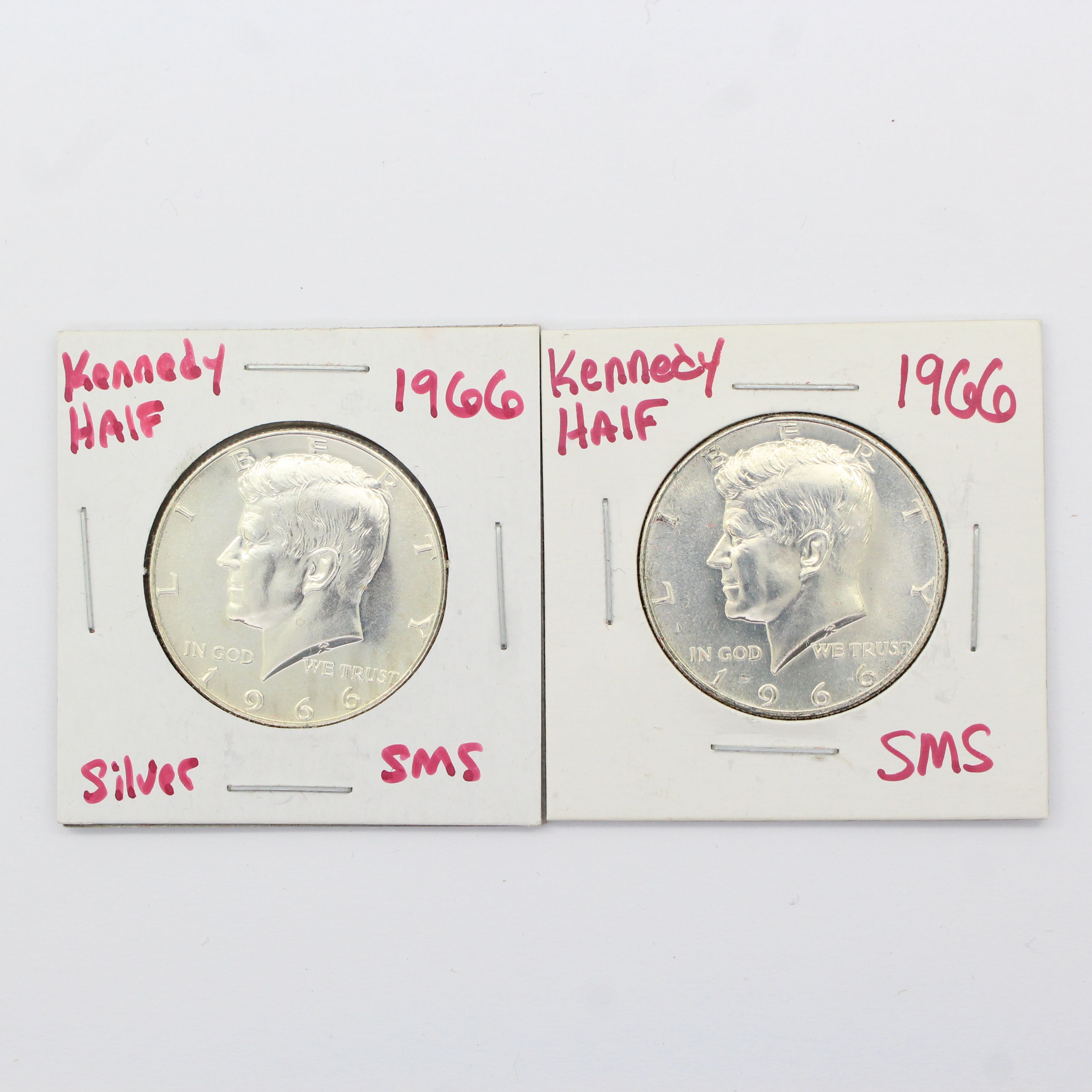
- Circulation and Mint Sets: All 1966 half dollars lack a mint mark on the obverse (just to the right of the truncation of Kennedy’s neck). They were struck for inclusion in United States Special Mint Sets (SMS) rather than traditional proof sets, as well as for general commerce.
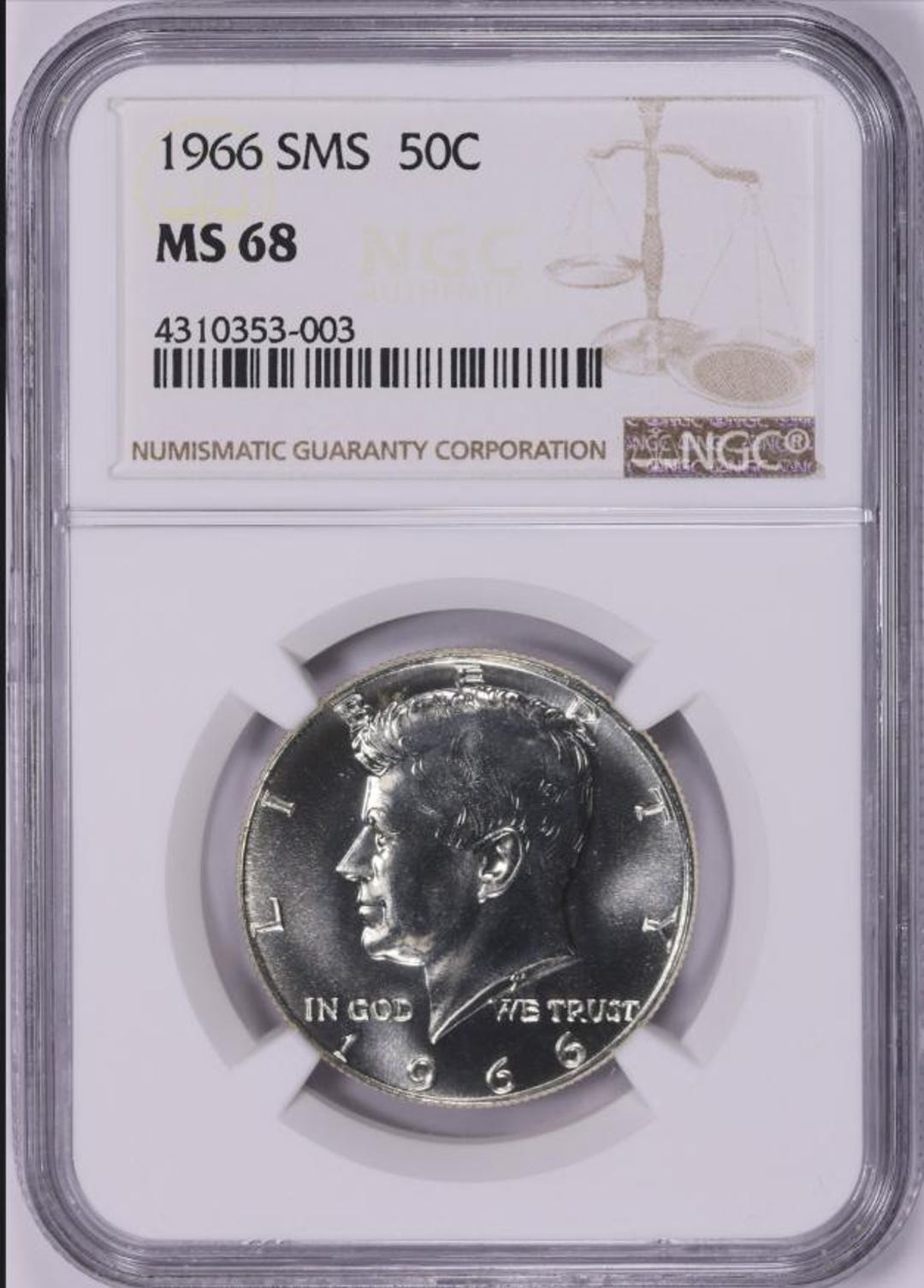
- Special Mint Set (SMS) Finishes: The 1966 coins found in official SMS packaging often exhibit sharper strikes, satin-like or brilliantly polished surfaces, and higher visual appeal than standard business-strike coins pulled from circulation. However, even standard business strikes from 1966 contain the exact same 40% silver composition.
Numismatic Value vs. Melt Value
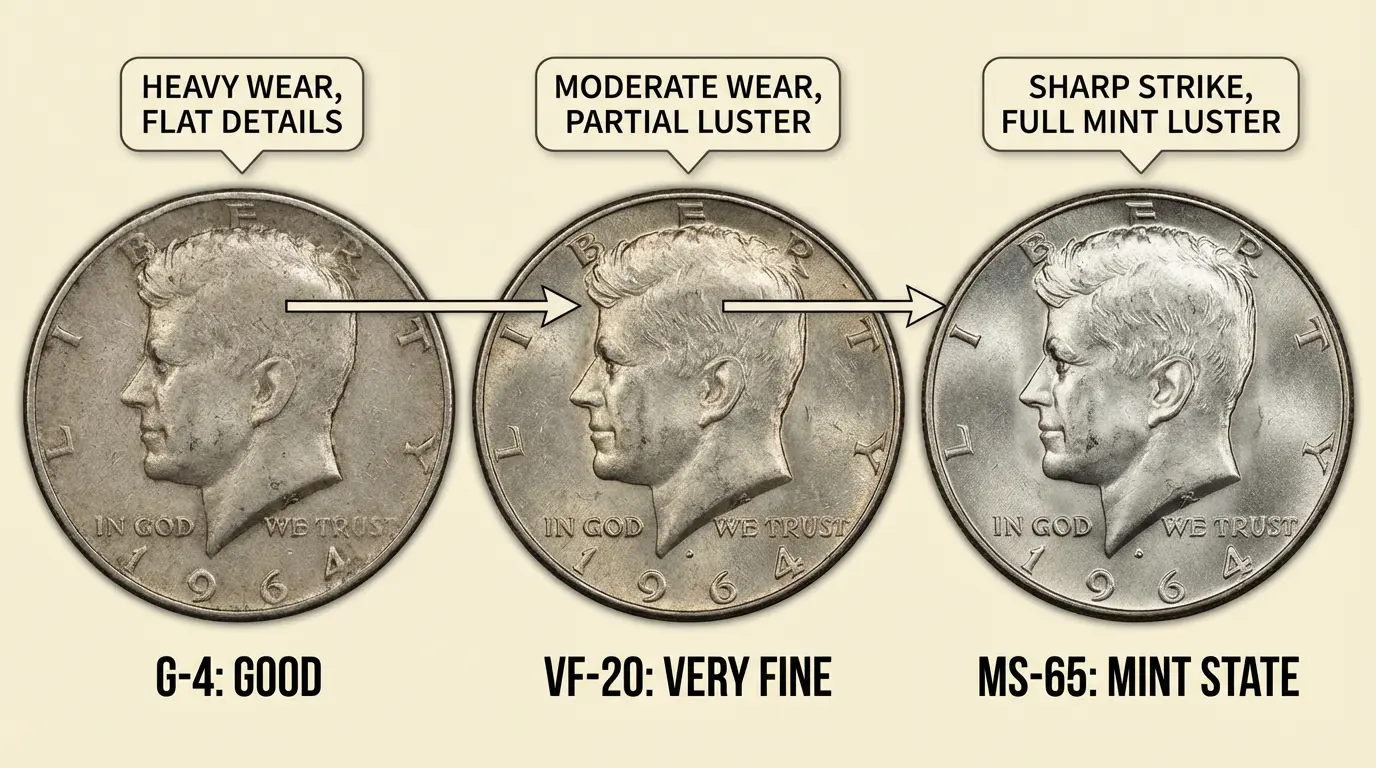
While the intrinsic silver value sets a hard price floor for the 1966 half dollar, numismatic (collector) value can vary depending on the coin's condition, grade, and historical demand.
- Circulated Condition: Coins found in pocket change or old change jars usually show wear, scratches, and dings. These are commonly traded strictly for their silver melt value plus a modest dealer premium.
- Uncirculated Condition: Coins preserved in pristine, uncirculated condition—particularly those originating from undisturbed Special Mint Sets—can command higher prices from collectors seeking high-grade examples (graded MS65 or higher by third-party services like PCGS or NGC).
- Errors and Varieties: Collectors look for minor mint errors, such as doubled die obverses or striking anomalies, though major valuable errors for the 1966 half dollar are relatively scarce.
Common Mistakes and Misconceptions
When evaluating mid-1960s half dollars, collectors and sellers frequently encounter several common pitfalls:
- Assuming All Pre-1971 Coins are 90% Silver: Many people mistakenly believe that any half dollar minted before 1971 is 90% silver like the 1964 issue. It is important to remember the transitional 40% rule for the years 1965 through 1970.
- Ignoring Condition When Selling: Attempting to clean silver coins to make them look shiny is a major error. Harsh cleaning or polishing leaves micro-scratches that destroy numismatic value, reducing a collectable coin down to raw melt value.
- Confusing SMS Finishes with Proofs: The 1966 Special Mint Set coins are unique to the mid-1960s gap when traditional proof sets were suspended. Treating them as standard circulation strikes undervalues their specialized mint production history.
Practical Next Steps for Holders of 1966 Half Dollars
If you have discovered a 1966 Kennedy half dollar in your possession, determining your next action depends on your collection goals:
- Sort and Separate: Isolate any 1965–1970 half dollars from your post-1971 modern coins by checking dates and weighing them if necessary. Keep 1964 half dollars separate, as they hold a higher 90% silver content.
- Assess Condition: Handle coins by their edges to avoid transferring skin oils. Examine them under good lighting to check for wear, scratches, or pristine mint luster.
- Check Live Silver Prices: Multiply the 0.1479 ASW factor by the current market spot price of silver to establish the baseline bullion value.
- Consult Price Guides: For uncirculated specimens or coins in original government packaging (SMS sets), consult recognized numismatic pricing guides before selling to ensure you capture collector premiums beyond raw melt value.