Heath Ledger’s vocal delivery, particularly his iconic transformation in The Dark Knight, stands as one of the most studied and dissected vocal performances in modern cinema history. Far from relying on a standard Hollywood approximation, Ledger approached accents with an actor's ear for regional cadence, breath control, and psychological grounding, leaving behind a legacy of speech patterns that continue to fascinate linguists, film critics, and aspiring actors alike.
When examining Heath Ledger’s accent work, audiences frequently look past the surface impression to uncover a masterclass in dialect coaching, improvisation, and psychological character building. From his native Australian tongue to the gravelly, anarchic cadence of the Joker, Ledger’s vocal versatility was a cornerstone of his dramatic range. Understanding how he built these voices requires an exploration of his linguistic origins, his collaborative relationships with dialect coaches, and the specific choices that defined his most memorable roles.
1. The Foundation: Perth, Western Australia, and the Natural Australian Vowels
To understand how Heath Ledger manipulated his voice on screen, one must first examine his native speech patterns. Born in Perth, Western Australia, in 1979, Ledger grew up with a classic Australian English accent, characterized by broad vowels, a non-rhotic delivery (where the "r" sound is dropped at the end of syllables), and a rising intonation pattern known as the Australian question intonation.
Early in his career, particularly in Australian television and film projects such as Two Hands (1999) and Roar (1997), Ledger utilized his natural accent. However, even in these formative years, he demonstrated an acute awareness of his speech. Australian English features a distinct placement in the mouth and throat compared to American English, requiring actors who transition internationally to deliberately shift their resonance chambers to achieve authenticity. Ledger’s early comfort with his native voice provided a flexible baseline against which he could build entirely foreign phonetic structures.
2. Conquering the American West in 10 Things I Hate About You
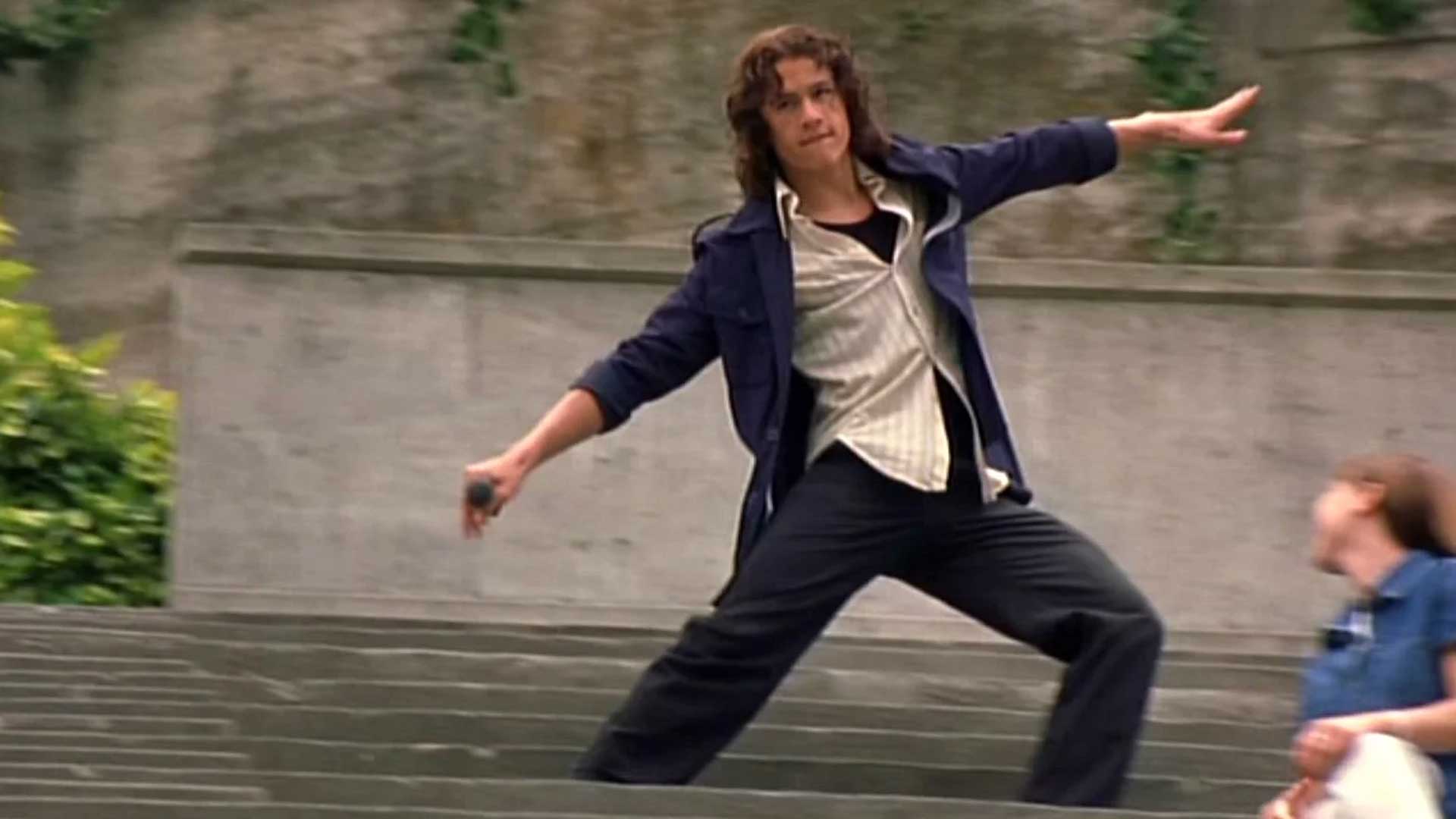
Ledger’s breakout American role in the 1999 teen comedy 10 Things I Hate About You required him to adopt an American accent that would appeal to a global audience while maintaining the charm of a rebellious high school outsider. Playing Patrick Verona, Ledger had to shed his Australian broad vowels and adopt a generalized American accent.
For a young actor working on his first major American studio film, maintaining dialect consistency while performing complex comedic and romantic scenes was a formidable hurdle. Ledger achieved this by flattening his vowel sounds, hardening his consonants, and moving his vocal placement forward in the mouth. While a few subtle Australian diphthongs occasionally slipped through—a common phenomenon for actors early in their international careers—his natural charisma and the rebellious, slightly aloof nature of his character masked any minor dialect slips, effectively establishing his viability as a leading man in Hollywood.
3. The Appalachian and Southern Dialects in Brokeback Mountain
One of the most praised aspects of Ledger’s performance as Ennis Del Mar in Ang Lee’s Brokeback Mountain (2005) was his deeply internalized, physically restrictive vocal delivery. Ennis is a man of few words, and his speech reflects the rugged, isolated landscape of the American West and the tight-lipped culture of rural Wyoming in the mid-20th century.
Ledger did not use a generic "cowboy" drawl; instead, he worked to create a low, rumbling, almost subterranean voice. He spoke through clenched teeth and tight lips, a physical choice that restricted his articulation and mirrored Ennis’s emotional repression. This technique required immense breath support to ensure that every mumbled or clipped line remained intelligible to the audience without breaking the illusion of an authentic, guarded working-class rancher.
4. The Melodic Romance of A Knight’s Tale
In A Knight’s Tale (2001), Ledger played William Thatcher, a peasant who masquerades as a knight. The film famously blends medieval settings with modern classic rock soundtracks, and Ledger’s vocal performance required a delicate balance between historical resonance and modern accessibility.
While Ledger utilized a modernized, accessible English accent rather than an authentic Middle English dialect—which would be virtually incomprehensible to modern viewers—he modulated his pitch and cadence to convey nobility, urgency, and youthful ambition. His delivery in this film sits comfortably between his natural Australian cadence and a standard British stage accent, showcasing his ability to find a middle ground that served the anachronistic tone of the production.
5. Capturing 19th-Century Europe in The Brothers Grimm
Terry Gilliam’s The Brothers Grimm (2005) cast Ledger alongside Matt Damon as historical folklorists traveling through Napoleonic-era Europe. This role demanded an English accent that felt distinct from contemporary British speech while remaining distinct from Damon’s American delivery.
Ledger opted for a refined, slightly clipped British dialect for Jacob Grimm, contrasting with Damon’s more pragmatic American phrasing. This vocal dichotomy helped establish the sibling dynamic on screen—Jacob as the dreamy, bookish romantic, and Will as the cynical showman. Ledger’s precision in maintaining this elevated, slightly archaic English speech pattern demonstrated his growing confidence in handling European period dialects.
6. Channeling Bob Dylan’s Midwestern Cadence in I’m Not There
In Todd Haynes’s avant-garde biographical film I’m Not There (2007), Ledger played Robbie Clark, a fictionalized actor representing one facet of Bob Dylan’s public persona. Capturing Bob Dylan’s iconic singing and speaking voice is a formidable challenge for any actor, given Dylan’s nasal resonance, shifting Midwestern inflections, and poetic phrasing.
Ledger studied Dylan’s cadence—marked by a rhythmic, drawling delivery with nasal undertones—and integrated it into his dialogue. While Ledger was not tasked with a direct vocal impersonation, he captured the elusive, observational quality of 1960s counterculture speech. This performance highlighted his ability to adopt specific cultural and generational idioms rather than just geographic dialects.
7. The Anarchic Vocal Blueprint of the Joker in The Dark Knight
Ledger’s crowning achievement in accent and vocal creation is undeniably his portrayal of the Joker in Christopher Nolan’s The Dark Knight (2008). Eschewing the theatrical, crisp RP (Received Pronunciation) of previous iterations, Ledger crafted a voice that sounded genuinely unhinged, organic, and unpredictable.
The Joker’s voice is built on a foundation of breathy vocal fry, erratic pitch shifts, and rhythmic tongue clicks. Ledger drew inspiration from a variety of sources, including Anthony Hopkins’s vocal cadence in The Silence of the Lambs and the anarchic energy of punk rock musicians like Sid Vicious. Instead of anchoring the character to a specific geographic location—the Joker’s accent is an ambiguous, fractured hodgepodge of American and transnational inflections—Ledger focused entirely on the psychological rhythm of the speech, making every line sound like it was being invented on the spot.
8. Physicality and Breath Control as Dialect Tools
Across his career, Ledger understood that an accent is not merely a set of phonetic rules applied to the tongue and lips; it is a physical state of being. Whether tightening his jaw for Brokeback Mountain or adopting a serpentine, wet-mouthed vocal placement for the Joker, Ledger tied his speech patterns directly to his physical posture.
By altering his breathing—shallow and restricted for repressed characters, deep and erratic for volatile ones—he forced his vocal cords to produce sounds that felt lived-in and authentic. This holistic approach to voice acting explains why his accents never felt forced or superficial; they were supported by the entire physical apparatus of his characters.
| Film / Role | Target Accent / Dialect | Primary Vocal Technique |
|---|---|---|
| 10 Things I Hate About You (Patrick Verona) | Standard American | Forward mouth placement, flattened vowels, casual teen cadence. |
| Brokeback Mountain (Ennis Del Mar) | Rural Wyoming / American West | Clenched jaw, low register, tight lips, emotional repression. |
| A Knight’s Tale (William Thatcher) | Modernized British English | Elevated pitch, clean articulation, heroic cadence. |
| The Dark Knight (The Joker) | Transnational / Ambiguous Anarchic | Vocal fry, erratic pitch shifts, wet articulation, breathy delivery. |
| I’m Not There (Robbie Clark) | 1960s Counterculture / Midwestern | Nasal resonance, rhythmic drawl, poetic phrasing. |
9. Collaboration with Dialect Coaches and Musical Training
While Ledger was known for his intense independent preparation—famously locking himself in a London hotel room for a month to develop the Joker's look, diary, and voice—he also relied on professional collaboration when required. Working with dialect coaches allowed him to refine the subtle micro-nuances of regional American and British speech that non-native speakers might otherwise miss.
Furthermore, Ledger’s strong musical ear played a crucial role in his accent acquisition. Because accents are fundamentally about rhythm, pitch, and musical intervals, actors with musical inclinations—such as Ledger, who was an accomplished guitarist and aspiring director of music videos—often find it easier to mimic and internalize foreign speech patterns as if they were learning a song.
10. The Enduring Legacy of Ledger’s Voice Work
Heath Ledger’s untimely passing in 2008 cut short a career that was continually pushing boundaries in character transformation. His approach to accents redefined what contemporary audiences expect from cinematic performances, proving that voice work should never be a static costume, but rather a dynamic extension of character psychology.
From the sun-drenched vowels of Western Australia to the terrifying whispers of Gotham City, Ledger demonstrated that mastering an accent requires empathy, observation, and an absolute commitment to the inner life of the character. His vocal legacy remains a benchmark for actors navigating international film industries and complex character transformations.
Frequently Asked Questions
What was Heath Ledger’s natural accent?
Heath Ledger’s natural accent was Australian English. He was born and raised in Perth, Western Australia, and maintained his Australian vowels and cadence in his personal life and early local acting projects.
How did Heath Ledger create the voice for the Joker?
Ledger developed the Joker’s voice by combining a breathy vocal fry, erratic pitch shifts, and physical choices like speaking through his teeth and licking his lips frequently. He aimed for a sound that lacked a specific geographic origin to emphasize the character’s chaotic, rootless nature.
Did Heath Ledger use a dialect coach for Brokeback Mountain?
Yes, Ledger worked with dialect coaches to fine-tune the specific rural Wyoming cadence required for Ennis Del Mar. He paired this with physical choices, such as a clenched jaw and restricted breathing, to portray the character’s emotional repression.
Was Heath Ledger criticized for his American accent in early films?
In his earliest American roles, such as 10 Things I Hate About You, critics occasionally noted minor traces of his native Australian diphthongs, but his natural charisma and strong screen presence easily outweighed any minor phonetic inconsistencies.
How did Ledger's musical background help him with accents?
Accents rely heavily on rhythm, pitch, and timing. Ledger’s strong musical ear—demonstrated by his proficiency with instruments and his keen interest in music—allowed him to treat foreign dialects like musical scores, making it easier to internalize new cadences.
Practical Recommendations for Aspiring Actors
If you are studying dialect work or seeking to improve your vocal versatility for performance, take inspiration from Ledger’s methodology:
- Anchor the Voice in the Body: Never treat an accent as a purely mental exercise. Adjust your physical posture, jaw tension, and breathing to match the physical lifestyle of the character.
- Study the Rhythm, Not Just the Vowels: Listen to the musicality of the speech pattern. Focus on where sentences rise and fall, and where pauses occur naturally.
- Immerse Without Over-Rehearsing: Spend time listening to native speakers in natural environments to let the cadence seep into your subconscious before stepping in front of a camera.