ASO stands for App Store Optimization, the systematic process of improving a mobile application's visibility and conversion rate within app stores such as the Apple App Store and Google Play Store. The primary goal of ASO is to increase organic downloads by ensuring an app appears prominently in search results and top charts while persuading users to install the software once they reach the product page.
Understanding the Definition and Scope of ASO
App Store Optimization is often described as the "SEO of mobile apps." While this comparison is helpful for conceptualizing the focus on search visibility, modern ASO in 2026 encompasses a much broader range of disciplines than simple keyword placement. It is a multi-dimensional marketing strategy that combines data science, technical optimization, creative design, and psychological conversion tactics.
In the current mobile ecosystem, discovery happens through two primary channels: Search and Browse. Search refers to users actively typing queries into a search bar (e.g., "fitness tracker" or "budget planner"). Browse (or Explore) refers to users discovering apps through category rankings, featured sections, or "similar app" recommendations. Effective ASO addresses both behaviors, ensuring the app is indexed correctly for search while maintaining the high-performance metrics required to be featured by store editors or suggested by recommendation algorithms.
The scope of ASO is divided into two main categories: On-Metadata and Off-Metadata factors. On-metadata elements are those that the developer can directly control, such as the title, description, and screenshots. Off-metadata factors are external influences that the developer can only impact indirectly, such as total download volume, user ratings, and crash rates.
The Core Components of On-Metadata Optimization
On-metadata optimization involves the strategic selection and placement of textual and visual elements. These are the levers developers pull to signal to the store's algorithm what the app does and who it is for.
App Title and Subtitle
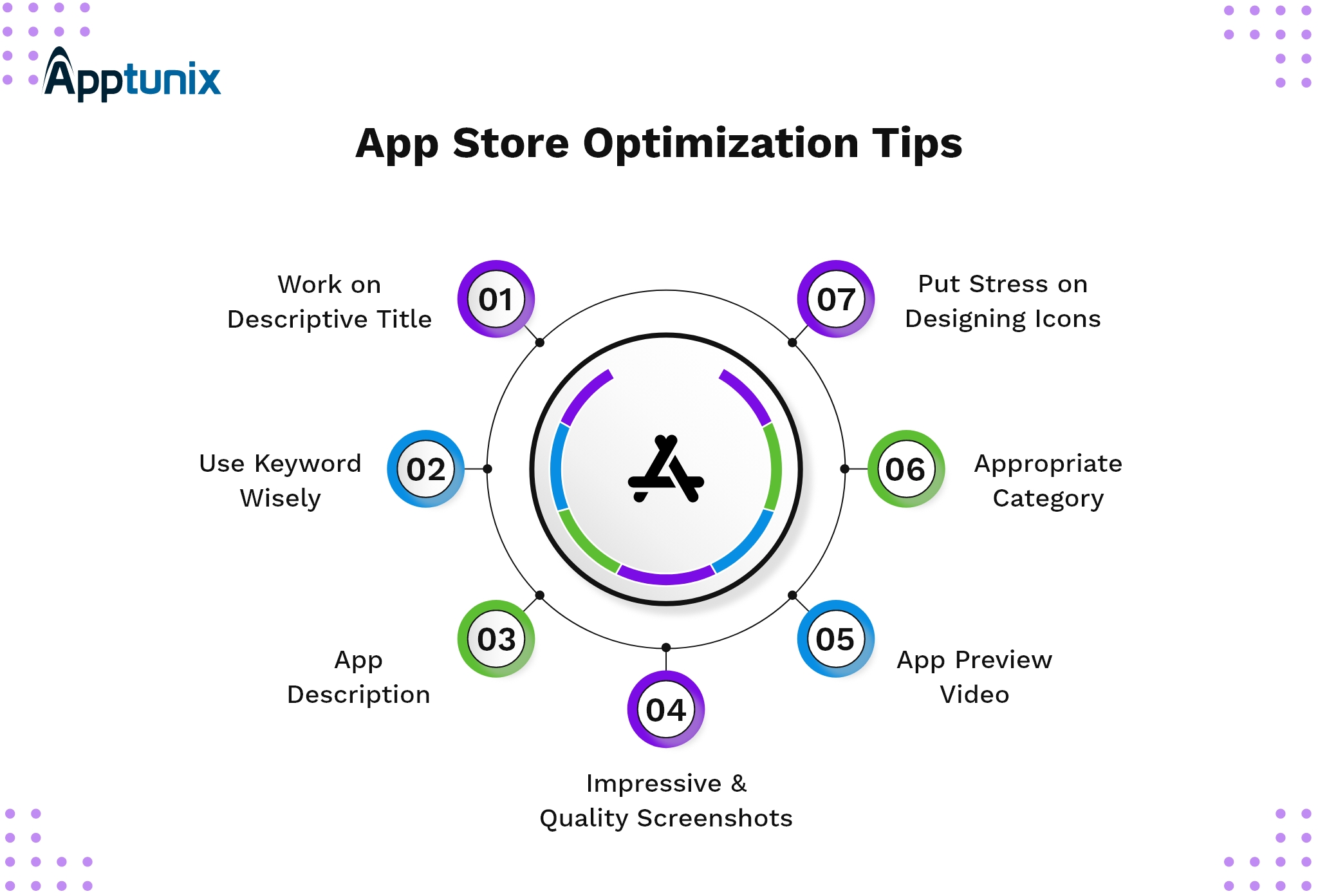
The App Title remains the most influential factor for search rankings in 2026. Keywords placed in the title carry the highest weight in the indexing algorithm. A successful title must balance keyword density with brand identity. On the Apple App Store, the title is limited to 30 characters, requiring extreme precision.
The Subtitle (iOS) and Short Description (Android) serve as secondary ranking signals. These fields are typically used to expand on the app's value proposition. While they still impact search rankings, their primary role is often to improve the click-through rate (CTR) by providing a concise summary of the app's main benefit.
The Keyword Field (iOS) vs. Description (Android)
A fundamental difference between the two major platforms lies in how they index keywords. Apple provides a hidden 100-character Keyword Field. This field is not visible to users and is used solely for search indexing. Success here requires avoiding spaces after commas, omitting the app's category name, and never repeating keywords already present in the title.
Conversely, the Google Play Store functions more like a traditional web search engine. It crawls the Long Description to identify relevant keywords and semantic themes. In 2026, Google’s natural language processing (NLP) is highly sophisticated, meaning developers must write for humans first, using a natural flow while ensuring primary keywords appear 3–5 times throughout the 4,000-character limit.
Conversion Rate Optimization (CRO): The Visual Pillar
Visibility is useless if users do not actually click "Install." Conversion Rate Optimization (CRO) is the practice of refining the visual assets to maximize the percentage of visitors who download the app.
App Icon and Screenshots
The App Icon is the first visual touchpoint a user encounters. In a crowded marketplace, the icon must be distinct, scalable, and reflective of the app's core function. It acts as the face of the brand and significantly impacts the CTR in search results.
Screenshots are not merely gallery images; they are a visual narrative. Data from 2026 shows that most users make a decision based on the first three screenshots. Therefore, these images must highlight the app's most unique features through "captioned screenshots"—images that combine UI highlights with short, punchy text. For games, the emphasis is often on gameplay mechanics and graphics, whereas for utility apps, the focus is on ease of use and problem-solving.
App Preview Videos
Video content has become a mandatory component of high-performing ASO strategies. An App Preview (Apple) or Promo Video (Google) provides a 15–30 second demonstration of the user experience. These videos are particularly effective for games or complex tools where static images cannot adequately convey the value. In 2026, autoplaying muted videos in search results has made high-quality motion design a critical factor in capturing user attention.
Off-Metadata Factors: The Influence of Performance
App stores prioritize "high-quality" apps to ensure user satisfaction. The algorithms analyze several performance-based metrics to determine an app's rank, many of which are external to the listing itself.
Download Velocity and Retention
Download Velocity refers to the number of installs an app receives within a specific timeframe. A sudden spike in downloads can propel an app to the top of the "Trending" or "Top Charts" sections. However, the algorithms also weigh Retention Rates. If an app has high downloads but is uninstalled within minutes, the store will interpret this as a sign of low quality or misleading ASO, eventually penalizing its search visibility.
Ratings and Reviews
User sentiment is a massive ranking signal. A high average rating (4.5 stars or higher) is essential for both search visibility and conversion. Reviews also provide a secondary benefit: the Google Play Store often indexes keywords found within user reviews. Encouraging users to leave positive feedback through timely, non-intrusive prompts is a cornerstone of "Off-Page ASO." Furthermore, responding to negative reviews can mitigate damage and demonstrate to the algorithm that the developer is actively maintaining the product.
Technical Health and App Vitals
In 2026, the technical performance of an app is inextricably linked to its ASO success. Google Play, in particular, uses Android Vitals as a major ranking factor.
- Crash Rates: Apps that crash frequently are suppressed in search results.
- ANR (App Not Responding): High latency or freezing leads to lower rankings.
- App Size: Larger apps often have lower conversion rates, especially in regions with limited data or storage.
- Update Frequency: Frequent updates signal to the store that the app is being actively maintained and optimized for the latest operating system versions.
Comparing App Store Optimization Across Platforms
While the principles remain the same, the execution of ASO differs significantly between the Apple App Store and Google Play Store.
| Feature | Apple App Store (iOS) | Google Play Store (Android) |
|---|---|---|
| Title Length | 30 Characters | 30 Characters |
| Primary Keyword Weight | Title, Subtitle, Keyword Field | Title, Short & Long Description |
| Keyword Field | Yes (100 characters, hidden) | No (uses NLP on description) |
| Visual Testing | Product Page Optimization (PPO) | Store Listing Experiments |
| Backlinks | Not a direct factor | Significant impact on authority |
| Discovery Emphasis | High focus on editorial featuring | High focus on algorithmic "Similar Apps" |
| Ranking Update Speed | Generally fast (hours/days) | Slower, indexed like web search |
Advanced ASO Strategies for 2026
The landscape of 2026 has introduced more granular ways to optimize, moving beyond a "one-size-fits-all" product page.
Custom Product Pages (CPP) and Store Listing Experiments
Developers no longer rely on a single storefront. Custom Product Pages (Apple) allow for the creation of up to 35 different versions of a product page, each with unique screenshots and videos. These can be linked to specific marketing campaigns. For example, a sports app could show football-themed screenshots to users coming from a football-related ad, while showing basketball themes to others. This level of personalization dramatically increases conversion rates.
Localization vs. Culturalization
Localization involves translating the text of an app listing into different languages. However, in 2026, the standard has shifted toward Culturalization. This means adapting not just the language, but the visual style, color palettes, and even the features highlighted based on regional preferences. An app that succeeds in the United States may need entirely different screenshots and a different tone of voice to succeed in the Japanese or Brazilian markets.
The Role of Artificial Intelligence in ASO
By 2026, AI has become deeply integrated into the ASO workflow. AI tools are used to analyze thousands of competitor reviews to identify "sentiment gaps"—features that users want but competitors aren't providing. AI is also used for generative asset testing, allowing developers to create and test hundreds of icon variations or screenshot layouts simultaneously to find the statistically optimal design.
Frequently Asked Questions
Does ASO really help if I am already running paid ads?
Yes, ASO is the foundation of any paid user acquisition strategy. Effective ASO improves your conversion rate, which in turn lowers your Cost Per Install (CPI). If your store listing is not optimized, you are essentially wasting money on ads that lead users to a page that fails to convert them. Furthermore, high organic rankings provide "free" installs that complement your paid growth.
How long does it take to see results from ASO?
ASO is a long-term strategy. While some changes to the Apple App Store can result in ranking shifts within a few days, the Google Play Store often takes weeks to re-index a listing based on new descriptions. Generally, a period of 4 to 8 weeks is required to gather enough data to determine if a specific optimization cycle was successful.
Can I just copy the keywords of the top-ranking app in my category?
While competitor research is a vital part of ASO, simply copying keywords is rarely effective. Top-ranking apps often have massive download velocity and brand recognition that allows them to rank for highly competitive, broad terms. A newer or smaller app should focus on long-tail keywords—specific phrases with lower search volume but also lower competition—to build an initial user base.
Is ASO a one-time setup?
No. App stores are dynamic environments. Competitors update their apps, store algorithms change, and user search trends evolve. For example, seasonal events (like the holidays or the Olympics) can shift search behavior significantly. A successful ASO strategy requires constant monitoring, A/B testing of visual assets, and periodic keyword refreshes to maintain and grow rankings.
Does the name of my developer account affect ASO?
On the Google Play Store, the developer name is a searchable and indexable field, meaning it can contribute to your SEO footprint. On both platforms, a developer name with a strong history of high-quality, well-rated apps can provide a "halo effect," making it slightly easier for new apps under that same account to gain initial traction in the "More by this developer" sections.
Final Recommendation for App Developers
To succeed in 2026, treat ASO as an iterative cycle rather than a checklist. Start by establishing a technical baseline: ensure your app is stable and performant. Move to keyword research using data-driven tools to identify high-intent, low-competition phrases. Once your visibility increases, pivot your focus to conversion rate optimization through rigorous A/B testing of your screenshots and videos. Finally, leverage Custom Product Pages to align your marketing message with your store presence. Continuous refinement is the only way to sustain growth in the increasingly competitive mobile marketplace.