ASP.NET development services provide businesses with the technical expertise required to build, deploy, and maintain high-performance web applications using the Microsoft .NET ecosystem. In 2026, these services prioritize cross-platform functionality, cloud-native architectures, and the integration of artificial intelligence to deliver scalable, secure, and enterprise-grade software solutions tailored to complex organizational needs.
The Evolution of ASP.NET Development Services in 2026
The landscape of ASP.NET development has shifted significantly from its legacy roots into a unified, high-performance ecosystem. As of 2026, service providers primarily focus on .NET 10 and the latest long-term support (LTS) releases, which have harmonized the development experience across Windows, Linux, and macOS. This unification allows development teams to build applications that are not only versatile in where they run but also exceptionally efficient in how they consume resources.
Modern ASP.NET development services are no longer just about writing code; they are about architecting digital environments. This includes the transition from monolithic structures to microservices, where individual components of an application are developed, deployed, and scaled independently. By leveraging the modular nature of the modern .NET runtime, service providers can offer faster time-to-market and reduced operational costs for their clients.
Core Technical Capabilities of ASP.NET Service Providers
When engaging with an ASP.NET development firm, it is essential to understand the breadth of their technical capabilities. These capabilities define the complexity and quality of the final product.
Web Application Development (MVC and Razor Pages)
The Model-View-Controller (MVC) pattern remains a cornerstone of ASP.NET development. It provides a clean separation of concerns, making applications easier to test and maintain. Service providers use MVC for complex, data-heavy applications where fine-grained control over the HTML and routing is required. For simpler, page-focused scenarios, Razor Pages offers a more streamlined approach, often used for content-heavy sites or administrative dashboards.
High-Performance API Development
In the era of interconnected systems, API development is a primary service offering. ASP.NET Core's Web API framework is recognized for its industry-leading performance. Service providers utilize this to build:
- RESTful Services: Standardized APIs for web and mobile frontends.
- gRPC: High-performance, contract-first remote procedure calls, ideal for internal microservices communication where low latency is critical.
- GraphQL: Flexible data querying that allows clients to request exactly what they need, reducing over-fetching and network load.
Real-Time Communication with SignalR
For applications requiring instantaneous updates—such as financial trading platforms, collaborative editing tools, or live chat systems—service providers leverage SignalR. This library simplifies the process of adding real-time web functionality, allowing server-side code to push content to connected clients instantly. In 2026, SignalR services often include integration with Azure SignalR Service to handle massive scale without managing complex WebSocket infrastructure.
Modern Frontend Development with Blazor
Blazor has revolutionized the .NET ecosystem by allowing developers to build interactive web UIs using C# instead of JavaScript. ASP.NET development services now frequently offer Blazor WebAssembly (WASM) and Blazor Server solutions. This capability allows for a shared code base between the client and server, significantly reducing development overhead and improving code consistency.
Cloud-Native and DevOps Integration
The synergy between ASP.NET and cloud platforms, particularly Microsoft Azure, is a defining feature of professional development services. A sophisticated provider does not merely host an application on a virtual machine; they build for the cloud.
Microservices and Containerization
Service providers use Docker and Kubernetes to containerize ASP.NET applications. This ensures that the application behaves identically in development, staging, and production environments. By breaking a large application into microservices, providers enable "polyglot" environments where different parts of a system can be updated without affecting the whole.
Serverless Computing
For tasks that are event-driven or require extreme scaling, providers utilize Azure Functions. This serverless approach allows businesses to pay only for the compute time they use, which is highly effective for processing background jobs, sending notifications, or handling sporadic API traffic.
CI/CD Pipelines
A mature ASP.NET service includes the setup of Continuous Integration and Continuous Deployment (CI/CD) pipelines. Using tools like GitHub Actions or Azure DevOps, providers automate the testing and deployment process. This minimizes human error and ensures that every code change is verified against a battery of unit and integration tests before reaching the production environment.
Legacy Modernization: Transitioning from .NET Framework
One of the most critical services offered today is the modernization of legacy applications. Many enterprises still rely on the older .NET Framework (versions 4.x and earlier), which is limited to Windows and lacks the performance benefits of modern .NET.
Migration Assessment and Strategy
Service providers perform a deep-dive analysis of existing codebases to identify dependencies that are incompatible with modern .NET. They use tools like the .NET Upgrade Assistant to automate parts of the migration. The strategy usually involves a phased approach:
- Refactoring: Updating code to comply with modern standards.
- Re-platforming: Moving the application to a cloud-native environment.
- Architectural Shift: Moving from a monolith to a more modular structure where applicable.
Maintaining Business Continuity
A primary concern during modernization is avoiding downtime. Experienced development services employ "strangler patterns," where new functionality is built in modern .NET while the legacy system is slowly phased out. This ensures that the business remains operational throughout the multi-month or multi-year transition.
Key Considerations for Selecting a Development Partner
Choosing the right partner for ASP.NET development services requires evaluating more than just their hourly rate. The following factors are critical for long-term project success.
Technical Depth and Specialization
Verify the provider's experience with the specific version of .NET relevant to your project. In 2026, you should look for expertise in .NET 10 and the latest C# language features. Ask for case studies that demonstrate their ability to handle high-concurrency environments or complex integrations with third-party ERP/CRM systems.
Security and Compliance Standards
Security is not an "add-on" but a fundamental requirement. Your service provider should follow the OWASP Top 10 guidelines and have experience implementing:
- Identity Management: Using ASP.NET Core Identity or external providers like Auth0 and Azure AD (Entra ID).
- Data Encryption: Both at rest and in transit.
- Regulatory Compliance: Knowledge of GDPR, HIPAA, or PCI-DSS, depending on your industry.
Maintenance and Support Agreements
Software is never "finished." Ensure the service provider offers robust post-launch support. This includes monitoring for performance bottlenecks, patching security vulnerabilities, and ensuring the application remains compatible with browser updates and third-party API changes.
Communication and Project Management
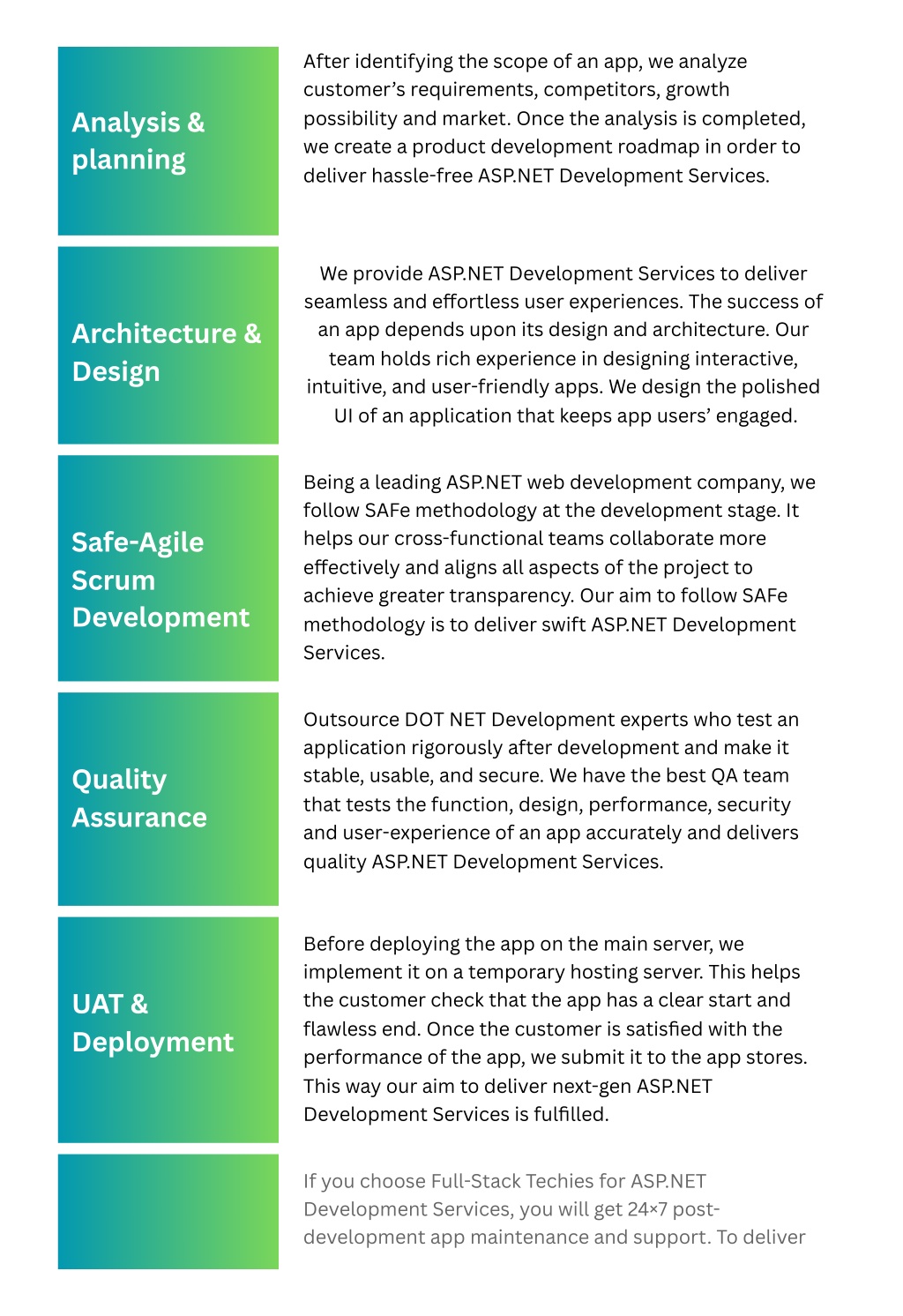
Transparent communication is vital. Modern services should utilize Agile methodologies, providing regular "sprints" and demos. This allows for iterative feedback and ensures the project does not deviate from the business goals.
Comparing ASP.NET with Alternative Tech Stacks
To understand the value of ASP.NET development services, it is helpful to see how it compares to other popular frameworks in 2026.
| Feature | ASP.NET Core (Modern .NET) | Node.js (JavaScript/TypeScript) | Java (Spring Boot) |
|---|---|---|---|
| Performance | Extremely High (Kestrel web server) | High (Event-driven) | Very High (JIT Compilation) |
| Type Safety | Strong (C#) | Optional (TypeScript) | Strong (Java) |
| Ecosystem | Integrated (Microsoft/NuGet) | Vast (NPM) | Mature (Maven/Gradle) |
| Cloud Integration | Best-in-class with Azure | Excellent with AWS | Excellent with all providers |
| Learning Curve | Moderate | Lower | Moderate to High |
| Enterprise Support | Direct from Microsoft | Community-driven | Red Hat / Oracle / Community |
Cost Factors in ASP.NET Development Services
The cost of engaging an ASP.NET development team varies based on several variables. Understanding these can help in budgeting and vendor selection.
- Geographic Location: Rates for developers in North America and Western Europe are typically higher than those in Eastern Europe, Latin America, or Southeast Asia. However, time-zone alignment and language proficiency should also be considered.
- Team Composition: A full-service project usually requires a Project Manager, Senior Architects, Frontend/Backend Developers, and QA Engineers.
- Engagement Model:
- Fixed Price: Best for well-defined, smaller projects with clear requirements.
- Time and Materials: Ideal for ongoing development where requirements may evolve.
- Dedicated Team: A long-term arrangement where a team works exclusively for your company.
- Licensing and Infrastructure: While .NET itself is open-source and free, costs may arise from Azure hosting, third-party libraries, or specialized developer tools.
Frequently Asked Questions
Is ASP.NET still relevant in 2026?
Yes, ASP.NET remains one of the most relevant frameworks for enterprise-grade applications. With the release of .NET 10, Microsoft has continued to improve its performance, making it one of the fastest web frameworks available. Its strong typing, cross-platform capabilities, and massive corporate backing ensure it is a safe, long-term investment for businesses.
Can ASP.NET applications run on Linux?
Absolutely. Since the introduction of .NET Core (now simply .NET), the framework has been fully cross-platform. Modern ASP.NET development services frequently deploy applications on Linux-based containers (Docker) because they are more resource-efficient and cost-effective for cloud hosting than Windows-based alternatives.
How does ASP.NET handle mobile development?
While ASP.NET is primarily for web and API development, it integrates seamlessly with .NET MAUI (Multi-platform App UI). This allows developers to use the same C# logic and back-end services to build native mobile applications for iOS and Android, as well as desktop apps for Windows and macOS.
What is the difference between ASP.NET and .NET Core?
Historically, ASP.NET referred to the Windows-only framework. .NET Core was the first cross-platform version. In 2026, these have merged into a single entity simply called ".NET" (starting from .NET 5 onwards). When people search for "ASP.NET development services" today, they are almost always referring to the modern, cross-platform version unless they specifically mention "Legacy Framework" or "ASP.NET 4.8."
How do I ensure my ASP.NET application is scalable?
Scalability is achieved through architectural choices made by your service provider. This includes implementing asynchronous programming (async/await) to prevent thread blocking, using distributed caching (like Redis), and architecting the system for "horizontal scaling," where more instances of the application can be added to handle increased traffic.
Strategic Recommendation
For organizations looking to build or modernize web infrastructure, the primary recommendation is to prioritize architectural flexibility. Do not simply hire a provider to build a website; hire a partner to build a platform. Ensure they are utilizing the latest LTS version of .NET and that they have a clear path for containerization and cloud deployment.
The most successful projects are those where the development service acts as a technical consultant, helping to align the software's capabilities with the company's five-year growth plan. Before signing a contract, perform a technical audit of their previous work or request a "Proof of Concept" (PoC) to verify their ability to handle your specific technical challenges.
For further information on the latest .NET standards and documentation, visit the official Microsoft .NET website or explore the ASP.NET Core GitHub repository for insights into the framework's ongoing evolution.