Preparing for the AP Calculus AB exam in 2026 requires a deep understanding of limits, derivatives, and integrals, alongside the ability to apply these concepts to real-world modeling. To succeed, students must master both calculator-aided and non-calculator problem-solving, focusing heavily on the Fundamental Theorem of Calculus and the interpretation of various representations of functions.
The AP Calculus AB exam remains one of the most challenging and widely taken Advanced Placement tests. It is designed to assess a student’s mastery of a first-semester college calculus course. As we look toward the 2026 testing season, the structure of the exam continues to prioritize conceptual understanding over rote memorization. This review provides a comprehensive breakdown of the exam format, essential content domains, and strategic study methods to help you secure a score of 5.
Understanding the 2026 Exam Format
Before diving into the mathematical concepts, it is vital to understand the structure of the assessment. The College Board maintains a consistent format for the AP Calculus AB exam, divided into two distinct sections: Multiple-Choice Questions (MCQ) and Free-Response Questions (FRQ). Each section contributes 50% to your final composite score.
Section I: Multiple-Choice Questions (MCQ)
The MCQ section consists of 45 questions and lasts 1 hour and 45 minutes. It is further subdivided into two parts:
- Part A (30 questions, 60 minutes, no calculator): This part tests your ability to perform algebraic manipulations, find limits, and calculate derivatives and integrals manually. It requires strong mental math and a firm grasp of basic function properties.
- Part B (15 questions, 45 minutes, graphing calculator required): This part focuses on complex computations, such as finding the intersection of functions, calculating the numerical derivative at a point, or finding a definite integral that cannot be solved easily through anti-differentiation.
Section II: Free-Response Questions (FRQ)
The FRQ section consists of 6 questions and lasts 1 hour and 30 minutes. Like the MCQ, it is split into two parts:
- Part A (2 questions, 30 minutes, graphing calculator required): These questions often involve real-world scenarios, such as rate-in/rate-out problems or motion along a line.
- Part B (4 questions, 60 minutes, no calculator): You may still work on Part A questions during this time, but you cannot use a calculator. These questions typically involve analytical proofs, interpreting graphs of derivatives, and solving differential equations.
| Section | Number of Questions | Time Allotted | Weighting | Calculator Use |
|---|---|---|---|---|
| Section I, Part A | 30 MCQs | 60 Minutes | 33.3% | No |
| Section I, Part B | 15 MCQs | 45 Minutes | 16.7% | Yes |
| Section II, Part A | 2 FRQs | 30 Minutes | 16.7% | Yes |
| Section II, Part B | 4 FRQs | 60 Minutes | 33.3% | No |
Core Content Domains: The "Big Three"
The AP Calculus AB curriculum is organized into eight units, but these units generally revolve around three "Big Ideas": Limits, Derivatives, and Integrals.
1. Limits and Continuity
Limits are the foundation of all calculus. You must be able to evaluate limits analytically (using algebraic techniques like factoring or rationalizing), graphically, and through tables.
- Continuity: A function is continuous at a point $x=c$ if the limit exists, the function is defined at $c$, and the limit equals the function value.
- Intermediate Value Theorem (IVT): This existence theorem is a frequent guest on the AP exam. It states that if a function is continuous on a closed interval $[a, b]$, it must take on every value between $f(a)$ and $f(b)$.
- L’Hôpital’s Rule: This rule is essential for solving limits that result in indeterminate forms like $0/0$ or $\infty/\infty$. Remember to state that the individual limits of the numerator and denominator approach zero or infinity before applying the rule to ensure full credit on FRQs.
2. Derivatives and Differentiation
Differentiation measures the instantaneous rate of change of a function. You must master the rules of differentiation, including the Power Rule, Product Rule, Quotient Rule, and the notoriously tricky Chain Rule.
- Implicit Differentiation: Essential for finding the slope of curves that are not functions (like circles or ellipses) and for solving related rates problems.
- Applications of Derivatives: This is a high-yield area. You will be asked to find relative and absolute extrema using the First and Second Derivative Tests. You must also understand the relationship between $f(x)$, $f'(x)$, and $f''(x)$ in terms of increasing/decreasing behavior and concavity.
- Mean Value Theorem (MVT): Another existence theorem. If $f$ is continuous on $[a, b]$ and differentiable on $(a, b)$, there exists at least one $c$ in $(a, b)$ such that $f'(c) = (f(b) - f(a)) / (b - a)$.
3. Integrals and the Fundamental Theorem of Calculus
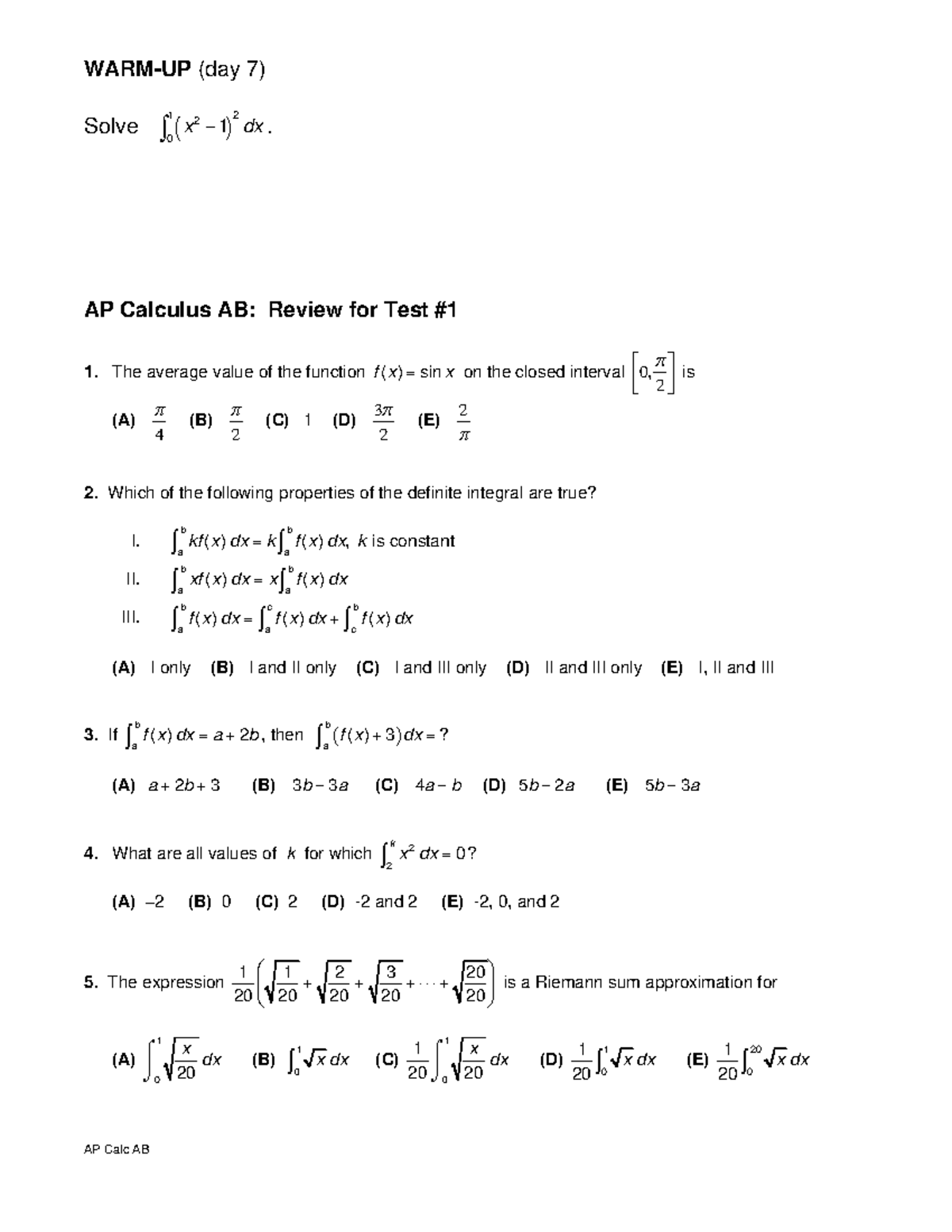
Integration is the study of accumulation. You will need to calculate definite and indefinite integrals and understand their relationship to the area under a curve.
- The Fundamental Theorem of Calculus (FTC): This connects differentiation and integration. Part 1 shows how to differentiate an integral function, and Part 2 provides the method for evaluating definite integrals using anti-derivatives.
- Accumulation Functions: Many FRQs provide a rate of change (like gallons per hour) and ask for the total amount accumulated over time. This always involves a definite integral.
- Integration by Substitution (u-sub): This is the primary advanced integration technique for AP Calculus AB. Mastery of $u$-substitution is required for both indefinite and definite integrals (remember to change your limits of integration when using $u$-sub for definite integrals).
Mastering the Free-Response Questions (FRQs)
The FRQs are where many students struggle, not because of the math, but because of the "justification" requirements. In 2026, the graders (AP Readers) will continue to look for specific mathematical notation and logical reasoning.
Justification and Communication
When a question asks you to "justify your answer," you cannot simply provide a numerical result. You must use mathematical theorems. For example, if you find a local maximum, you must state: "Since $f'(x)$ changes from positive to negative at $x=c$, $f(x)$ has a relative maximum at $x=c$." Avoid using the word "it" (e.g., "it is increasing"). Instead, be specific: "the function $f$" or "the derivative $f'$."
Common FRQ Problem Types
- Rate-In/Rate-Out Problems: These involve a rate at which something enters a system and a rate at which it leaves. The total amount is the initial amount plus the integral of the "in" rate minus the integral of the "out" rate.
- Area and Volume: You will be asked to find the area between two curves and the volume of a solid of revolution (using the disk or washer method) or a solid with known cross-sections.
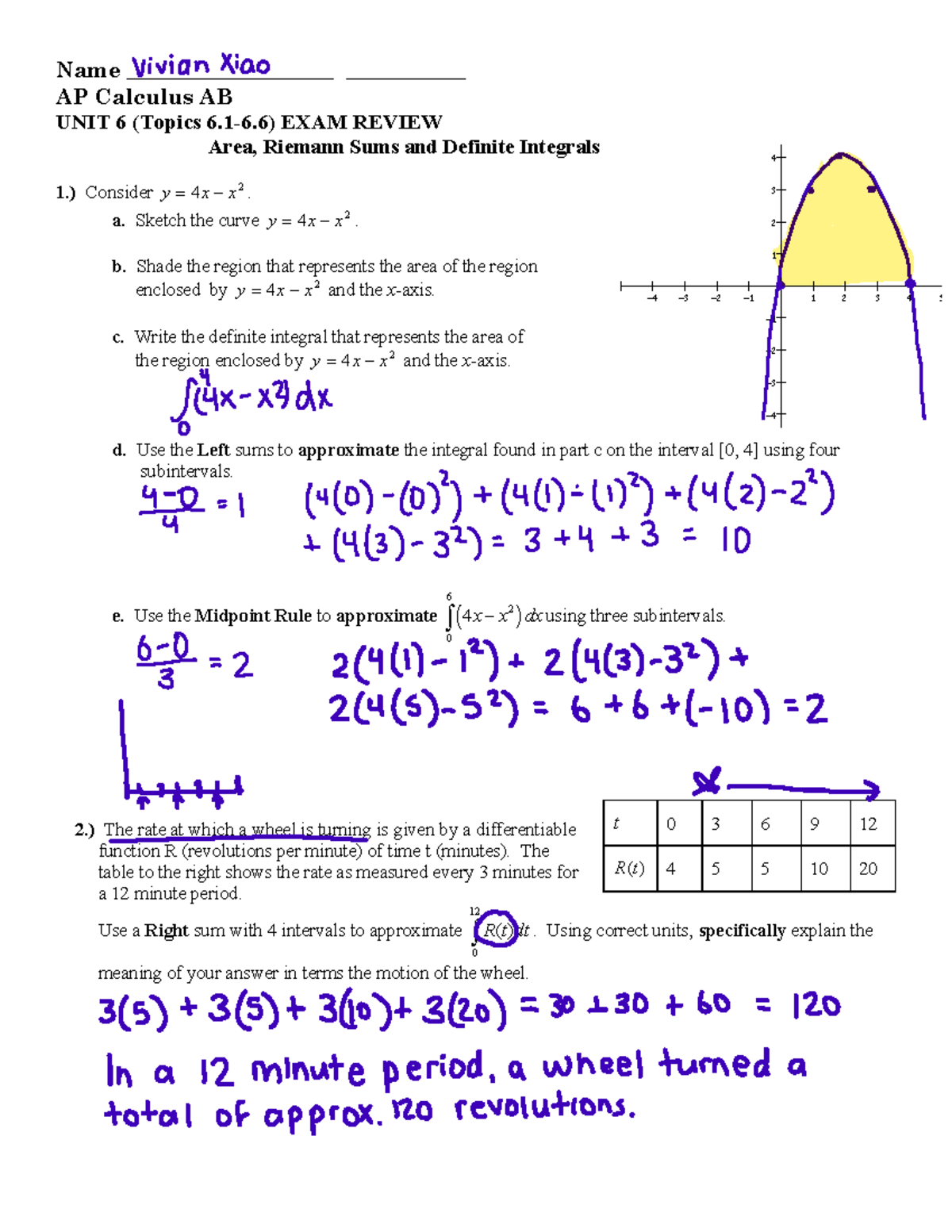
- The Table Problem: You are given a table of values for a function (often representing a rate like velocity). You must use Riemann sums (Left, Right, Midpoint, or Trapezoidal) to approximate a definite integral and interpret the meaning in the context of the problem.
- Differential Equations: This involves solving a separable differential equation by "separating the variables," integrating both sides, and using an initial condition to find the constant of integration ($C$).
Calculator Policy and Best Practices
For the 2026 exam, having a high-functioning graphing calculator (like a TI-84 Plus CE or TI-Nspire) is non-negotiable for Section I Part B and Section II Part A. According to the College Board AP Calculator Policy, your calculator must be able to:
- Graph a function in a specific window.
- Find the zeros of a function (solve equations numerically).
- Calculate the numerical derivative of a function at a specific point.
- Calculate the numerical value of a definite integral.
Pro-Tip: Do not round your intermediate steps. Always keep as many decimals as possible in your calculator and only round your final answer to at least three decimal places. If you round too early, your final answer may be outside the accepted range.
Effective Study Timeline for 2026
A successful review is not a sprint; it is a marathon. Start your dedicated review at least 6-8 weeks before the May exam date.
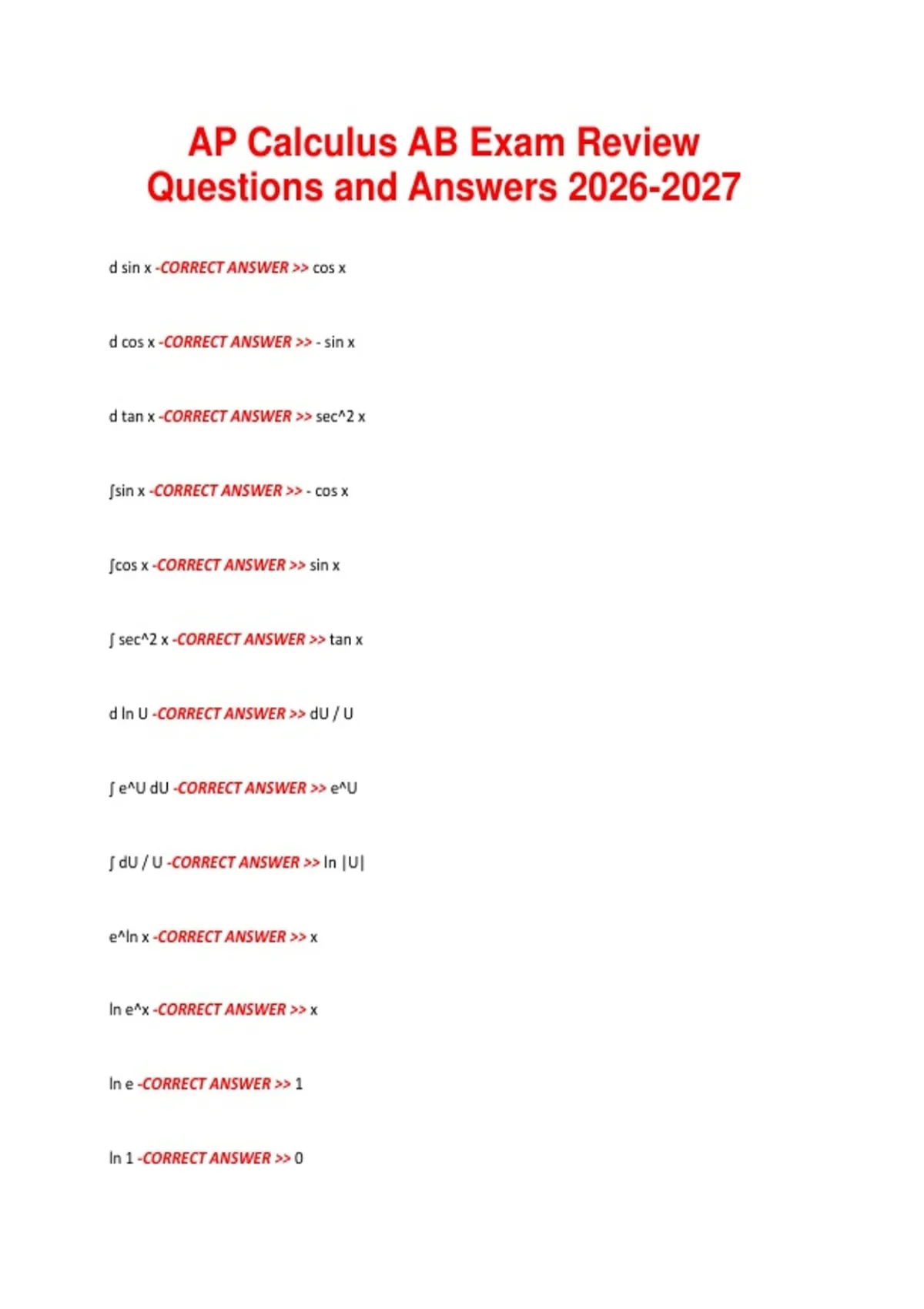
- Weeks 1-2 (Foundation): Re-examine limits and basic derivative rules. Ensure you have the derivatives of trigonometric, exponential, and logarithmic functions memorized perfectly.
- Weeks 3-4 (Applications): Focus on the Mean Value Theorem, Related Rates, and Optimization. Practice identifying which theorem applies to which scenario.
- Weeks 5-6 (Integration): Master $u$-substitution and the Fundamental Theorem of Calculus. Practice area and volume problems, as these are guaranteed to appear on the exam.
- Weeks 7-8 (Practice Exams): Take at least two full-length, timed practice exams. Use official released exams from the College Board AP Central website to get a feel for the actual phrasing of questions.
Common Pitfalls and How to Avoid Them
Even high-performing students can lose points on simple errors. Being aware of these common mistakes is a key part of your test review.
- Forgetting "+ C": When evaluating an indefinite integral, always add the constant of integration. In differential equation FRQs, forgetting $+C$ can cost you more than half the points for that specific question.
- Misusing the Power Rule: The Power Rule $(\frac{d}{dx} x^n = nx^{n-1})$ only applies when the base is a variable and the exponent is a constant. It does not apply to $2^x$ or $x^x$.
- Chain Rule Errors: This is the most common derivative error. Always ask yourself: "Is there an 'inside' function?" If so, you must multiply by its derivative.
- Radians vs. Degrees: Calculus is done in radians. Ensure your calculator is in radian mode the moment you walk into the exam room.
- Average Value vs. Average Rate of Change:
- Average Value of $f$ on $[a, b]$: $\frac{1}{b-a} \int_a^b f(x) dx$
- Average Rate of Change of $f$ on $[a, b]$: $\frac{f(b) - f(a)}{b - a}$ These are frequently confused. One involves an integral; the other is simply the slope of the secant line.
FAQs About AP Calculus AB Review
Is AP Calculus AB harder than AP Calculus BC? No, AP Calculus BC is more extensive. BC covers all the material in AB plus additional topics like sequences and series, polar coordinates, and parametric equations. AB is essentially the first two-thirds of the BC curriculum.
What is a "passing" score on the AP Calculus AB exam? A score of 3 is generally considered passing, but many competitive universities require a 4 or a 5 to grant college credit. The exact "curve" or scale varies slightly each year depending on the difficulty of the questions.
Can I use a calculator on the entire Free-Response section? No. You may use a calculator for the first two questions (Part A). After 30 minutes, you must put your calculator away and move on to the remaining four questions (Part B). You can still work on Part A during the second block of time, but without the aid of a calculator.
How should I handle questions I don't understand? On the MCQ, there is no penalty for guessing, so never leave a bubble blank. On the FRQ, try to earn "setup points." Even if you can't solve the whole problem, writing down a correct definite integral or a correct derivative expression can often earn you 1 or 2 points out of 9.
Are there new topics in the 2026 AP Calculus AB exam? As of 2026, the Course and Exam Description (CED) has remained stable. The focus remains on the eight units defined by the College Board: Limits/Continuity, Differentiation (Definition/Basic Rules, Composite/Implicit/Inverse), Contextual Apps of Differentiation, Analytical Apps of Differentiation, Integration/Accumulation, Differential Equations, and Apps of Integration.
Final Recommendation
To maximize your score on the 2026 AP Calculus AB exam, prioritize active retrieval over passive reading. Instead of just reading through your notes, solve "unseen" problems from previous years. Focus heavily on interpreting the meaning of a derivative or integral in context, as the AP exam has shifted away from pure computation toward conceptual literacy. Use the official resources on AP Classroom and ensure you can justify your mathematical conclusions with the names of specific theorems. If you can explain why a function behaves the way it does using calculus terminology, you are well on your way to a 5.