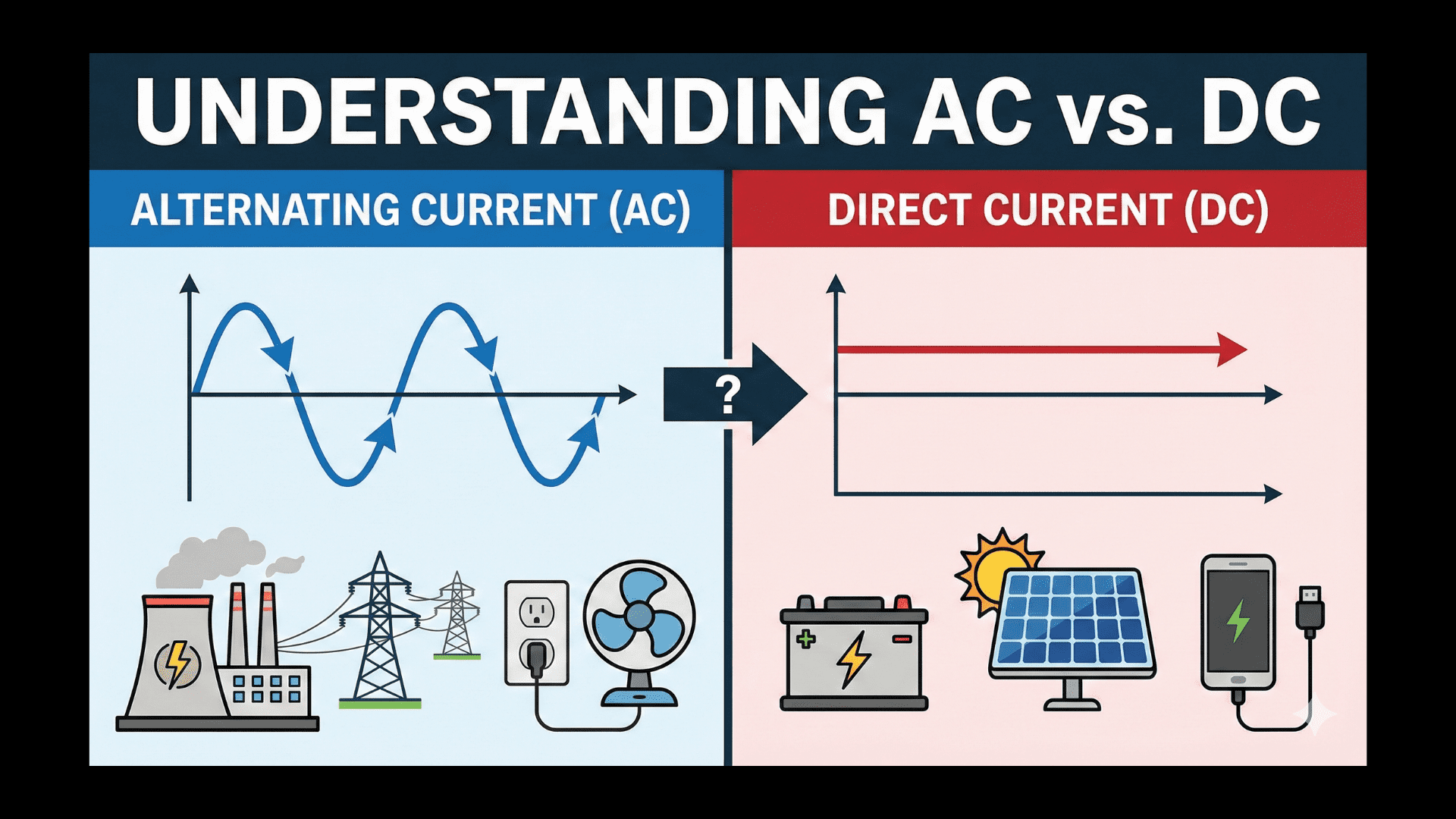
Alternating current (AC) periodically reverses direction and changes magnitude over time, while direct current (DC) flows continuously in one constant direction. AC powers residential and industrial power grids due to its efficiency over long-distance transmission, whereas DC powers virtually all modern electronics, computers, and battery-stored systems.
The Foundations of Electricity: Charge, Flow, and Motion
To understand the differences between alternating current and direct current, one must first examine the fundamental mechanics of electricity. Electrical current represents the flow of electric charge—specifically electrons—through a conductive medium such as a copper wire. How these electrons move dictates whether the resulting current is classified as alternating or direct.
In any electrical circuit, charge requires a driving force, known as voltage or electrical potential difference, to push electrons from an area of higher potential to an area of lower potential. The resistance of the material opposes this flow, and the interaction between voltage, current, and resistance forms the bedrock of electrical engineering, as defined by Ohm's Law.
However, the directional behavior of the electron flow separates electrical systems into two distinct paradigms. Thomas Edison and Nikola Tesla famously locked horns over these two methodologies in the late 19th century—a period often referred to as the War of Currents. While Edison championed DC for its early low-voltage municipal distribution, Tesla and George Westinghouse demonstrated that AC could travel much farther, ultimately shaping the modern electrical grid. In the year 2026, engineers no longer view these systems as mutually exclusive competitors; rather, they are complementary technologies that work together in an increasingly electrified, renewable-energy-driven world.
Direct Current (DC): Characteristics, Sources, and Applications
Direct current is characterized by the unidirectional flow of electric charge. Electrons emerge from the negative terminal of a power source, travel through a circuit, and return to the positive terminal. Throughout this journey, the magnitude of the current remains relatively constant, maintaining a steady, unchanging voltage level over time.
Sources of Direct Current
Direct current is inherently produced by power sources that maintain a fixed polarity.
- Batteries: Chemical reactions within lead-acid, lithium-ion, and alkaline batteries generate DC by separating positive and negative charges at the terminal nodes.
- Photovoltaic Solar Panels: Solar cells convert sunlight directly into DC electricity by exciting electrons using photon energy within semiconductor materials like silicon.
- Fuel Cells: These electrochemical devices combine hydrogen and oxygen to produce electricity continuously as long as fuel is supplied, outputting DC power.
- AC-to-DC Rectifiers: Most wall outlets supply AC, but electronic power supplies use internal components called rectifiers and transformers to convert that AC into usable DC.
Common Uses for DC
Virtually all digital and computing hardware relies on DC power. Smartphones, laptop computers, LED lighting arrays, and microprocessor-based automation systems operate internally on low-voltage DC. In industrial settings, DC motors provide precise speed control required for manufacturing machinery, electric overhead cranes, and variable-speed conveyor systems. Furthermore, modern data centers, telecommunications towers, and electric vehicles (EVs) utilize internal DC distribution buses to optimize energy efficiency and simplify battery integration.
Alternating Current (AC): Characteristics, Generation, and Transmission
Alternating current differs fundamentally because the direction of the electron flow periodically reverses. Instead of moving in a single loop, electrons oscillate back and forth within the conductor. This cyclic reversal typically follows a smooth mathematical waveform known as a sine wave.
The Anatomy of an AC Waveform
An AC waveform is defined by several key parameters:
- Frequency: Measured in Hertz (Hz), frequency describes how many complete cycles occur in one second. For example, the standard electrical grid frequency in North America is 60 Hz, while Europe and much of the world operate at 50 Hz.
- Amplitude: This represents the peak voltage or current reached during each half-cycle.
- Phase: In multi-phase power systems (such as the three-phase power used in industrial settings), multiple AC waveforms are offset in time to deliver smoother, more continuous power to heavy machinery.
Why AC Dominates Power Transmission
The primary advantage of alternating current lies in its compatibility with transformers. Transformers can easily step up (increase) and step down (decrease) AC voltages using electromagnetic induction.
When transmitting electricity across hundreds of miles from a power plant to residential neighborhoods, high resistance in transmission lines causes energy losses through heat dissipation ($I^2R$ losses). By using a step-up transformer to elevate voltage to hundreds of thousands of volts while simultaneously reducing current, power companies can transmit electricity over vast distances with minimal energy loss. Once the electricity reaches its destination, step-down transformers reduce the voltage to safe levels (such as 120V or 240V) for consumer use.
Side-by-Side Comparison of AC and DC Current
| Feature | Alternating Current (AC) | Direct Current (DC) |
|---|---|---|
| Electron Flow Direction | Periodically reverses back and forth | Flows in one constant direction |
| Primary Source | Alternators and AC generators | Batteries, solar cells, and rectifiers |
| Voltage Transformation | Easily stepped up/down using transformers | Requires complex electronic conversion circuits |
| Long-Distance Efficiency | High efficiency when transmitted at high voltages | High resistance losses over long distances |
| Storage Capability | Cannot be stored directly in batteries | Easily stored in chemical batteries |
| Primary Applications | Power grids, household appliances, heavy industry | Computers, smartphones, LEDs, EVs, solar arrays |
Safety, Hazards, and Human Physiology
Understanding how AC and DC interact with the human body is critical for electrical safety. Both currents can cause severe injury or death, but their physiological effects differ based on frequency, voltage, and pathway through the body.
Alternating current at standard grid frequencies (50–60 Hz) is particularly dangerous to the human heart because it easily disrupts the heart's natural electrical pacing, inducing ventricular fibrillation—a fatal chaotic quivering of the heart muscle. Furthermore, AC tends to cause muscle tetany, meaning the muscles contract uncontrollably and lock the victim onto the live conductor, preventing them from letting go.
Direct current, by contrast, generally causes a single, violent muscular contraction that may throw a person away from the electrical source. However, high-voltage DC systems present severe arc-flash hazards and can cause severe electrolytic burns and internal tissue damage due to continuous unidirectional electron migration. Standard safety guidelines established by organizations such as the Occupational Safety and Health Administration (OSHA) and the National Fire Protection Association (NFPA) must be strictly followed when working with either current type.
The Modern Convergence: High-Voltage Direct Current (HVDC)
While AC historically won the War of Currents for regional distribution, technological advancements in power electronics have sparked a resurgence in direct current transmission, known as High-Voltage Direct Current (HVDC).
Traditional AC transmission suffers from capacitive and inductive losses over extremely long underwater or underground cables. HVDC systems convert high-voltage AC to DC at a sending station, transmit the power with significantly lower line losses over thousands of miles, and then invert the DC back into AC at the receiving end. This technology enables efficient cross-continental energy grids and the integration of offshore wind farms into mainland power systems.
| System Aspect | Traditional AC Grid | Modern HVDC Integration |
|---|---|---|
| Line Losses | Higher over long submarine/underground routes | Lower resistive and reactive losses over distance |
| Asynchronous Links | Cannot directly connect unsynchronized grids | Easily links independent regional power grids |
| Equipment Cost | Lower terminal station equipment costs | Higher initial conversion station costs |
Frequently Asked Questions
Can appliances run on both AC and DC?
Most standard household appliances are engineered specifically for AC power and contain motors or transformers tuned to 50 or 60 Hz. Connecting an AC appliance directly to a DC source will usually cause the transformer to overheat and burn out, or the motor to fail to rotate. Conversely, electronic devices powered by DC require an external power brick or internal rectifier to convert incoming AC wall power into usable DC.
Why do batteries only store DC?
Batteries operate via electrochemical reactions that involve the transfer of electrons from one chemical species to another in a single direction. Reversing the current direction forces the chemical reaction backward (charging), but the fundamental voltage polarity across the battery terminals remains static, inherently outputting direct current.
Is DC safer than AC?
Neither current is inherently safer; safety depends entirely on voltage, current magnitude, and exposure duration. While low-voltage DC (such as a 12V car battery) is generally safe to handle, high-voltage DC lines can produce devastating electrical arcs and severe internal injuries. AC is particularly hazardous at low frequencies due to its ability to disrupt cardiac rhythms.
How do solar panels produce electricity if the sun provides light?
Solar panels do not use heat; they utilize the photovoltaic effect. When photons strike the semiconductor material in a solar cell, they knock electrons free from their atomic bonds. An internal electric field within the cell forces these liberated electrons to flow in one direction, creating a direct current.
Which current is more efficient for powering electric vehicles?
Electric vehicles operate almost entirely on DC. The traction battery stores DC, and the electric motors are driven by sophisticated motor controllers that convert that DC into variable-frequency AC (or pulse-width modulated DC) to control vehicle speed and torque. Charging an EV at a DC fast-charging station bypasses the vehicle's internal charger, pumping high-voltage DC directly into the battery for rapid energy transfer.
Practical Next Actions for Electrical Projects
When designing, troubleshooting, or interacting with electrical systems, always verify whether you are dealing with AC or DC before connecting test equipment or appliances. Utilize a digital multimeter set to the correct measurement mode—Voltage Alternating Current (VAC) or Voltage Direct Current (VDC)—to test circuits safely. For complex wiring, residential renovations, or grid-tied solar installations, consult a licensed electrician or certified electrical engineer to ensure compliance with local electrical codes and safety standards.