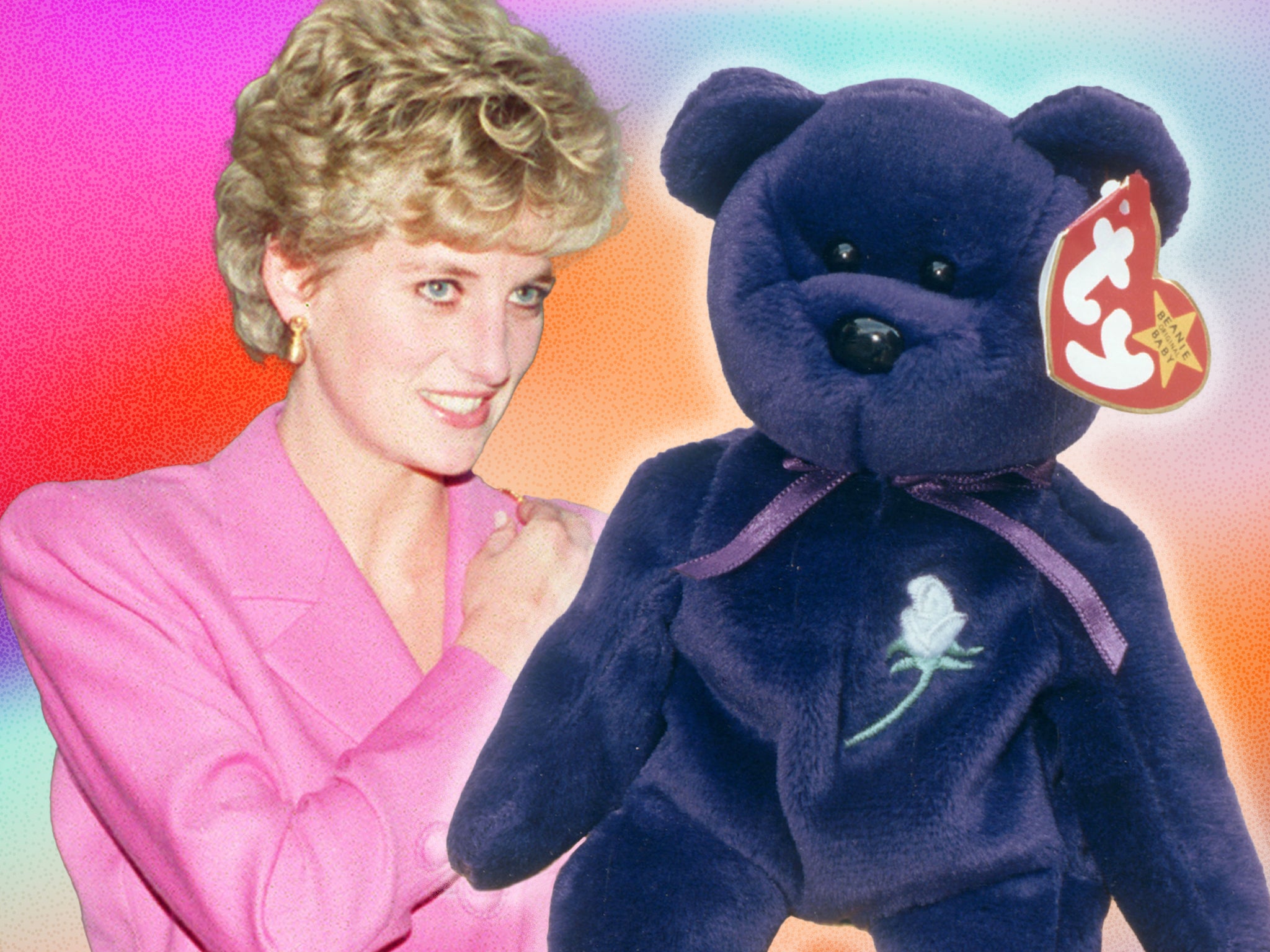
The 1st generation Princess Diana Beanie Baby is one of the most culturally significant and misunderstood collectibles in the hobby. Originally released in late 1997 to honor the late Princess of Wales, its value is determined by specific "no space" swing tags, pellet composition, and country of origin, though market myths often obscure its true appraisal.
The Historical Origin of the Princess Beanie Baby
The story of the Princess Diana Beanie Baby begins in the wake of the tragic passing of Diana, Princess of Wales, in August 1997. Ty Warner, the enigmatic founder of Ty Inc., sought to create a memorial tribute that would also serve a philanthropic purpose. On October 29, 1997, Ty Inc. announced the release of a deep purple bear featuring a white rose embroidered on its chest. Unlike previous releases, the Princess bear was specifically tied to the Diana, Princess of Wales Memorial Fund, with a portion of the proceeds from every sale intended to support the late Princess's favorite charities.
The initial release was shrouded in logistical constraints that inadvertently fueled the Beanie Baby craze of the late 1990s. Ty Inc. initially restricted shipments to just twelve bears per authorized retailer. This artificial scarcity, combined with the global outpouring of grief and affection for Princess Diana, created a frenzy. Long lines formed outside small gift shops, and the secondary market prices began to climb almost instantly.
In 2026, looking back at this period, it is clear that the Princess bear represented the apex of the "Beanie Bubble." It was the moment when the hobby transitioned from a niche children’s toy collection into a high-stakes speculative market. While millions of these bears were eventually produced in subsequent "generations" to satisfy demand, the 1st generation versions—those produced in the very first production runs—remain the primary focus for serious numismatic-style toy collectors.
Identifying a Genuine 1st Generation Princess Beanie
For a collector in 2026, the term "1st generation" specifically refers to the earliest production iterations, characterized by several technical markers on the tags and the materials used. It is a common mistake to assume that every Princess bear is rare; in reality, only a tiny fraction of the total population qualifies as a true first edition.
The Swing Tag: The "No Space" Legend
The most critical identifier of a 1st generation Princess Beanie Baby is the "swing tag" (the heart-shaped tag attached to the ear). On the earliest versions, the text on the right-hand side of the inner tag—which contains the poem and memorial information—is formatted differently than later versions.
In the 1st generation tag, there is no extra space between the end of the poem and the text indicating the contribution to the memorial fund. Collectors colloquially call this the "No Space" version. In later runs, Ty Inc. adjusted the layout to add a line of space for better legibility. Additionally, the 1st generation swing tag is a "5th Generation" Ty heart tag, which does not feature a yellow star or "Original" text inside a star, as those were phased out or modified during this specific production window.
The Tush Tag: Pellets and Origin
The "tush tag" (the small fabric label on the rear of the bear) provides the second layer of verification. There are two primary locations of manufacture for the initial run: China and Indonesia.
- PVC Pellets: The very first bears were stuffed with Polyvinyl Chloride (PVC) pellets. Shortly after the initial run, Ty Inc. transitioned to Polyethylene (PE) pellets, which were considered more environmentally friendly. A 1st generation Princess bear with PVC pellets is significantly rarer than the PE pellet version.
- The Indonesian "Ghost" Version: Some of the most sought-after 1st generation bears were made in Indonesia. These often have a slightly different fabric texture and a tush tag that lacks a Chinese factory stamp. These are frequently referred to as "Ghost" versions because of their elusive nature in the early secondary market.
Physical Characteristics
The physical bear itself must also meet specific criteria. The fabric should be a rich "royal purple" polyester fiber. The white rose on the chest must be cleanly embroidered. While later "Made in China" versions are common, the "Made in Indonesia" versions often feature a rose that is slightly smaller or more tightly stitched, a nuance that experienced 1st generation collectors look for when verifying authenticity.
The "Million Dollar" Myth: Market Realities in 2026
One of the greatest challenges in collecting the 1st generation Princess Diana Beanie Baby is the pervasive misinformation regarding its value. For over two decades, misleading "clickbait" articles and unverified eBay listings have suggested that these bears are worth hundreds of thousands, or even a million dollars.
As of 2026, the market reality is much more grounded. While a 1st generation, PVC-pellet, "No Space" tag bear in mint condition is certainly valuable, its price point is typically in the low thousands, not the hundreds of thousands. Factors that influence the 2026 valuation include:
- Authentication: A bear that has been authenticated and "cased" by a reputable service like Becky’s Beanie Classics or True Blue Beans carries a significant premium. An unauthenticated bear is often viewed with skepticism due to the high volume of counterfeits.
- Condition of the Tags: Creases, "tag rash" (scuffs on the red ink), or fading significantly reduce the value. A "Mint" 1st generation bear must have a tag that looks as though it just left the factory.
- Provenance: Documentation proving the bear was purchased during the initial December 1997 release can add historical value, though physical condition remains the primary driver.
Technical Comparison of Princess Beanie Generations
To assist collectors in distinguishing the 1st generation from the mass-produced later versions, the following table outlines the key technical differences.
| Feature | 1st Generation (First Edition) | 2nd/3rd Generation (Common) |
|---|---|---|
| Swing Tag Text | No space before the fund info | Extra space before the fund info |
| Stuffing Material | PVC Pellets (usually) | PE Pellets |
| Country of Origin | Indonesia or China | China |
| Tush Tag Date | 1997 | 1997 (Note: Year did not change) |
| Handmade In | Indonesia or China | China |
| Stamp Inside Tag | No number inside tush tag | Often has a factory stamp (e.g., 4xx) |
Major Challenges for Modern Collectors
Collecting the 1st generation Princess bear in 2026 involves navigating a field of obstacles ranging from physical preservation to sophisticated forgeries.
Identifying Counterfeits
Because the Princess bear was so popular, it became one of the most counterfeited toys in history. Early counterfeits are often easy to spot due to the wrong shade of purple or a poorly embroidered rose. However, some "high-end" fakes use genuine tags swapped from other Beanie Babies. A common tactic in the early 2000s was to take a "No Space" tag from a less valuable bear and attach it to a common PE-pellet Princess bear. Collectors must inspect the plastic "tacher" (the plastic connector) for signs of tampering or re-attachment.
Environmental Degradation
The materials used in 1997 were not necessarily designed for 30-year archival stability. The white rose is particularly susceptible to yellowing if exposed to sunlight or cigarette smoke. Furthermore, the PVC pellets in the 1st generation bears can, in some storage conditions, off-gas or "weep," causing the fabric to feel slightly oily or developing a distinct chemical scent. Preserving these bears in acid-free cases in climate-controlled environments is a prerequisite for maintaining their 2026 market value.
The Influence of Online Scams
The "Princess Diana Beanie Scams" remain a fixture of online marketplaces. Sellers often list common 2nd or 3rd generation bears with "errors" (such as a misspelled word or a supposed "rare" date) at astronomical prices to lure uninformed buyers. In reality, most of these "errors" were standard across millions of units. A 1st generation collector must rely on verified technical specifications rather than the hyperbolic descriptions found on general auction sites.
FAQs About 1st Generation Princess Beanies
Is the "Made in Indonesia" version really worth more? Yes, generally. The Indonesian production run was much smaller than the Chinese run. Collectors prize the Indonesian version for its rarity and the slight variations in fabric texture, which is often described as being softer or "shaggier" than the Chinese counterparts.
Do all 1st generation bears have PVC pellets? Most do, but the transition to PE pellets happened quickly. There are "No Space" swing tag bears that contain PE pellets. These are still considered "early" versions, but the PVC pellet version is the "true" 1st generation in the eyes of most elite collectors.
How can I tell if a swing tag has been swapped? Look at the plastic "barb" or fastener. A factory-attached tag will have a smooth, untampered fastener. If the plastic looks stretched, kinked, or if the "T" shape at the end is jagged, the tag may have been removed from another bear and reattached to inflate the value of a common Princess bear.
What is the "Ghost Version"? The "Ghost Version" typically refers to the Indonesian-made bear that lacks a factory stamp on the inside of the tush tag. These were among the very first to hit the market and are highly coveted for their "clean" appearance and confirmed early-run status.
Are there any 1st generation Princess bears with a 1998 tush tag? No. All genuine Princess Diana Beanie Babies, regardless of generation, should have a tush tag date of 1997. If a bear has a 1998 date, it is either a different product entirely or a poorly made counterfeit.
Practical Recommendations for Collectors
If you are looking to acquire or sell a 1st generation Princess Diana Beanie Baby in 2026, the first step is professional authentication. Due to the high volume of misinformation and the technical nuances of the "No Space" tag and pellet types, a third-party certificate is the only way to guarantee the item's status.
For those holding a bear, avoid cleaning the fabric with harsh chemicals, as this can damage the polyester fibers and the delicate rose embroidery. Instead, use a soft, dry microfiber cloth for dusting and store the bear in a UV-protective acrylic case. Finally, always cross-reference the tush tag and swing tag together; a mismatch between the production site (e.g., a China swing tag on an Indonesia tush tag) is a red flag for a "franken-bear" that has been reconstructed from parts.