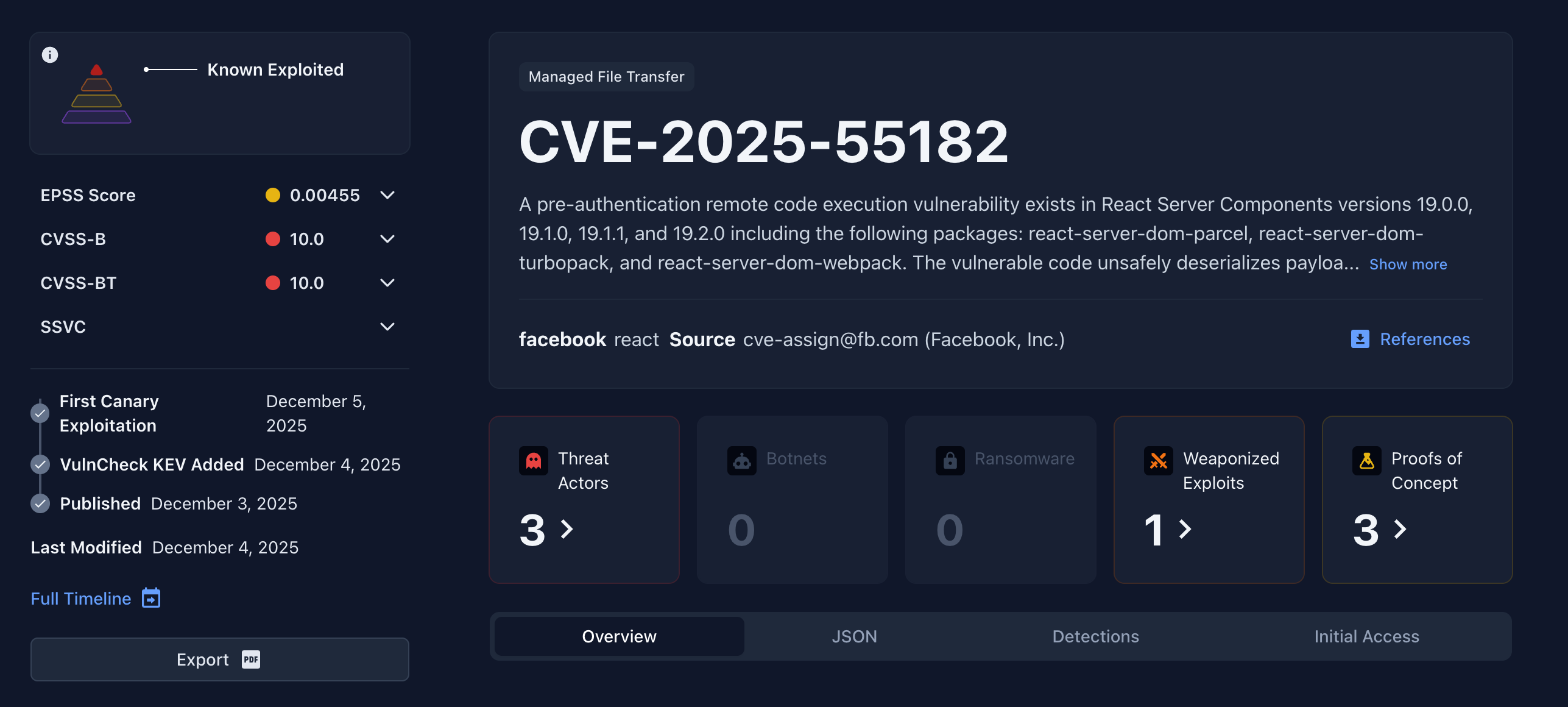
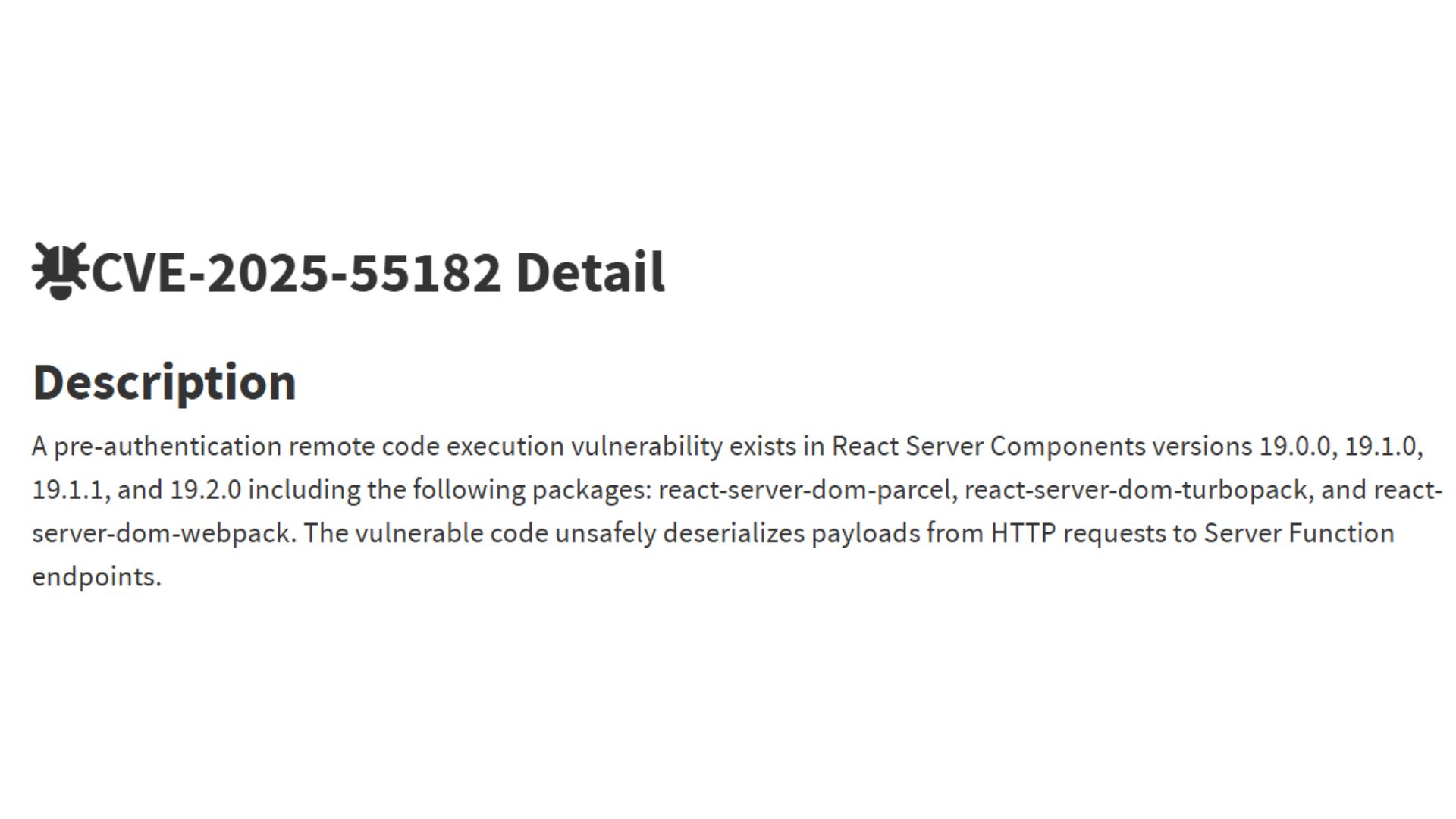
The 10.0 severity CVE-2025-55182 represents a critical vulnerability impacting React Server Components, allowing unauthenticated remote code execution under specific framework configurations. Engineering teams must immediately audit their dependency trees, patch affected versions, and review server-side rendering pipelines to prevent potential compromise.
Introduction to React Server Components and Modern Web Architecture
React Server Components (RSC) fundamentally changed how developers build modern web applications by shifting rendering logic from the client browser to the server environment. This paradigm allows components to execute closer to data sources, reducing the JavaScript bundle size shipped to end-users and accelerating initial page loads. However, blending server-side execution with client-driven component trees introduces complex trust boundaries.
When developers pass serialized data structures and component boundaries across the network, security mechanisms must strictly validate every payload. The discovery of high-impact security flaws in server-side JavaScript runtimes underscores the reality that architecture shifts bring novel attack vectors. Understanding CVE-2025-55182 requires a deep dive into how frameworks handle server-side component evaluation, payload deserialization, and why a maximum severity rating of 10.0 was assigned to this vulnerability.
Anatomy of CVE-2025-55182: Maximum Severity Breakdown
A Common Vulnerability Scoring System (CVSS) rating of 10.0 is reserved for flaws that require zero authentication, demand no user interaction, can be exploited remotely over a network, and result in complete system compromise. CVE-2025-55182 meets these strict criteria due to flaws in how certain implementations of React Server Components parse and deserialize incoming component payloads.
When a React application utilizing server components processes requests, it often ingests data streams that dictate the composition of the UI. If the underlying parser fails to adequately sanitize or restrict object instantiation during deserialization, an attacker can craft malicious input payloads. By injecting specially structured data, malicious actors can coerce the server runtime into executing arbitrary system commands or arbitrary code within the hosting environment.
Core Vulnerability Mechanics
- Unrestricted Deserialization: The parsing mechanism accepts complex object graphs without sufficiently validating class types or execution contexts.
- Remote Code Execution (RCE): Attackers leverage prototype pollution or gadget chains within the runtime environment to transition from data injection to code execution.
- Zero Authentication Requirement: Because the vulnerable endpoints are typically exposed to handle standard client-server navigation or component re-rendering, no privileged session is required to trigger the bug.
Impact Analysis Across Affected Environments and Frameworks
The reach of CVE-2025-55182 extends beyond core React libraries, heavily impacting upstream frameworks that adopt React Server Components natively, such as Next.js, Remix (in experimental configurations), and custom SSR implementations. Because enterprise applications rely heavily on these frameworks for enterprise portals, e-commerce platforms, and internal dashboards, the blast radius of a successful exploit is exceptionally wide.
When an attacker successfully achieves remote code execution via CVE-2025-55182, they gain access to the underlying container or virtual machine hosting the Node.js process. Depending on the container's security posture and permission configurations, this can lead to lateral movement within cloud environments, database exfiltration, or complete infrastructure takeover.
| Attribute | Detail |
|---|---|
| CVSS Base Score | 10.0 (Critical) |
| Attack Vector | Network (Remote) |
| Privileges Required | None (Unauthenticated) |
| User Interaction | None |
| Impacted Component | React Server Components Deserialization Pipeline |
| Primary Risk | Remote Code Execution (RCE) |
Identifying Vulnerable Configurations and Dependencies
Determining whether your application is exposed to CVE-2025-55182 requires a comprehensive audit of both your direct dependencies and transitive packages. Developers should examine their package.json and lockfiles (package-lock.json, pnpm-lock.yaml, or yarn.lock) to trace the exact versions of React, react-dom, and associated meta-frameworks currently deployed in production and staging environments.
Applications that do not utilize React Server Components—relying strictly on traditional Client-Side Rendering (CSR) or classic Server-Side Rendering (SSR) without component streaming—are generally not exposed to this specific vector. However, modern applications often enable RSC incrementally, making manual code reviews and automated software composition analysis (SCA) mandatory.
Steps to Verify Exposure
- Run Software Composition Analysis (SCA): Utilize tools like
npm audit,yarn audit, or dedicated enterprise security scanners to flag known vulnerable package versions. - Inspect Framework Configurations: Check routing configuration files to identify endpoints configured to accept React Server Component payload streams.
- Review Network Logs: Analyze historical ingress traffic for unusual payload structures targeting RSC serialization endpoints.
Mitigation Strategies and Immediate Patching Protocols
Mitigating CVE-2025-55182 requires immediate action centered on upgrading vulnerable packages to their patched versions. Maintainers of React and major meta-frameworks have released security advisories and updated package releases designed to harden deserialization logic and enforce strict input validation checks.
Beyond updating dependencies, organizations should implement defense-in-depth measures to limit the potential impact of any future zero-day vulnerabilities in server-side rendering pipelines.
Recommended Remediation Steps
- Upgrade Core Packages: Update
react,react-dom, and your meta-framework (such as Next.js) to the official patched releases immediately. - Harden Runtime Environments: Ensure Node.js processes run with the principle of least privilege, utilizing non-root service accounts inside containerized environments like Docker or Kubernetes.
- Implement Web Application Firewalls (WAF): Configure WAF rules to inspect and block anomalous HTTP POST requests containing suspicious object payloads directed at RSC endpoints.
- Isolate Network Traffic: Restrict outbound network access from application servers to prevent malicious actors from establishing reverse shells or exfiltrating data in the event of a successful exploit.
Frequently Asked Questions
What makes CVE-2025-55182 a 10.0 severity vulnerability?
A 10.0 score is assigned to vulnerabilities that allow unauthenticated remote code execution over a network without requiring any user interaction. Because CVE-2025-55182 permits attackers to execute arbitrary system commands through malformed server component payloads, it receives the highest possible severity rating.
Are traditional React applications safe from this issue?
Applications that use standard client-side rendering or traditional server-side rendering without React Server Components are not vulnerable to CVE-2025-55182. The flaw specifically resides in the parsing and deserialization logic unique to the Server Components architecture.
How can I check if my application uses React Server Components?
You can review your framework configuration and component file structure. If your application utilizes features like async server components, server actions, or data streaming endpoints native to RSC-enabled frameworks, your application is utilizing the affected paradigm.
Is there a workaround if I cannot patch immediately?
While temporary workarounds such as strict WAF rule enforcement can help filter malicious payloads, they do not replace patching. Upgrading the underlying packages is the only definitive way to resolve the vulnerability.
Can this vulnerability be exploited internally and externally?
Yes. Because the attack vector is network-based, the vulnerability can be exploited by external attackers over the public internet or by internal actors with network access to the application server if perimeter defenses fail.
Next Actions and Conclusion
The discovery of CVE-2025-55182 highlights the critical importance of robust input validation in modern server-side JavaScript architectures. Engineering teams must prioritize updating affected React and framework dependencies across all environments, beginning with production systems. Conduct a thorough review of container security boundaries, apply least-privilege access principles to your Node.js runtimes, and integrate automated dependency scanning into your continuous integration and deployment (CI/CD) pipelines to catch similar threats early.