Revenue recognition under Accounting Standards Update (ASU) 2014-09, codified as Accounting Standards Codification (ASC) 606, represents a fundamental shift in how entities report income from contracts with customers. The core principle requires an organization to recognize revenue to depict the transfer of promised goods or services to customers in an amount that reflects the consideration to which the entity expects to be entitled in exchange for those goods or services. By following the standardized five-step framework, businesses ensure transparency, consistency, and comparability in financial reporting across diverse industries.
The Evolution of Revenue Recognition Standards
Prior to the issuance of ASU 2014-09, revenue recognition guidance in the United States was fragmented, relying on a mix of broad principles and industry-specific requirements. This created inconsistencies where similar transactions might be accounted for differently depending on the sector. The Financial Accounting Standards Board (FASB) developed ASC 606 in collaboration with the International Accounting Standards Board (IASB) to create a converged, principle-based model that applies globally.
As of 2026, ASC 606 remains the definitive standard for both public and private entities. While the initial adoption period has long passed, ongoing compliance remains a critical focus for auditors and financial controllers. Organizations must navigate the complexities of contract modifications, variable consideration, and the allocation of transaction prices to distinct performance obligations.
The Five-Step Revenue Recognition Model
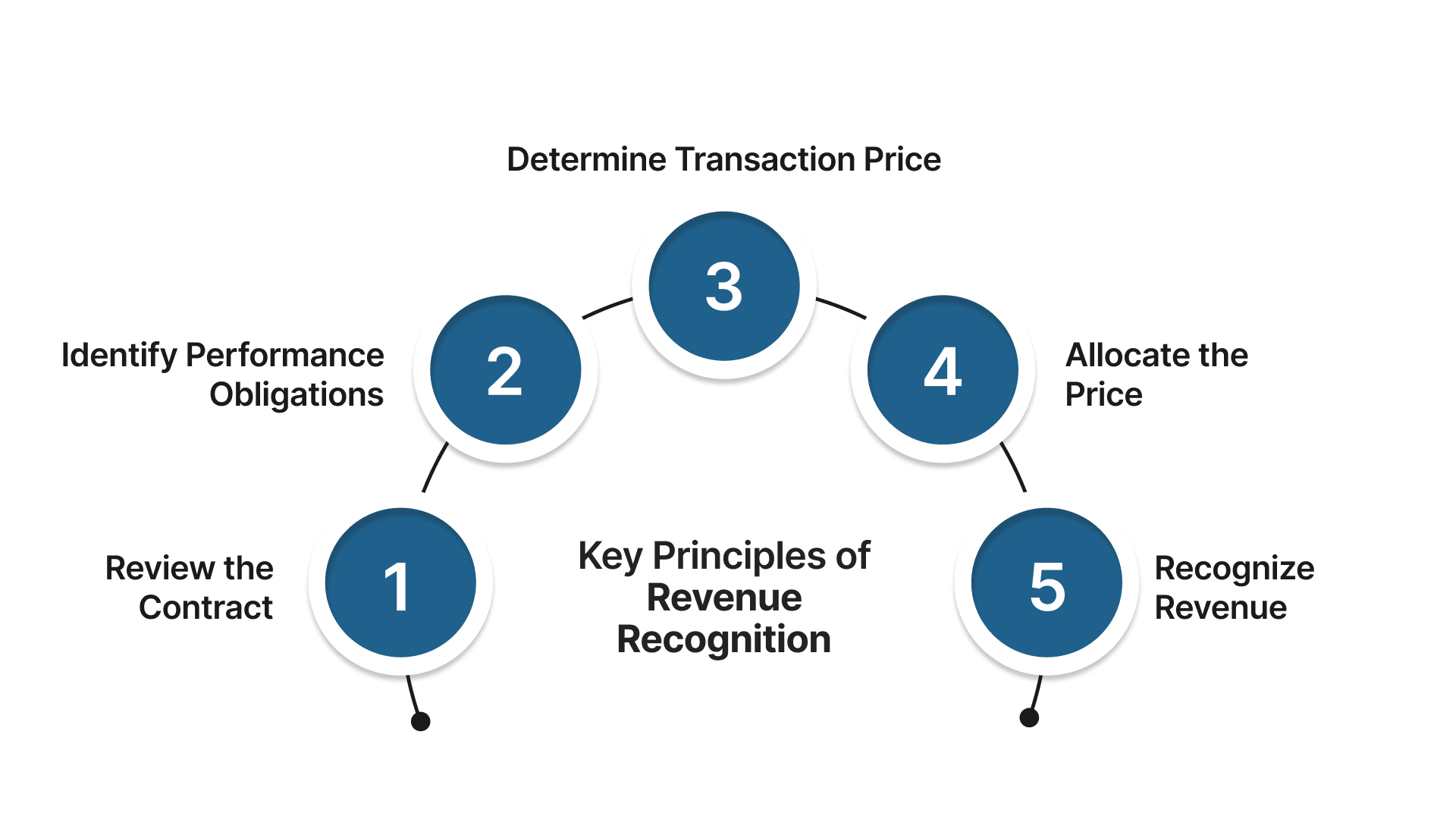
The framework provided by ASC 606 is built on five sequential steps. Understanding these steps is essential for any financial professional responsible for period-end reporting.
- Identify the contract with a customer: A contract exists when both parties have approved it, rights regarding goods or services are identifiable, payment terms are clear, the contract has commercial substance, and collection of consideration is probable.
- Identify the performance obligations in the contract: An entity must assess the goods or services promised in a contract and identify each "distinct" performance obligation. A good or service is distinct if the customer can benefit from it on its own or with other readily available resources.
- Determine the transaction price: The transaction price is the amount of consideration an entity expects to receive. This often involves estimating variable consideration, such as discounts, rebates, refunds, credits, performance bonuses, or royalties, using either the "expected value" or "most likely amount" method.
- Allocate the transaction price: If a contract contains multiple performance obligations, the entity must allocate the transaction price to each obligation based on its relative standalone selling price.
- Recognize revenue when (or as) the entity satisfies a performance obligation: Revenue is recognized when the customer obtains control of the good or service. This can occur at a point in time or over a period of time, depending on how the transfer of control happens.
Key Technical Challenges in Implementation
Handling Variable Consideration
One of the most complex areas of ASU revenue recognition is the estimation of variable consideration. Entities are required to include the estimated amount of variable consideration in the transaction price only to the extent that it is probable that a significant reversal of cumulative revenue will not occur when the uncertainty is resolved. In 2026, companies must maintain rigorous documentation of the data points used for these estimates to satisfy audit requirements.
Distinct Performance Obligations
Distinguishing between a "combined" performance obligation and multiple "distinct" obligations can significantly impact the timing of revenue recognition. If a company sells software along with an implementation service and ongoing updates, it must determine whether those items are "separately identifiable." If they are not—for example, if the software is useless without the implementation—they must be bundled into a single performance obligation.
Contract Modifications
Changes in contract scope or price are common in long-term service agreements. Under ASC 606, companies must assess whether a modification is a separate contract or an update to an existing one. If the added goods or services are distinct and priced at their standalone selling prices, the modification is treated as a separate contract. Otherwise, it is typically accounted for as a cumulative catch-up adjustment or on a prospective basis.
Comparison of Recognition Timing
| Scenario | Recognition Timing | Primary Driver |
|---|---|---|
| Point-in-Time | Upon delivery/transfer | Transfer of physical possession or legal title |
| Over Time | Pro-rata over service period | Customer consumes benefit simultaneously with performance |
| Variable Consideration | When constraint is lifted | Probability of no significant reversal |
| Licenses | Varies (Point/Over Time) | Nature of the license (functional vs. symbolic) |
Disclosure Requirements
The objective of the disclosure requirements in ASC 606 is to provide financial statement users with sufficient information about the nature, amount, timing, and uncertainty of revenue and cash flows. Companies are mandated to provide qualitative and quantitative information about:
- Contracts with customers (disaggregated revenue).
- Significant judgments made in applying the guidance.
- Assets recognized from the costs to obtain or fulfill a contract.
In 2026, regulators emphasize that disclosures should not be boilerplate. They must reflect the unique business model of the entity, specifically highlighting how management estimates variable consideration and determines the standalone selling prices for non-standardized bundles.
Common Pitfalls and Troubleshooting
Over-reliance on Automated Systems
Many organizations utilize revenue recognition software to automate the five-step process. However, a common mistake is assuming the software inherently understands unique contract nuances. If an implementation project has non-standard termination clauses, an automated system may incorrectly trigger revenue recognition prematurely. Periodic manual review of high-value or non-standard contracts is vital.
Misjudging "Control"
The shift from "risks and rewards" (the old standard) to "control" (the current standard) is a frequent source of error. Control represents the ability to direct the use of and obtain substantially all remaining benefits from the asset. If an entity continues to exert control over a product after shipping it (e.g., via a restrictive right of return), revenue cannot be recognized until those restrictions expire or are otherwise resolved.
Failure to Capitalize Contract Costs
Companies often overlook the requirement to capitalize incremental costs of obtaining a contract (e.g., sales commissions) if those costs are expected to be recovered. Amortizing these costs over the expected life of the customer relationship is a requirement under ASC 606, yet it is frequently missed during the migration of accounting processes.
Practical Steps for Financial Professionals
To maintain compliance in 2026, financial teams should conduct an annual "Revenue Health Check."
- Review Contract Templates: Ensure that standard customer contracts still align with current operational reality. If your delivery model has changed, your revenue recognition policy must be updated to match.
- Audit Variable Estimates: Compare historical estimates of variable consideration (like volume rebates) against actual outcomes. If there is a consistent variance, the estimation model needs adjustment.
- Verify Disaggregation: Ensure revenue is disaggregated into categories that depict how economic factors affect the nature, amount, and timing of revenue. Investors and auditors expect clear links between operational KPIs and financial statement line items.
- Update Staff Training: Ensure that project managers and sales staff understand that their actions—such as offering a side letter or an unapproved extension—can fundamentally alter the revenue recognition timeline for a contract.
Frequently Asked Questions
How does ASC 606 impact long-term service contracts? ASC 606 typically requires that revenue for long-term service contracts be recognized over the period that the services are provided, provided the customer receives and consumes the benefits simultaneously. The key is to determine if the performance obligation is satisfied over time or at a point in time.
Are there differences between ASC 606 and IFRS 15? While ASC 606 (FASB) and IFRS 15 (IASB) are largely converged, there are minor differences regarding specific industry-related guidance and scope exceptions. For most standard commercial contracts, the application is identical, but multinational entities should confirm specific jurisdictional requirements.
What is the impact of "standalone selling price" (SSP) on revenue? SSP is the price at which an entity would sell a promised good or service separately to a customer. Allocating the transaction price based on relative SSP ensures that each performance obligation in a bundle is accounted for at its fair value, preventing the front-loading or back-loading of revenue.
Can I recognize revenue before a formal contract is signed? In some cases, yes. Under ASC 606, a contract may exist if the parties are committed to performing their respective obligations, even if the contract is not in writing. However, the entity must be able to identify the rights and payment terms, and collection must be probable.
What happens if a customer cancels a contract? If a contract is terminated, the entity must determine the amount of consideration it is entitled to for the work performed to date. If the consideration is variable or subject to dispute, the entity must apply the constraint to ensure revenue is not recognized that might later be reversed.
Next Actions for Compliance
If your organization has not conducted a comprehensive review of its revenue recognition policies within the last 24 months, begin by identifying your most complex revenue streams. Cross-reference these streams against the five-step model. For any area where the recognition timing is based on internal estimates or management judgment, ensure that you have documented the "why" and the "how" behind those figures.
Maintain a "Revenue Recognition Memo" file for each significant contract type. This document should serve as the primary audit evidence, detailing how the performance obligations were identified and how the transaction price was allocated. For professional guidance, consult the latest FASB implementation guides or reach out to a certified public accountant familiar with your industry's specific revenue recognition challenges.