Artificial intelligence in nanotechnology serves as a critical accelerator for material discovery, molecular design, and precision manufacturing. By 2026, AI-driven computational models have transitioned from experimental tools to the primary framework for simulating atomic interactions, allowing researchers to predict material properties with high accuracy and bypass years of traditional trial-and-error laboratory experimentation.
The Convergence of the Very Small and the Very Smart
The intersection of artificial intelligence (AI) and nanotechnology represents a fundamental shift in how we manipulate matter. At the nanoscale—typically defined as 1 to 100 nanometers—classical physics often gives way to quantum mechanical effects. For decades, this unpredictability made consistent results difficult to achieve. However, the integration of machine learning (ML) and deep learning architectures has provided the "computational vision" necessary to navigate this complexity.
In 2026, the primary challenge is no longer just seeing atoms, but managing the astronomical amount of data generated by characterization tools like Scanning Tunneling Microscopy (STM) and Atomic Force Microscopy (AFM). AI algorithms process these massive datasets in real-time, identifying patterns in atomic lattice defects or molecular vibrations that would be invisible to human observers. This synergy allows for the creation of "smart" materials that can adapt their properties based on environmental stimuli, a feat previously confined to theoretical physics.
AI-Driven Nanomaterial Discovery and Synthesis
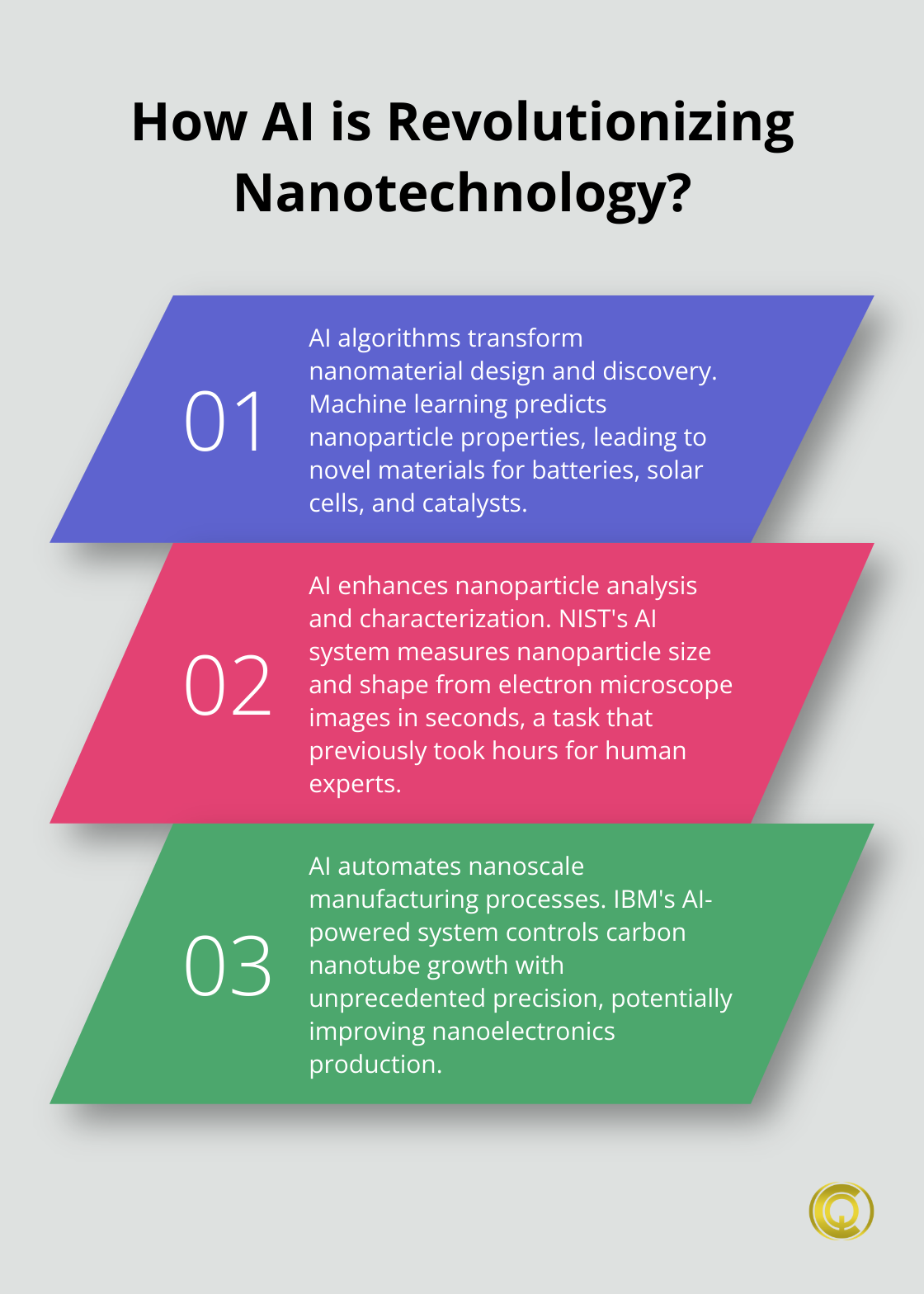
Traditionally, discovering a new nanomaterial involved a "cook and look" approach: synthesizing a substance and then testing its properties. This process was slow, expensive, and often yielded marginal improvements. Today, Generative AI and Graph Neural Networks (GNNs) have inverted this workflow. Researchers now define the desired properties first—such as specific electrical conductivity, thermal stability, or optical transparency—and AI models suggest the exact atomic configuration required to achieve them.
High-Throughput Screening and Predictive Modeling
AI systems are now capable of performing high-throughput screening in silico (within computer simulations). By utilizing Density Functional Theory (DFT) datasets, machine learning models predict the stability of thousands of theoretical compounds in seconds. This is particularly vital for the development of:
- Perovskite Solar Cells: AI optimizes the chemical composition of thin-film solar cells to maximize efficiency while ensuring long-term stability against environmental degradation.
- Metal-Organic Frameworks (MOFs): These porous materials are designed via AI to capture carbon dioxide or store hydrogen, with algorithms calculating the optimal pore size and surface area for gas adsorption.
- Two-Dimensional Materials: Beyond graphene, AI identifies new "MXenes" and van der Waals heterostructures that could revolutionize the next generation of semiconductors.
Automated Nanofabrication
The role of AI extends into the cleanroom. Nanofabrication—the process of building structures at the nanoscale—requires extreme precision. By 2026, AI-enhanced lithography systems use reinforcement learning to self-correct in real-time. If a laser or electron beam deviates by even a fraction of a nanometer due to thermal expansion or vibration, the AI compensates instantly, significantly increasing the yield of functional nanotransistors and quantum dots.
Nanomedicine and Targeted Drug Delivery
Perhaps the most human-centric application of artificial intelligence in nanotechnology is within the biomedical field. Nanomedicine relies on "nanocarriers"—tiny capsules designed to deliver medication directly to diseased cells while sparing healthy tissue.
Designing Smart Nanoparticles
AI models analyze biological barriers, such as the blood-brain barrier or the acidic environment of a tumor, to design the surface chemistry of nanoparticles. By simulating how these particles interact with protein coronas in the bloodstream, AI helps prevent the body’s immune system from clearing the drug before it reaches its target.
In 2026, we see the rise of autonomous nanobots. These are not "robots" in the mechanical sense, but molecular machines governed by biochemical logic gates. AI is used to program these gates, allowing the nanobots to perform complex tasks like:
- Target Recognition: Identifying specific biomarkers on the surface of cancer cells.
- Controlled Release: Determining the precise moment to trigger the release of a therapeutic payload based on local pH or enzyme concentrations.
- Real-time Monitoring: Sending signals back to external sensors to provide clinicians with a "live feed" of the treatment's progress.
Advanced Characterization and Imaging
Characterizing nanomaterials is a significant bottleneck. When imaging at the sub-atomic level, noise is a constant interference. Artificial intelligence, specifically Convolutional Neural Networks (CNNs), has revolutionized image reconstruction.
AI algorithms can now "de-noise" images from electron microscopes, filling in missing data points with high statistical confidence. This allows for the observation of dynamic processes—such as a chemical reaction occurring on a catalyst surface—in real-time and at higher resolutions than were previously possible. Furthermore, AI can automate the identification of crystalline phases and defects, tasks that used to take researchers weeks of manual analysis.
Comparison: Traditional vs. AI-Enhanced Nanotechnology
| Feature | Traditional Nanotechnology (Pre-AI) | AI-Enhanced Nanotechnology (2026) |
|---|---|---|
| Material Discovery | Trial-and-error; experimental focus | Predictive modeling; in silico design |
| Synthesis Time | Months to years | Days to weeks |
| Data Analysis | Manual interpretation of microscopy | Automated, real-time ML processing |
| Precision | Limited by hardware tolerances | Self-correcting autonomous systems |
| Complexity | Simple binary or ternary alloys | Complex, multi-component "high-entropy" materials |
| Cost | High due to wasted materials/failed tests | Lowered through optimized simulation |
Challenges: Ethics, Safety, and the "Black Box"
Despite the progress, the integration of AI in nanotechnology faces significant hurdles. One major concern is the toxicity of nanomaterials. Because of their small size, nanoparticles can enter cells and tissues in ways larger particles cannot. AI is being used to develop "Quantitative Structure-Activity Relationship" (QSAR) models to predict toxicity, but the biological complexity of the human body remains difficult to simulate fully.
Moreover, the "Black Box" problem of deep learning remains a concern in high-stakes fields like nanomedicine. If an AI designs a new nanoparticle for drug delivery, researchers must understand why that specific design works to ensure safety and regulatory compliance. Interpretability in AI models is a major research focus in 2026, as the U.S. Food and Drug Administration (FDA) and European regulators require transparent logic for AI-generated medical interventions.
Another risk involves the dual-use nature of this technology. The same AI that designs life-saving nanomedicines could theoretically be used to design novel toxins or biochemical agents. This has led to the establishment of international guidelines for the ethical development of nano-AI systems, emphasizing the need for robust cybersecurity in research labs.
Frequently Asked Questions
How does AI help in creating smaller microchips?
AI optimizes the layout of transistors at the nanoscale to reduce heat and increase processing speed. In 2026, AI-driven nanolithography allows for the manufacturing of sub-2nm nodes by predicting and correcting for "stochastic" effects—unpredictable variations in light and chemistry that occur at such small scales.
Is AI-designed nanomedicine safe for humans?
While AI-designed nanomedicines undergo rigorous clinical trials just like traditional drugs, the use of AI allows for better prediction of how these particles will behave in the human body. By 2026, many AI-optimized lipid nanoparticles (LNPs) are already in use, having shown fewer side effects in early trials compared to their non-AI counterparts.
Can AI predict the environmental impact of nanoparticles?
Yes, researchers use AI to simulate the "lifecycle" of a nanoparticle, from its production to its eventual degradation in the soil or water. These models help in creating "green" nanomaterials that are programmed to break down into harmless components after their functional life is over.
Do I need to be a computer scientist to work in nanotechnology today?
While a deep understanding of physics or chemistry is still the foundation, the role of a "nanotechnologist" in 2026 increasingly requires proficiency in data science and machine learning. Most research teams are now interdisciplinary, combining material scientists with AI engineers to build the models that drive discovery.
What are the "Digital Twins" of nanomaterials?
A Digital Twin is a virtual replica of a physical nanomaterial. By creating a Digital Twin, researchers can test how a material will respond to extreme heat, pressure, or chemical exposure in a virtual environment before ever manufacturing it in the lab. This saves millions in research costs and speeds up the deployment of new technologies.
Recommendations and Next Actions
For organizations and researchers looking to leverage artificial intelligence in nanotechnology, the following steps are recommended:
- Invest in Data Infrastructure: AI is only as good as the data it is trained on. Ensure that experimental results—both successes and failures—are recorded in standardized, machine-readable formats.
- Prioritize Hybrid Models: Purely data-driven AI models can sometimes suggest physically impossible structures. Use "physics-informed neural networks" (PINNs) that incorporate the laws of thermodynamics and quantum mechanics into the learning process.
- Focus on Regulatory Compliance: For those in the nanomedicine sector, begin integrating "explainable AI" (XAI) frameworks early in the design process to satisfy the transparency requirements of health authorities.
- Collaborate Across Disciplines: The most significant breakthroughs in 2026 are occurring at the edges of traditional fields. Foster partnerships between computational scientists, molecular biologists, and chemical engineers.
As we move further into 2026, the distinction between "nanotechnology" and "AI-driven nanotechnology" is disappearing. AI has become the standard toolkit for anyone working at the atomic scale, turning the once-mysterious world of the very small into a predictable, designable, and programmable frontier.