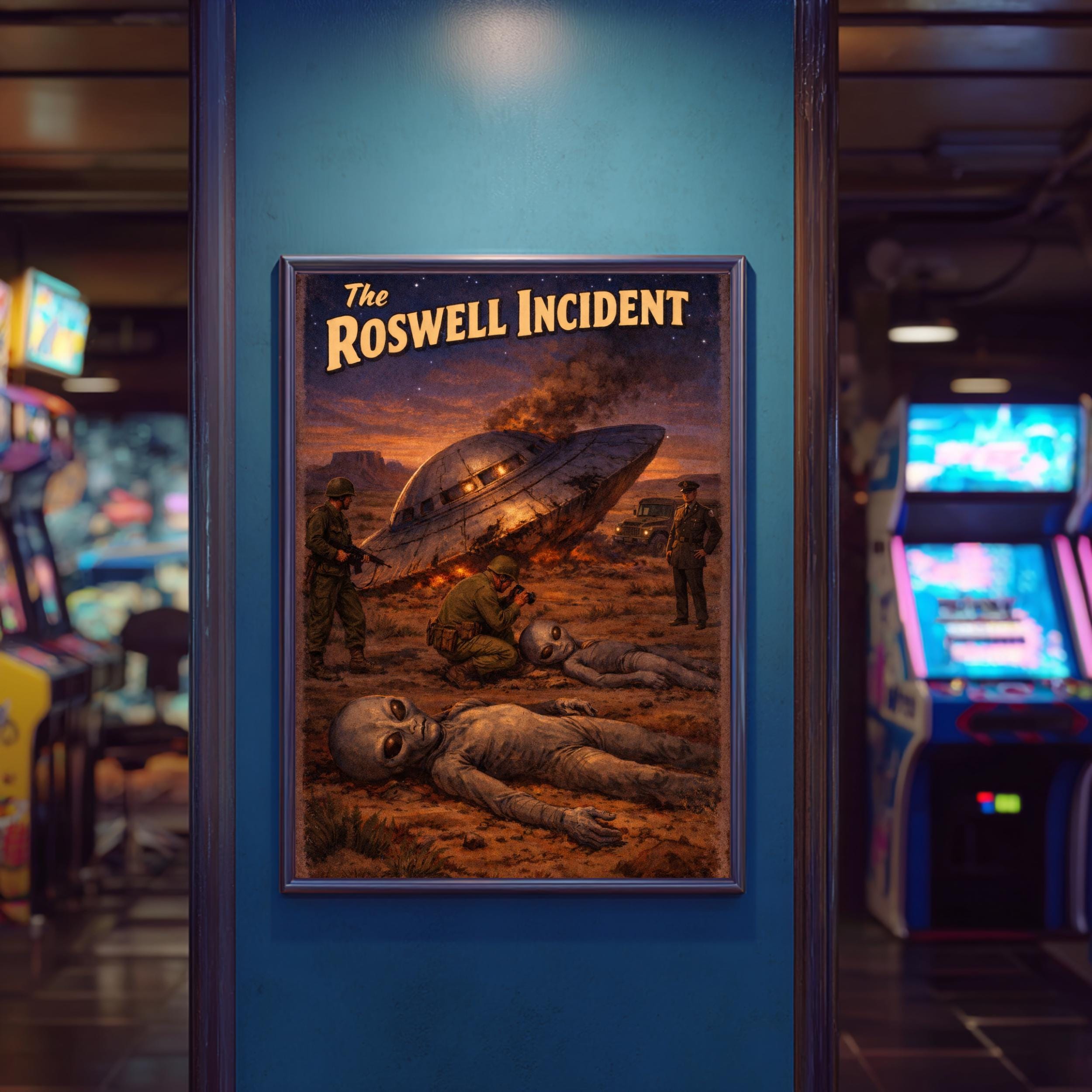
The Roswell incident of 1947 and the highly classified installation known as Area 51 are two distinct pillars of American military history that have become inextricably linked in public consciousness through decades of speculation regarding extraterrestrial visitation and government secrecy. While historical records confirm that both involve real-world testing of advanced aerospace technology, they are separate events connected primarily by the evolution of post-World War II aviation and the subsequent classification of sensitive military research.
The Roswell Incident: Fact and Historical Context
The Roswell incident refers to the 1947 recovery of debris from a ranch near Corona, New Mexico. On July 8, 1947, the Roswell Army Air Field (RAAF) issued a press release stating that they had recovered a "flying disc." Within twenty-four hours, the military retracted the statement, identifying the object as a conventional weather balloon carrying a radar target.
For decades, this incident remained a minor footnote in aviation history until the late 1970s, when researchers began interviewing individuals who claimed the debris was not a weather balloon. The subsequent cultural explosion surrounding the event transformed it into the definitive touchstone for modern UFO interest.
The Project Mogul Connection
In 1994, the United States Air Force released an extensive report regarding the Roswell incident. Declassification of records revealed that the "flying disc" was, in fact, part of Project Mogul. This was a highly classified military project designed to detect Soviet nuclear testing by launching high-altitude balloon arrays equipped with acoustic sensors and radar reflectors. Because the project utilized top-secret, cutting-edge technology during the early Cold War, the military initially obscured its true nature, leading to the rapid proliferation of alternative theories.
Understanding Area 51: The Groom Lake Facility
Area 51 is a highly classified United States Air Force installation located within the Nevada Test and Training Range. Geographically, it sits adjacent to Groom Lake, a salt flat. While the base has been the subject of intense media scrutiny and folklore, its actual historical function was to serve as a secure location for the research, development, and testing of advanced aerial platforms.
Evolution of Aerial Technology
The facility is historically significant for its role in the Cold War arms race. It served as the primary testing ground for the Lockheed U-2 spy plane, the A-12 Oxcart, and the F-117 Nighthawk stealth fighter. The extreme secrecy required for these projects necessitated the creation of a restricted environment where the testing of prototype aircraft would remain invisible to foreign adversaries and the general public.
Comparing Historical Realities and Public Speculation
The link between Roswell and Area 51 is largely thematic rather than operational. Roswell represents the initial public encounter with the concept of "unidentified" flying objects, while Area 51 represents the realization of "unidentified" government technology.
| Feature | The Roswell Incident | Area 51 (Groom Lake) |
|---|---|---|
| Primary Date | July 1947 | Operational since 1955 |
| Actual Nature | Project Mogul balloon debris | Advanced aerospace testing facility |
| Location | Corona, New Mexico | Lincoln County, Nevada |
| Public Status | Historical event | Restricted military installation |
| Key Research | Acoustic nuclear detection | Low-observable aircraft (stealth) |
The Mechanics of Secrecy and Classification
The intersection of these two subjects is fundamentally a study in the mechanics of national security classification. During the 1940s and 1950s, the U.S. government faced a critical need to maintain technological superiority over the Soviet Union. This required keeping the development of new radar, high-altitude surveillance, and stealth technologies hidden from view.
The Impact of Compartmentalization
Military "compartmentalization"—the practice of limiting access to information strictly to those with a "need to know"—is a core requirement of national security. When the public observed experimental, high-altitude aircraft moving at speeds or appearing in forms not seen in commercial aviation, the lack of official acknowledgment created a vacuum. This vacuum was filled by speculative theories that bridge the gap between observed, unidentified phenomena and the reality of classified military testing.
Addressing Common Questions and Misconceptions
To understand the relationship between these entities, it is essential to distinguish between proven historical records and cultural narratives.
Did the Roswell debris go to Area 51?
There is no historical evidence linking the debris recovered at Roswell in 1947 to the Groom Lake facility. Area 51 did not begin its life as a test site until 1955, eight years after the Roswell incident. Any suggestion that the two are physically linked by the transfer of materials is inconsistent with the chronological development of the Nevada base.
Why is Area 51 still restricted?
Area 51 remains restricted not because of extraterrestrial artifacts, but because it continues to function as a secure location for testing, evaluating, and training with advanced military systems. In 2026, the base maintains its high-security status to protect the integrity of ongoing aerospace research and personnel safety.
What was Project Mogul?
Project Mogul was a top-secret program that used high-altitude balloons equipped with microphones to listen for the sound of Soviet atomic bomb detonations in the upper atmosphere. Because the technology was highly sensitive, the balloon arrays were designed to be obscure, which inadvertently contributed to the ambiguity surrounding their recovery.
Can you visit Area 51?
While you cannot enter the military installation, the surrounding areas, including the perimeter of the Nevada Test and Training Range, are popular destinations for aviation enthusiasts. The "Extraterrestrial Highway" (State Route 375) runs near the facility. Visitors should be aware that the base perimeter is heavily monitored, and trespassing on military land carries significant legal consequences.
Operational Limitations and Security Protocols
For those interested in the history of these sites, it is important to recognize the operational realities. The U.S. government maintains strict control over information regarding modern aerospace testing. Official records regarding past projects like the U-2 or A-12 are eventually declassified, but this process can take decades. Understanding this timeline is the most reliable way to separate speculation from verifiable facts.
The Role of Freedom of Information
Researchers rely on the Freedom of Information Act (FOIA) to gain access to historical documents. While FOIA is a powerful tool, it has limitations. National security exemptions protect ongoing sensitive projects. Consequently, documents regarding the most recent developments at facilities like Groom Lake remain protected, which fuels ongoing interest and debate.
Summary for the Historical Researcher
The relationship between Area 51 and the Roswell incident is a testament to the friction between the government's need for absolute technological secrecy and the public's desire for transparency. Roswell serves as the origin point of public concern over unidentified aerial objects, while Area 51 serves as the long-standing symbol of that secrecy. When evaluating these topics, prioritize primary source documentation from the Department of Defense and established historical analysis over anecdotal reporting.
For those conducting further research, the best next step is to consult the official declassified archives maintained by the National Archives and Records Administration (NARA) or the Air Force Historical Research Agency. These institutions hold the primary logs and project briefings that clarify the true purpose of the military operations often associated with these two distinct sites.