Life insurance is primarily designed to provide a financial safety net for dependents upon the insured's death, covering immediate expenses, replacing lost income, and funding long-term liabilities. Beyond this core income-replacement function, permanent life insurance policies feature cash-value components that can be strategically leveraged for supplemental retirement income, estate planning liquidity, and business continuity funding under specific financial conditions.
Introduction to Life Insurance Fundamentals
Life insurance is often misunderstood as a monolithic financial product. In reality, it encompasses a wide spectrum of contracts designed to manage financial risk associated with human life. At its core, a life insurance policy is a legally binding contract between an individual (the policyholder) and an insurance company (the insurer). In exchange for regular payments—known as premiums—the insurer promises to pay a designated sum of money—the death benefit—to named beneficiaries upon the insured's passing.
However, the modern financial landscape utilizes these instruments for much more than basic post-mortem income replacement. Consumers, estate planners, and business owners routinely integrate life insurance into complex financial architectures. Understanding the appropriate uses for life insurance requires evaluating the distinctions between temporary protection and permanent asset accumulation, assessing tax advantages, and matching policy structures to explicit financial goals.
Because financial, tax, and legal regulations govern these contracts, policyholders must evaluate their choices carefully. Life insurance involves upfront costs, ongoing administrative fees, and underwriting constraints based on age, health, and lifestyle. This analysis explores the standard and advanced applications of life insurance, highlighting where these products serve a vital purpose and where alternative financial instruments might prove more effective.
Core Personal Uses: Replacing Income and Protecting Dependents
The foundational and most universally accepted purpose of life insurance is the protection of financial dependents. When an individual contributes to a household's financial stability through wages, business earnings, or unpaid labor (such as childcare and home management), their sudden absence creates an immediate economic deficit.
Income Replacement for Surviving Family Members
When a primary wage earner dies, surviving family members often face severe financial distress. Term life insurance is frequently deployed to address this risk. By purchasing a policy with a term length that matches the household's peak earning and dependency years—such as until children graduate from college—families can secure a death benefit designed to replace the deceased's projected future earnings. Financial planners often recommend a death benefit equivalent to 10 to 15 times the insured's annual salary, though exact calculations depend on existing savings, outstanding debts, and future inflation expectations.
Funding Immediate Final Expenses
The financial shock of a death extends far beyond lost wages. Immediate expenses can quickly overwhelm a grieving family. Appropriate uses for life insurance funds include:
- Funeral and Burial Costs: Average modern funeral arrangements routinely cost thousands of dollars for services, caskets, and burial plots or cremation.
- Uninsured Medical Bills: Final illnesses can generate substantial out-of-pocket medical expenses that are not covered by health insurance.
- Immediate Living Expenses: Surviving spouses often require a financial bridge during the transition period immediately following a partner's death, while sorting out estates, changing housing situations, or adjusting employment statuses.
Covering Major Household Liabilities
Beyond recurring living expenses, families frequently carry large capital liabilities that require immediate liquidation or ongoing servicing in the event of a death.
- Mortgage Protection: A dedicated policy or a specialized decreasing term policy can be structured to pay off the remaining balance of a home mortgage, ensuring that surviving dependents do not face foreclosure or forced relocation.
- Personal Debt Obligations: Auto loans, personal credit lines, and private student loans can sometimes burden surviving family members, particularly if co-signed. Life insurance proceeds provide the liquidity required to clear these obligations cleanly.
Long-Term Family Planning and Education Funding
As families progress through different life stages, the appropriate uses for life insurance shift from basic survival protection toward legacy creation, asset preservation, and targeted milestone funding.
Securing Higher Education for Children
Higher education costs continue to rise, presenting a formidable barrier for families if a parent dies prematurely. While dedicated college savings vehicles like 529 plans are standard tools for education funding, life insurance acts as a failsafe. If a parent passes away before college savings goals are met, the life insurance death benefit can fund tuition, room, and board, ensuring that children retain access to educational opportunities.
Providing for Dependents with Special Needs
Estate planning for families with special needs dependents involves complex legal and financial orchestration. If a child or relative has a disability that prevents them from achieving financial independence, their care must be provided for long after the parents are gone.
- Special Needs Trusts (SNTs): Life insurance policies are frequently structured to pay out directly to an irrevocable Special Needs Trust rather than to the individual directly. This preserves the beneficiary's eligibility for government assistance programs like Medicaid and Supplemental Security Income (SSI) while providing a dedicated pool of capital for supplemental care, housing, and quality-of-life expenses.
| Policy Type | Primary Purpose | Key Advantage | Main Limitation |
|---|---|---|---|
| Term Life Insurance | Temporary income replacement and debt protection. | Highly affordable; high death benefit per premium dollar. | Expires without value if the insured outlives the term. |
| Whole Life Insurance | Lifetime protection and predictable cash accumulation. | Guaranteed cash value growth and fixed premiums. | Higher cost; less flexibility in premium payments. |
| Universal Life Insurance | Flexible lifetime coverage with adjustable premiums. | Adjustable death benefits and flexible premium structures. | Cash value performance depends on current interest rates. |
| Variable Life Insurance | Permanent coverage with investment-linked growth. | Potential for higher returns through sub-account investments. | Subject to market risk; fees can be substantially higher. |
Wealth Preservation and Estate Planning
For high-net-worth individuals and families, life insurance serves as a specialized instrument for mitigating estate tax liabilities, equalizing inheritances, and ensuring smooth wealth transfer across generations.
Mitigating Estate and Inheritance Taxes
At both federal and state levels, large estates can be subject to significant estate or inheritance taxes upon the owner's death. Because the Internal Revenue Service (IRS) and state tax authorities generally demand tax settlements in cash within months of death, families can be forced to sell illiquid assets—such as family businesses, real estate, or rare collections—at depressed market prices to satisfy the tax burden.
- Irrevocable Life Insurance Trusts (ILITs): To prevent life insurance proceeds from being added to the taxable estate, affluent individuals often establish an ILIT. The trust owns the policy, meaning the death benefit passes to beneficiaries completely free of federal estate and income taxes, providing immediate liquidity specifically earmarked to pay tax liabilities.
Equalizing Inheritances Among Heirs
Estate planning becomes complicated when a parent's primary asset is indivisible or non-liquid, such as a working farm, a commercial real estate property, or a closely held family business. If one child works in the family business and another pursues a different career, leaving the business entirely to the first child creates an imbalance in total inheritance value.
- Inheritance Equalization: Parents can leave the business to the active child and use a life insurance policy's tax-free death benefit to provide an equivalent cash inheritance to the non-participating child, preserving family harmony and business continuity.
Business Applications of Life Insurance
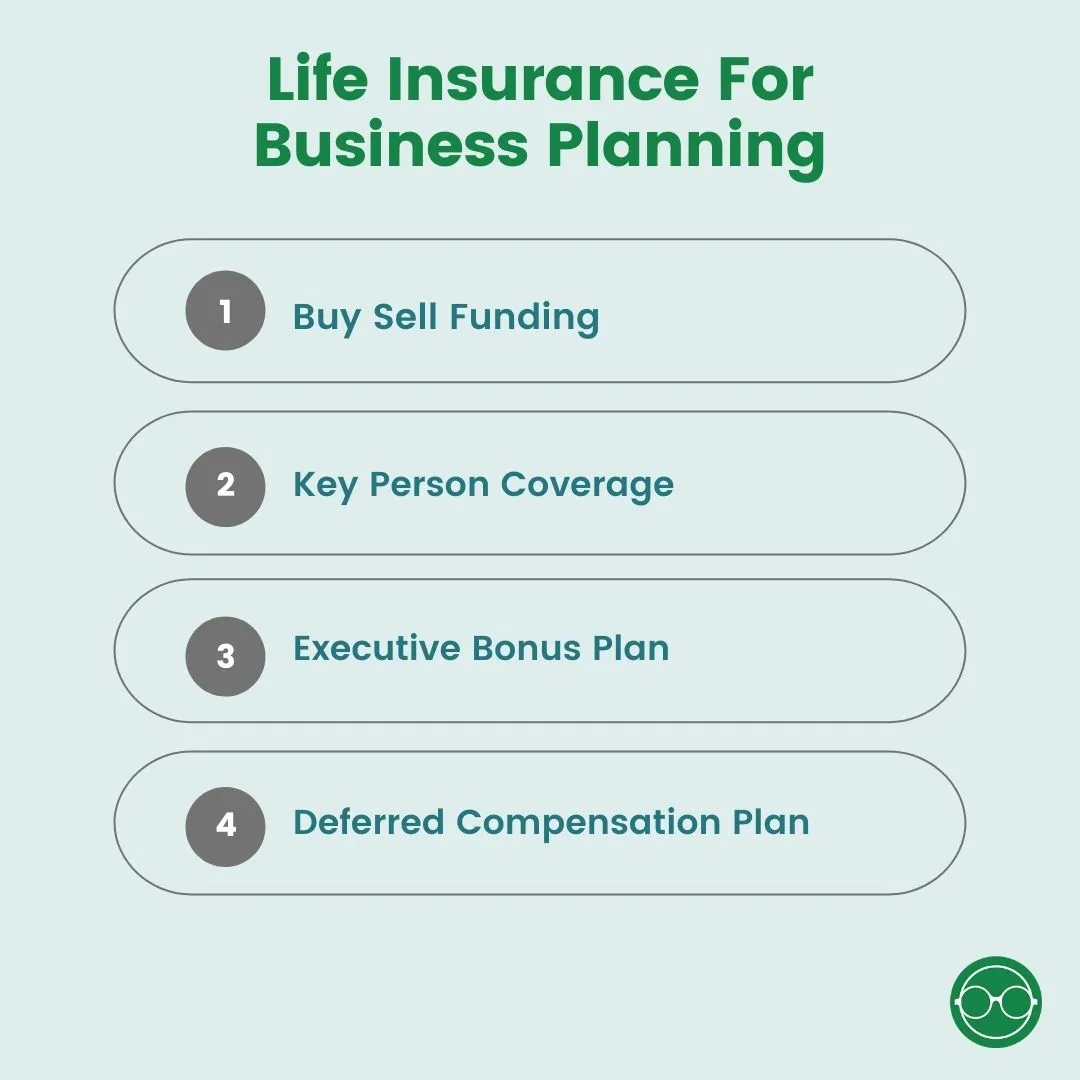
Commercial entities face severe financial vulnerabilities if key personnel die or if co-owners experience a sudden partnership disruption. Businesses deploy corporate-owned life insurance (COLI) and executive benefit plans to mitigate these commercial risks.
Buy-Sell Agreements and Business Continuity
When a co-owner of a privately held business dies, their ownership stake typically passes to their heirs, who may have no interest in running the company or may demand an immediate buyout that the surviving owners cannot afford.
- Cross-Purchase and Entity-Purchase Agreements: Co-owners enter into a legally binding buy-sell agreement funded by life insurance policies. Each owner purchases a policy on the lives of the others (in a cross-purchase setup) or the business purchases policies on all owners (in an entity-purchase setup). Upon an owner's death, the insurance proceeds provide the surviving owners or the business with the immediate cash required to buy out the deceased's heirs at a pre-agreed valuation.
Key Person Insurance
Many businesses rely heavily on specific individuals—such as a founder, a lead software architect, or a top sales executive—whose sudden loss would cause catastrophic revenue declines or operational paralysis.
- Mitigating Operational Disruption: Key person insurance is owned by the business, which pays the premiums and is named as the beneficiary. If the key employee dies, the insurance payout provides cash flow to stabilize operations, hire and train a replacement, and reassure nervous creditors or investors during the transition.
Executive Compensation and Retention Strategies
To attract and retain top-tier talent in competitive industries, corporations utilize permanent life insurance within executive compensation packages.
- Executive Bonus Plans (Sec. 162): The business pays the premiums on a policy owned by the employee, treating the payments as taxable compensation.
- Split-Dollar Arrangements: The employer and the executive share the costs, benefits, and cash value growth of a permanent life insurance policy, providing the employee with valuable death benefit protection and potential cash accumulation while securing their long-term loyalty to the firm.
Cash-Value Strategies: Supplemental Retirement and Asset Diversification
Unlike term insurance, which only provides a death benefit, permanent life insurance products (such as whole life, universal life, and variable universal life) feature a cash-value account. A portion of each premium payment is directed into this tax-advantaged account, where it grows over time. Understanding appropriate uses for cash value requires examining how policyholders can legally access these funds during their lifetimes.
Tax-Advantaged Cash Growth
The cash value within a permanent life insurance policy grows on a tax-deferred basis. This means policyholders do not pay annual capital gains or income taxes on the interest, dividends, or market gains credited to their cash value account. This tax treatment allows the principal to compound more efficiently compared to standard taxable brokerage accounts.
Accessing Funds via Policy Loans and Withdrawals
Policyholders can access their accumulated cash value while alive through policy withdrawals or policy loans issued by the insurer, using the cash value as collateral.
- Tax-Free Income Stream: Under current tax laws, policy loans are generally not treated as taxable income, provided the policy remains in force and does not lapse into a modified endowment contract (MEC) status.
- Retirement Supplementation: Retirees occasionally leverage properly structured permanent life insurance to supplement retirement cash flow during down market years, avoiding the need to sell depreciated equities in standard retirement accounts like IRAs or 401(k)s.
Inappropriate or Misunderstood Uses of Life Insurance
While life insurance is versatile, attempting to use these products outside their intended financial scope can lead to severe underperformance, unnecessary costs, and financial strain. Recognizing improper applications is as critical as understanding appropriate uses.
Purchasing Permanent Insurance for Short-Term Needs
Buying a whole life or universal life policy to cover a short-term liability—such as a 5-year personal loan or a temporary income gap while a child is an infant—is financially inefficient. Permanent insurance carries high upfront underwriting, acquisition, and administrative costs. These expenses are amortized over decades; using a permanent product for a short-term need results in high costs and minimal efficiency compared to an inexpensive term life policy.
Treating Life Insurance Primarily as a High-Yield Investment
While permanent policies offer tax advantages and stable cash-value growth, they are fundamentally insurance products, not aggressive investment vehicles. Individuals seeking maximum long-term capital appreciation generally achieve better net returns through dedicated, low-fee investment vehicles such as broad-market equity index funds or tax-advantaged retirement accounts (e.g., Roth IRAs and 401(k)s). Life insurance should be viewed as a risk-management and asset-preservation tool that includes a conservative cash component, rather than a direct replacement for the stock market.
Overfunding Policies Beyond IRS Limits
To maximize tax-free cash growth, some policyholders attempt to pump excessive capital into life insurance contracts. However, the IRS established strict limits on premium payments relative to the death benefit. If a policy receives too much cash too quickly, it loses its favorable tax status and is reclassified as a Modified Endowment Contract (MEC). Distributions from an MEC—including loans and withdrawals—are subject to ordinary income tax and potential IRS penalties on earnings, defeating the primary financial incentive of the cash value strategy.
Frequently Asked Questions
What is the primary difference between term and permanent life insurance uses?
Term life insurance is designed exclusively for temporary financial protection, such as replacing income during working years or covering a mortgage. Permanent life insurance is structured for lifelong protection and includes a cash-value component utilized for estate planning, long-term wealth preservation, and supplemental retirement liquidity.
Can I use life insurance cash value while I am still alive?
Yes. Policyholders can access accumulated cash value through policy withdrawals or by taking policy loans against the cash value collateral. These distributions are generally tax-free, provided the policy remains active and does not lapse, though outstanding loans reduce the final death benefit paid to beneficiaries.
Is life insurance proceeds subject to income tax for beneficiaries?
Generally, no. Life insurance death benefits paid to named beneficiaries are received completely income-tax-free under federal law. However, if the policy is owned by an estate or if the estate is named as the beneficiary, the proceeds can become subject to federal and state estate taxes.
How does key person insurance benefit a company?
Key person insurance provides a cash injection to a business if a critical owner, executive, or revenue-producing employee dies. The company uses the tax-free death benefit to stabilize operations, offset lost revenue during the search for a replacement, and satisfy nervous creditors or investors.
What happens if I outlive a term life insurance policy?
If you outlive a term life insurance policy, the coverage expires, and no death benefit is paid to your beneficiaries. Premiums paid over the life of the term are retained by the insurance company to cover the cost of insurance during the active period. Some policies offer a Return of Premium (ROP) rider, though this significantly increases the cost of the initial coverage.
Practical Recommendations and Next Actions
Evaluating appropriate uses for life insurance requires a structured, objective assessment of your current financial obligations, long-term goals, and risk tolerance. To ensure your coverage aligns with your personal or business needs, take the following sequential steps:
- Conduct a Needs Analysis: Calculate your total outstanding financial liabilities, including mortgages, consumer debt, future college expenses, and the exact income your dependents would require to maintain their standard of living if you were to pass away.
- Separate Protection from Investment Goals: Determine whether your primary need is pure risk protection (favoring term insurance) or long-term estate and asset management (which may justify permanent insurance). Avoid mixing these goals without professional guidance.
- Consult Licensed Financial Professionals: Work with certified financial planners (CFPs) or estate attorneys who do not rely solely on commission-based product sales to ensure your policy structure integrates seamlessly with your broader financial plan.