The approximate cost to repair a 1,600 square foot foundation in 2026 typically ranges from $6,500 to $19,000, with most homeowners spending an average of $11,500. For minor crack repairs, costs may stay under $3,000, while major structural stabilization involving deep piering can exceed $35,000.
Repairing a foundation is one of the most significant maintenance tasks a homeowner can face. For a 1,600 square foot home—a standard size for many suburban ranch-style houses or bungalows—the costs are dictated not just by the footprint of the building, but by the depth of the local water table, the composition of the soil, and the specific type of foundation (slab-on-grade, crawlspace, or full basement). As of 2026, labor rates and material costs for steel and high-density polymers have stabilized following the volatility of the early 2020s, but they remain a primary driver of the final invoice.
Understanding the Variables of a 1,600 Square Foot Footprint
When calculating the cost of foundation repair, the square footage of the home provides a baseline for the potential scale of the project, but it is the linear footage of the perimeter that usually determines the quantity of materials needed. A 1,600 square foot home that is perfectly square (40' x 40') has 160 linear feet of foundation wall. A rectangular version (e.g., 20' x 80') has 200 linear feet. The more perimeter wall there is, the higher the cost for waterproofing, exterior excavation, or pier placement.
Soil Composition and Geographic Influence
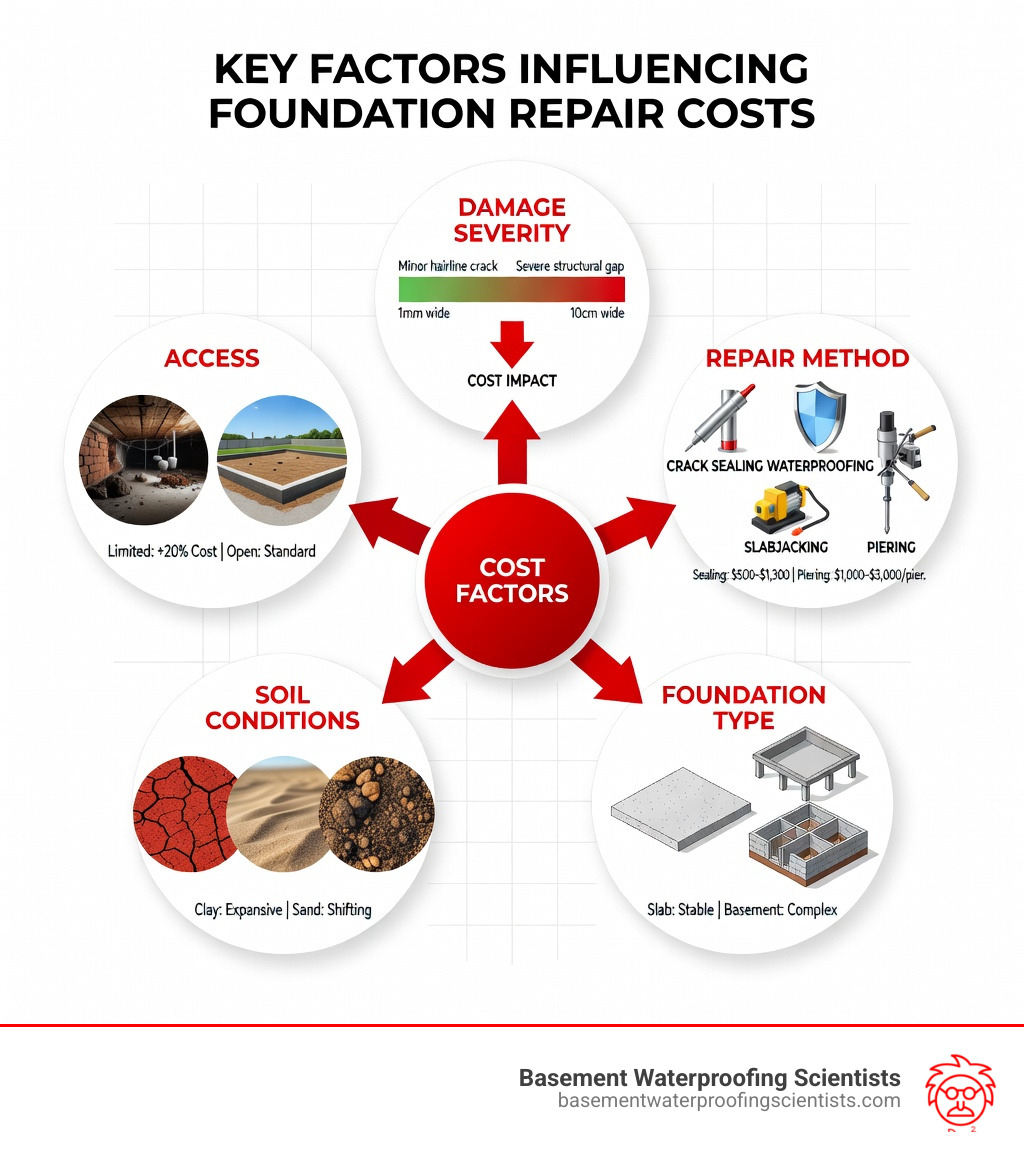
The type of soil beneath your 1,600 square foot home is the single most important factor in why foundations fail and how much they cost to fix. In 2026, geotechnical data continues to show that homes built on expansive clay soils—common in the southern and central United States—face the highest repair costs. Clay expands when wet and shrinks when dry, creating a "cycling" effect that eventually snaps concrete slabs or bows basement walls.
Conversely, homes built on sandy or loamy soils may experience settling due to "washouts" or poor compaction. Repairing a home on clay often requires deeper, more expensive piers to reach stable bedrock or load-bearing strata, whereas repairs on sandy soil might favor chemical stabilization or soil grouting.
Foundation Type: Slab vs. Crawlspace vs. Basement
- Concrete Slabs: These are common in warmer climates. Repairs usually involve "polyjacking" (lifting the slab with foam) or interior piering. Because there is no access under the home, workers may need to cut through your flooring to reach the foundation, which adds to the restoration cost.
- Crawlspaces: These offer better access for repair crews. Cost drivers here include support beam replacement, floor jack installation, and vapor barrier encapsulation.
- Full Basements: Repairs here are often the most expensive because they involve deep excavation around the exterior or the installation of heavy-duty steel I-beams or carbon fiber strips to prevent wall collapse.
Common Repair Methods and Their 2026 Pricing
In 2026, the technology used for foundation stabilization has become more precise, utilizing laser-guided leveling and advanced hydraulic systems. The following methods are the standard industry solutions for a 1,600 square foot home.
Piering and Underpinning
Piering is the process of driving steel or concrete pillars deep into the ground to support the weight of the foundation. For a 1,600 square foot home experiencing "settlement" (sinking), this is the most common permanent fix.
- Push Piers: These use the weight of the house to drive the pier into the ground. In 2026, expect to pay $1,400 to $2,200 per pier. A typical 1,600 sq ft home needing one side stabilized might require 8 to 10 piers, totaling $11,200 to $22,000.
- Helical Piers: These are screwed into the ground and are better for lighter structures or specific soil conditions. They range from $1,800 to $2,800 per pier.
Slab Jacking and Polyjacking
If your 1,600 square foot slab foundation is sinking but the structure remains sound, "jacking" is used to level it.
- Mudjacking: An older method using a slurry of sand and cement. It is cheaper (approx. $5 to $12 per square foot) but adds significant weight to the soil, which can cause future sinking.
- Polyjacking: The modern standard in 2026. A high-density polyurethane foam is injected under the slab. It is lightweight, waterproof, and cures in minutes. For a localized area of a 1,600 sq ft slab, this typically costs $2,500 to $6,000.
Crack Repair and Sealing
Not all foundation issues are structural. Many are related to water intrusion.
- Epoxy or Polyurethane Injections: Used to seal cracks in basement walls. These cost roughly $600 to $1,200 per crack.
- Exterior Waterproofing: If the 1,600 sq ft foundation requires a full "blue-skin" membrane and new French drains, the cost can range from $10,000 to $25,000 due to the massive amount of excavation required.
| Repair Category | Unit Measurement | 2026 Estimated Cost (Low) | 2026 Estimated Cost (High) |
|---|---|---|---|
| Structural Engineering Report | Per Inspection | $600 | $1,500 |
| Steel Push Piers | Per Pier (8-10 units) | $11,200 | $22,000 |
| Helical Piers | Per Pier (8-10 units) | $14,400 | $28,000 |
| Polyjacking | Per Project Area | $2,500 | $7,000 |
| Wall Carbon Fiber Straps | Per Strap (approx. 4ft apart) | $700 | $1,200 |
| Crawlspace Encapsulation | Full 1,600 sq ft Area | $6,000 | $14,000 |
| Foundation Crack Injection | Per Major Crack | $500 | $1,100 |
The Hidden Costs of Foundation Repair
When budgeting for a 1,600 square foot foundation repair, the initial quote from a contractor rarely covers the "total" cost of returning the home to its original state.
Structural Engineering Fees
Before hiring a repair contractor, it is essential to hire an independent Structural Engineer. In 2026, an engineer's report is a requirement for most municipal permits. They provide an unbiased assessment of what is actually wrong, ensuring you don't pay for 20 piers when you only need 10. This report usually costs between $800 and $1,500.
Plumbing and Hydrostatic Testing
When a house is lifted or leveled, the plumbing moves with it. In a 1,600 square foot home, the sewer lines under the slab are at risk of snapping during the lifting process. Most municipalities require a hydrostatic pressure test after the repair to ensure no leaks were created. If a line is broken, repairs can cost an additional $3,000 to $7,000.
Landscaping and Hardscape Restoration
To install piers or waterproof an exterior wall, contractors must excavate a perimeter around the home. This means your bushes, flower beds, and possibly your porch or driveway will be disturbed. Many foundation companies do not include "re-beautification" in their quotes. Replacing a 1,600 square foot home's peripheral landscaping and repairing cracked walkways can add $2,000 to $5,000 to the project total.
Permitting and Administrative Fees
Building permits for structural repairs vary by county but are generally calculated based on the value of the repair. Expect to pay $200 to $800 for permits and local government inspections.
Warning Signs That Require Immediate Attention
A 1,600 square foot home provides enough surface area that foundation stress often shows up in specific, predictable patterns. Identifying these early in 2026 can be the difference between a $5,000 crack injection and a $30,000 piering job.
- Stair-Step Cracking: Most common in brick or block walls. If the cracks follow the mortar lines in a zigzag pattern, the foundation is likely settling at one corner.
- Doors and Windows that Bind: If a door suddenly sticks or a window won't lock, the frame has likely shifted out of square due to foundation movement.
- Floor Gaps: In 1,600 sq ft homes with crawlspaces, look for gaps between the baseboards and the flooring, or "bouncy" spots in the middle of a room.
- Chimney Separation: If your chimney is pulling away from the siding of the house, it is a sign of a localized foundation failure that needs immediate stabilization.
- Wall Shearing: Horizontal cracks in a basement wall are a sign of hydrostatic pressure (water-soaked soil pushing against the wall). This is a critical failure that could lead to wall collapse.
Is It Worth Repairing a 1,600 Square Foot Foundation?
Homeowners often wonder if the high cost of repair is a sound investment. From a real estate perspective in 2026, a house with an unrepaired foundation is nearly impossible to sell to a traditional buyer using a mortgage. Most lenders will not approve a loan on a home with structural instability.
Furthermore, foundation issues are progressive. A small tilt this year will lead to cracked drywall, broken pipes, and roof leaks next year. By spending $12,000 today to stabilize a 1,600 square foot home, you are likely preserving $50,000 to $100,000 in home equity that would otherwise be lost if the home were sold "as-is" to an investor.
Frequently Asked Questions
Does homeowners insurance cover foundation repair in 2026?
Generally, no. Standard homeowners insurance policies exclude "earth movement," which covers settling, shrinking, and swelling of the soil. Insurance only typically pays for foundation damage if it was caused by a "covered peril," such as a sudden pipe burst or a vehicle crashing into the home. It is advisable to check your specific 2026 policy riders for "earthquake" or "sinkhole" coverage if you live in high-risk zones.
How long does it take to repair a 1,600 square foot foundation?
For a standard piering job or polyjacking, the work usually takes 3 to 5 days. If the project requires extensive exterior waterproofing and deep excavation, it can take 2 to 3 weeks. Weather is the primary variable; heavy rain can delay excavation projects significantly.
Can I live in the house during the repair?
Yes, in most cases. Foundation repair is loud and involves heavy machinery outside the home, but it rarely requires the residents to vacate. The exception is if the home is deemed structurally "unsafe for occupancy" by an engineer, or if the internal plumbing must be disconnected for several days.
What is the difference between a "lifetime warranty" and a "transferable warranty"?
In 2026, most reputable contractors offer a lifetime warranty on the piers themselves. However, a transferable warranty is what adds value to your home. This means that if you sell your 1,600 square foot home, the new owner is still covered. Always ensure the warranty is backed by a third-party trust or a long-standing company to ensure it remains valid if the contractor goes out of business.
Will foundation repair fix the cracks in my drywall?
Stabilizing the foundation stops the house from moving further, but it does not always "close" existing drywall cracks perfectly. In 2026, contractors recommend waiting 6 to 8 weeks after the foundation is leveled before repairing drywall and repainting. This allows the home's framing to "settle" into its new, level position.
Final Recommendation for Homeowners
If you suspect your 1,600 square foot home has foundation issues, do not call a repair contractor first. Instead, hire an independent structural engineer to perform a "Level B" inspection. This will give you a detailed CAD drawing and a specific "plan of repair" that you can then hand to contractors for bidding. This step prevents "scope creep" and ensures that the quotes you receive—likely ranging between $8,000 and $18,000—are based on the actual structural needs of the building rather than a salesperson's commission targets.