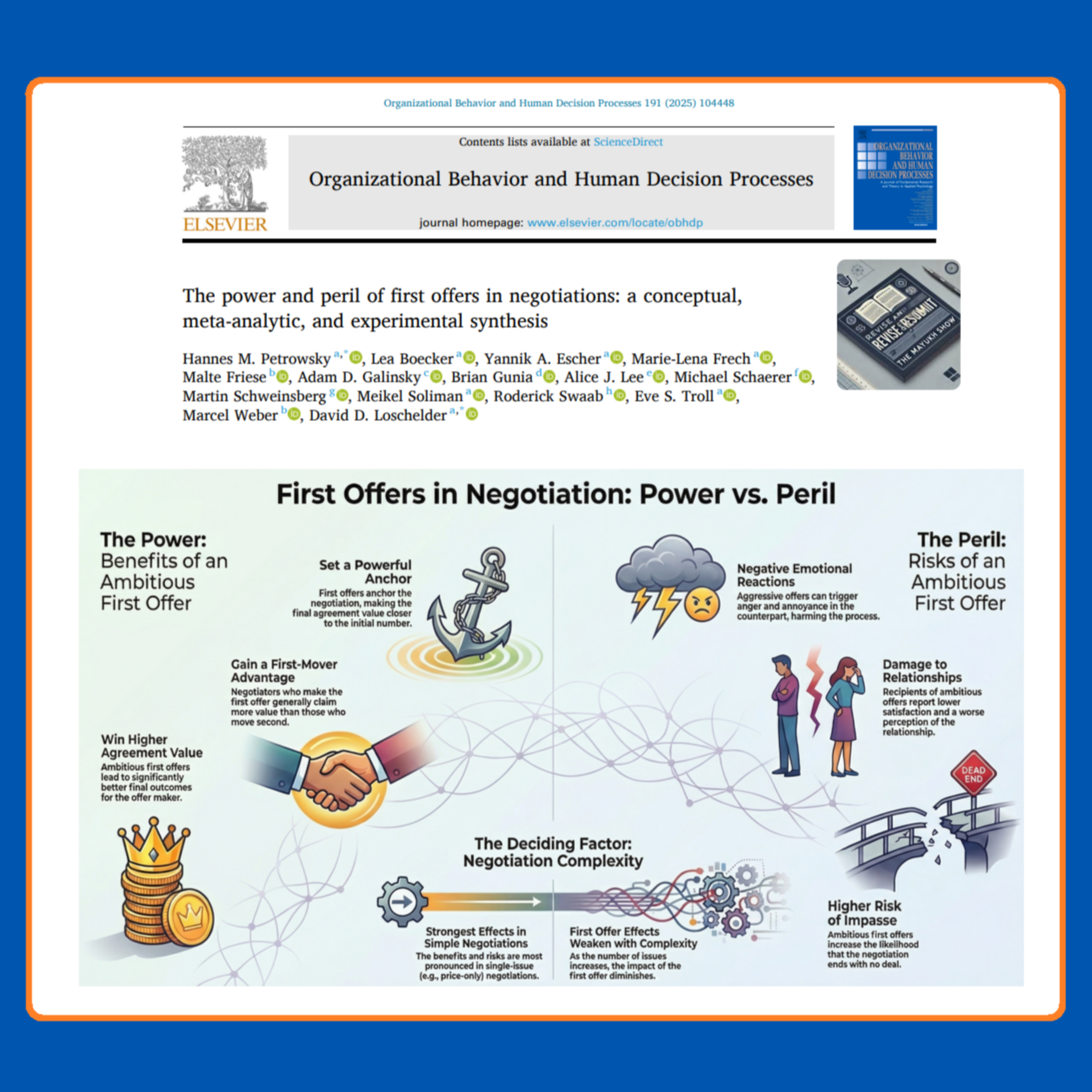
Anchoring in negotiation is a cognitive bias where the initial offer establishes an invisible reference point that disproportionately influences the final agreement. Because human minds instinctively adjust from starting numbers rather than evaluating true objective value, the party making the first offer often pulls the final settlement closer to their desired outcome.
The Psychological Foundations of Anchoring Bias
The concept of anchoring originates in behavioral economics and cognitive psychology. First systematically identified by psychologists Amos Tversky and Daniel Kahneman in their seminal 1974 paper Judgment under Uncertainty: Heuristics and Biases, anchoring refers to the tendency of individuals to rely too heavily on an initial piece of information (the "anchor") when making subsequent judgments or estimations. Once an anchor is set, all future discussions, counteroffers, and compromises revolve around that specific starting value.
- Initial Anchor (First Offer Made)
- Selective Accessibility (Mind Searches for Supporting Evidence for the Anchor)
- Compromise (Final Agreement Pushed Near Anchor)
To leverage or counter anchoring effectively, negotiators must understand the psychological mechanisms that make human brains so vulnerable to initial numbers:
- The Anchor-and-Adjustment Heuristic: Tversky and Kahneman proposed that when people estimate an unknown value, they start with an initial anchor and adjust away from it. However, these adjustments are almost always insufficient. In negotiations, a buyer presented with an initial asking price of $100,000 may negotiate the price down to $85,000, feeling they secured a steep discount, even if the underlying asset is objectively worth only $60,000.
- The Selective Accessibility Model: Later refined by psychologists Thomas Mussweiler and Fritz Strack, this model suggests that when an anchor is presented, negotiators engage in hypothesis-consistent testing. The mind automatically searches its memory and knowledge base for evidence that supports the anchor's validity. If a seller demands a premium rate, the buyer’s brain instinctively looks for reasons why the product might justify that cost, temporarily suppressing counter-arguments.
- Informational Asymmetry and Priming: In commercial settings, negotiators rarely possess complete information about an opponent's true cost structures, urgency, or alternative options. The opening offer serves as an informational signal. It subconsciously communicates what the offering party believes the market will bear, subtly redefining what both sides view as a reasonable outcome.
Mechanics of the First Offer Effect
The "first offer effect" is the practical manifestation of anchoring bias in bargaining scenarios. Landmark empirical research by Adam D. Galinsky and Thomas Mussweiler demonstrated a direct correlation between the initial offer and the final settlement amount. Across numerous experiments, the party that made the first offer consistently achieved outcomes shifted significantly in their favor.
Impact on ZOPA and BATNA
To understand why first offers carry such immense strategic weight, it is helpful to analyze their impact on two foundational negotiation parameters:
- Zone of Possible Agreement (ZOPA): ZOPA represents the overlapping spectrum between the lowest amount a seller is willing to accept (reservation price) and the highest amount a buyer is willing to pay. A strong opening anchor alters the perceived boundaries of the ZOPA. An ambitious initial anchor pulls the center of gravity of the negotiation toward one extreme of the range.
- Best Alternative to a Negotiated Agreement (BATNA): An aggressive anchor forces the opposing party to re-evaluate their own BATNA. When faced with a dramatically high or low opening move, negotiators often second-guess whether their backup options are as competitive as they originally believed.
- Perceived ZOPA:
- Seller's Min: $70,000
- Buyer's Max: $100,000
- Aggressive First Offer: $115,000 (Pushes perceived center of ZOPA upward)
The Informational Signal of the First Offer
A initial offer does not simply state a numeric price; it establishes the context for the conversation. When a vendor opens a contract discussion with an aggressive, well-justified proposal, it signals high confidence, product differentiation, and strong market positioning. Conversely, an overly timid initial offer signals desperation or uncertainty, inviting the opposing party to push for maximum concessions.
Strategic Anchoring: When and How to Make the First Offer
While conventional wisdom long suggested letting the other party speak first to avoid "leaving money on the table," modern negotiation science demonstrates that initiating the first offer provides a structural advantage—provided specific information criteria are met.
The Rule of Information Completeness
The decision to anchor first hinges entirely on informational clarity:
- Anchor First When Information is High: If you have conducted thorough market research, understand the asset's objective valuation, and have a clear sense of the opponent's options, you should make the first offer. This allows you to set the frame and capture the first-mover advantage.
- Defer When Information is Low: If you enter a negotiation with high uncertainty regarding market rates, technical requirements, or the counterpart’s budget constraints, making the first offer carries severe risks. You risk setting an anchor that is far too generous (underselling yourself) or absurdly unreasonable (alienating the counterparty). In such cases, let the other party anchor first while you gather data.
| Negotiator Knowledge | Market Data / Valuation: Clear | Market Data / Valuation: Unclear |
|---|---|---|
| High | ANCHOR FIRSTMaximum Advantage | ANCHOR FIRST(Focus on Data Signals) |
| Low | DEFER ANCHOR(Rely on Market Bench) | DEFER FIRST(Information Gathering) |
Advanced Anchoring Techniques
Executing a strategic anchor involves more than simply blurting out an extreme number. Successful negotiators employ precise psychological techniques to maximize anchor retention while maintaining professional goodwill.
1. Precision Anchoring
Research published by Janiszewski and Uy in Psychological Science demonstrates that precise numbers exert a stronger anchoring effect than rounded numbers.
For example, an asking price of $49,750 acts as a more powerful anchor than $50,000. When presented with a round number, the human brain assumes the figure is a coarse estimate, leading negotiators to adjust in large increments (e.g., counter-offering $40,000). When presented with a precise number, the mind infers that the figure was calculated through meticulous cost accounting, causing the counterparty to adjust in significantly smaller, more granular increments (e.g., counter-offering $47,500).
2. Range Anchoring (Bracketing)
Rather than stating a single rigid number, negotiators can utilize range anchors to appear flexible while still controlling the lower or upper boundary:
- Bolstering Range: Offering a range where the least favorable end represents your actual goal (e.g., "We are looking for compensation between $110,000 and $125,000" when your true target is $110,000).
- Bracket Range: Placing your target directly in the middle of a balanced range to establish a compromise zone.
3. Framing with Contextual Justification
An anchor presented without explanation appears arbitrary and invites immediate rejection. Pairing an ambitious anchor with a reasoned rationale—such as underlying operational costs, regulatory compliance requirements, or proprietary technology features—activates the Selective Accessibility Model. It compels the counterpart's brain to analyze the valid points of your justification rather than attacking the number itself.
Tactical Guide: How to Defuse and Counter an Opponent’s Anchor
Falling victim to an opponent's anchor is the primary cause of poor negotiation outcomes. When an opponent anchors first with an aggressive opening, you must act deliberately to neutralize the psychological pull of their starting figure.
- REJECT THE FRAME (Flinch & Reset)
- IDENTIFY FLAWS (Audit Assumptions)
- RE-ANCHOR HARD (Set New Baseline)
1. The Flinch and Immediate Deflection
Never accept an ambitious first offer as the natural starting point for discussion. If an opponent opens with an extreme figure, immediately register surprise or disagreement—a physical or verbal response known as a "flinch."
Explicitly state that the opening number falls completely outside your acceptable frame. By verbally rejecting the offer, you prevent the number from settling into your cognitive processing as an established baseline.
2. The Re-Anchoring Technique
The most effective response to an aggressive anchor is to set a strong counter-anchor of your own. Do not respond to an opening offer of $100,000 with a slight adjustment to $90,000; doing so validates their original baseline.
Instead, reset the table by presenting a counter-anchor equally distant from your true target in the opposite direction. If their anchor was $100,000 and your objective target is $70,000, your counter-anchor should be set near $40,000, anchored firmly by objective market metrics. This pulls the center of the ongoing negotiation back toward your intended ZOPA.
3. Deconstruct the Underlying Assumptions
Force the opposing party to explain the mechanics of their figure. Ask targeted open-ended questions:
- "What specific cost components led you to that starting figure?"
- "Which market benchmarks were used to calculate this rate?"
By forcing the opponent to justify their anchor line by line, you can systematically dismantle unsupported premises, exposing the artificial nature of their opening position.
4. Walk Away or Pause the Conversation
If an opening anchor is so extreme that negotiating from it would lead to a severely unfavorable outcome, call a strategic intermission. Express clearly that the current terms provide no basis for agreement, and request that the opponent re-evaluate their proposal before resuming talks. This forces the counterpart to voluntarily revise their anchor before detailed bargaining begins.
Comparative Analysis of Anchoring Tactics
The effectiveness of an anchoring strategy depends heavily on the dynamics of the transaction. The table below compares common anchoring approaches, appropriate use cases, tactical risks, and recommended counter-strategies.
| Strategy Type | Best Used When | Primary Risk | Counter-Strategy | Core Psychological Driver |
|---|---|---|---|---|
| Aggressive Extreme Anchor | High information symmetry, single-issue distributive sales, strong alternative options (BATNA). | Risk of immediate negotiation breakdown or damaging long-term relationship. | Outright rejection, strategic intermission, and setting an equally extreme counter-anchor. | Insufficient Adjustment Heuristic |
| Precise Numeric Anchor | Detailed cost breakdowns exist (e.g., engineering estimates, real estate appraisals). | Appearing rigid or overly calculating if costs are later challenged. | Deconstruct granular line items and challenge the foundational formula. | Attribution of Informational Authority |
| Bolstering Range Anchor | Multi-issue integrative negotiations where flexibility must be signaled. | Opponent will inevitably focus exclusively on the favorable end of the range. | Anchor strictly to the favorable end of their range and disregard the higher boundary. | Range-Frequency Theory |
| Data-Backed Narrative Anchor | Highly complex, customized B2B contracts, SaaS agreements, or specialized consulting services. | Vulnerable if counterpart possesses superior industry intelligence that disproves assumptions. | Request raw underlying data and apply alternative market benchmarks. | Selective Accessibility Model |
Anchoring in Multi-Issue and Integrative Bargaining
While simple price negotiations are strictly distributive (win-lose allocation of a fixed pie), complex business deals are typically integrative (value-creating across multiple variables). Anchoring operates differently when managing multi-issue deals.
Distributive Anchoring (Single Axis):
- Seller Anchor: $100k
- Buyer Target: $70k
Integrative Anchoring (Multi-Variable Matrix):
| Variable | Variable | Variable |
|---|---|---|
| Price ($85k) | Payment Terms (90d) | Delivery (30 Days) |
| SLA (99.9%) | IP Rights (Shared) | Volume Discounts |
Anchoring Non-Monetary Terms
In enterprise software procurement, service agreements, or merger negotiations, price is only one of many variables. You can anchor effectively by setting early expectations on non-monetary parameters:
- Payment Schedules: Anchoring on net-90 payment terms early in contract drafting establishes leverage that can be traded away later for price concessions.
- Service Level Agreements (SLAs): Establishing stringent baseline performance parameters forces the supplier to anchor their operational assumptions to your preferred standard.
- Intellectual Property and Exclusivity: Demanding broad IP assignments at the outset creates valuable concession currency during final contract revisions.
Package Anchoring
Rather than negotiating items sequentially—which subjects every individual point to isolated anchoring battles—experienced negotiators present complete package anchors.
By anchoring a comprehensive offer combining price, timeline, volume commitments, and warranty terms simultaneously, you control the holistic valuation framework. If the counterparty wants to change one variable (e.g., lower the price), you can adjust another variable (e.g., extend contract length) to preserve the overall economic balance of your initial anchor.
Common Pitfalls and Strategic Mistakes
Leveraging the first offer effect effectively requires discipline. Avoid these frequent mistakes:
1. The Phantom Anchor (Anchoring Without Grounding)
Throwing out an absurdly aggressive number without supporting logic destroys trust. If an anchor is perceived as a bad-faith attempt to gouge the counterparty, it often leads to immediate negotiation termination. An anchor must always be backed by a believable, defendable narrative.
2. Falling Victim to Anchor Acceptance Syndrome
Unprepared negotiators frequently make the mistake of using their opponent's initial offer as the baseline for their own calculations. Once you start thinking, "They asked for $100,000, so maybe I can get them down to $90,000," you have lost the structural advantage. Always calibrate counter-offers against your pre-negotiation market research and baseline valuation, never against the opponent's opening figure.
3. Premature Anchoring Under High Uncertainty
Making an ambitious initial offer when you lack essential market information is dangerous. If you anchor too low, the counterparty will quickly accept, leaving significant value on the table (the "winner's curse"). If you anchor too high without market context, you expose a fundamental lack of industry awareness. When information is scarce, prioritize diagnostic questioning over early offer generation.
Frequently Asked Questions
Why does the first offer effect hold so much power in negotiations?
The first offer effect works because human cognitive processing relies on starting points to evaluate unknown variables. The initial offer sets a mental reference frame, activating memory networks that search for reasons to justify that baseline figure. Consequently, final compromises adjust from that initial point rather than starting from an objective, neutral baseline.
Should you always make the first offer if possible?
No. You should make the first offer primarily when you possess reliable information about market values, costs, and industry standards. High information allows you to set an ambitious, defendable anchor that pulls the final settlement in your favor. If you face significant informational asymmetry or do not understand the counterparty's constraints, defer the first offer to gather data.
How do precise numbers impact the strength of an anchor?
Precise numbers (e.g., $48,350 instead of $50,000) create a stronger cognitive anchor because they signal thorough calculation and domain expertise. Opponents process precise figures as detailed cost estimates rather than arbitrary approximations, leading them to respond with smaller, more conservative counter-adjustments.
What is the best immediate response to an aggressive opening anchor?
The most effective immediate response is a clear verbal or visual rejection ("flinching"), followed by resetting the framework entirely. Refuse to negotiate directly from their number. Instead, point out why the starting figure is unviable based on market benchmarks, and set your own firm counter-anchor to realign the negotiation zone.
How does range anchoring differ from single-value anchoring?
Range anchoring presents a target spectrum (e.g., $80,000 to $90,000) rather than a fixed number ($85,000). Utilizing a "bolstering range"—where the lower end represents your actual target—allows you to appear cooperative while still guiding the opponent toward your intended goal, preserving professional relationships without sacrificing position.
Can anchoring tactics be applied to non-monetary contract terms?
Yes. Anchoring applies to any quantifiable or negotiable dimension, including delivery schedules, payment windows, warranty terms, liability caps, and termination windows. Setting early standards on non-monetary provisions establishes structural leverage that can later be traded strategically during multi-issue concessions.
Strategic Action Plan
To systematically incorporate anchoring techniques into your negotiation process, apply this tactical workflow before entering your next commercial discussion:
- Conduct Data Benchmarking: Determine objective market rates, minimum cost thresholds, and replacement costs for the asset or service. Establish your walk-away point (reservation price) before starting talks.
- Evaluate Information Symmetry: Assess whether you possess sufficient market data to set the initial anchor. If yes, prepare an ambitious, precise starting offer supported by a clear rational framework.
- Prepare Counter-Anchors in Advance: If you anticipate that the opposing party will anchor first, calculate your counter-anchor and supporting benchmarks beforehand to prevent being pulled into their baseline during the discussion.
- Audit the Bargaining Context: Determine whether the transaction is a single-issue distributive deal or a multi-issue integrative negotiation. For complex contracts, prepare package anchors to control multiple variables simultaneously.