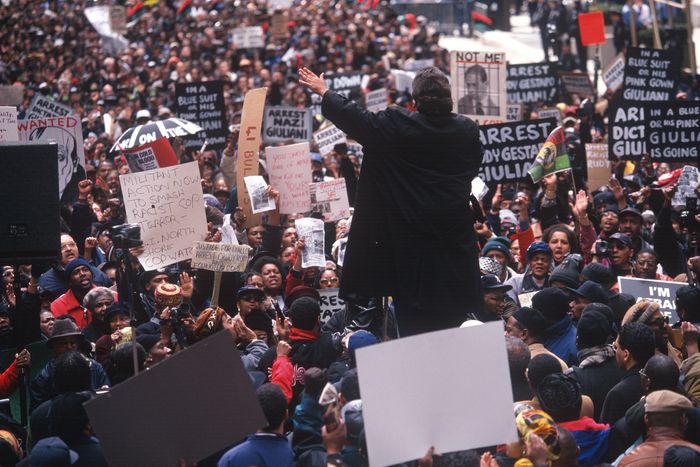
On February 4, 1999, four plainclothes New York City Police Department (NYPD) officers fired 41 shots at Amadou Diallo, an unarmed 22-year-old Guinean immigrant, in the vestibule of his Bronx apartment building. Hit 19 times, Diallo died at the scene. The incident sparked national outrage, intensive legal scrutiny, and fundamental debates regarding racial profiling, plainclothes police tactics, and excessive force standards.
Historical Context and Pre-Incident Conditions
To understand the sequence of events on February 4, 1999, one must examine the socio-political environment and policing strategies active in New York City during the late 1990s. Under Mayor Rudy Giuliani and Police Commissioner Howard Safir, the NYPD implemented aggressive "quality-of-life" policing and crime reduction initiatives based largely on variants of the "broken windows" theory.
Central to this strategy was the NYPD Street Crime Unit (SCU), an elite tactical unit operating under the motto "We Own the Night." The unit was primarily tasked with interdicting illegal firearms in high-crime neighborhoods. Unlike precinct patrol officers who wore standard uniforms and responded to 911 dispatch calls, SCU members operated in plainclothes, drove unmarked vehicles, and executed proactive stop-and-frisk encounters based on reasonable suspicion parameters established under Terry v. Ohio (1968).
- Citywide Gun Interdiction Strategy
- NYPD Street Crime Unit (SCU)
- Plainclothes / Proactive Patrol
- High-Frequency Stop-and-Frisk Encounters
Between 1997 and 1999, the SCU significantly increased its force size, expanding from roughly 150 experienced officers to over 400. Critics, civil rights advocates, and community leaders argued that this rapid expansion diluted specialized training protocols, reduced supervisory oversight, and incentivized aggressive search tactics that disproportionately targeted Black and Latino residents across New York City.
Amadou Diallo's Background
Amadou Diallo was born in Liberia on September 2, 1976, to Guinean parents. He spent his youth in various countries, including the United Kingdom, Guinea, and Vietnam, where he attended international schools and became fluent in multiple languages. Diallo moved to New York City in 1996 to pursue higher education in computer science while working as a street vendor selling socks, gloves, and video tapes in Lower Manhattan. He possessed no criminal record and had lived in his apartment building at 1157 Wheeler Avenue in the Soundview section of the Bronx for roughly six months prior to the shooting.
The Sequence of Events: February 4, 1999
Shortly after midnight on February 4, 1999, four SCU officers—Sean Carroll, Richard Murphy, Edward McMellon, and Kenneth Boss—were patrolling the Soundview neighborhood in an unmarked sedan. None of the officers were in police uniform; they wore street clothes, including jackets and baseball caps, with their badges concealed beneath their outer garments or displayed on chains around their necks.
- 00:00 - SCU Unit Patrols Soundview in Unmarked Vehicle
- 00:15 - Officers Observe Diallo Standing in Vestibule (1157 Wheeler Ave)
- 00:16 - Officers Exit Vehicle; Command Diallo to Show Hands
- 00:17 - Diallo Reaches into Pocket; Draws Black Leather Wallet
- 00:17 - Officer McMellon Trips Backwards; Shouts "He's Got a Gun!"
- 00:18 - 41 Shots Fired in Rapid Succession (19 Hit Diallo)
- 00:19 - Officers Discover Wallet; Request Emergency Medical Assistance
The Initial Encounter
According to court testimony, the officers were searching for a serial rapist who had committed crimes in the neighborhood weeks earlier. As their vehicle passed 1157 Wheeler Avenue, Officer Sean Carroll observed Diallo standing in the doorway vestibule of his building, taking fresh air. Carroll later testified that Diallo fit the broad description of the suspect and was acting suspiciously by stepping back into the building's dimly lit entryway as the unmarked car passed.
The officers stopped their vehicle and exited to question Diallo. As Officers Carroll and McMellon approached the front exterior steps of the building, they shouted instructions for Diallo to stop and show his hands.
The Misinterpretation of Intent
Diallo, whose primary language was French and Fulani, was standing inside the small glass-enclosed vestibule. The inner door leading into the hallway was locked. As the plainclothes officers rushed toward the entrance with weapons drawn, Diallo reached into his jacket pocket and pulled out a dark, rectangular object—his black leather wallet—to produce his identification.
Officer Carroll interpreted Diallo's movement as drawing a firearm. As Carroll yelled a warning to his partners, Officer McMellon stepped backward on the icy front porch, lost his footing, and fell down the entrance steps. The remaining officers believed McMellon had been shot by Diallo.
The Discharge of Firearms
In response to the perceived threat, the four officers opened fire in rapid succession within the tight confines of the entryway:
- Officer Sean Carroll: Fired 16 rounds (emptied firearm magazine).
- Officer Edward McMellon: Fired 16 rounds (emptied firearm magazine).
- Officer Kenneth Boss: Fired 5 rounds.
- Officer Richard Murphy: Fired 4 rounds.
Out of 41 total bullets discharged by the officers, 19 struck Diallo. Several bullets severed his aorta and damaged vital organs. When Carroll approached the fallen Diallo and turned him over to administer aid, he saw the black wallet resting beneath Diallo's body, realizing no weapon was present. Carroll began shouting for a medical unit, but Diallo died at the scene within minutes.
The Legal Proceedings: People v. Boss et al.
The killing of an unarmed man on his own doorstep led to immediate public condemnation, widespread street demonstrations, and multiple independent legal investigations.
Indictment and Venue Change
In March 1999, a Bronx County grand jury indicted all four officers on charges of second-degree murder and reckless endangerment. Due to intense media coverage, public protest, and community tension in New York City, defense attorneys filed a motion requesting a change of venue, arguing that their clients could not receive a fair trial in the Bronx.
In December 1999, the Appellate Division of the New York State Supreme Court granted the motion, moving the trial over 140 miles north to Albany, New York. This decision drew heavy criticism from civil rights organizations, who pointed out that Albany County's jury pool possessed a significantly different demographic composition than the Bronx.
- Bronx County Grand Jury
- Indictment (2nd Degree Murder / Reckless Endangerment)
- Appellate Division Motion
- Venue Change Granted (Pretrial Publicity Concerns)
- Trial Relocated to Albany
- Jury Selection from Albany County Pool
Key Legal Arguments
The trial began in Albany in January 2000 before State Supreme Court Justice Joseph Teresi. The central legal battle centered on New York State Penal Law Section 35.30, which governs the use of deadly physical force by police officers, and Penal Law Section 35.15 regarding self-defense.
- Prosecution Strategy: Prosecutors argued that the officers acted recklessly and unreasonably. They contended that approaching an unidentified citizen in plainclothes with guns drawn created a dangerous situation that invited confusion. They stressed that firing 41 rounds into an enclosed space at an unarmed man constituted an unjustified and excessive application of deadly force.
- Defense Strategy: The defense focused on the concept of "reasonable mistake of fact." Defense attorneys argued that the officers subjectively believed Diallo was executing an armed ambush. Under New York law, an officer's use of force is judged based on whether a reasonable officer on the scene, possessing the same information and facing the same split-second dynamics, could have perceived an imminent threat of death or serious physical injury.
During their testimony, the officers expressed deep remorse but maintained that they executed their actions based on an honest, reasonable fear for their lives when Officer McMellon fell backward and Carroll yelled that Diallo had a gun.
The Verdict
On February 25, 2000, after three days of deliberation, the mixed-gender Albany jury acquitted all four officers of all criminal charges, including second-degree murder, manslaughter, and reckless endangerment.
| Officer | Charges Faced | Jury Verdict | Departmental Action |
|---|---|---|---|
| Sean Carroll | 2nd-Degree Murder, Reckless Endangerment | Acquitted (All Counts) | Reassigned to non-operational administrative duty; later retired. |
| Edward McMellon | 2nd-Degree Murder, Reckless Endangerment | Acquitted (All Counts) | Resigned from NYPD; later joined Fire Department of New York (FDNY). |
| Kenneth Boss | 2nd-Degree Murder, Reckless Endangerment | Acquitted (All Counts) | Reassigned; gun restored in 2012; promoted to Sergeant (2015); retired (2017). |
| Richard Murphy | 2nd-Degree Murder, Reckless Endangerment | Acquitted (All Counts) | Reassigned to administrative duty; later transferred out of department. |
Federal and Civil Action
The criminal acquittal did not conclude the legal consequences surrounding the incident. Both federal authorities and civil courts reviewed the case under distinct legal standards.
Department of Justice Civil Rights Inquiry
Following the criminal verdict, the U.S. Department of Justice (DOJ) Civil Rights Division, alongside the U.S. Attorney's Office for the Southern District of New York, conducted an investigation to determine whether the officers willfully violated Diallo’s constitutional civil rights under Federal Criminal Statute 18 U.S.C. § 242.
To secure a conviction under Section 242, federal prosecutors must establish beyond a reasonable doubt that an officer acted with the specific intent to violate a victim's constitutional rights, rather than acting out of mistake, fear, or bad judgment. On January 31, 2001, the DOJ announced that it would not file federal criminal charges, concluding that the evidence did not support a finding of willful misconduct.
Civil Settlement
In 2000, Kadiatou Diallo and Saikou Diallo, Amadou's parents, filed a $61 million wrongful death lawsuit against the City of New York and the four officers, alleging gross negligence, improper training, and civil rights violations.
In March 2004, the City of New York settled the lawsuit for $3 million. At the time, it stood as one of the largest pre-trial wrongful death settlements paid by the city for a single police shooting incident.
Policy Reforms and Structural Changes
The fatal shooting of Amadou Diallo served as a major catalyst for structural changes within the NYPD and national law enforcement policy. The public fallout pushed city officials, legal experts, and police executives to overhaul tactical doctrines.
- Diallo Shooting (1999)
- Tactical & Structural Reforms
- SCU Disbanded (2002)
- Plainclothes Restrictions
- Tactical Retreat Doctrine
- Institutional Accountability
- Mandatory Use-of-Force Reporting
- Federal Consent Decrees & Reviews
- CCRB Scope Expansion
- Tactical & Structural Reforms
Disbandment of the Street Crime Unit
The most immediate organizational casualty of the incident was the NYPD Street Crime Unit itself. Following intense public pressure, legal challenges, and reports from the U.S. Commission on Civil Rights, the NYPD initially modified the unit by requiring officers to wear standard police uniforms while on patrol.
In April 2002, Police Commissioner Raymond Kelly officially disbanded the Street Crime Unit entirely, reassigning its personnel to precinct-level patrol and conventional detective squads.
Overhaul of Tactical Training and Firearms Guidelines
The incident prompted the NYPD to evaluate how officers manage high-stress confrontations, perceived threats, and firearm handling. Tactical adjustments included:
- Contagious Fire Training: The shooting highlighted the psychological phenomenon of "contagious fire," wherein officers discharge weapons simply because adjacent officers have fired. NYPD academy curricula were revised to train officers to independently evaluate threats rather than reacting automatically to partner discharges.
- Tactical Retreat and Cover: Rather than rushing into unidentified environments in plainclothes, officers were instructed to prioritize seeking cover, establishing clear verbal communication, and waiting for uniformed backup when immediate life safety is not compromised.
- Identification Protocols: Plainclothes officers were subjected to stricter guidelines requiring clear verbal identification as police officers prior to brandishing firearms during non-felony stops.
Legislative and Oversight Developments
In the years following the trial, the New York City Council and the New York State Legislature enacted several oversight mechanisms:
- Data Collection Mandates: The NYC Council passed legislation requiring the NYPD to publish quarterly reports detailing the racial demographics of individuals subjected to stop-and-frisk searches.
- Civilian Complaint Review Board (CCRB) Expansion: The independent CCRB received increased funding and expanded authority to investigate allegations of improper stops, searches, and excessive force.
Comparative Analysis of Incident Metrics
To provide clarity on how the Diallo shooting compares with regulatory standards and tactical frameworks, the following table synthesizes key operational variables of the 1999 incident against modern NYPD operational standards.
| Operational Category | 1999 Diallo Incident Parameters | Modern NYPD Standard Guidelines |
|---|---|---|
| Unit Structure | Unmarked Plainclothes Interdiction Squad (SCU) | Neighborhood Policing / Uniformed Patrol Primary |
| Firearms Discharge Volume | 41 rounds fired by 4 officers (19 hits) | Strict individual accountability; emphasis on de-escalation |
| Stop Standard | Proactive Terry stop based on broad spatial match | Specific, articulable reasonable suspicion mandatory |
| Identification Mandate | Concealed badges; plainclothes approach | Outer-garment badge display; immediate verbal declaration |
| Video Recording | None (Pre-body-worn camera era) | Mandatory Body-Worn Camera (BWC) activation during stops |
| Legal Outcome | Criminal Acquittal; $3M Civil Settlement | Updated state use-of-force legislation & duty to intervene |
The Legacy: The Amadou Diallo Foundation
Following her son's death, Kadiatou Diallo established the Amadou Diallo Foundation to promote educational opportunities for African students and foster positive dialogue between minority communities and law enforcement agencies.
- Amadou Diallo Foundation
- Higher Education Scholarships
- African & Diaspora Students
- University Partnerships
- Community-Police Dialogue
- Youth Leadership Workshops
- Tactical Bias Awareness
- Civil Rights Advocacy
- Policy Consultation
- Victim Family Support
- Higher Education Scholarships
The foundation provides higher education scholarships to promising students of African descent in the United States and abroad, transforming a tragedy into a sustained educational legacy. Kadiatou Diallo became a prominent national voice on police reform, regularly engaging with municipal leaders, academic institutions, and international human rights organizations to advocate for de-escalation training and racial equity in policing.
Frequently Asked Questions
What was Amadou Diallo doing when police approached him?
Amadou Diallo was returning home and standing in the exterior doorway vestibule of his apartment building at 1157 Wheeler Avenue in the Bronx. He was unarmed, taking air, and reached into his jacket pocket to retrieve his leather wallet to show identification when the plainclothes officers approached him.
Why were the officers who shot Amadou Diallo acquitted?
The jury acquitted the four officers based on the legal standard of self-defense and "reasonable mistake of fact" under New York Penal Law. The defense argued that when Officer McMellon fell backward off the steps, the officers reasonably, though mistakenly, believed they were under armed fire from Diallo, justifying their use of deadly force under the law as written at the time.
How many shots were fired during the incident?
The four NYPD officers fired a total of 41 shots in rapid succession. Diallo was hit 19 times and sustained fatal injuries to major organs, including his aorta.
Was the NYPD Street Crime Unit disbanded because of this shooting?
Yes. The shooting brought intense criticism to the Street Crime Unit's plainclothes tactics and high-volume stop-and-frisk methods. Following years of public protest, federal inquiries, and policy reviews, the NYPD officially disbanded the unit in April 2002.
Did Amadou Diallo’s family receive financial compensation?
Yes. In March 2004, the City of New York settled a wrongful death lawsuit filed by Diallo’s parents for $3 million. The funds were partly utilized by his mother to build and maintain the Amadou Diallo Foundation.
Where was the trial held and why was the location moved?
The trial was moved from Bronx County to Albany County, New York. The Appellate Division of the New York State Supreme Court granted a defense motion for a change of venue, ruling that pervasive pretrial publicity in New York City made it impossible to select an impartial jury in the Bronx.
Key Takeaways and Practical Guidance
The shooting of Amadou Diallo remains a landmark reference point in legal studies, criminal justice reform programs, and civil rights history. For policy researchers, law enforcement leaders, and civil rights advocates, the key lessons of the case highlight several structural imperatives:
- Clear Police Identification: Plainclothes enforcement tactics carry inherent risks of fatal miscommunication. Modern policing standards prioritize uniformed response for routine interactions to ensure immediate clarity of authority.
- De-Escalation over Immediate Force: The doctrine of tactical retreat—stepping back, seeking cover, and establishing communication—is essential to prevent split-second tragic errors when no active firearm is confirmed.
- Comprehensive Data Accountability: Municipalities must continuously monitor stop-and-frisk patterns and tactical unit mandates to prevent systemic civil rights infringements and mitigate public distrust.
- Independent Civilian Oversight: Robust civilian oversight boards and mandatory body-worn cameras serve as essential components for maintaining transparency and institutional accountability in modern law enforcement.