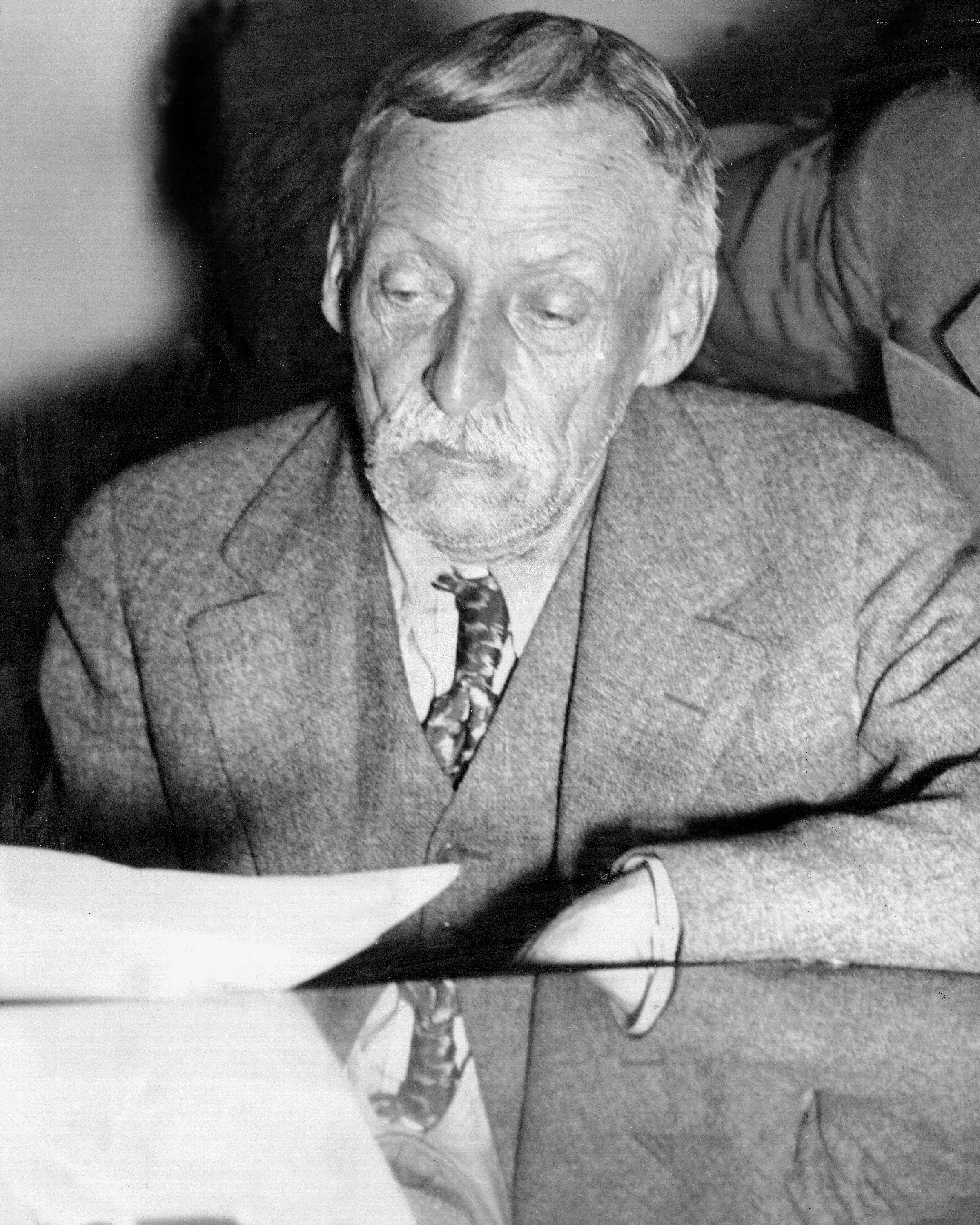
Albert Fish was a prolific American serial killer, kidnapper, and cannibal who terrorized the United States during the early 20th century. Known as the "Gray Man" and the "Brooklyn Vampire," he was convicted for the 1928 murder of Grace Budd and executed in 1936 after confessing to numerous additional atrocities and child murders.
The Early Life and Psychological Descent of Albert Fish
Born Hamilton Howard Fish on May 19, 1870, in Washington, D.C., the man who would become one of history’s most reviled figures came from a family with a profound history of mental illness. His father was 75 at the time of Albert's birth and died when the boy was only five years old. This instability led his mother to place him in St. John’s Orphanage, an institution where he reportedly witnessed and experienced significant physical abuse.
Historians and forensic psychologists often point to these formative years as the catalyst for Fish’s later masochistic and sadistic tendencies. At the orphanage, he became accustomed to corporal punishment, eventually associating physical pain with religious or sexual stimulation. Upon leaving the orphanage and returning to his mother, his behavioral patterns remained erratic. By the time he reached adulthood, Fish had developed an array of severe paraphilias, including coprophilia, urophilia, and pica—the latter manifested in his consumption of non-food items and, eventually, human flesh.
Fish moved to New York City in the late 19th century, where he worked as a house painter. Outwardly, he appeared to be a harmless, elderly man—a "grandfatherly" figure that allowed him to move through society unnoticed. He married and fathered six children, yet his private life was consumed by increasing depravity. Following his wife's abandonment of the family in 1917, Fish’s mental state deteriorated further, and his crimes escalated from minor indecency to abduction and murder.
The Murder of Grace Budd: The Crime That Led to Justice
The most documented and significant of the crimes committed by Albert Fish was the 1928 abduction and murder of ten-year-old Grace Budd. This case is pivotal because it eventually provided the forensic and testimonial evidence required to secure a conviction.
In June 1928, Fish responded to an advertisement placed by Grace’s brother, Edward Budd, who was seeking employment. Using the alias "Frank Howard," Fish visited the Budd family home in New York. He presented himself as a respectable farmer looking for a hired hand. During the visit, he charmed the family and eventually requested to take young Grace to a birthday party for his niece. Trusting the elderly man’s demeanor, the Budds allowed Grace to go with him.
Fish did not take Grace to a party. Instead, he led her to an abandoned farmhouse in Greenburgh, New York, known as "Wysteria." It was there that he committed a crime so heinous that it remains a dark chapter in American criminal history. Fish murdered the child, dismembered her body, and consumed parts of her remains over several days. For six years, the Budd family remained in agony, unaware of Grace’s fate, while Fish continued to live as a free man in the New York area.
The Infamous "Grace Budd Letter" and the Investigation
The resolution of the Grace Budd case came not from standard police work of the era, but from Fish’s own pathological need for recognition and cruelty. In 1934, Fish sent an anonymous, handwritten letter to the Budd family detailing the specifics of Grace’s murder and his cannibalistic acts. The letter was graphic and intended to inflict maximum emotional trauma on the grieving parents.
However, this letter proved to be Fish’s undoing. Detective William King of the New York Police Department took charge of the investigation. King noticed a small, embossed emblem on the stationery used for the letter. The emblem belonged to a private chauffeurs’ benevolent association. King meticulously traced the stationery to a rooming house in Manhattan where a former member of the association had resided.
Through patient surveillance and interviews with the landlady, King identified the current tenant as an elderly man matching the description of "Frank Howard." In December 1934, Albert Fish was arrested upon returning to the rooming house to collect his mail. While he initially denied involvement, the evidence—including his distinctive handwriting and the stationery—was insurmountable. Fish eventually confessed not only to the murder of Grace Budd but to dozens of other crimes across several states.
Confirmed and Suspected Victims
While Fish claimed to have "had" children in every state, the exact number of his victims remains a subject of debate among historians. He frequently boasted of having over 100 victims, though most investigators believe the number of actual murders was lower, likely between three and fifteen.
| Victim Name | Date of Incident | Location | Status/Outcome |
|---|---|---|---|
| Francis McDonnell | July 15, 1924 | Staten Island, NY | Confessed Murder; body found in woods. |
| Billy Gaffney | February 11, 1927 | Brooklyn, NY | Confessed Murder; body never recovered. |
| Grace Budd | June 3, 1928 | Greenburgh, NY | Confessed Murder; led to conviction and execution. |
| Yelena Paleas | 1930 (approx) | New York City, NY | Suspected disappearance linked to Fish. |
| Benjamin Levine | 1929 | New York City, NY | Suspected; Fish confessed to a similar case. |
The murder of four-year-old Billy Gaffney was particularly brutal. Gaffney vanished while playing in his apartment building hallway. Years later, Fish confessed to taking the boy to an abandoned location, killing him, and engaging in cannibalism. Despite Fish's detailed confession, Gaffney's remains were never found, likely due to the length of time that had passed before the confession was obtained. Similarly, the 1924 murder of Francis McDonnell was a case where Fish lured a young boy into the woods under the guise of showing him a bird's nest, only to strangle him.
The Psychological Profile: Paraphilias and Religious Mania
Understanding the crimes of Albert Fish requires an analysis of his complex psychological state. He was not a typical "thrill killer" or "mission-oriented" serial killer. His motivations were deeply rooted in severe sexual deviancy and religious delusions.
Fish was a devoutly religious man, albeit in a highly distorted sense. He frequently read the Bible and believed that his acts of self-mutilation and the sacrifice of children were commanded by a divine or higher power. He often compared his actions to the biblical story of Abraham and Isaac, viewing himself as a figure performing a necessary, albeit gruesome, ritual.
Clinically, Fish was diagnosed with various conditions during his trial, though the legal definition of insanity was much narrower in 1935 than it is in 2026. His primary behaviors included:
- Masochism: Fish derived intense pleasure from his own pain. He would beat himself with paddles embedded with nails and frequently inserted needles into his own body.
- Self-Mutilation: Upon his arrest, X-rays revealed that Fish had inserted approximately 29 sewing needles into his pelvic region and perineum. Many of these needles had migrated deep into his tissue and remained there for years.
- Cannibalism and Pica: Fish did not just kill; he consumed his victims as part of a sexualized ritual. This was often preceded by pica, where he would eat substances like wool, paper, or feces.
These behaviors created a profile of a man who was profoundly disconnected from societal norms, yet high-functioning enough to maintain employment and a family for decades.
The Trial and the Insanity Defense
The trial of Albert Fish began in March 1935 and became a media sensation. The primary focus of the defense, led by attorney James Dempsey, was the M'Naghten rule—the legal standard for insanity. Dempsey argued that Fish was "insane" in every sense of the word, citing his self-mutilation, his consumption of waste, and his religious hallucinations as proof that he could not distinguish right from wrong.
The prosecution, however, argued that Fish was a "sane" predator. They pointed to the calculated nature of his crimes: the use of aliases, the planning required to lure Grace Budd away from her parents, and the efforts he took to conceal her body. They argued that his ability to evade capture for six years demonstrated a clear understanding of the illegality and consequences of his actions.
Forensic psychiatrists of the era were divided. Some testified that Fish was a "psychopathic personality" but legally responsible, while others argued he was a "chronic paranoid" who belonged in a mental institution. Ultimately, the jury sided with the prosecution. In their view, the cruelty of the crimes did not excuse the perpetrator from the ultimate penalty. After only a few hours of deliberation, Fish was found guilty of first-degree murder.
Execution at Sing Sing: The End of the Gray Man
Albert Fish was sentenced to death by electrocution. He was moved to Sing Sing Correctional Facility to await his execution. Even in his final days, Fish’s behavior remained disturbing. He reportedly told guards that he was looking forward to the electric chair, viewing it as the ultimate masochistic experience—the "supreme thrill" he had been seeking his entire life.
On January 16, 1936, Albert Fish was led to "Old Sparky," the electric chair at Sing Sing. Reports from the time indicate a strange occurrence during the execution: the first surge of electricity failed to kill him. Legend suggests that the numerous needles embedded in his body caused a short circuit or interfered with the flow of electricity. However, forensic historians note that it was more likely a technical malfunction or the need for a second, stronger jolt. The second surge was successful, and Fish was pronounced dead at the age of 65.
Historical Impact on Criminology and Child Safety
The case of Albert Fish fundamentally changed how law enforcement viewed child predators. Prior to this era, the concept of a "stranger danger" predator who would hunt children across state lines was not well-integrated into local policing. The investigation led by Detective William King highlighted the need for better communication between jurisdictions and more sophisticated forensic tracing of evidence.
Furthermore, the Fish case contributed to the evolution of forensic psychiatry. It challenged the rigid boundaries of the M'Naghten rule and forced a dialogue on whether individuals with extreme paraphilias should be treated as patients or criminals. While Fish was executed, his case is still studied in modern criminal justice programs as a benchmark for understanding the "disorganized" yet "cautious" serial killer.
In 2026, the legacy of the Fish case serves as a reminder of the historical vulnerabilities that allowed such predators to operate. The lack of centralized databases and the relative ease of moving between cities under false identities in the early 20th century provided Fish with the "cover" he needed to commit his crimes for nearly 40 years.
FAQs About Albert Fish
Who were the primary victims of Albert Fish?
While Albert Fish claimed to have murdered scores of children, he was officially linked to the murders of Grace Budd, Billy Gaffney, and Francis McDonnell. Grace Budd is his most famous victim because the investigation into her disappearance eventually led to his arrest, confession, and execution.
Why was Albert Fish called the "Gray Man"?
He was nicknamed the "Gray Man" (and sometimes the "Gray Ghost") because of his unassuming appearance. He was an elderly man with gray hair and a frail physique, which made him appear harmless to parents and children. This "grandfatherly" facade was his primary tool for luring victims away from public spaces.
Did the needles in his body actually interfere with his execution?
There is a persistent urban legend that the 29 needles Fish had inserted into his pelvic region caused the electric chair to malfunction. While it is true that the first jolt did not immediately kill him, most historians attribute this to the standard technical difficulties occasionally associated with "Old Sparky" rather than the presence of the needles.
What was the "Grace Budd Letter"?
The Grace Budd Letter was a graphic, handwritten confession sent by Fish to the Budd family six years after Grace disappeared. In the letter, he detailed how he lured her away, killed her, and consumed her remains. Fish's decision to send this letter, likely for a sadistic thrill, provided the police with the stationery and handwriting evidence needed to capture him.
Was Albert Fish considered legally insane?
During his 1935 trial, his defense argued that he was insane due to his extreme paraphilias and religious delusions. However, under the legal standards of the time, the jury found that because he planned his crimes and attempted to hide his tracks, he understood the difference between right and wrong and was therefore legally sane.
Recommendation for Further Research
For those interested in the deep psychological and historical aspects of this case, it is recommended to review the original trial transcripts or read comprehensive biographies such as Deranged by Harold Schechter. These sources provide a factual, non-sensationalized look at the evidence presented in 1935. Additionally, visiting the archives of the New York Police Department or historical crime museums can offer insight into the investigative techniques used by Detective William King to solve a case that had gone cold for over half a decade.