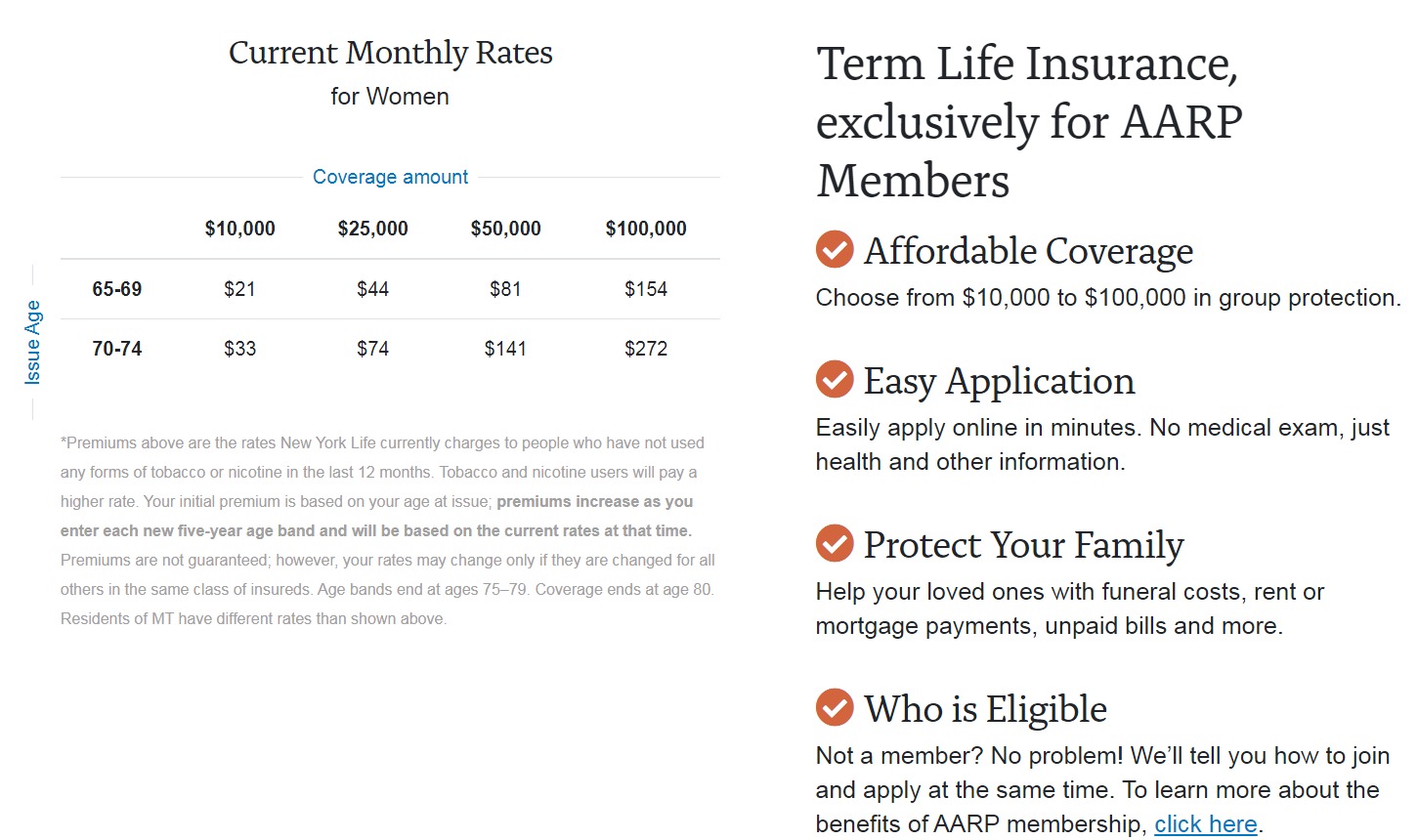
The AARP Life Insurance rate calculator is a digital tool provided by New York Life to help members estimate monthly premiums based on their age, gender, tobacco use, and desired coverage amount. Rates are typically structured in five-year age bands for term life insurance or locked in at the age of enrollment for permanent whole life policies.
Navigating life insurance options after age 50 requires a clear understanding of how age dictates cost and eligibility. The AARP Life Insurance Program, underwritten by New York Life Insurance Company, is one of the most recognized providers for seniors. While the program offers convenience and brand trust, the underlying "rate calculator" logic is what determines whether a policy is financially sustainable for your retirement budget. As of 2026, these digital tools have become highly sophisticated, allowing for instant quotes that reflect the current actuarial tables used by the industry.
Understanding the AARP and New York Life Partnership
To understand how the rate calculator works, it is essential to recognize the relationship between AARP and New York Life. AARP is not an insurance company; it is a member organization that endorses products for its base. Since 1994, New York Life has been the exclusive underwriter for the AARP Life Insurance Program.
When you use the AARP life insurance rates by age calculator, you are interacting with New York Life’s pricing models. These models are designed specifically for the 50-to-80-year-old demographic. Unlike standard policies that may require extensive medical exams, many AARP products utilize "simplified issue" underwriting, which relies on a few health questions rather than a physical exam. This convenience is factored into the rates you see on the calculator, often resulting in higher premiums compared to fully underwritten policies for those in excellent health.
How the AARP Life Insurance Rate Calculator Functions
The online rate calculator is designed for simplicity, reflecting the user experience preferences of the AARP demographic. To generate a quote, the tool typically requires four primary data points:
- Current Age: This is the most significant factor. For term life, your age determines your initial "band." For whole life, it determines your fixed monthly premium for the duration of the policy.
- Gender: In most states, gender influences life expectancy calculations, which in turn affects the premium.
- Tobacco Status: Tobacco users face significantly higher rates due to the increased actuarial risk. The calculator distinguishes between smokers and non-smokers (often defined as being tobacco-free for at least 12 to 24 months).
- Coverage Amount: Users can select death benefit amounts, usually ranging from $5,000 to $100,000 for simplified issue products, and higher for fully underwritten term options.
The Role of "Age Bands" in Term Life Quotes
A unique feature explained by the calculator for AARP Term Life Insurance is the "age band" system. Unlike a standard level-premium term policy where the rate stays the same for 10 or 20 years, AARP term rates are structured in five-year increments (e.g., 50–54, 55–59, 60–64).
When you reach the first day of the year in which you enter a new age band, your premiums will increase. The calculator allows you to see the current rate for your current band, but it is vital to understand that this price is not permanent. As you move into your 60s and 70s, these step-up increases can become substantial.
Breakdown of Rates by Product Type
The calculator handles different insurance products with varying logic. Understanding these differences is crucial for choosing the right plan.
Term Life Insurance
The AARP Term Life Insurance product is generally available to members aged 50 to 74 (and spouses aged 45 to 74). The coverage can last until age 80. The calculator will show you a premium that is relatively low in your 50s but climbs significantly every five years. This product is often used to cover specific temporary needs, such as a mortgage or the remaining years of a child’s education.
Permanent Whole Life Insurance
For members seeking "final expense" coverage or a policy that will never expire, the Whole Life calculator provides a different set of numbers. Rates for whole life are based on your age at the time of application and are guaranteed to never increase. While the initial monthly cost is higher than term life, the stability of the premium is the primary selling point for those on a fixed income.
Guaranteed Acceptance Life Insurance
This product is available to members aged 50 to 80. The calculator for this product does not ask health questions because acceptance is guaranteed. However, because the insurer takes on a higher risk without health screening, the rates per $1,000 of coverage are the highest in the program. Additionally, there is a "graded death benefit" period, usually the first two years, where the full death benefit is only paid for accidental deaths.
Comparative Overview of AARP Life Insurance Features
The following table summarizes the key metrics the calculator uses to differentiate between the primary AARP life insurance offerings as of 2026.
| Feature | Term Life Insurance | Permanent Whole Life | Guaranteed Acceptance |
|---|---|---|---|
| Eligibility Age | 50–74 (Spouse 45–74) | 50–80 (Spouse 45–80) | 50–80 (Spouse 45–80) |
| Max Coverage | Typically up to $150,000 | Typically up to $50,000 | Typically up to $25,000 |
| Premium Structure | Increases every 5 years | Fixed/Level for life | Fixed/Level for life |
| Medical Questions | Yes (Simplified) | Yes (Simplified) | No (None) |
| Cash Value | No | Yes | Yes (Limited) |
| Expiration | Ends at age 80 | Never (as long as paid) | Never (as long as paid) |
Why Rates Change with Age: The Actuarial Perspective
The calculator is essentially a front-end interface for an actuarial table. As an individual ages, the statistical probability of a claim (death) increases. For the AARP Life Insurance Program, the "Simplified Issue" nature means the company is not looking at your blood work or physician statements in most cases.
Instead, they use "aggregate risk." Because they know a percentage of applicants will have undiagnosed or unmanaged health issues, the base rates for all users in an age band are higher than they would be for a "Preferred Plus" candidate at a commercial brokerage. If you are 55 and in perfect health, the AARP calculator might show a rate that is 20–30% higher than a fully underwritten policy. Conversely, if you have minor health issues that might disqualify you from a standard policy, the AARP rate might be a bargain.
Factors the Calculator May Not Disclose Immediately
While the calculator provides a quick estimate, the final rate (or the "offer") depends on the underwriting process.
- Medical Records (MIB): New York Life may check the Medical Information Bureau (MIB) database. If your records show a history of heart disease or cancer that contradicts your answers on the simplified application, the rate could change or the application could be denied.
- Prescription History: Many modern life insurance quotes are subject to a prescription check. If you are taking high-intensity medications for chronic conditions, you may be steered toward the Guaranteed Acceptance product, which the calculator will reflect as a higher-cost, lower-benefit option.
- State Variations: Insurance is regulated at the state level. In 2026, some states have specific mandates regarding how "age nearest" versus "age last birthday" is calculated, which can cause slight variations in the quotes generated by the tool.
Common Mistakes When Using the AARP Rate Calculator
To get the most accurate information from the AARP life insurance rates by age calculator, users should avoid several common errors:
- Underestimating the Tobacco Definition: Many users assume that occasional cigar use or "vaping" does not count as tobacco use. However, New York Life's definitions are strict. Selecting "Non-Smoker" when you use tobacco will result in a quote that is invalid and could lead to a claim denial later.
- Ignoring the Term Increase Schedule: Users often see the low price of term insurance at age 55 and assume it will remain affordable. It is crucial to look at the "rates by age" chart, which is usually linked near the calculator, to see what the premium will be when you are 65, 70, and 75.
- Selecting Too Much Coverage: Because the rates are higher than standard term life, selecting a $100,000 policy in your 70s can lead to premiums that exceed several hundred dollars a month. It is often more practical to use the calculator to find a "sweet spot" that covers final expenses without straining your pension or Social Security.
How to Verify Your Quote
Once the calculator provides a number, it is considered a "non-binding estimate." To verify and lock in that rate, you must complete the full application. This can be done online through the AARP Life Insurance Program portal or by requesting a paper application.
The verification process typically involves:
- Confirming your AARP membership number (which is required for these specific rates).
- Answering the health questions (for Term or Whole Life).
- Providing authorization for a background medical/prescription check.
Alternatives to AARP Life Insurance
While the AARP calculator is a great starting point, it is not the only option for seniors in 2026. If the rates provided by the calculator seem high, consider the following:
- Fully Underwritten Life Insurance: If you are in good health, a policy that requires a medical exam will almost always be cheaper than the "simplified" AARP options.
- Group Life Insurance: Some retirees can still access group rates through former employers or other professional associations.
- Final Expense/Burial Insurance: Specialized companies like Mutual of Omaha or Globe Life offer products specifically for the $5,000 to $25,000 range that may have different age-based pricing structures.
Frequently Asked Questions
What is the maximum age to use the AARP life insurance calculator?
The calculator generally provides quotes for individuals up to age 80. For Term Life, the cut-off for new applications is usually age 74, while Whole Life and Guaranteed Acceptance allow applications until age 80. Coverage for term policies typically terminates at age 80, whereas permanent policies last for the remainder of your life.
Why does my AARP term life rate increase every five years?
AARP term life insurance uses a "banded" rate structure. This means that instead of recalculating your risk every year, the insurer groups you with others in your age range (e.g., 60–64). When you "age out" of one band and into the next, the premium jumps to reflect the statistically higher risk of mortality associated with the older group.
Can I get a quote if I am not an AARP member?
You can use the calculator to see estimated rates without a membership, but you must be an active AARP member to actually apply for and be issued a policy under this program. Membership is available to anyone age 50 or older for a nominal annual fee.
Does the calculator account for "Age Nearest" or "Actual Age"?
New York Life generally uses the "Age Nearest" method. This means that if you are 59 and 7 months old, the calculator will treat you as age 60. If you are 59 and 2 months old, you will be quoted the age 59 rate. This is an important distinction when you are close to a birthday that moves you into a new age band.
Is the rate from the calculator guaranteed?
No. The calculator provides a quote based on the information you input. The final rate is determined after New York Life reviews your application and health history (if applicable). Only the Guaranteed Acceptance product has a "fixed" rate that is virtually certain to match the quote, provided your age and gender are entered correctly.
Practical Recommendations
Before committing to a policy based on the AARP Life Insurance rates by age calculator, take the following steps:
- Run multiple scenarios: Check the cost for $10,000, $25,000, and $50,000 to see how the price scales.
- Compare Term vs. Whole Life: If you are 55, the term rate will look much better, but look at the projected term rate for age 75. If you plan to keep the policy for 20+ years, the Whole Life option may actually be more cost-effective in the long run.
- Check for "Rate Leveling": If you are in excellent health, take your AARP quote to an independent agent and ask if they can beat it with a fully underwritten policy.
- Review the "Contestability Period": Remember that like almost all life insurance, these policies have a two-year contestability period. Ensure all answers on the application (which the calculator leads to) are 100% accurate to avoid future claim denials.
Professional Advice Disclaimer: This article provides general information for educational purposes and does not constitute financial, legal, or medical advice. Life insurance regulations and product availability vary by jurisdiction. Consult with a licensed insurance professional or financial advisor before making significant changes to your insurance coverage.