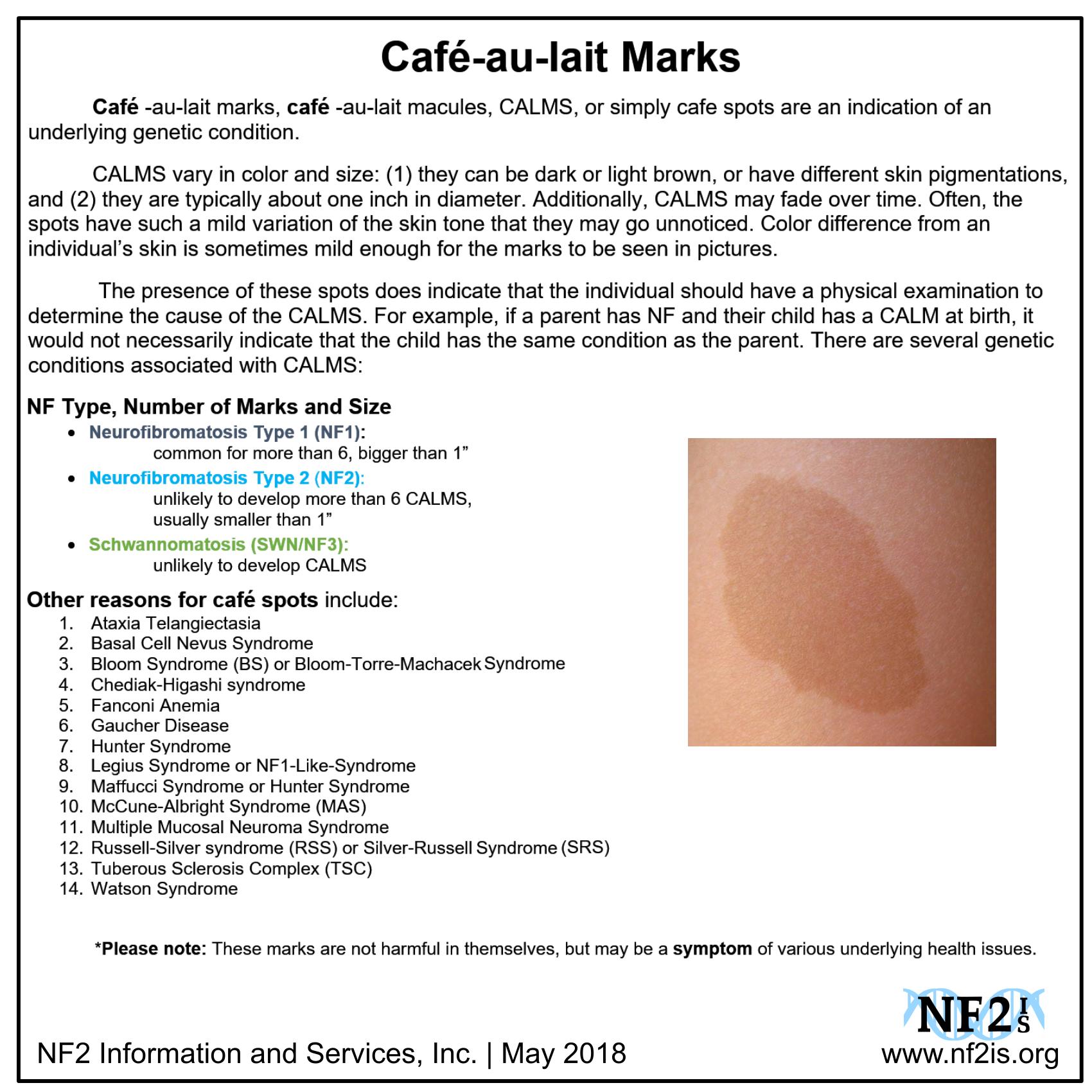
The presence of 6 or more cafe au lait macules (CALMs) is a primary clinical indicator for Neurofibromatosis Type 1 (NF1) and other pigmentary disorders. While isolated spots are common in the general population, reaching the threshold of six spots—measuring at least 5mm in prepubertal children or 15mm in adults—necessitates a comprehensive medical evaluation.
What Are Cafe Au Lait Macules?
Cafe au lait macules are flat, pigmented skin lesions that derive their name from the French term for "coffee with milk," reflecting their light-to-dark brown coloration. These spots are birthmarks caused by an increased amount of melanin (pigment) within the skin cells (melanocytes) and the surrounding keratinocytes. Unlike moles, they are flush with the skin’s surface and do not have a raised texture.
In the general population, CALMs are relatively common. Approximately 10% to 25% of healthy individuals possess at least one or two of these spots. However, the clinical perspective shifts significantly when the count reaches six or more. In dermatology and genetics, the "rule of six" serves as a diagnostic "red flag" that suggests an underlying multisystem genetic condition rather than a benign skin variation.
The appearance of these macules typically occurs at birth or during early infancy. They may be faint initially, becoming more prominent and darker with sun exposure or as the child ages. While the spots themselves are entirely benign—meaning they do not become cancerous—their role as a phenotypic marker for internal conditions makes them a critical focus of pediatric and dermatological screenings in 2026.
The "Rule of Six": Diagnostic Criteria and Thresholds
The significance of finding 6 cafe au lait macules is rooted in the formal diagnostic criteria for Neurofibromatosis Type 1, originally established by the National Institutes of Health (NIH) and refined by international consensus. As of 2026, clinical guidelines continue to emphasize specific size and count requirements to minimize false positives while ensuring early detection of genetic syndromes.
Size Requirements for Diagnosis
The mere presence of six spots is not enough to satisfy diagnostic criteria; the size of these spots is equally important:
- Prepubertal Children: At least six macules must measure more than 5 millimeters in their greatest diameter.
- Postpubertal Individuals: At least six macules must measure more than 15 millimeters in their greatest diameter.
These measurements are taken across the longest axis of the spot. If a patient has four large spots and three tiny ones, they do not yet meet the "6 or more" threshold for a formal diagnosis of NF1, although they should still be monitored closely.
Distribution and Border Characteristics
Clinicians also examine the borders and distribution of the macules. In typical NF1 cases, the spots often have smooth, regular borders, sometimes referred to as the "Coast of California" appearance. This is contrasted with the "Coast of Maine" borders—jagged and irregular—often associated with McCune-Albright syndrome. While this distinction is not absolute, it provides essential clues during a physical examination.
Neurofibromatosis Type 1 (NF1): The Primary Concern
When a patient presents with 6 cafe au lait macules, the most common and significant concern is Neurofibromatosis Type 1 (NF1). NF1 is a genetic disorder caused by a mutation in the NF1 gene on chromosome 17, which produces neurofibromin, a protein that acts as a tumor suppressor.
Why 6 Macules Matter in NF1
In approximately 95% of children with NF1, the required number of cafe au lait macules appears by the age of six. Because many of the other hallmark signs of NF1 (such as neurofibromas or Lisch nodules in the eyes) do not appear until later in childhood or adolescence, the CALMs are often the very first sign of the condition.
Additional Diagnostic Signs
To be diagnosed with NF1, a patient must typically meet at least two of the following criteria (with some variations for genetic testing results):
- Six or more CALMs of the required size.
- Freckling in the axillary (armpit) or inguinal (groin) regions, known as Crowe sign.
- Two or more neurofibromas (benign nerve sheath tumors) or one plexiform neurofibroma.
- Optic glioma (a tumor on the optic nerve).
- Two or more Lisch nodules (benign hamartomas of the iris) or two or more choroidal abnormalities.
- Distinctive osseous (bone) lesions, such as sphenoid dysplasia or thinning of long bone cortex.
- A first-degree relative diagnosed with NF1.
If a child has 6 cafe au lait macules but no other symptoms, they are often given a "suspected NF1" designation and monitored annually until either further symptoms appear or genetic testing provides a definitive answer.
Beyond NF1: Differential Diagnoses
While NF1 is the most frequent association, 6 cafe au lait macules can also be indicative of other, rarer genetic syndromes. Distinguishing between these conditions is vital because the long-term management and risks associated with each differ significantly.
Legius Syndrome
Legius syndrome is perhaps the most important "mimic" of NF1. It is caused by a mutation in the SPRED1 gene. Patients with Legius syndrome often present with multiple cafe au lait macules and axillary freckling, exactly like those with NF1. However, they do not develop the tumors (neurofibromas, optic gliomas) or Lisch nodules associated with NF1. Because Legius syndrome has a much milder prognosis, genetic testing is often recommended for individuals with 6+ spots to differentiate between the two.
McCune-Albright Syndrome
This condition is characterized by large, irregular cafe au lait spots, fibrous dysplasia of the bones, and endocrine abnormalities (such as precocious puberty). In McCune-Albright, the spots are usually fewer in number but much larger and often follow "Blaschko's lines" (pathways of fetal cell development), typically staying on one side of the body.
Constitutional Mismatch Repair Deficiency (CMMRD)
CMMRD is a rare but severe condition caused by biallelic mutations in mismatch repair genes. Children with CMMRD can have many cafe au lait spots, appearing very similar to NF1. However, these patients have a significantly higher risk of developing childhood cancers, particularly brain tumors, hematological malignancies, and colorectal cancers. Clinicians must be vigilant if a child has 6+ spots and a family history of early-onset cancer.
Comparison Table: Conditions Associated with Multiple CALMs
| Condition | Primary Gene | CALM Appearance | Key Distinguishing Features |
|---|---|---|---|
| NF1 | NF1 | Smooth borders ("California") | Neurofibromas, Lisch nodules, bone changes. |
| Legius Syndrome | SPRED1 | Identical to NF1 | No neurofibromas or Lisch nodules; generally milder. |
| McCune-Albright | GNAS | Jagged borders ("Maine") | Fibrous dysplasia, precocious puberty, endocrine issues. |
| Noonan Syndrome | PTPN11 (and others) | Can be present | Short stature, heart defects, distinct facial features. |
| CMMRD | MLH1, MSH2, MSH6, PMS2 | NF1-like | High risk of early-onset internal cancers. |
The Diagnostic Pathway: What to Expect
If you or your child has 6 cafe au lait macules, the diagnostic process in 2026 follows a structured multidisciplinary approach to ensure accuracy and provide peace of mind.
Step 1: Pediatric or Dermatological Examination
The first step is a physical exam using a Wood’s Lamp (ultraviolet light). A Wood’s lamp can highlight subtle pigment changes that are not easily visible to the naked eye, helping the doctor accurately count the number of spots and measure their dimensions. The doctor will also check the armpits and groin for freckling, which is a significant secondary indicator.
Step 2: Ophthalmology Referral
Even if no other symptoms are present, a referral to a pediatric ophthalmologist is common. The specialist uses a slit-lamp exam to look for Lisch nodules (pigmented spots on the iris) and performs a funduscopic exam to check for choroidal abnormalities. These findings are often the second diagnostic criterion met by children as they age.
Step 3: Genetic Consultation and Testing
Genetic testing has become the gold standard for resolving ambiguity. A simple blood or saliva test can analyze the NF1 and SPRED1 genes.
- NF1 Testing: Modern sequencing can identify a mutation in about 95% of affected individuals.
- Targeted Panels: Clinicians often order a "pigmentary disorder panel" that checks multiple genes simultaneously (NF1, SPRED1, and others) to provide a definitive diagnosis.
Step 4: Long-term Monitoring
If a diagnosis of NF1 is confirmed or if the patient meets the "6 spots" criteria but has no other signs yet, regular monitoring is established. This typically involves:
- Annual physical exams to check for new neurofibromas or scoliosis.
- Blood pressure monitoring (hypertension is common in NF1).
- Developmental and educational screenings (learning disabilities occur in about 50% of NF1 cases).
Pathophysiology: Why Do These Spots Form?
The development of 6 cafe au lait macules is tied to the regulation of the RAS/MAPK signaling pathway. In a healthy individual, the NF1 gene produces neurofibromin, which regulates cell growth by "turning off" a protein called Ras.
When a mutation is present, Ras remains overactive. In the skin, this overactivity leads to an overproduction of melanin within melanocytes or an increase in the number of melanocytes in a localized area. This results in the hyperpigmented patch seen as a cafe au lait macule. Because the mutation is present in every cell of the body (in the case of germline NF1), multiple spots can form as the skin develops.
The reason why some people have exactly six spots while others have dozens—even within the same family—is still a subject of research. Factors such as "second-hit" mutations (localized genetic changes) and environmental influences may play a role in the density and size of the macules.
Management and Psychological Considerations
It is important to emphasize that the spots themselves require no medical treatment. They are not painful, itchy, or contagious, and they do not pose a direct health risk. However, the psychological impact of having multiple visible birthmarks, combined with the stress of a potential genetic diagnosis, can be significant.
Cosmetic Options
If the macules are in highly visible areas like the face and cause distress, some patients explore laser therapy. While Q-switched lasers or pulsed-dye lasers can lighten the spots, the results are often inconsistent. There is a high rate of recurrence, where the pigment returns after several months or years. Most specialists discourage laser treatment for CALMs unless they are a major source of psychological burden.
Support and Resources
For families navigating a diagnosis related to 6 cafe au lait macules, organizations like the Children's Tumor Foundation and the Neurofibromatosis Network provide invaluable support. These groups offer updated research, clinical trial information, and community connections for those living with NF1 or Legius syndrome.
Frequently Asked Questions
Can 6 cafe au lait macules appear later in life?
While most spots associated with genetic syndromes appear by age 6, it is possible for new ones to develop during puberty or pregnancy due to hormonal shifts. However, if an adult suddenly develops 6 or more macules without any prior history, a thorough medical evaluation is necessary to distinguish them from other types of acquired pigmentation.
Does having 6 spots mean my child will have a severe case of NF1?
No. The number of cafe au lait macules does not correlate with the severity of NF1. Some individuals with many spots have very mild cases with no major health complications, while others with fewer spots may develop more significant symptoms. NF1 is known for its "variable expressivity," even among members of the same family.
Are cafe au lait spots the same as freckles?
No. Freckles (ephelides) are much smaller and typically darken significantly with sun exposure and fade in the winter. Cafe au lait macules are larger and remain consistent in color regardless of the season, though sun exposure may make them slightly more visible.
What if my child has 5 spots?
Having five spots that meet the size criteria is not enough for a clinical diagnosis of NF1. However, since new spots can appear over time, your pediatrician will likely document the spots and re-evaluate the child during their annual well-visits.
Is genetic testing mandatory if 6 spots are found?
It is not mandatory but highly recommended. Genetic testing can provide a definitive answer, differentiating between NF1 and Legius syndrome, which helps in planning the appropriate long-term monitoring and easing parental anxiety.
Can these spots be removed with cream?
No. Topical bleaching creams or over-the-counter skin lighteners are ineffective for cafe au lait macules because the excess pigment is located deep within the skin's structure and is governed by genetic factors.
Next Steps and Recommendations
If you have identified 6 or more cafe au lait macules on yourself or your child, the most important next step is to schedule an appointment with a pediatrician or a dermatologist. Use a ruler to measure the largest spots and bring a record of these measurements to the appointment.
Do not assume a diagnosis based solely on the presence of spots. Many individuals who meet the "rule of six" lead healthy, normal lives with minimal medical intervention. However, early identification of the underlying cause allows for proactive management, ensuring that any associated health concerns are addressed before they become problematic. In 2026, the combination of clinical expertise and advanced genetic screening makes it easier than ever to get clear answers and a structured care plan.