Navigating IRS Form 4797 requires an understanding of how to report the sale, exchange, or involuntary conversion of business property, including Section 1231 assets, ordinary gains and losses, and the complex rules of depreciation recapture.
When a business disposes of property used in its trade or operation—such as buildings, machinery, land, and equipment—the transaction rarely fits neatly onto a standard individual or corporate income return without supplementary reporting. IRS Form 4797, titled Sales of Business Property, serves as the primary bridge between everyday asset management and the federal tax code. Whether a transaction results in a favorable capital gain or a heavily taxed ordinary income adjustment, understanding this form is essential for minimizing liability, ensuring IRS compliance, and accurately balancing business ledgers.
Proper filing prevents underreported income, miscalculated depreciation, and costly audits. Taxpayers must grasp the mechanics behind the form to properly classify assets and execute filings accurately.
1. Purpose and Scope of IRS Form 4797
IRS Form 4797 is utilized by sole proprietors, partnerships, corporations, and individuals to report gains and losses from the sale or exchange of property used in a trade or business. Understanding its foundational purpose requires looking at the broader ecosystem of business assets. Unlike inventory, which is sold to customers in the ordinary course of business, business property generally consists of long-term assets held for more than one year, often referred to as Section 1231 property.
The form acts as a multi-part calculator that segregates different types of gains and losses. It handles depreciable and amortizable property, land, and certain capital assets that were compulsorily or involuntarily converted. When a business sells equipment or real estate for more than its adjusted basis, Form 4797 determines whether that profit is taxed as an ordinary income rate or a preferential capital gains rate.
Furthermore, Form 4797 intersects with other IRS tax forms. For instance, ordinary gains or losses calculated on Form 4797 ultimately flow into Form 1040 (Schedule 1), Form 1120, or Form 1065. If a transaction involves an installment sale, the taxpayer must often use Form 6252 before pulling the figures into Form 4797. Consequently, treating Form 4797 as an isolated document is a common mistake; it is part of a broader reporting chain that requires meticulous cross-referencing of purchase prices, accumulated depreciation, and selling expenses.
2. Navigating the Structural Sections of the Form
Form 4797 is divided into distinct operational parts, each serving a specific class of property and type of gain or loss. Knowing which part of the form to complete prevents filing errors and ensures accurate tax calculations.
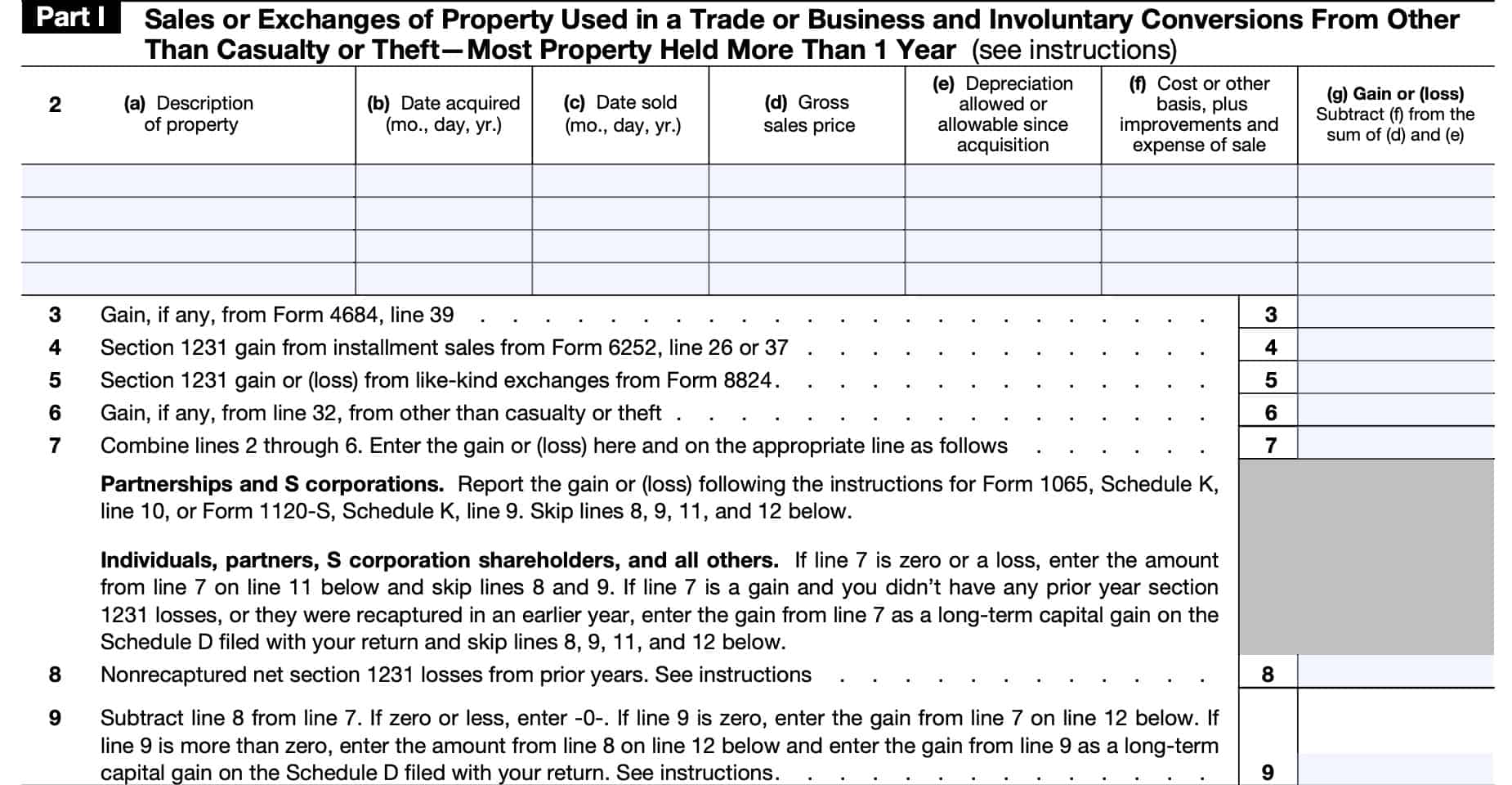
Part I: Sales or Exchanges of Property Used in a Trade or Business and Involuntary Conversions
Part I deals primarily with Section 1231 property held for more than one year. This includes real estate and depreciable property used in a trade or business. If the total gains from these items exceed the total losses, the net gain is treated as a long-term capital gain. If losses exceed gains, the net loss is treated as an ordinary loss, which can be deducted fully against ordinary income.
Part II: Ordinary Gains and Losses
Part II captures property held for one year or less, as well as ordinary gains and losses from other sections of the Internal Revenue Code. For example, if a piece of machinery is sold after being held for only nine months, any gain is treated as ordinary income and is reported in Part II. This section also handles the recapture of certain deductions under Sections 179 and 280F(b)(2).
Part III: Gain From Disposition of Property Under Sections 1245, 1250, 1252, 1253, and 1255
Part III is often the most complex portion of Form 4797. It calculates depreciation recapture. When a business claims depreciation on an asset over its useful life, that depreciation reduces the asset's basis. If the asset is later sold at a price higher than its depreciated basis, a portion of that gain must be recaptured and taxed at ordinary income rates rather than capital gains rates. Part III separates the gain into ordinary income (recaptured depreciation) and any remaining excess gain, which is then carried over to Part I or Schedule D.
Part IV: Election to Defer Gain Under Section 1033
Part IV is used when a taxpayer elects to postpone reporting a gain from an involuntary conversion—such as property destruction, theft, seizure, or condemnation—if the proceeds are reinvested into similar or related property within a specified statutory timeframe.
3. The Mechanics of Depreciation Recapture
Depreciation allows businesses to recover the cost of wear-and-tear on income-producing assets over time. However, when those assets are sold, the IRS invokes depreciation recapture rules to reclaim the tax benefits previously granted. Understanding Section 1245 and Section 1250 property is vital for anticipating tax liabilities on Form 4797.
| Property Classification | Typical Asset Types | Primary Recapture Rule |
|---|---|---|
| Section 1245 Property | Machinery, vehicles, equipment, office furniture | All depreciation claimed is recaptured as ordinary income up to the total gain. |
| Section 1250 Property | Buildings, structural components, commercial and residential real estate | Generally applies unrecaptured Section 1250 gain, taxed at a maximum 25% rate |
Under Section 1245, personal property and certain other tangible assets that have been depreciated are subject to full recapture. If a business bought heavy machinery for $50,000, claimed $30,000 in depreciation (reducing its adjusted basis to $20,000), and then sold it for $40,000, the total gain is $20,000 ($40,000 minus $20,000). Because the depreciation claimed ($30,000) exceeds the total gain ($20,000), the entire $20,000 gain is recaptured as ordinary income on Part III of Form 4797.
Section 1250 property, which generally covers real estate like buildings and land improvements, follows different rules. For real property depreciated under the Modified Accelerated Cost Recovery System (MACRS), straight-line depreciation is mandatory. Because straight-line depreciation does not create excess accelerated depreciation, standard Section 1250 recapture is typically zero for most modern commercial real estate. However, the taxpayer must account for "unrecaptured Section 1250 gain," which is the amount of depreciation previously claimed that is taxed at a maximum federal rate of 25% rather than standard capital gains rates.
4. Section 1231 Look-Back Rules and Their Long-Term Impact
A common trap for business owners filing Form 4797 involves the Section 1231 "look-back" rule. While net Section 1231 gains are generally treated as long-term capital gains—offering a favorable tax climate—taxpayers cannot simply ignore past losses.
If a business experienced net Section 1231 losses in any of the preceding five tax years, any current-year net Section 1231 gain must be recharacterized as ordinary income to the extent of those prior unrecaptured net Section 1231 losses. This mechanism prevents taxpayers from strategically timing sales to claim ordinary losses in bad years and long-term capital gains in good years without accounting for the multi-year cycle of asset disposition.
For example, if a company suffered a $10,000 net Section 1231 loss three years ago and deducted it against ordinary income, and then realizes a $15,000 net Section 1231 gain in the current year, the first $10,000 of that gain must be reported as ordinary income in Part II (via Part I routing). Only the remaining $5,000 enjoys long-term capital gain treatment. Business owners and tax accountants must maintain historical records spanning at least five years to accurately calculate this look-back adjustment.
5. Common Filing Errors and Best Practices for Compliance
Filing Form 4797 incorrectly can trigger automated IRS notices, delayed refunds, or comprehensive audits. Because the calculations involve tracking historical asset bases, depreciation schedules, and multi-part transfers, certain errors recur frequently.
Failing to Reconcile Asset Basis and Depreciation Schedules
One of the most frequent mistakes is using an incorrect starting basis or failing to account for all depreciation claimed (or allowable) in prior years. The adjusted basis of an asset is its original cost plus improvements, minus all depreciation deductions actually taken or allowable. Understating depreciation leads to an inflated adjusted basis, which miscalculates the final gain or loss.
Confusing Installment Sales with Outright Dispositions
When a business sells property and does not receive the full purchase price in the year of the sale, it is typically classified as an installment sale under Section 453. Taxpayers must report these transactions using Form 6252 before transferring the taxable portion of the gain to Form 4797. Failing to use Form 6252 for qualifying installment sales can result in the IRS assessing tax on the entire gain in a single tax year.
Overlooking State Tax Divergences
While Form 4797 is a federal document, state tax jurisdictions often handle depreciation and business property sales differently. Many states decoupled from federal bonus depreciation rules or Section 179 expensing limits in past years. Consequently, the adjusted basis of a business asset for federal purposes may differ from its state-level adjusted basis, requiring separate tracking and reporting spreadsheets.
To ensure compliance, business owners should maintain a permanent asset ledger that tracks:
- Date of acquisition and date of disposition.
- Original cost basis and subsequent capital improvements.
- Method and rate of depreciation used each year.
- Total depreciation allowed or allowable.
- Direct expenses of the sale (e.g., legal fees, commissions, advertising).
Frequently Asked Questions
What triggers the requirement to file IRS Form 4797?
Form 4797 is required whenever a business sells, exchanges, or involuntarily converts property used in its trade or operation that has been held for any length of time. This includes depreciable personal property, real estate, land, and certain livestock or timber. It is also required for recapturing specific deductions under Section 179 or Section 280F.
How does Form 4797 interact with Schedule D?
Net gains from Section 1231 property calculated in Part I of Form 4797 generally flow directly to Schedule D (Form 1040 or corporate equivalents) as long-term capital gains. However, if the Section 1231 look-back rule applies, a portion of those gains is redirected to Part II as ordinary income and does not reach Schedule D.
Are losses on business property fully deductible?
Yes, if business property is sold at a loss and qualifies as an ordinary loss under Section 1231 or Part II, the loss is generally fully deductible against ordinary business income without being subject to the $3,000 capital loss limitation that applies to individual investment assets. However, passive activity loss rules and at-risk limitations may still restrict the deduction.
What is the difference between Section 1245 and Section 1250 property on the form?
Section 1245 property consists primarily of depreciable personal property, equipment, and machinery where all depreciation is recaptured as ordinary income. Section 1250 property covers depreciable real estate, such as buildings and structural components, where standard recapture is generally zero under straight-line depreciation, but unrecaptured gains may be taxed up to a maximum 25% rate.
Can individuals file Form 4797 without a registered corporation?
Yes. Sole proprietors, independent contractors, and single-member LLC owners who file Schedule C often own business equipment, vehicles, or real estate. When these assets are sold or retired, the transaction must be reported on Form 4797 and integrated into the individual's Form 1040 tax return.
Practical Next Steps for Taxpayers
Before filing your annual tax return, audit your fixed asset ledger against previous tax returns to verify that cumulative depreciation matches across all periods. Gather settlement statements, closing disclosures, and invoices documenting the exact expenses incurred during any asset disposition. Because tax laws involving depreciation recapture and property sales are intricate and subject to legislative adjustments, consult a certified public accountant (CPA) or a qualified tax professional to review your completed Form 4797, especially if the transactions involve high-value real estate or multi-state operations.