The evolution from 1G to 5G represents the transformation of mobile communication from basic analog voice calls to a hyper-connected ecosystem supporting billions of devices. Each generation is defined by shifts in data transmission standards, frequency usage, and network architecture, progressively increasing speeds from 2.4 kbps to over 10 Gbps.
The history of mobile telecommunications is categorized into "generations," or "G" for short. Each new generation typically emerges every decade, bringing a fundamental change in the underlying technology and the services available to the end user. As of 2026, the global telecommunications landscape is dominated by 5G, while legacy networks like 2G and 3G have been largely decommissioned in developed markets to free up spectrum for more efficient standards. Understanding these shifts is essential for grasping how modern society achieved ubiquitous high-speed connectivity and what technical constraints defined each era.
1G: The Dawn of Analog Mobile Voice
Introduced in the late 1970s and early 1980s, 1G was the first generation of wireless cellular technology. Unlike the digital systems we use today, 1G relied entirely on analog signaling. The primary standard in the United States was the Advanced Mobile Phone System (AMPS), while other regions utilized standards like TACS (Total Access Communication System) and NMT (Nordic Mobile Telephone).
Technical limitations were significant during the 1G era. The network used Frequency Division Multiple Access (FDMA), which allocated a specific frequency band to each individual call. This was an inefficient use of the available spectrum, leading to limited capacity and frequent "busy" signals in crowded areas. Because the signals were analog and unencrypted, security was non-existent; anyone with a radio scanner could potentially eavesdrop on a conversation. Furthermore, 1G suffered from poor battery life and massive hardware requirements—the iconic "brick phones" were a direct result of the energy-intensive analog components required to maintain a signal.
2G: The Digital Revolution and the Rise of SMS
The transition from 1G to 2G in the early 1990s marked the most significant conceptual shift in mobile history: the move from analog to digital. The implementation of the Global System for Mobile Communications (GSM) and Code Division Multiple Access (CDMA) standards introduced encryption and allowed for much more efficient use of the radio spectrum.
2G introduced the concept of Time Division Multiple Access (TDMA), which allowed multiple users to share the same frequency channel by dividing it into different time slots. This drastically increased the number of concurrent users a single cell tower could support. Beyond voice, 2G enabled data services for the first time, starting with the Short Message Service (SMS).
As 2G evolved, "bridge" technologies like GPRS (General Packet Radio Service, often called 2.5G) and EDGE (Enhanced Data rates for GSM Evolution, or 2.75G) were introduced. These allowed for basic mobile internet access, albeit at speeds ranging from 56 kbps to 384 kbps. While slow by modern standards, 2G was the catalyst for the mobile culture, enabling the first wave of text-based digital communication.
3G: The Birth of the Mobile Web
By the early 2000s, the demand for data grew beyond simple text messages. 3G was developed to facilitate high-speed data transfer, video calling, and mobile internet access. The primary technological advancement was the move to packet switching for data, while retaining circuit switching for voice calls.
The Universal Mobile Telecommunications System (UMTS) and CDMA2000 became the dominant standards. 3G utilized Wideband Code Division Multiple Access (W-CDMA), which provided significantly more bandwidth than 2G. Theoretical speeds reached up to 2 Mbps, which eventually climbed higher with the introduction of HSPA (High-Speed Packet Access) and HSPA+.
3G was the era of the smartphone. Devices like the original iPhone and early Android handsets relied on 3G to download apps, stream music, and browse the web. It changed the utility of the mobile phone from a communication tool into a portable computer. However, as mobile apps became more resource-intensive, 3G quickly reached its capacity limits, leading to the development of the Fourth Generation.
4G: The Era of High-Definition Streaming and LTE
Launched around 2010, 4G was built from the ground up as an all-IP (Internet Protocol) network. This meant that even voice calls were treated as data packets (Voice over LTE or VoLTE), significantly improving call quality and reducing connection times. The dominant standard for 4G is LTE (Long Term Evolution).
Technically, 4G relies on Orthogonal Frequency Division Multiple Access (OFDMA). This technology splits the signal into several sub-carriers, which makes the transmission much more resilient to interference and allows for much higher data throughput. 4G also introduced Multiple Input Multiple Output (MIMO), using multiple antennas at both the transmitter and receiver to increase capacity.
4G changed the digital economy. With real-world speeds often exceeding 20-50 Mbps and theoretical peaks at 1 Gbps (LTE-Advanced), it enabled high-definition video streaming, online gaming, and the "gig economy" (Uber, DoorDash, etc.). By 2026, 4G remains the backbone of global connectivity, providing essential coverage in areas where 5G infrastructure is still being optimized.
5G: Ultra-Low Latency and Massive Connectivity
5G is the current state-of-the-art in mobile networking. Unlike previous generations that focused primarily on mobile handsets, 5G was designed to connect everything: cars, industrial sensors, smart city infrastructure, and millions of IoT (Internet of Things) devices.
The architecture of 5G is built on three main pillars:
- eMBB (Enhanced Mobile Broadband): Providing multi-gigabit speeds for consumers.
- URLLC (Ultra-Reliable Low Latency Communications): Reducing latency to as low as 1 millisecond, which is critical for autonomous vehicles and remote surgery.
- mMTC (Massive Machine Type Communications): Supporting up to one million devices per square kilometer, enabling the true Internet of Things.
5G utilizes a wider range of frequencies than any previous generation. It operates on Sub-6 GHz bands for broad coverage and mmWave (millimeter wave) for extremely high speeds over short distances. It also employs "Network Slicing," allowing operators to create virtualized portions of the network tailored for specific use cases, such as a dedicated "slice" for emergency services.
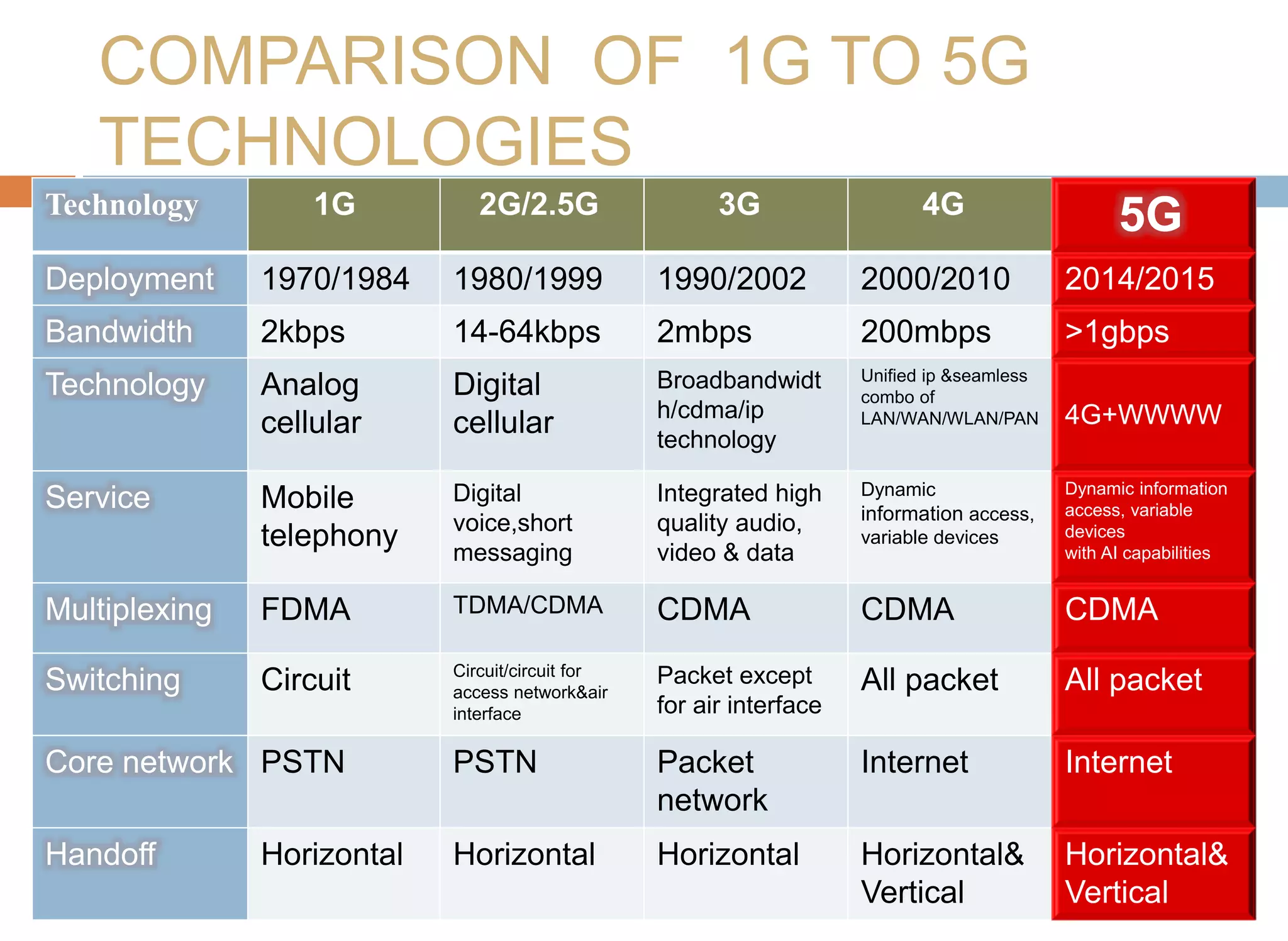
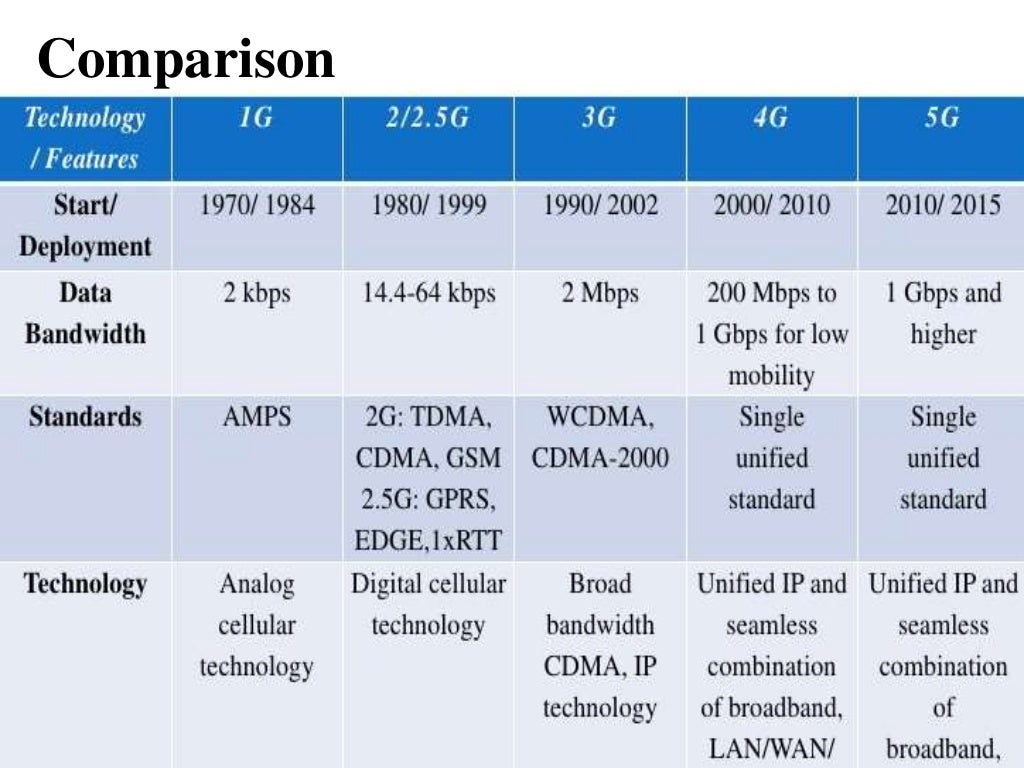
Technical Comparison Table
The following table outlines the fundamental differences across the five generations of mobile technology as they are understood in 2026.
| Feature | 1G | 2G | 3G | 4G (LTE) | 5G |
|---|---|---|---|---|---|
| Deployment Era | 1980s | 1990s | 2000s | 2010s | 2020s |
| Primary Standard | AMPS, TACS | GSM, CDMA | UMTS, HSPA | LTE, WiMAX | 5G NR (New Radio) |
| Signal Type | Analog | Digital | Digital | Digital (IP-based) | Digital (IP-based) |
| Switching Type | Circuit | Circuit & Packet | Circuit & Packet | Packet Only | Packet Only |
| Peak Data Rate | 2.4 kbps | 64 kbps - 384 kbps | 2 Mbps - 42 Mbps | 100 Mbps - 1 Gbps | 1 Gbps - 20 Gbps |
| Average Latency | N/A (Voice only) | 300 - 500 ms | 100 - 150 ms | 30 - 50 ms | < 1 - 10 ms |
| Multiplexing | FDMA | TDMA, CDMA | W-CDMA | OFDMA | OFDMA, SC-FDMA |
| Key Service | Voice Only | Voice, SMS | Mobile Data | HD Video, Cloud | IoT, VR/AR, Auto |
Spectrum Management and the Sunset of Legacy Networks
In 2026, one of the most pressing topics in telecommunications is spectrum refarming. Radio frequency spectrum is a finite resource. To provide the high bandwidth required by 5G, mobile network operators (MNOs) must "sunset" or shut down older 2G and 3G networks.
By reallocating the frequencies previously used for 3G (such as the 1900 MHz or 2100 MHz bands) to 5G, operators can significantly increase the capacity and efficiency of their modern networks. This transition has practical implications for consumers. Devices that lack 4G or 5G capability—including older home security systems, medical alerts, and e-readers—will lose connectivity. This process is governed by the International Telecommunication Union (ITU), which sets the global standards for radio frequency allocation.
The Role of 4G in the 5G Era
It is a common misconception that 5G will immediately replace 4G. In 2026, 4G LTE continues to play a vital role. Most 5G deployments initially utilized Non-Standalone (NSA) architecture, which uses a 4G core network to manage the connection.
Even as Standalone (SA) 5G becomes the norm, 4G serves as the essential coverage layer. Because 5G mmWave signals have difficulty penetrating buildings and travel shorter distances, 4G remains the fallback for indoor environments and rural regions. Furthermore, LTE-Advanced Pro has pushed 4G speeds into the gigabit range, narrowing the gap for the average user who may not yet require the ultra-low latency of 5G.
Security Evolution Across Generations
Security has evolved drastically since the unencrypted days of 1G.
- 2G introduced the A5/1 and A5/2 encryption algorithms, which were eventually found to be vulnerable to sophisticated attacks.
- 3G improved on this with Mutual Authentication, ensuring both the device and the network verified each other's identity.
- 4G brought more robust encryption and protected the user's identity by using temporary IDs (GUTI) instead of permanent ones (IMSI) over the air.
- 5G represents the pinnacle of mobile security, featuring 256-bit encryption and enhanced protection against "Stingray" devices (IMSI catchers). Security protocols in 5G are managed by the 3GPP (3rd Generation Partnership Project), the global organization responsible for mobile technical specifications.
Common Questions and Practical Considerations
Is 5G dangerous to human health?
Based on extensive research by the World Health Organization (WHO) and the Federal Communications Commission (FCC), there is no scientific evidence that the radio frequency (RF) levels used by 5G (including mmWave) pose a risk to human health. 5G operates within the non-ionizing part of the electromagnetic spectrum, meaning it lacks the energy to damage DNA or cells.
Why does my phone still show 4G if I have a 5G plan?
This usually occurs for one of three reasons: signal strength, network congestion, or device settings. In areas where 5G signals are weak (often due to distance from a tower or physical obstructions), your phone will automatically switch to 4G to maintain a stable connection. Additionally, if your phone is in "Power Saving Mode," it may disable 5G to conserve battery.
Do I need a new SIM card for 5G?
While many 4G SIM cards are compatible with 5G networks, a "5G-ready" SIM or an eSIM is recommended to access the full suite of 5G features, particularly Standalone (SA) 5G and enhanced security protocols. Many carriers in 2026 require a modern SIM to authorize access to high-frequency mmWave bands.
What is 6G, and is it already here?
As of 2026, 6G is in the early research and standardization phase. It is expected to utilize terahertz (THz) frequencies to achieve speeds up to 1 Tbps and integrate AI directly into the network architecture. However, commercial availability is not expected until approximately 2030.
Can I still use a 3G phone in 2026?
In most developed nations, the answer is no. Major carriers have completed their 3G shutdowns to repurpose the spectrum for 5G. A 3G-only device will no longer be able to make calls (including emergency calls) or use data unless it is connected to a Wi-Fi network.
Conclusion and Next Actions
The progression from 1G to 5G has been a journey from simple voice communication to a massive digital foundation for the modern world. For consumers and businesses in 2026, the focus has shifted from mere "connectivity" to "quality of service."
If you are still using hardware or infrastructure designed for 3G or early 4G, your primary next action should be an audit of your hardware. Ensure that your mobile devices, IoT sensors, and emergency communication systems support VoLTE (for 4G) and 5G NR standards. As 2G and 3G continue to disappear, staying ahead of these technical sunsets is the only way to ensure uninterrupted service in an increasingly connected global landscape.