Whether whole life insurance is exempt in bankruptcy depends on your state of residence, whether you use federal or state exemptions, your policy's cash surrender value, and who is named as the beneficiary. While death benefits paid to third-party beneficiaries are usually protected, Chapter 7 trustees can seize and liquidate non-exempt cash value.
Disclaimer: This guide is provided strictly for educational purposes and does not constitute formal legal, financial, or tax advice. Bankruptcy codes and asset exemption statutes vary substantially by jurisdiction and are subject to statutory revisions. Consult a licensed bankruptcy attorney or certified financial planner in your state before taking action regarding policy assets.
Understanding How Bankruptcy Courts Treat Whole Life Insurance
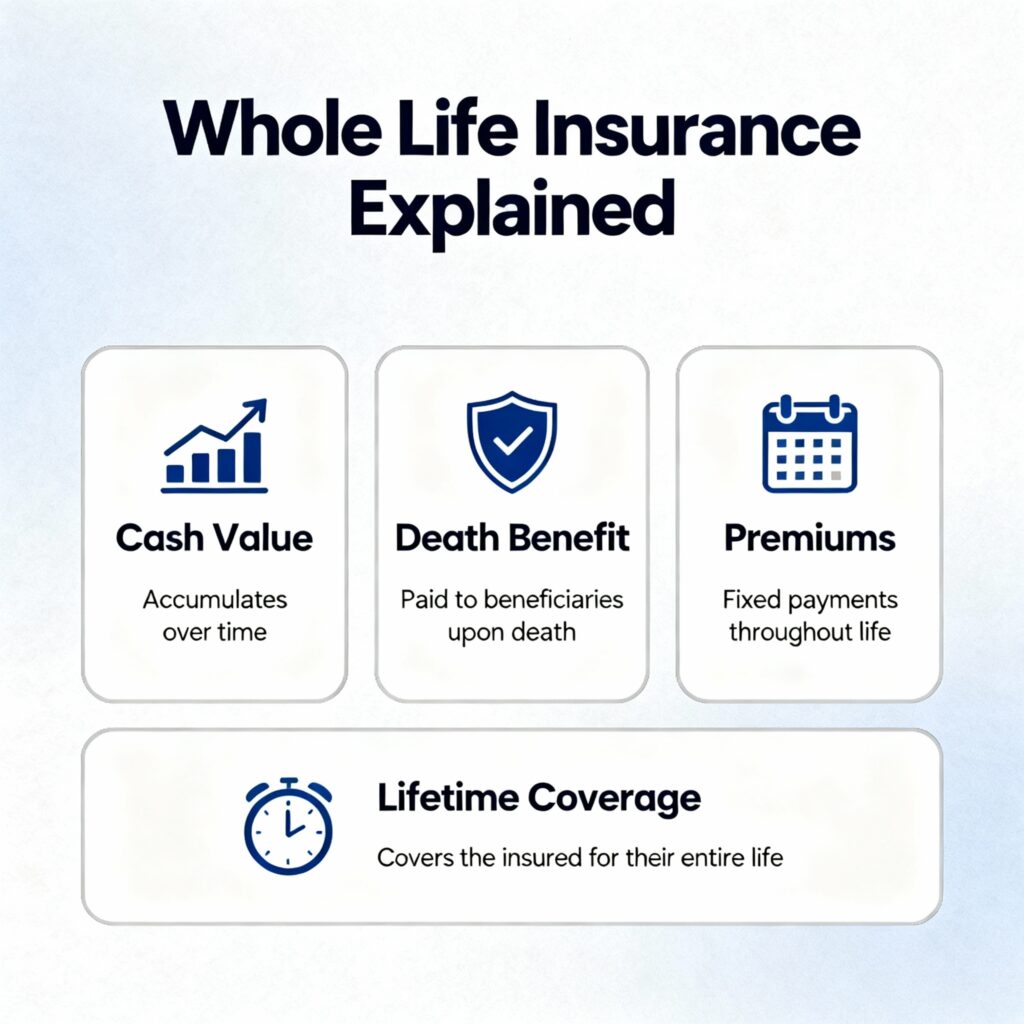
To evaluate whether a whole life insurance policy is protected during bankruptcy, courts examine the policy's structure. Unlike term life insurance—which provides purely financial protection for a set period without accumulating intrinsic asset value—whole life insurance is a permanent life policy containing two distinct financial components:
- The Death Benefit: The contractual amount payable to named beneficiaries upon the death of the insured.
- The Cash Surrender Value (CSV): The equity accumulated within the policy that the policyholder can borrow against, withdraw, or claim upon surrendering the contract.
In bankruptcy proceedings, the court distinguishes between the rights of the policy owner, the insured, and the beneficiary.
- Whole Life Policy Structure:
- Death Benefit: Protected if designated to third-party beneficiary (Subject to 180-day post-filing rule under § 541)
- Cash Surrender Value: Asset of Bankruptcy Estate (11 U.S.C. § 541)
- Exempt under State or Federal Code: Retained by Debtor
- Non-Exempt Portion: Surrendered to Trustee
When you file for bankruptcy, everything you own becomes part of the "bankruptcy estate" under 11 U.S.C. § 541. Because the policy owner retains the legal right to surrender a whole life policy and collect its accumulated cash surrender value, that cash value is treated as personal property. If that cash value is not protected by an applicable federal or state exemption, the Chapter 7 bankruptcy trustee has the statutory authority to surrender the policy to the insurer, liquidate the cash value, and distribute those funds to non-priority unsecured creditors.
Federal Bankruptcy Exemptions for Whole Life Insurance
If your state allows debtors to choose between federal and state exemption schemes, you can evaluate the protections offered under the federal bankruptcy code (11 U.S.C. § 522). Federal exemptions provide two separate protections for life insurance:
Unmatured Life Insurance Contracts — § 522(d)(7)
Under 11 U.S.C. § 522(d)(7), a debtor may exempt any unmatured life insurance contract owned by the debtor, other than a credit life insurance contract. This protects the contract itself from being terminated simply because a bankruptcy petition was filed, preserving ownership rights and future coverage.
Loan, Interest, or Dividend Values — § 522(d)(8)
While § 522(d)(7) protects the underlying contract, 11 U.S.C. § 522(d)(8) governs the actual cash value accumulated within that contract. Section 522(d)(8) permits a debtor to exempt up to a statutory dollar ceiling in accrued dividend, interest, or loan value in an unmatured life insurance contract owned by the debtor, provided the debtor is the insured or a dependent of the insured.
Note: Statutory exemption limits under the federal code are adjusted every three years to reflect inflation. Any cash surrender value exceeding the § 522(d)(8) cap is exposed to liquidation unless covered by additional exemptions.
Stacking the Federal Wildcard Exemption — § 522(d)(5)
If your whole life policy’s cash value exceeds the statutory allowance of § 522(d)(8), you can apply unused portions of the federal "wildcard exemption" under 11 U.S.C. § 522(d)(5). The wildcard exemption allows debtors to apply any unused homestead exemption (up to a designated dollar threshold) plus a baseline wildcard amount toward any asset, including whole life insurance cash surrender value.
State Exemption Systems: Broad Protections vs. Narrow Caps
States fall into two categories regarding bankruptcy exemptions:
- Opt-Out States: States that require residents filing for bankruptcy to use state-specific exemption statutes exclusively.
- Non-Opt-Out States: States that allow debtors to select either the federal exemption system or the state exemption system (though they cannot mix and match between the two).
State laws regarding whole life cash value protection vary significantly across the country:
Unlimited or High-Protection States
Several states provide robust asset protection for permanent life insurance, safeguarding the full cash surrender value from bankruptcy trustees regardless of the dollar amount:
- Florida: Under Florida Statute § 222.14, the cash surrender value of a life insurance policy issued upon the life of a Florida resident is completely exempt from execution, attachment, or legal process, provided the debtor is the insured policyholder.
- Texas: Under Texas Property Code § 42.002(a)(12), present values of life insurance policies are fully exempt from creditor claims, protecting accumulated cash surrender value without a dollar cap.
Conditional or Capped-Protection States
Many states cap cash value exemptions or restrict protections based on policy structure and designated beneficiaries:
- New York: Under New York Insurance Law § 3212, life insurance policies are generally exempt if the policy is created for the benefit of a third-party beneficiary (such as a spouse or child). However, if the debtor names themselves or their estate as the primary beneficiary, the exemption is weakened, exposing the cash value to bankruptcy claims.
- California: California provides two alternative exemption systems (System 1 and System 2 under the Code of Civil Procedure). System 1 offers capped protection specifically for life insurance policy loan values, while System 2 provides a general wildcard exemption that can be applied to cash surrender value.
Chapter 7 vs. Chapter 13: What Happens to Your Policy?
The operational impact on your whole life policy differs based on the bankruptcy chapter under which you file.
- Chapter 7 Liquidation:
- Exempt Cash Value: Retain Policy intact
- Non-Exempt Cash Value: Trustee surrenders policy to carrier (Cash value paid to creditors; coverage terminates)
- Chapter 13 Reorganization:
- Exempt Cash Value: Policy untouched
- Non-Exempt Cash Value: Policy retained, but debtor must repay equivalent amount through 3 to 5-year repayment plan
Chapter 7 Liquidation Proceedings
In Chapter 7 bankruptcy, non-exempt assets are converted to cash by the trustee to pay creditors. If your whole life cash surrender value exceeds applicable exemptions:
- The trustee submits formal demand paperwork to the life insurance company.
- The insurer surrenders the contract and sends the non-exempt cash value balance to the bankruptcy trustee.
- The underlying policy is canceled, terminating coverage.
- If only a portion of the cash value is non-exempt, the trustee may allow the debtor to buy back the non-exempt equity using non-estate funds (such as post-petition income or exempt gifts) to keep the policy active.
Chapter 13 Reorganization Plans
Chapter 13 does not involve the physical liquidation of assets. Instead, debtors propose a 3- to 5-year court-supervised repayment plan. However, the Best Interests of Creditors Test (11 U.S.C. § 1325(a)(4)) mandates that unsecured creditors must receive at least as much under the Chapter 13 plan as they would if the debtor's estate were liquidated under Chapter 7.
If your whole life policy has $20,000 in non-exempt cash surrender value, you do not lose the policy. Instead, you must pay an extra $20,000 into your Chapter 13 plan distributed over the 36 to 60 months of your plan duration.
Special Considerations: Death Benefits and Fraudulent Transfers
The 180-Day Rule for Death Benefit Proceeds
If you are the beneficiary of someone else's whole life insurance policy and that person passes away, the proceeds become part of your bankruptcy estate under 11 U.S.C. § 541(a)(5) if you become entitled to receive them within 180 days after filing your bankruptcy petition. If the entitlement arises after the 180-day window expires, the proceeds generally belong to you free of estate claims.
Fraudulent Transfer Rules and Asset Conversion
Transferring non-exempt cash into a whole life policy shortly before filing bankruptcy can backfire. Under federal law (11 U.S.C. § 548) and state Uniform Voidable Transactions Acts (UVTA):
- If a debtor moves non-exempt liquid cash into an exempt whole life insurance contract with the intent to hinder, delay, or defraud creditors, the bankruptcy trustee can void the transfer.
- Trustees audit financial transactions occurring within 2 to 4 years prior to filing (and up to 10 years in specific statutory circumstances).
- When a transfer is unwound as fraudulent, the court strips the exemption from the asset, allowing the trustee to seize the funds.
Comparison of Whole Life Exemptions Across Key Frameworks
The following table summarizes how key bankruptcy exemption regimes treat whole life insurance assets.
| Exemption Framework | Unmatured Contract Exemption | Cash Value Exemption Cap | Beneficiary Restrictions / Requirements | Stacking Protection Available |
|---|---|---|---|---|
| Federal Exemptions (11 U.S.C. § 522) | Fully Exempt under § 522(d)(7) | Capped under § 522(d)(8) (Adjusted triennially) | Debtor must be the insured or dependent of insured | Yes (Can stack unused § 522(d)(5) Wildcard) |
| Florida (Fla. Stat. § 222.14) | Fully Exempt | Unlimited Cash Value Exemption | Applies to policies issued on Florida residents | N/A (State law provides full exemption) |
| Texas (Tex. Prop. Code § 42.002) | Fully Exempt | Unlimited Cash Value Exemption | Beneficiary rights protected from creditor execution | N/A (State law provides full exemption) |
| California System 1 (CCP § 704.100) | Fully Exempt | Capped aggregate loan/cash surrender value | Protects policy accrued value based on statutory schedules | Limited wildcard options in System 1 |
| California System 2 (CCP § 703.140) | Fully Exempt | Protected primarily via Wildcard Provision | Similar to federal structure | Yes (Substantial Wildcard available under § 703.140(b)(5)) |
| New York (N.Y. Ins. Law § 3212) | Fully Exempt | Exempt if third-party beneficiary designated | Must be payable to spouse, child, or third party (not estate) | Limited general wildcard options |
Pre-Filing Checklist for Whole Life Insurance Policyholders
Before filing a Chapter 7 or Chapter 13 bankruptcy petition, complete the following steps to assess policy vulnerability:
- Obtain an In-Force Policy Illustration: Contact your insurance carrier to request an official statement showing the exact cash surrender value, active policy loans, and current surrender charge schedules.
- Verify Policy Ownership and Insured Identity: Confirm whether you are the owner, the insured, or both. Exemption provisions often require the debtor to be both owner and insured.
- Audit Beneficiary Designations: Check whether the beneficiary is a third-party dependent (spouse, child) or designated as your estate. Beneficiaries listed as "the estate" frequently forfeit state-level statutory exemptions.
- Calculate Net Cash Surrender Value: Subtract outstanding policy loans and surrender penalties from the gross cash value to establish the net monetary value exposed to the bankruptcy estate.
- Review Contribution Timelines: Identify any lump-sum premium payments, policy top-ups, or transfers made into the policy over the preceding 24 to 48 months to evaluate potential fraudulent transfer risks.
Common Mistakes to Avoid
- Failing to List the Policy on Schedule A/B: All assets—regardless of whether they are 100% exempt—must be fully disclosed on Schedule A/B (Property) and claimed on Schedule C (Property Claimed as Exempt). Concealing a policy is federal bankruptcy fraud and can result in discharge denial or criminal prosecution.
- Surrendering the Policy Prior to Filing: Liquidating a policy right before filing converts an exempt or partially protected insurance contract into non-exempt cash on hand, exposing those funds directly to the trustee.
- Changing Beneficiary Designations Immediately Before Filing: Altering beneficiary designations right before filing can be flagged by trustees as an improper attempt to hinder creditors.
- Overlooking Outstanding Policy Loans: Policy loans reduce the net cash surrender value available to a trustee. Failing to account for outstanding loan balances can cause you to overestimate your policy's vulnerability.
Frequently Asked Questions
Can a bankruptcy trustee force me to surrender my whole life insurance policy?
Yes. In a Chapter 7 bankruptcy, if your whole life policy contains cash surrender value that cannot be fully covered under federal or state exemption statutes, the trustee has the authority to surrender the policy to the carrier, collect the net cash value, and distribute the funds to your creditors.
Is term life insurance treated differently than whole life insurance in bankruptcy?
Yes. Term life insurance contracts do not accumulate cash surrender value. Because there is no liquid equity for a trustee to seize, term life insurance contracts are generally exempt from liquidation, provided the death benefit has not matured prior to or within 180 days after filing.
What happens if I receive a life insurance payout while in Chapter 13 bankruptcy?
If you become entitled to receive a life insurance death benefit as a beneficiary while in an active Chapter 13 bankruptcy, those funds must be reported to your Chapter 13 trustee. Depending on local local court rules, your plan confirmation status, and local exemption limits, the payout may need to be committed to paying off your remaining unsecured debt.
Does naming my estate as the beneficiary affect bankruptcy exemptions?
Yes. Many state statutes explicitly require whole life policies to be payable to a named third-party beneficiary (such as a spouse, child, or financial dependent) to qualify for statutory protection. Naming your estate as the beneficiary often eliminates state exemption protections, exposing the cash value to bankruptcy claims.
Can I borrow against my whole life cash value right before filing bankruptcy?
Borrowing against your cash value shortly before filing bankruptcy requires extreme caution. Taking out a policy loan converts non-liquid cash value into liquid cash. If you retain that cash when filing, it is considered personal property and subject to seizure unless fully protected by a wildcard exemption. Furthermore, using loan proceeds to purchase non-exempt assets or pay select creditors can trigger trustee avoidance claims.
Practical Recommendations and Next Actions
If you hold a whole life insurance policy and are considering filing for bankruptcy:
- Secure Official Statements: Request a current, itemized policy statement from your insurer showing the gross cash value, surrender charges, outstanding loans, and current net cash surrender value.
- Map Out State vs. Federal Exemptions: Compare your state's specific insurance exemptions against the federal exemption scheme (if your state allows federal exemptions) to determine which structure offers the highest total asset protection.
- Avoid Last-Minute Policy Changes: Do not make major policy changes—such as executing large premium payments, changing beneficiaries, or taking policy loans—without consulting legal counsel.
- Consult a Qualified Bankruptcy Attorney: Schedule a consultation with an experienced bankruptcy attorney in your jurisdiction. Bring your complete policy documents to review your policy's exemption status before submitting your petition to the court.