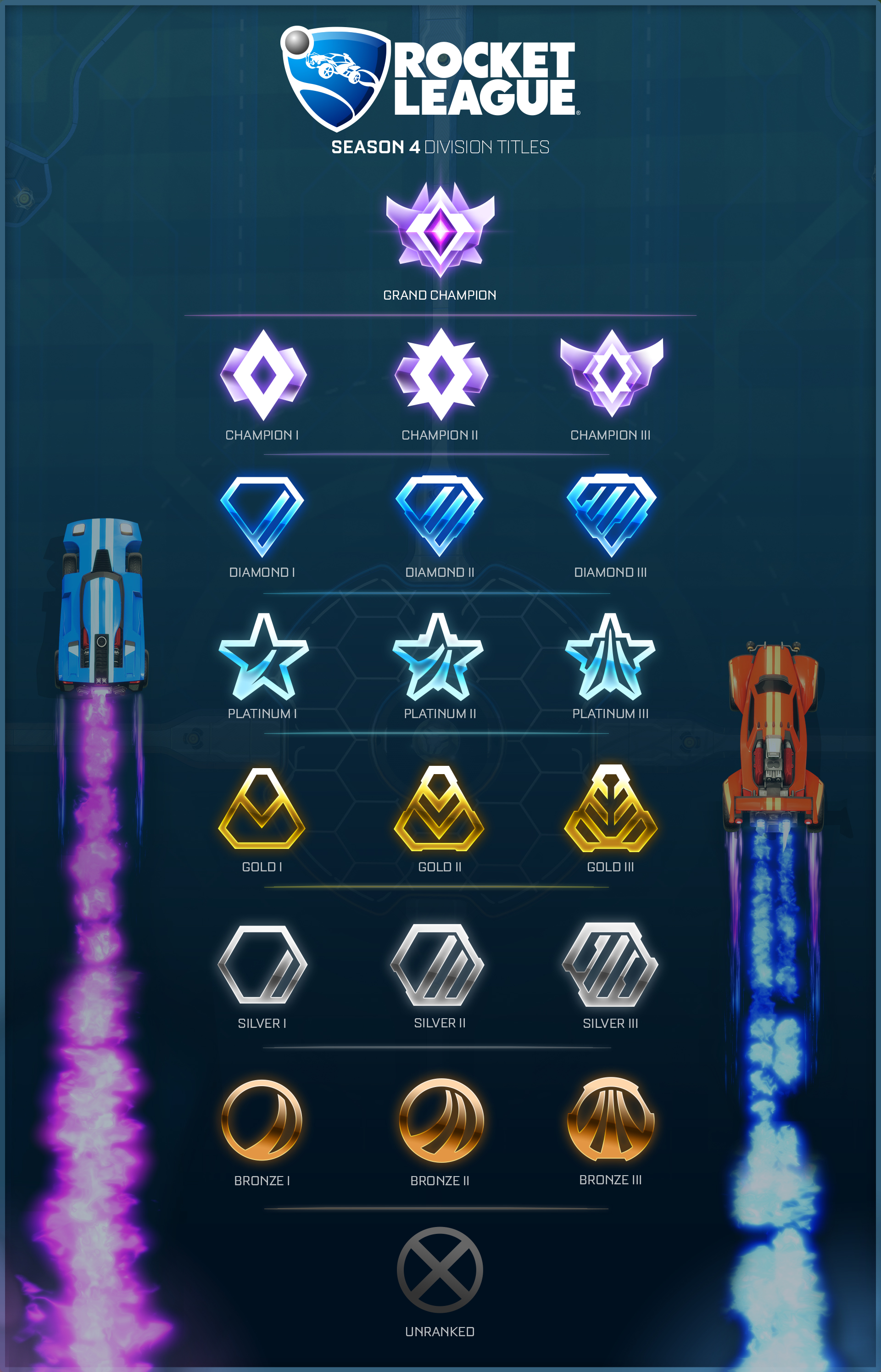
Rocket League features a competitive ranking system consisting of eight primary tiers: Bronze, Silver, Gold, Platinum, Diamond, Champion, Grand Champion, and Supersonic Legend. Each tier, except for the highest, is subdivided into three ranks (e.g., Gold I, II, and III), and each rank contains four divisions. Players progress by winning matches and earning Matchmaking Rating (MMR).
To understand the competitive landscape of Rocket League in 2026, one must look beyond the colorful icons and icons of the UI. The ranking system is a sophisticated mathematical engine designed to ensure fair matches while providing a clear sense of progression. Whether you are a newcomer struggling to hit the ball in Bronze or a seasoned veteran chasing the elusive white-glow of the Supersonic Legend title, the hierarchy remains the definitive measure of skill in this physics-based esport.
The Rocket League Ranking Hierarchy
The ranking system is structured to separate the player base into distinct skill brackets. As of 2026, the distribution of players across these ranks follows a bell-curve model, where the majority of the population resides in the middle tiers (Gold through Diamond), while the extremes (Bronze and Supersonic Legend) house the smallest percentages of players.
The Entry Tiers: Bronze, Silver, and Gold
These ranks represent the foundational stages of a player's journey.
- Bronze (I, II, III): This is where every journey begins. In Bronze, the gameplay is characterized by "ball-chasing" and fundamental mechanical errors. Players at this level are still learning the basic physics of the car and the ball. Success in Bronze usually comes down to simply making contact with the ball more consistently than the opponent.
- Silver (I, II, III): Silver players have begun to grasp the concept of "driving with purpose." You will see the beginnings of basic aerials (leaving the ground to hit the ball), though they are often inaccurate. Tactical positioning starts to emerge, but rotations are usually non-existent.
- Gold (I, II, III): Often considered the "average" skill level, Gold is where the game becomes more structured. Players can hit the ball with more power and are starting to use the walls. This is the first rank where basic team play and rotating back to defense become necessary to advance.
The Intermediate Tiers: Platinum and Diamond
Moving into these ranks requires a shift from "hitting the ball" to "controlling the ball."
- Platinum (I, II, III): Platinum is famously known for being a "bottleneck" rank. Players here have decent mechanics and can perform fast aerials, but their decision-making is often impulsive. To move past Platinum, a player must focus on "shadow defense" and avoiding over-committing as the last man back.
- Diamond (I, II, III): In Diamond, the game speed increases significantly. Players begin to utilize "half-flips" and "wave dashes" to maintain momentum. Communication (even through Quick Chat) becomes vital. Errors at this level are punished much more frequently by opponents who can now aim their shots with reasonable accuracy.
The Elite Tiers: Champion and Grand Champion
These ranks represent the top 5% to 10% of the active player base. The gap between a Diamond player and a Champion player is often larger than the gap between Bronze and Gold.
- Champion (I, II, III): Champion players possess high-level mechanical consistency. They can perform backboard clears, basic flip resets, and consistent air dribbles. However, the real differentiator in Champion is "game sense"—knowing when to challenge a ball and when to buy time for a teammate.
- Grand Champion (I, II, III): Until 2020, this was the highest rank in the game. Grand Champions (GC) are elite players who rarely make unforced errors. GC I, II, and III serve as a proving ground for those aspiring to enter the professional scene. The speed of play here is blistering, requiring near-perfect boost management.
The Pinnacle: Supersonic Legend
Introduced to provide more room at the top of the ladder, Supersonic Legend (SSL) is the highest possible rank. It does not have numbered sub-ranks (I, II, III). Instead, it is a single, prestigious tier reserved for the absolute best players in the world—typically the top 0.01%. Achieving SSL rewards players with a unique, glowing white title that changes every season.
Understanding Matchmaking Rating (MMR)
While the game shows you icons and divisions, the "real" rank is a hidden numerical value called Matchmaking Rating (MMR). Every time you win a match, your MMR increases; when you lose, it decreases.
The amount of MMR gained or lost depends on the relative strength of your opponents. If you defeat a team with a higher average MMR than yours, you will gain more points than if you defeated a team ranked lower than you. Conversely, losing to a lower-ranked team results in a more significant MMR penalty.
How Divisions Work
Each rank (e.g., Platinum II) is split into four divisions: Division I, II, III, and IV.
- Division I is the lowest part of the rank.
- Division IV is the "promotion zone."
When your MMR crosses a specific threshold, you move up a division. If you reach the top of Division IV and win again, you are promoted to the next rank (e.g., from Platinum II Div IV to Platinum III Div I). Psyonix uses a "buffer" system to prevent players from constantly bouncing between two ranks after every single game. This means you usually need to win one or two extra games to promote, but you also have a "cushion" before demoting.
Tracking Your MMR
On the PC version of Rocket League, players often use third-party tools like BakkesMod to see their exact MMR numbers in real-time during matches. For console players (PlayStation, Xbox, Switch), the primary way to check exact MMR is through the Rocket League Tracker Network.
Competitive Playlists and Game Modes
Ranks are not universal across all game modes. Your rank in 2v2 has no impact on your rank in 1v1. Each "playlist" has its own independent MMR.
Core Competitive Playlists
- 3v3 Standard: The classic Rocket League experience. It is highly strategic and relies heavily on rotations and team-based passing plays.
- 2v2 Doubles: Historically the most popular playlist. It offers a balance between individual skill and teamwork. Because there is only one teammate to cover for mistakes, 2v2 is excellent for developing defensive discipline.
- 1v1 Duel: Often considered the most stressful mode. There is no one to blame but yourself. 1v1 is the best way to improve raw mechanics and kick-off consistency. Interestingly, most players have a significantly lower rank in 1v1 than in other modes due to the different MMR distribution.
Extra Modes
Rocket League also features "Extra Modes" which use the same ranking tiers but with different gameplay mechanics:
- Rumble: 3v3 with randomized power-ups.
- Hoops: 2v2 basketball-style gameplay.
- Dropshot: A unique mode where players must break floor tiles to score.
- Snow Day: 3v3 hockey played with a puck instead of a ball.
As of the seasonal updates leading into 2026, some Extra Modes rotate in and out of the "Competitive" slot each season to keep the player queues healthy.
Comprehensive Rank Comparison Table
The following table outlines the hierarchy and the general skill expectations for each tier as of the 2026 competitive season.
| Tier Group | Rank Level | Divisions | Primary Skill Focus |
|---|---|---|---|
| Beginning | Bronze I - III | I - IV | Ball contact and basic movement |
| Foundational | Silver I - III | I - IV | Basic aerials and power clears |
| Intermediate | Gold I - III | I - IV | Rotation and wall play |
| Advanced | Platinum I - III | I - IV | Speed and shadow defense |
| Elite | Diamond I - III | I - IV | Consistent mechanics and passing |
| Master | Champion I - III | I - IV | Backboard reads and high-speed play |
| Grand Master | Grand Champion I - III | I - IV | Near-perfect consistency and game sense |
| Legendary | Supersonic Legend | N/A | Professional-level speed and mechanics |
The Season Cycle and Placement Matches
Rocket League operates on a seasonal schedule, typically lasting three to four months. At the start of every new season, ranks are "soft reset."
Placement Matches
If you were ranked in the previous season, you will start the new season "Unranked." You must complete 10 placement matches in each playlist to reveal your new rank. During these matches, your MMR is hidden but still fluctuates. Usually, the soft reset pulls all players toward the "median" MMR (Gold/Platinum), meaning high-ranked players will start slightly lower than they finished, while very low-ranked players may see a slight boost.
Seasonal Rewards
The primary motivation for climbing the ranks—aside from pride—is the Season Rewards. These are cosmetic items (decals, wheels, goal explosions) given at the end of the season based on the highest rank you successfully "secured."
To secure rewards for a specific rank, you must:
- Reach that rank.
- Win 10 matches at that rank (or higher).
- Each tier must be unlocked sequentially. You must first win 10 matches at the "Unranked" level (which counts as Bronze), then 10 at Silver, then 10 at Gold, and so on.
Strategies for Advancing Through the Tiers
Climbing the ladder in Rocket League is less about learning flashy "freestyle" moves and more about fundamental efficiency.
Escaping the Lower Tiers (Bronze - Gold)
- Defense Wins Games: At these levels, everyone wants to score. If you simply stay back and wait for the opponents to miss the ball, you will find easy open-net opportunities.
- Free Play Training: Spend 15 minutes before every session in Free Play. Just hit the ball as hard as you can against the walls and try to follow it up.
Breaking Through the Middle (Platinum - Diamond)
- Master the "Half-Flip": This is the most essential mechanic for recovering when you are out of position. It allows you to turn 180 degrees while maintaining speed.
- Stop Double-Committing: If you see your teammate going for the ball, do not go for it too. Even if they have a "bad" hit, you need to be behind them to defend the counter-attack.
Reaching the Top (Champion - SSL)
- Analyze Replays: At this level, your mistakes are subtle. Use the in-game replay viewer to watch the game from your opponent's perspective. You will quickly see where you were leaving gaps in your defense.
- Boost Management: High-level play is determined by who has boost. Learn to pick up the small "pads" on the field rather than always driving to the 100-boost canisters in the corners.
Frequently Asked Questions
What is the most common rank in Rocket League?
In most seasons, the highest concentration of players is found in Gold III and Platinum I. This represents the "average" player who understands the game mechanics but lacks the consistency of the higher tiers.
Can you lose your rank due to inactivity?
Yes. If you do not play a specific competitive playlist for approximately 30 days, your rank becomes "inactive" and will be hidden. You must win two or three matches to "re-calibrate" and reveal your rank again. Your MMR does not significantly drop during this time; only the visual representation is removed.
Is there a difference between "Rank" and "Level"?
Yes. Your Rank (e.g., Diamond) is your competitive standing and fluctuates based on wins and losses. Your Level (e.g., Level 500) is a permanent account progression metric that increases based on XP earned through play-time and challenges. Level has no impact on matchmaking.
Why is my 1v1 rank lower than my 2v2 rank?
This is a common phenomenon. Because there are fewer players in the 1v1 playlist, the MMR requirements for each rank are shifted. Furthermore, 1v1 is mechanically punishing, making it harder for "team players" to climb.
How do I unlock Competitive mode?
New accounts created after the game went free-to-play must reach Level 20 through casual play before they are allowed to enter Competitive playlists. This prevents "smurfing" (highly skilled players creating new accounts to beat lower-ranked players) and ensures newcomers have a basic understanding of the controls.
Final Recommendation
To progress effectively in the 2026 Rocket League ranking system, focus on consistency over complexity. While "flip resets" look impressive on social media, 90% of games up to the Champion level are won by the team that makes the fewest defensive errors and executes basic rotations. Utilize tools like Epic Games Support for official updates on season changes and keep an eye on your MMR trends via the Tracker Network to identify which playlists offer your best path to Supersonic Legend.