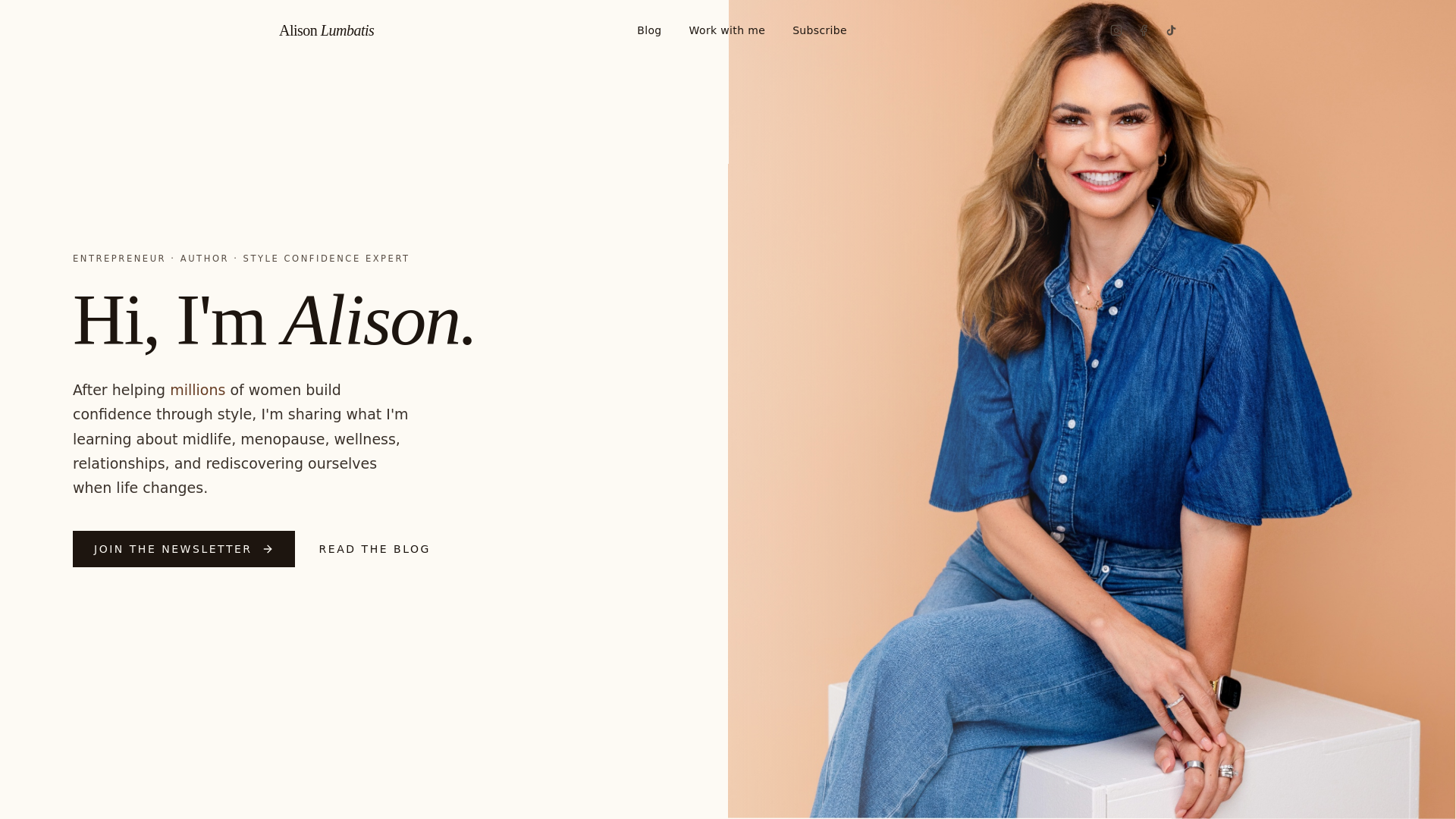
Estimating the net worth of a digital content creator like Alison Lumbatis requires an understanding of diverse revenue streams, including online course sales, affiliate marketing, brand partnerships, and the historical performance of her primary platform, Outfit Formulas. As of 2026, her financial standing is built on a decade of expertise in personal style and fashion education, positioning her as a prominent figure in the niche of wardrobe simplification.
The Evolution of the Outfit Formulas Brand
To understand the financial foundations of Alison Lumbatis, one must look at the inception and growth of Outfit Formulas. Launched in 2014, the platform was designed to solve a specific problem for women: the daily struggle of deciding what to wear. By moving away from the traditional, high-pressure world of fashion blogging, Lumbatis focused on "capsule wardrobes." This pivot shifted her business model from traditional ad-based revenue—which is often volatile—to a subscription-based and product-based ecosystem.
The business model relies on the sale of seasonal outfit guides. These guides provide a structured, simplified approach to dressing, which resonated with a large audience looking for efficiency rather than trends. Unlike traditional influencers who depend heavily on sponsored posts for third-party brands, Lumbatis created an intellectual property-based business. The recurring nature of seasonal releases creates a predictable revenue cycle, which is a critical factor in the valuation of any creator-led enterprise.
Revenue Streams and Financial Drivers
Analyzing a creator's net worth involves breaking down the gross revenue generated by their business and the subsequent overhead required to maintain it. For Lumbatis, the financial trajectory is tied to several key pillars:
1. Digital Product Sales
The core of the business is the distribution of digital guides. Since these products have near-zero marginal costs once created, the profit margins on these sales are significantly higher than physical retail or service-based businesses. The automation of the sales funnel—moving potential customers through email marketing and community engagement—allows for scalability that isn't tethered to the number of hours the founder works.
2. Community and Membership Models
Lumbatis has successfully cultivated a private community. Membership models provide recurring monthly or annual revenue. This "membership economy" is highly prized by investors and financial analysts because it provides stable cash flow, which is the cornerstone of a sustainable personal brand.
3. Affiliate Marketing and Strategic Partnerships
While the primary revenue comes from her own products, affiliate marketing acts as a supplementary income source. By recommending specific clothing items that fit into her "capsule wardrobe" methodology, she earns commissions. Her influence in the specific niche of wardrobe management gives her high conversion rates, making her an attractive partner for retailers.
The Financial Complexity of Creator Businesses
It is common for the public to confuse gross revenue with net worth. Net worth is an individual’s total assets minus their liabilities. For a digital entrepreneur, assets include:
- Intellectual Property: The accumulated content, guides, and brand trademarks.
- Customer Databases: An email list of thousands of active, engaged subscribers is a significant business asset in 2026.
- Operating Infrastructure: The software, websites, and automated systems that run the business.
Conversely, liabilities include the operational costs of maintaining the platform, customer support, marketing expenditures, and the costs associated with employing staff or contractors to assist in content production.
Comparative Market Value in the Fashion Niche
When comparing the financial impact of Alison Lumbatis to other figures in the style-education space, it is useful to look at the differences between "fashion influencers" and "style educators."
| Business Model | Primary Revenue Source | Scalability | Revenue Predictability |
|---|---|---|---|
| Fashion Influencer | Brand Deals / Ads | Low (Time-Dependent) | Variable |
| Style Educator | Courses / Memberships | High (System-Dependent) | Stable |
| Retailer | Inventory Sales | Moderate (Logistics-Heavy) | Seasonal |
Lumbatis operates primarily in the "Style Educator" category. This sector has historically shown more resilience during economic downturns because the value proposition—saving money by buying fewer, more versatile clothes—is perceived as a cost-saving measure rather than a luxury expense.
The Role of Passive Income and Automation
A significant portion of the financial success surrounding the Outfit Formulas model is due to the high level of automation. By 2026, the systems that Lumbatis implemented years ago have been refined to operate with minimal manual intervention. This allows the founder to focus on brand growth and high-level strategy rather than daily content creation.
The move toward automation is a classic path for increasing the "valuation" of a business. If a business can continue to generate revenue without the founder being present for every sale, it is considered much more valuable in a potential acquisition or partnership scenario.
Challenges and Operational Realities
No business is without risks. The fashion education space is subject to shifts in consumer behavior. The reliance on email marketing, for example, makes the business sensitive to changes in deliverability and platform algorithms. Additionally, the constant need to refresh seasonal content requires a dedicated team, which represents a fixed cost that must be managed against the fluctuations in seasonal product launches.
Furthermore, there is the risk of market saturation. As more creators enter the "capsule wardrobe" space, the cost of acquiring a new customer through social media advertising typically rises. Maintaining a competitive advantage requires constant iteration on the core product offerings and deep customer loyalty.
Frequently Asked Questions
How is Alison Lumbatis’s net worth determined? Her net worth is estimated based on the value of her digital business, Outfit Formulas, including its revenue-generating digital products, community memberships, and the asset value of her established brand and customer base. It is not a liquid cash figure but a valuation of her business interests.
Does she make money through social media sponsorships? While influencers often rely on sponsored posts, the primary financial engine for Lumbatis is her proprietary digital product ecosystem. Social media serves more as a top-of-funnel marketing tool to drive traffic to her website rather than a primary source of direct income.
What is the impact of the Outfit Formulas model on her financial growth? The model is built on scalability. Because she sells digital products rather than physical inventory, her profit margins are high, allowing for consistent growth without the logistical overhead associated with retail fashion.
Is her wealth primarily based on clothing sales? No. She does not typically sell her own clothing line; she sells the strategy and the "formula" for building a wardrobe. This positions her as an information product entrepreneur, which has a very different financial profile than a retail fashion business.
Why is it difficult to verify an exact dollar amount? Net worth figures for private citizens and independent digital entrepreneurs are estimates. Because she does not hold a public company with mandatory financial filings, the exact figures are kept private. Publicly available reports are based on industry-standard revenue multiples and estimated traffic metrics.
Next Steps for Understanding Creator Economics
For readers interested in the mechanics of how digital creators build wealth, the key is to look past the surface-level vanity metrics of social media followings. Instead, focus on the "back-end" of the business. Observe how a creator converts interest into a digital product, how they nurture a community, and how they utilize recurring revenue models to create stability.
If you are evaluating the feasibility of a similar business model, analyze the "Customer Lifetime Value" (CLV). A creator who focuses on long-term relationships with subscribers, as Lumbatis has done, will always be in a stronger financial position than one who relies on one-off, transactional viral moments. The longevity of her platform proves that in the digital age, utility-based content—providing a direct solution to a daily problem—is a powerful strategy for building a sustainable financial future.