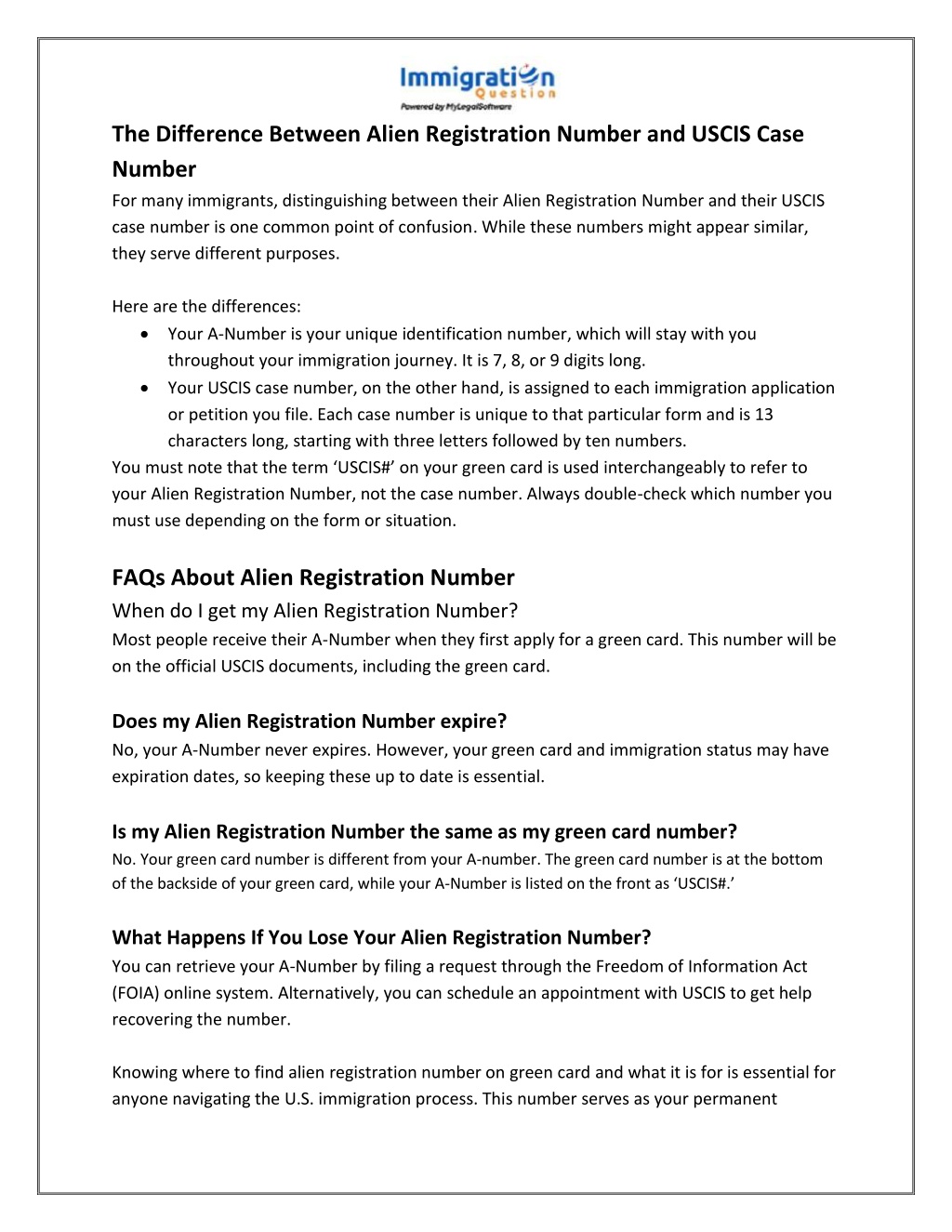
The Alien Registration Number (A-Number) and the USCIS Number are often used interchangeably because they represent the same unique seven- to nine-digit identification number assigned to non-citizens by the U.S. government. While they appear on different documents and serve slightly different purposes in modern digital systems, they refer to the same individual’s permanent immigration file maintained by the Department of Homeland Security.
Understanding the Immigration Identifier System
Navigating the U.S. immigration system involves a significant amount of paperwork, much of which requires specific identifiers to track your status, history, and eligibility for benefits. Among the most critical of these is the A-Number, officially known as the Alien Registration Number.
Historically, the A-Number was assigned to individuals who were required to register with the government as aliens—non-citizens—to monitor their presence and activities within the United States. Today, the U.S. Citizenship and Immigration Services (USCIS) uses this same number as the foundation for its digital tracking systems. Consequently, you will see it referred to as both an A-Number and a USCIS Number. Understanding why these two terms exist and how they function is vital for anyone completing forms, applying for work authorization, or checking the status of a pending petition.
What is an Alien Registration Number (A-Number)?
The Alien Registration Number is a unique, typically seven-, eight-, or nine-digit number assigned to non-citizens who have a file with the Department of Homeland Security (DHS). This number stays with an individual for their entire lifetime. It is the primary index for an individual's "Alien File," or A-File, which contains the complete record of their immigration history, including entries, exits, applications, and legal status changes.
Because this number is permanent, you should never discard it or lose track of it. Whether you are adjusting your status, renewing a green card, or applying for naturalization, the A-Number acts as the master key that allows government adjudicators to pull your history and verify your eligibility for new benefits.
Defining the USCIS Number
The USCIS Number is functionally identical to the A-Number. The transition to the term "USCIS Number" occurred as the agency modernized its internal databases and document formatting. On modern Permanent Resident Cards (Green Cards) issued after May 2010, the identifier is explicitly labeled as the "USCIS#" on the back of the card.
The evolution of the terminology reflects a shift from a focus on "Alien Registration"—a concept rooted in 20th-century statutes—to a focus on modern agency identity management. Despite this shift in nomenclature, the underlying data remains the same. If an immigration form or an online USCIS portal asks for your "USCIS Number," you provide the A-Number you have been issued. If it asks for your "A-Number," you provide that same nine-digit string.
Comparison of Identifiers
While they represent the same core identity, the context in which you encounter these terms can lead to confusion. The following table illustrates how these terms appear in professional and official settings.
| Feature | Alien Registration Number (A-Number) | USCIS Number |
|---|---|---|
| Purpose | Unique tracking of immigration history | Unique tracking of immigration history |
| Format | Typically 7 to 9 digits | Typically 7 to 9 digits |
| Primary Location | Historical documentation, some older IDs | Modern Green Cards, EADs, USCIS accounts |
| Permanence | Assigned for life | Assigned for life |
| Interchangeability | Often used synonymously | Often used synonymously |
Where to Locate Your Number
Finding your A-Number or USCIS Number is straightforward if you have access to your official immigration documents. Because this number is critical for verification, it is prominently displayed on almost all formal correspondence from the Department of Homeland Security.
- Permanent Resident Card (Green Card): On newer cards, look at the back. You will see a nine-digit number labeled "USCIS#." On older cards, the A-Number is typically found on the front.
- Employment Authorization Document (EAD): The EAD card, often issued to those with pending adjustment of status applications, will display the USCIS number, typically listed as the "USCIS Number" on the face of the card.
- Immigrant Visa Stamp: If you entered the United States via a visa stamp in your passport, the A-Number is usually printed near the top, often preceded by an "A" followed by the digits.
- Official Correspondence: Almost all notices of action (Form I-797) sent by USCIS regarding your case will list your A-Number in the header area, usually near your name or case number.
If you are a new applicant and have not yet received a document with an A-Number, you may not have one yet. USCIS typically assigns an A-Number during the processing of your first substantive petition or upon your formal entry into the immigration system.
The Role of the A-Number in Online Portals
In 2026, the reliance on digital portals for managing immigration accounts is absolute. When you create an account on the USCIS website to track your case status or pay filing fees, the platform often links your profile to your A-Number. This connection ensures that even if you change your address or have multiple concurrent filings, the agency maintains a cohesive view of your file.
If you lose your documentation or cannot recall your number, you generally cannot retrieve it solely through a public, open-access database due to privacy and security laws. You must usually wait for official correspondence, such as a Notice of Action, which will serve as the verifiable record of your A-Number.
Common Mistakes and Troubleshooting
One frequent mistake applicants make is confusing the "Case Receipt Number" with the "A-Number." While they are both critical, they serve different functions:
- Case Receipt Number: This is a 13-character code (usually three letters followed by ten numbers) unique to a specific application or petition. It is used to track the status of that specific filing. It changes with every new application you submit.
- A-Number (USCIS Number): This is your permanent identifier. It stays the same regardless of how many applications you file or how many times your status changes.
If you believe your A-Number is recorded incorrectly on an official document, you should contact the USCIS contact center. Discrepancies in official records can cause significant delays in processing times, particularly if the mismatch prevents the system from correctly merging your current application with your existing A-File.
Privacy and Security Considerations
Your A-Number is a sensitive piece of personal information. Because it provides direct access to your immigration history and identity, you should exercise caution when sharing it.
- Secure your documents: Always keep original immigration documents, such as your Green Card or work authorization, in a secure location.
- Verify official channels: Never provide your A-Number on websites that are not official government portals (those ending in .gov). Phishing scams often target immigrants by masquerading as immigration services, soliciting sensitive information like A-Numbers to commit identity theft.
- Reporting loss: If your documents containing your A-Number are stolen, report the incident to the appropriate authorities and, if necessary, follow USCIS procedures for replacing lost or stolen immigration documents.
Frequently Asked Questions
Does every immigrant have an A-Number? Not necessarily. Individuals who have never filed a petition with USCIS or have never been subject to immigration enforcement actions may not have an assigned A-Number. It is typically assigned when a person becomes part of the immigration system through a visa application, an adjustment of status, or an enforcement procedure.
Can my A-Number change? No. The A-Number is designed to be a permanent identifier assigned to an individual for life. It does not change even if your immigration status changes, such as moving from a visa holder to a permanent resident, or even if you become a naturalized U.S. citizen.
Is my USCIS online account number the same as my A-Number? Sometimes, but not always. When you register for an online USCIS account, the agency may assign you a separate "Online Account Number" to manage your digital profile. While this may be linked to your A-Number in the background, you should not assume they are the same if the portal explicitly asks for them separately.
What should I do if I cannot find my A-Number anywhere? If you have never received a notice or document from USCIS containing your A-Number, you may not have one yet. If you have had previous contact with the immigration system and have lost your documentation, you may need to file a Freedom of Information Act (FOIA) request (Form G-639) to obtain copies of your records from your A-File.
Does a U.S. citizen have an A-Number? U.S. citizens do not have A-Numbers unless they were previously non-citizens who were naturalized. If you were a naturalized citizen, you likely had an A-Number during your immigration journey, which remains in your historical file even after you gain citizenship.
Practical Next Actions
If you are currently filling out forms for a USCIS benefit, the best practice is to cross-reference your A-Number across multiple documents to ensure consistency.
- Verify Existing Records: Locate your most recent piece of correspondence from USCIS. Ensure the A-Number listed there is the one you are using on your current application.
- Review for Typos: A common error is a single-digit transposition when copying the number from a paper document to an online form. Always double-check this digit-by-digit.
- Consult Legal Counsel: If you are unsure about your status or how to locate your identifier, consult with a qualified immigration attorney or an accredited representative. They can help you interpret your immigration records and ensure that your filings are accurate and complete.
Disclaimer: This information is for educational purposes only and does not constitute legal advice. Immigration laws and policies can change, and individual circumstances vary. For specific legal questions regarding your immigration status or filings, consult the official U.S. Citizenship and Immigration Services website or a licensed immigration attorney.