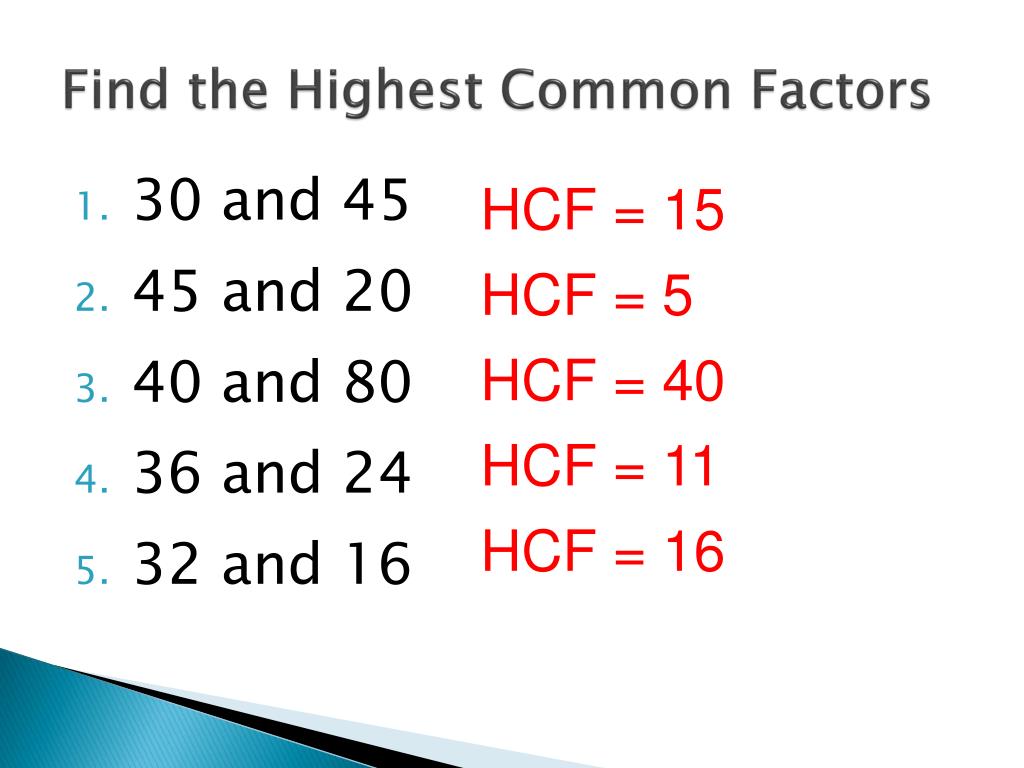
The highest common factor (HCF) of 12 and 18 is 6. This value represents the largest positive integer that divides both 12 and 18 without leaving a remainder. In mathematical terms, 6 is the greatest element in the set of common factors shared by these two specific numbers.
Understanding the Concept of the Highest Common Factor
The Highest Common Factor, often abbreviated as HCF, is a fundamental concept in number theory and arithmetic. It is also frequently referred to as the Greatest Common Divisor (GCD) or the Greatest Common Factor (GCF). Regardless of the terminology used, the objective remains the same: identifying the largest whole number that can be divided into two or more numbers evenly.
In 2026, understanding HCF remains a cornerstone of mathematics education and practical application, particularly in fields such as computer science, cryptography, and logistical planning. When we examine the relationship between 12 and 18, we are looking for the maximum size of a "unit" that can fit perfectly into both quantities. This is not merely a theoretical exercise; it is the basis for simplifying fractions, finding common denominators, and optimizing resources in various engineering and scheduling tasks.
The Importance of Factors
To understand why 6 is the HCF of 12 and 18, one must first understand what a factor is. A factor is a number that divides another number completely, resulting in an integer quotient and a remainder of zero. For example, if you have 12 items, you can arrange them into equal groups of 1, 2, 3, 4, 6, or 12. These are the factors of 12. Similarly, 18 items can be grouped into 1, 2, 3, 6, 9, or 18. The HCF is the largest group size that works for both sets of items simultaneously.
Methodology 1: The Listing Method
The most intuitive way to determine that 6 is the highest common factor of 12 and 18 is through the listing method. This involves identifying every individual factor for both numbers and then comparing the lists to find the intersection.
Factors of Twelve
To find the factors of 12, we look for pairs of numbers that, when multiplied together, equal 12:
- 1 × 12 = 12
- 2 × 6 = 12
- 3 × 4 = 12
Therefore, the complete set of factors for 12 is: {1, 2, 3, 4, 6, 12}.
Factors of Eighteen
Using the same logic for 18, we identify the multiplication pairs:
- 1 × 18 = 18
- 2 × 9 = 18
- 3 × 6 = 18
The complete set of factors for 18 is: {1, 2, 3, 6, 9, 18}.
Identifying the Common Factors
Next, we look for numbers that appear in both sets. These are the "common factors."
- 1 is in both lists.
- 2 is in both lists.
- 3 is in both lists.
- 6 is in both lists.
The set of common factors for 12 and 18 is {1, 2, 3, 6}. Among these, the largest number is 6. Thus, 6 is the highest common factor.
Methodology 2: Prime Factorization
For larger numbers, listing every factor can become cumbersome and prone to error. Professional mathematicians and senior students often prefer prime factorization. This method breaks each number down into its most basic building blocks: prime numbers.
Prime Factorization of 12
A prime number is a number greater than 1 that has no divisors other than 1 and itself. We begin dividing 12 by the smallest prime number, which is 2.
- 12 ÷ 2 = 6
- 6 ÷ 2 = 3
- 3 ÷ 3 = 1
The prime factors of 12 are 2, 2, and 3. Written in exponential form, this is 2² × 3¹.
Prime Factorization of 18
We apply the same process to 18:
- 18 ÷ 2 = 9
- 9 ÷ 3 = 3
- 3 ÷ 3 = 1
The prime factors of 18 are 2, 3, and 3. Written in exponential form, this is 2¹ × 3².
Determining the HCF from Prime Factors
To find the HCF using this method, we identify the common prime bases and choose the one with the lowest exponent for each.
- Common Prime Base 2: The exponents are 2 (for 12) and 1 (for 18). We choose the lower exponent, which is 2¹.
- Common Prime Base 3: The exponents are 1 (for 12) and 2 (for 18). We choose the lower exponent, which is 3¹.
To get the final HCF, we multiply these choices together: 2¹ × 3¹ = 2 × 3 = 6.
This method confirms that 6 is indeed the highest common factor. It provides a more structured approach that is essential when dealing with three or more numbers or values in the thousands.
Methodology 3: The Euclidean Algorithm
The Euclidean Algorithm is one of the oldest and most efficient algorithms in mathematics, attributed to the Greek mathematician Euclid. It is based on the principle that the HCF of two numbers does not change if the smaller number is subtracted from the larger number. In a more modern application, we use the division remainder (modulo).
Step-by-Step Calculation for 12 and 18
The algorithm follows a simple iterative process:
- Divide the larger number (18) by the smaller number (12).
- Identify the remainder.
- Replace the larger number with the smaller number and the smaller number with the remainder.
- Repeat until the remainder is zero.
Step 1: 18 ÷ 12
- 18 = (1 × 12) + 6
- The remainder is 6.
Step 2: Now, divide the previous divisor (12) by the remainder (6).
- 12 ÷ 6
- 12 = (2 × 6) + 0
- The remainder is 0.
Once the remainder reaches zero, the divisor used in that step is the HCF. In this case, the divisor was 6. Therefore, the HCF is 6. This method is particularly useful in computer programming (such as Python or C++) as it can be implemented with a simple "while" loop, making it the standard approach for digital calculations in 2026.
Comparison of Methods
Choosing the right method depends on the context of the problem and the numbers involved. The following table compares the three primary methods discussed.
| Method | Best Used For | Pros | Cons |
|---|---|---|---|
| Listing Factors | Small integers (like 12 and 18) | Easy to visualize and understand for beginners. | Slow for large numbers; easy to miss a factor. |
| Prime Factorization | Medium-sized numbers | Highly structured; helps in finding LCM as well. | Requires knowledge of prime numbers and exponents. |
| Euclidean Algorithm | Large numbers and programming | Extremely fast and efficient; no need to know factors. | Can be abstract; requires understanding of remainders. |
Practical Applications of HCF 6
Knowing that 6 is the HCF of 12 and 18 is not just an academic fact; it has several practical uses in real-world scenarios.
Simplifying Fractions
If you are working with the fraction 12/18, you can use the HCF to reduce it to its simplest form. By dividing both the numerator and the denominator by their HCF (6), you get:
- 12 ÷ 6 = 2
- 18 ÷ 6 = 3
The simplified fraction is 2/3. This is the most efficient way to handle ratios in chemistry, construction, and cooking.
Grouping and Tiling
Suppose you have two pieces of timber, one 12 feet long and the other 18 feet long. You want to cut them into smaller pieces of equal length without any wood being wasted. What is the longest possible length for these pieces? The answer is 6 feet. You would get two 6-foot pieces from the 12-foot plank and three 6-foot pieces from the 18-foot plank.
Distribution Logistics
Imagine a teacher has 12 pens and 18 notebooks to distribute among students. To ensure every student receives the exact same number of pens and the exact same number of notebooks with nothing left over, the teacher must find the HCF. The HCF of 6 means the items can be distributed to a maximum of 6 students, with each student receiving 2 pens and 3 notebooks.
The Relationship Between HCF and LCM
It is also valuable to understand how the Highest Common Factor (HCF) relates to the Least Common Multiple (LCM). While the HCF looks for the largest common divisor, the LCM looks for the smallest number that both 12 and 18 can divide into.
There is a consistent mathematical relationship between these two values: Product of Two Numbers = HCF × LCM
For the numbers 12 and 18:
- Product = 12 × 18 = 216
- HCF = 6
- To find the LCM: 216 ÷ 6 = 36
Thus, the LCM of 12 and 18 is 36. This relationship is a useful verification tool. If you know the HCF is 6, and you calculate an LCM that doesn't satisfy this equation, you know an error has occurred in your calculations.
Common Mistakes to Avoid
When determining the HCF of 12 and 18, students and practitioners often encounter a few common pitfalls:
- Confusing HCF with LCM: A common error is providing 36 instead of 6. Remember that the "Factor" (HCF) must be equal to or smaller than the numbers involved, while the "Multiple" (LCM) must be equal to or larger.
- Stopping at a Common Factor: Some might identify 2 or 3 as a common factor and stop there. While 2 and 3 are factors of both 12 and 18, they are not the highest. Always check if a larger number (like 6) fits.
- Prime Factorization Errors: When using prime factorization, it is easy to forget to include all instances of a prime or to accidentally use a non-prime number (like 4 or 9) in the tree.
- Division Calculation Errors: Especially in the Euclidean algorithm, a simple subtraction or division error can lead to the wrong remainder, throwing off the entire sequence.
Frequently Asked Questions
Is the GCF of 12 and 18 the same as the HCF?
Yes. GCF (Greatest Common Factor), GCD (Greatest Common Divisor), and HCF (Highest Common Factor) are identical concepts used interchangeably in different regions and educational systems. In the United States, GCF is more common, whereas HCF is frequently used in the UK, India, and other Commonwealth nations.
Why isn't 12 the HCF of 12 and 18?
While 12 is a factor of 12, it is not a factor of 18. If you divide 18 by 12, you get 1 with a remainder of 6. A factor must divide the number perfectly with a zero remainder. Since 12 does not divide 18 evenly, it cannot be a common factor, let alone the highest one.
Can the HCF of two numbers be 1?
Yes. If two numbers share no common factors other than 1, their HCF is 1. These numbers are called co-prime or relatively prime. For example, the HCF of 12 and 13 is 1. However, since 12 and 18 are both even numbers, they will always have at least 2 as a common factor, meaning they can never be co-prime.
How does the HCF change if we add a third number, like 24?
To find the HCF of 12, 18, and 24, you find the common factors of all three.
- Factors of 12: {1, 2, 3, 4, 6, 12}
- Factors of 18: {1, 2, 3, 6, 9, 18}
- Factors of 24: {1, 2, 3, 4, 6, 8, 12, 24} The largest number present in all three lists is still 6. Therefore, the HCF of 12, 18, and 24 is 6.
Is there a fast way to find the HCF of 12 and 18 mentally?
A quick mental trick is to find the difference between the two numbers. The difference between 18 and 12 is 6. Often, the HCF is either the difference itself or a factor of that difference. Since 6 divides both 12 and 18 perfectly, you can immediately identify it as the HCF.
Recommendation for Further Study
For those looking to master number theory or prepare for advanced mathematics in 2026, it is highly recommended to practice the Euclidean Algorithm specifically. While listing factors is helpful for small numbers like 12 and 18, the Euclidean method scales to any size and provides a deeper understanding of how numbers interact. For digital practitioners, exploring how this algorithm is used in modern encryption—such as RSA—will demonstrate the vital importance of the HCF (GCD) in securing 21st-century communications.