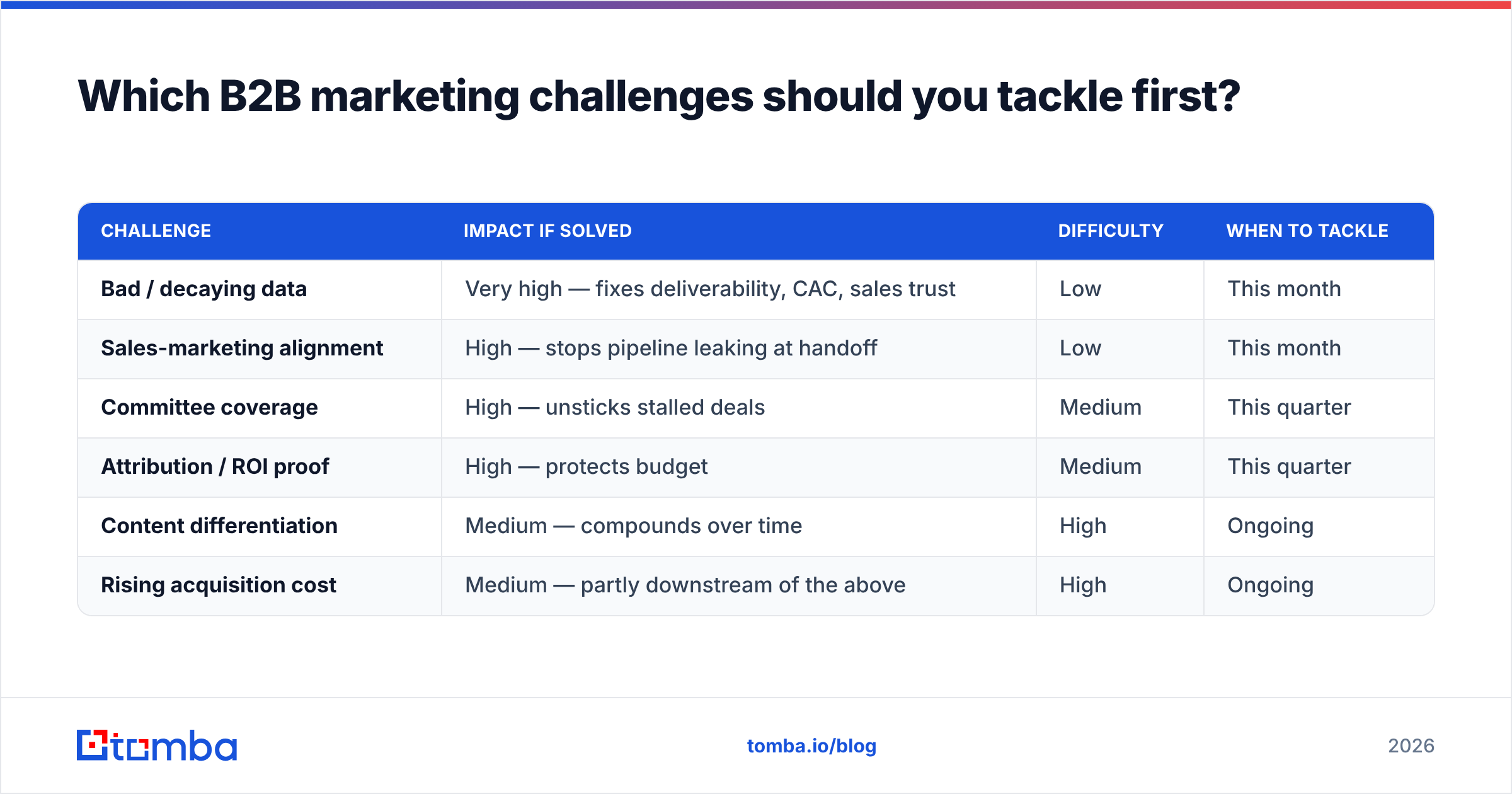
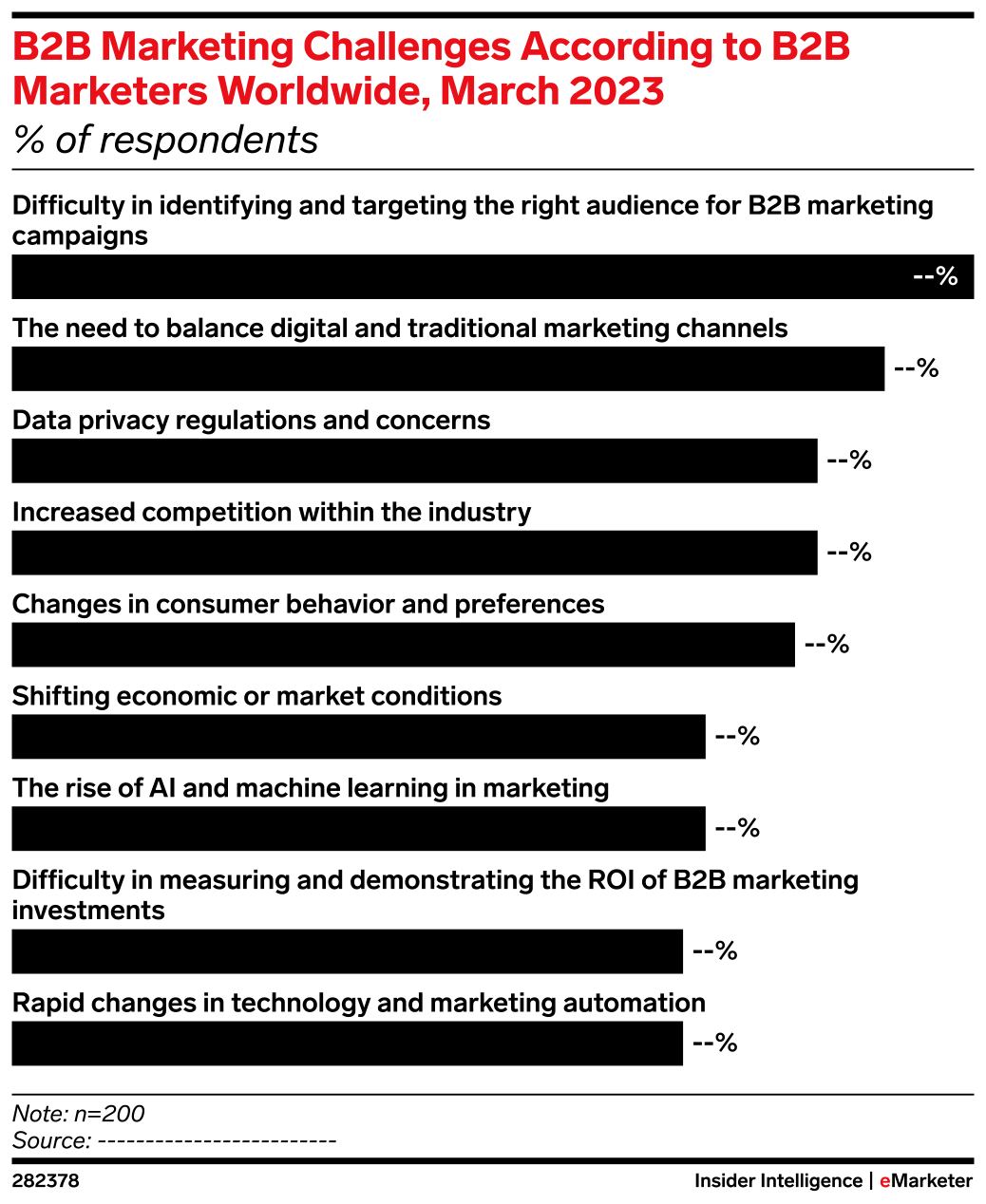
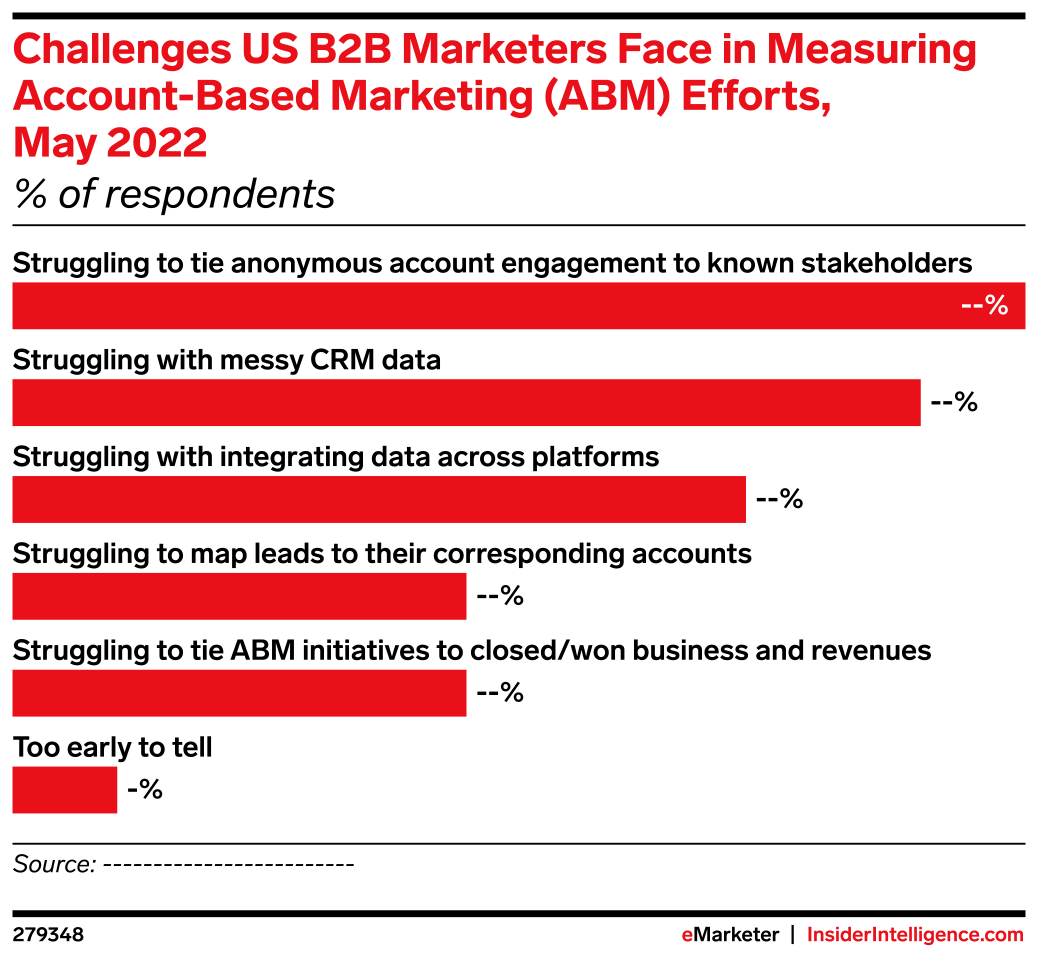
Modern B2B marketing in 2026 requires navigating a landscape defined by extreme data privacy, the ubiquity of generative AI, and fragmented buyer journeys. Companies currently struggle with attribution in cookieless environments, content saturation, sales-marketing misalignment, the rise of "dark social," and managing increasingly large, anonymous buying committees that resist traditional outbound tactics.
1. Navigating the Post-Cookie Attribution Crisis and Signal Loss
As of 2026, the complete phasing out of third-party cookies across all major browsers has fundamentally altered how B2B organizations track the customer journey. This "signal loss" means that the traditional linear path from a click to a conversion is no longer visible through standard analytics tools. For B2B marketers, who often deal with sales cycles lasting six to eighteen months, the inability to connect early-stage awareness with late-stage revenue is a critical roadblock.
The Shift to First-Party and Zero-Party Data
To combat this, companies are forced to prioritize the collection of first-party data (information collected directly from your audience) and zero-party data (information customers intentionally share). This requires a value-exchange model where users are willing to trade their contact information and professional details for high-value insights, specialized tools, or exclusive community access. However, the challenge lies in the infrastructure; many legacy MarTech stacks are not equipped to unify these disparate data points into a cohesive "Golden Record" of the customer.
Privacy-Preserving Measurement
The regulatory environment has also tightened. With the maturation of the EU AI Act and expanded privacy laws in North America, B2B marketers must now utilize privacy-preserving measurement techniques. This includes server-side tracking and Marketing Mix Modeling (MMM). Unlike traditional attribution, MMM uses statistical analysis to estimate the impact of various marketing tactics on revenue without needing to track individual user movements. Implementing these complex mathematical models requires a level of data science expertise that many mid-market B2B marketing teams still lack.
2. Overcoming Content Saturation and the "AI Noise" Floor
By 2026, the barrier to entry for content production has effectively vanished. Generative AI tools can produce thousands of white papers, blog posts, and social media updates in seconds. This has led to an unprecedented level of content saturation, making it nearly impossible for high-quality, human-led thought leadership to reach its intended audience through organic search or social feeds alone.
The Requirement for Information Gain
Search engines and social algorithms have pivoted to prioritize "Information Gain"—a metric that rewards content providing new, unique information not found in the existing index. For B2B companies, the challenge is moving away from "SEO-first" content that merely rehashes existing ideas. Instead, they must invest in original research, proprietary data reports, and first-person expert interviews. These assets are expensive and time-consuming to produce, creating a significant resource strain on marketing departments that are simultaneously being asked to do more with less.
Maintaining Brand Voice in an Automated World
Furthermore, as companies integrate agentic AI to handle personalized email outreach and LinkedIn engagement, maintaining a consistent and authentic brand voice becomes difficult. When every competitor is using the same underlying Large Language Models (LLMs) to generate "personalized" messages, the result is a paradoxical state of "automated genericism." B2B buyers have become highly sensitive to AI-generated outreach, often disregarding any communication that feels even slightly robotic. The challenge is using AI for efficiency while keeping the "human-in-the-loop" to ensure strategic nuance.
3. Bridging the Gap Between Marketing, Sales, and RevOps
The divide between marketing and sales is a perennial issue, but in 2026, the stakes are higher due to the demand for extreme efficiency. The traditional "hand-off" model—where marketing generates a Lead (MQL) and hands it to Sales (SAL)—is largely seen as obsolete. B2B buyers now perform up to 80% of their research before ever speaking to a representative, meaning the roles of marketing and sales have become permanently blurred.
The Data Silo Problem
The primary technical challenge here is the persistence of data silos. Marketing may be looking at engagement metrics in a Customer Data Platform (CDP), while Sales is looking at deal velocity in a CRM. Without a unified Revenue Operations (RevOps) framework, the two departments often work at cross-purposes. For example, marketing might be incentivized to drive volume, while sales requires high-intent accounts. This misalignment leads to wasted ad spend and missed revenue targets.
Shared KPIs and Full-Funnel Accountability
Successful companies in 2026 have moved toward shared KPIs, such as "Pipeline Velocity" and "Customer Acquisition Cost (CAC) by Cohort." However, transitioning to this model requires a cultural shift and a re-engineering of the compensation structure for both marketing and sales leaders. Achieving this "Single Source of Truth" remains a top-tier challenge for B2B organizations attempting to scale in a volatile economic climate.
4. Capturing Demand in the "Dark Social" Funnel
A significant portion of the B2B buying journey now happens in "Dark Social"—private channels where marketers have no visibility or tracking capabilities. This includes Slack communities, Discord servers, private LinkedIn groups, and direct messages between peers. Research suggests that B2B buyers trust peer recommendations far more than any vendor-produced content.
The Attribution Gap in Private Communities
Because these interactions cannot be tracked via UTM codes or cookies, they often appear in analytics as "Direct" traffic or "Organic Search," leading marketers to undervalue the channels that actually drove the decision. The challenge for companies is to influence these private conversations without being intrusive. This requires a shift from traditional "Demand Capture" (ads and gated content) to "Demand Generation" (building brand affinity through un-gated, high-value participation in the ecosystem).
Employee Advocacy as a Solution
To penetrate these dark channels, companies are increasingly relying on employee advocacy programs. When a subject matter expert within a company shares a unique insight on their personal profile, it carries more weight than a corporate brand post. However, managing an advocacy program at scale—while ensuring compliance and brand consistency—is a complex operational hurdle. It requires training staff to be content creators, which is often outside their core job descriptions.
5. Managing Complexity in the B2B Buying Committee
The average B2B buying committee has grown to include 10 to 12 stakeholders, ranging from finance and IT to legal and end-users. In 2026, these committees are more risk-averse than ever. Each stakeholder has different concerns: IT focuses on integration and security, Finance on ROI and TCO (Total Cost of Ownership), and end-users on UX and functionality.
Multi-Threaded Account-Based Marketing (ABM)
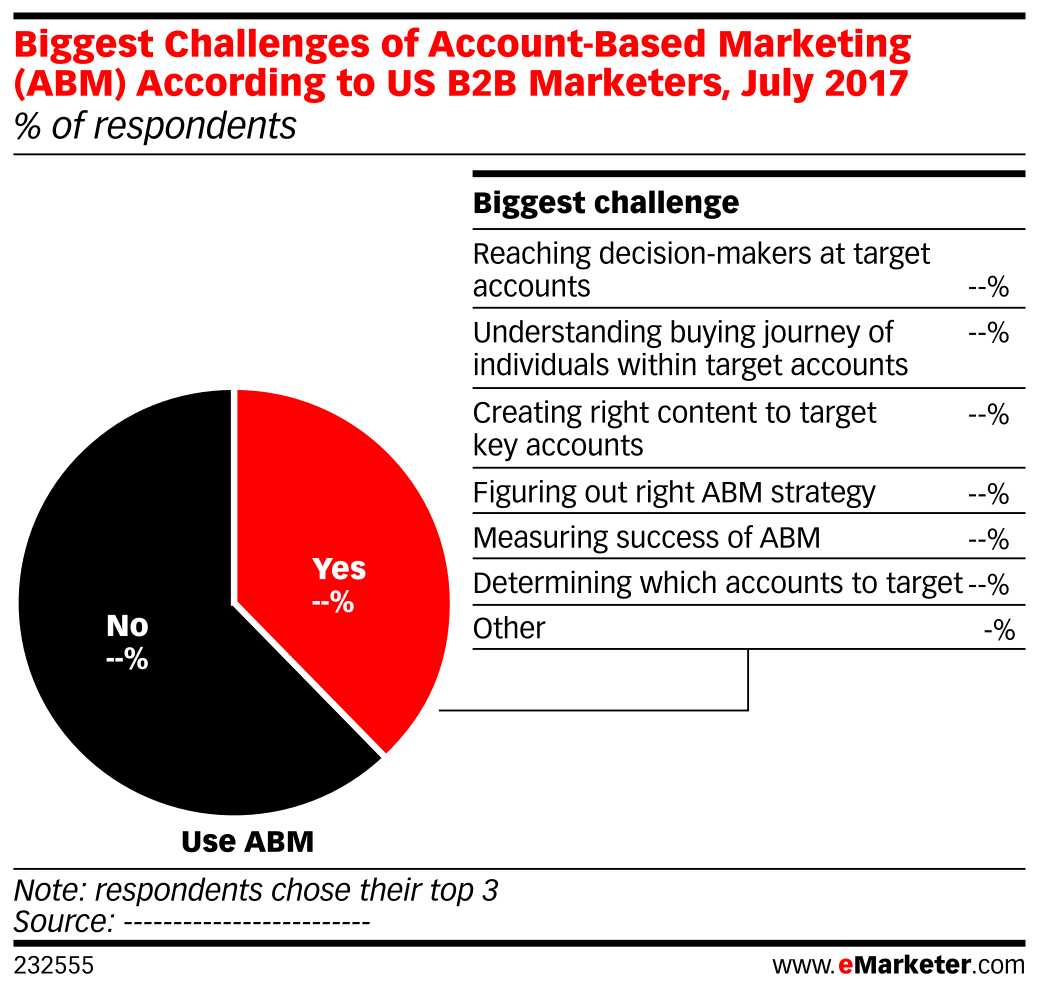
The challenge is delivering the right message to the right stakeholder at the right time. A generic "one-size-fits-all" marketing approach fails because it doesn't address the specific anxieties of the different committee members. Companies must employ "multi-threaded" ABM strategies, creating customized content paths for every role involved in the purchase. This level of personalization is difficult to achieve without significant investment in MarTech and creative resources.
The "Status Quo" as the Biggest Competitor
In a high-interest-rate environment, the biggest competitor for most B2B companies is not another vendor, but "no decision." Buying committees often choose to stick with their current, albeit flawed, processes rather than risk a failed implementation. Marketing's challenge is no longer just proving that their product is the best, but proving that the cost of inaction is higher than the cost of change.
| Challenge Category | 2026 Core Obstacle | Required Strategic Shift | Key Technology/Tool |
|---|---|---|---|
| Data & Privacy | Third-party cookie deprecation/Signal loss | Focus on First-Party Data & MMM | Customer Data Platforms (CDP) |
| Content Strategy | AI-generated content saturation | Focus on "Information Gain" & Research | Proprietary Data/Surveys |
| Organizational | Sales and Marketing misalignment | Unified RevOps & Shared Pipeline KPIs | Integrated CRM/RevOps Suites |
| Buyer Behavior | Dark Social & Invisible Journeys | Community-led Growth & Advocacy | Employee Advocacy Platforms |
| Sales Cycle | Large, Risk-Averse Buying Committees | Multi-threaded ABM | Intent Data Providers |
Frequently Asked Questions
Why is B2B attribution more difficult in 2026 than in previous years?
Attribution has become harder primarily due to the "Triple Threat" of privacy regulations (like GDPR/CCPA updates), the technical removal of third-party cookies by browsers, and the increased complexity of the B2B buyer journey. Buyers now use multiple devices and interact with brands across private channels (Dark Social) that do not pass referral data. This makes it impossible to use traditional "last-click" models, forcing companies to adopt more complex, probabilistic modeling like Marketing Mix Modeling.
How can B2B companies stand out if AI is generating all the content?
To stand out, companies must provide "Information Gain." This means publishing content that contains data, insights, or perspectives that an AI cannot generate because they don't exist in its training data. Examples include original industry benchmarks, case studies with specific proprietary metrics, and contrarian thought leadership from recognized human experts. Brand personality and "human" storytelling are now more valuable than ever because they are scarce.
What is the role of "Dark Social" in B2B marketing?
Dark Social refers to the "invisible" mentions and recommendations that happen in private messaging apps, email, and closed communities. In 2026, this is where the majority of brand discovery and vendor shortlisting occurs. Marketers cannot track it directly, so they must influence it indirectly by creating "contagious" content that people want to share privately and by encouraging their employees to build personal brands within those communities.
Is Account-Based Marketing (ABM) still effective?
Yes, but it has evolved. In 2026, "Broad ABM" is dead. Effective ABM is now "Hyper-Personalized" and "Multi-Threaded." This involves identifying the specific individuals within a buying committee and serving them content tailored to their specific job function and stage in the journey. It requires a deep integration between marketing automation and sales intelligence tools to ensure the messaging is consistent across all touchpoints.
What is RevOps, and why is it necessary?
Revenue Operations (RevOps) is the strategic integration of sales, marketing, and customer success operations. It is necessary because it breaks down data silos and ensures that all teams are working toward a single goal: revenue growth. By centralizing data and processes, RevOps allows for better lead scoring, more accurate forecasting, and a smoother transition for the customer as they move through the funnel.
Practical Recommendation: The Next Steps
To address these five challenges, B2B organizations should prioritize a "Data-First, Content-Unique" strategy. Start by auditing your current MarTech stack to ensure it can support server-side tracking and first-party data collection; this is the only way to survive the cookieless future. Simultaneously, move away from high-volume, low-quality content production. Instead, redirect that budget toward one major original research project per quarter that can be sliced into hundreds of smaller, high-signal assets for different members of the buying committee. Finally, formalize your RevOps function to ensure that your marketing efforts are directly fueling the sales pipeline with high-intent accounts rather than just vanity metrics.