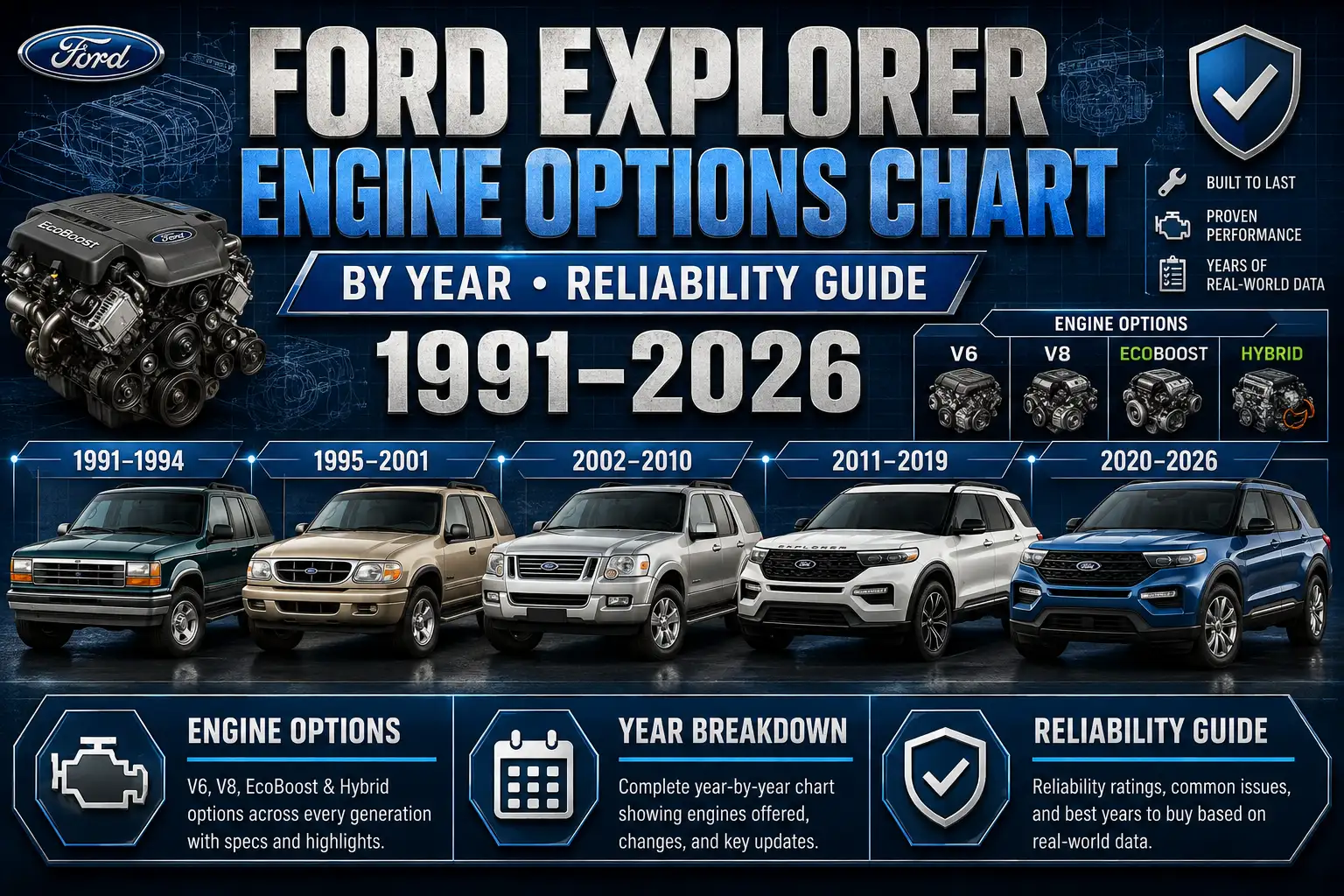
The 2020 Ford Explorer offers three distinct engine options across its lineup: a standard 2.3-liter EcoBoost turbocharged inline-four, a larger 3.0-liter EcoBoost twin-turbocharged V6, and a 3.3-liter hybrid V6 powertrain designed to balance fuel economy with traditional utility performance.
When Ford redesigned the Explorer for the 2020 model year, it transitioned the platform from a front-wheel-drive-based layout to a rear-wheel-drive architecture. This significant engineering shift directly influenced how power is delivered, how towing capacities are rated, and how the vehicle handles varying road conditions. Choosing the right engine for a 2020 Ford Explorer depends on evaluating your specific priorities, whether that means maximizing fuel economy for long highway commutes, demanding high towing capacity for heavy trailers, or seeking a balanced daily driver with responsive acceleration.
Understanding the technical specifications, performance metrics, fuel economy ratings, and ideal use cases for each powertrain helps prospective buyers and current owners navigate the complexities of the sixth-generation Explorer lineup.
The 2020 Ford Explorer Powertrain Architecture
The sixth-generation Ford Explorer introduced a completely overhauled powertrain strategy. By moving to the CD6 rear-wheel-drive platform, Ford positioned the engine longitudinally rather than transversely. This orientation allows for better weight distribution, improved handling dynamics, and more seamless integration of four-wheel-drive and intelligent all-wheel-drive systems.
Each engine option is paired with a 10-speed SelectShift automatic transmission. This multi-speed transmission is engineered to keep the engine operating within its optimal power band while reducing fuel consumption during highway cruising. The transmission utilizes a wide gear ratio spread, allowing for a low first gear for strong launch acceleration and multiple overdrive gears to lower engine RPM at highway speeds.
1. The Standard 2.3-Liter EcoBoost Inline-Four
Overview and Specifications
The 2.3-liter EcoBoost I-4 serves as the entry-level engine for the 2020 Explorer, powering the base, XLT, and Limited trim levels. Despite its small displacement, this turbocharged and direct-injected engine delivers substantial output through a twin-scroll turbocharger that virtually eliminates turbo lag.
- Horsepower: 300 hp at 5,500 RPM
- Torque: 310 lb-ft at 3,500 RPM
- Induction: Turbocharged, direct injection
- Fuel Requirement: Regular unleaded (87 octane recommended, though premium yields minor performance gains)
Performance and Drivability
For daily commuting and general family transportation, the 2.3-liter EcoBoost provides more than adequate power. Peak torque arrives relatively low in the rev range at 3,500 RPM, giving the midsize SUV a responsive feel from a stoplight. When paired with the 10-speed automatic transmission, power delivery remains smooth and linear.
Fuel Economy and Efficiency
One of the primary benefits of choosing the four-cylinder EcoBoost is fuel efficiency. In rear-wheel-drive configurations, the EPA estimated fuel economy sits at approximately 21 mpg city and 28 mpg highway. Selecting the Intelligent 4WD system decreases these figures slightly to around 20 mpg city and 27 mpg highway, depending on the specific trim level and wheel size.
Towing Capacity
When properly equipped with the Class III Trailer Tow Package, the 2.3-liter EcoBoost model achieves a maximum towing capacity of 5,300 pounds. This capacity comfortably handles small utility trailers, pop-up campers, and lightweight boats.
2. The High-Performance 3.0-Liter EcoBoost V6
Overview and Specifications
Reserved for performance-oriented and luxury trims—specifically the ST and the Platinum—the 3.0-liter EcoBoost V6 utilizes twin turbochargers to deliver V8-like performance from a smaller displacement block.
- Horsepower: 400 hp at 5,500 RPM (ST and Platinum) / 365 hp on earlier exploratory builds, standardized to 400 hp for production ST/Platinum models.
- Torque: 415 lb-ft at 3,500 RPM
- Induction: Twin-turbocharged (biturbo), direct injection
- Fuel Requirement: Premium fuel (91 octane or higher recommended for maximum advertised output)
Performance and Drivability
The 3.0-liter twin-turbo V6 transforms the driving dynamics of the Explorer. In the ST trim, the suspension is stiffened, and the transmission mapping is tuned for sharper shifts. The 415 lb-ft of torque creates rapid acceleration, allowing the heavy SUV to reach 60 mph in under six seconds—a notable achievement for a three-row family hauler.
Fuel Economy and Efficiency
Unsurprisingly, the pursuit of high performance incurs a penalty at the fuel pump. The 3.0-liter EcoBoost V6 returns an EPA-estimated fuel economy of roughly 18 mpg city and 24 mpg highway in standard 4WD configurations. Heavy throttle application will quickly push real-world figures below these EPA estimates.
Towing Capacity
With the standard Class III Trailer Tow Package, the 3.0-liter EcoBoost V6 matches the maximum towing capability of the platform, rated at 5,600 pounds. The abundant low-end torque makes pulling heavy loads up steep grades significantly easier compared to the base four-cylinder engine.
3. The 3.3-Liter Hybrid V6 Powertrain
Overview and Specifications
Ford introduced a hybrid variant for the 2020 model year, combining a naturally aspirated 3.3-liter V6 engine with an electric motor integrated into the transmission housing. This powertrain is primarily found on the Limited Hybrid trim and certain police interceptor variants.
- Combined Horsepower: 318 hp at 6,500 RPM
- Combined Torque: 322 lb-ft at 2,500 RPM
- Battery Pack: 1.5-kWh liquid-cooled lithium-ion battery
- Transmission: 10-speed hybrid modular hybrid transmission
Performance and Drivability
The hybrid system uses electric motor assistance to fill in the torque gaps during initial acceleration. While it lacks the aggressive punch of the 3.0-liter twin-turbo V6, the hybrid powertrain feels remarkably smooth and quiet during city driving. The transition between electric-only operation and internal combustion engine activation is seamless under normal driving conditions.
Fuel Economy and Range
The primary selling point of the 3.3L Hybrid is efficiency and extended range. Rear-wheel-drive hybrid models achieve up to 27 mpg city and 29 mpg highway, while four-wheel-drive variants achieve approximately 23 mpg city and 26 mpg highway. Combined with an 18-gallon fuel tank, the hybrid offers a cruising range exceeding 500 miles on a single fill-up.
Towing Capacity
Despite being a hybrid, this model retains functional utility. When equipped with the Class III Trailer Tow Package, the 3.3L Hybrid is rated to tow up to 5,000 pounds, making it a viable option for those who want high fuel economy without completely sacrificing towing capability.
Comparative Specifications Table
| Engine Option | Displacement | Horsepower | Torque | EPA Fuel Economy (RWD/4WD Est.) | Max Towing Capacity | Primary Trims |
|---|---|---|---|---|---|---|
| 2.3L EcoBoost I4 | 2.3 Liters | 300 hp | 310 lb-ft | 21/28 mpg (RWD) 20/27 mpg (4WD) | 5,300 lbs | Base, XLT, Limited |
| 3.0L EcoBoost V6 | 3.0 Liters | 400 hp | 415 lb-ft | 18/24 mpg (4WD Standard) | 5,600 lbs | ST, Platinum |
| 3.3L V6 Hybrid | 3.3 Liters | 318 hp (Combined) | 322 lb-ft | 27/29 mpg (RWD) 23/26 mpg (4WD) | 5,000 lbs | Limited Hybrid |
Drivetrain Configurations: RWD vs. Intelligent 4WD
The choice of engine is closely tied to how power reaches the pavement. Unlike previous generations where front-wheel drive was standard, the 2020 Explorer uses rear-wheel drive as its baseline.
Rear-Wheel Drive (RWD)
- Availability: Standard on 2.3L EcoBoost (Base, XLT, Limited) and 3.3L Hybrid RWD models.
- Characteristics: Offers a balanced weight distribution, a tighter turning radius, and slightly higher fuel economy figures.
Intelligent Four-Wheel Drive (4WD)
- Availability: Optional on 2.3L and 3.3L models; standard on the 3.0L EcoBoost ST and Platinum.
- Characteristics: Features a terrain management system with selectable drive modes (Normal, Trail, Deep Snow/Sand, Slippery, Sport, Tow/Haul, and Eco). The system continuously monitors traction and can automatically transfer torque between the front and rear axles before wheel slip occurs.
Frequently Asked Questions
Which 2020 Ford Explorer engine is the most reliable?
Long-term reliability data indicates that the naturally aspirated 3.3L V6 hybrid engine and the 2.3L EcoBoost four-cylinder have proven generally reliable when properly maintained. The 2.3L EcoBoost has been a staple of Ford’s lineup for years, though early sixth-generation models required routine checks regarding coolant intrusion bulletins on select early-production blocks. The 3.0L EcoBoost V6 is mechanically robust but experiences higher thermal loads due to twin turbocharging, making strict adherence to oil change intervals essential.
Can all 2020 Ford Explorer engines tow a camper?
Yes, but capacities vary. The 2.3L EcoBoost (5,300 lbs), 3.0L EcoBoost V6 (5,600 lbs), and 3.3L Hybrid (5,000 lbs) can all tow lightweight to medium-sized campers, provided the vehicle is equipped with the optional Class III Trailer Tow Package. Always verify your specific vehicle's Gross Combined Weight Rating (GCWR) and tongue weight limits before hitching a trailer.
Do the 2020 Explorer engines require premium fuel?
Only the 3.0-liter EcoBoost V6 (found in the ST and Platinum) specifically benefits from and recommends 91-octane premium fuel to achieve its advertised 400 horsepower. The 2.3-liter EcoBoost and the 3.3-liter Hybrid are engineered to run on standard 87-octane regular unleaded fuel without risking engine damage, though the engine computer will automatically adjust timing if higher octane is used.
Why does the 2020 Explorer use a 10-speed automatic transmission?
The 10-speed transmission allows the engine to operate in its optimal power and efficiency band across a wider range of vehicle speeds. Having more gears means the engine can cruise at lower RPMs on the highway, reducing fuel consumption, while lower gear ratios provide strong acceleration from a dead stop and better control when towing.
Is the 2020 Explorer Hybrid worth the extra cost?
The 3.3L Hybrid makes financial and practical sense primarily for drivers who log significant miles in heavy city traffic where regenerative braking and electric motor assist maximize fuel savings. If your driving habits consist mostly of short trips or sustained high-speed highway cruising, the standard 2.3L EcoBoost may offer a more favorable upfront purchase price relative to its fuel savings.
Recommendations and Next Steps
When selecting a 2020 Ford Explorer, match your choice directly to your driving profile:
- Choose the 2.3L EcoBoost if you need a balanced, cost-effective daily driver that offers great fuel economy, ample cargo space, and respectable towing capability for everyday family tasks.
- Choose the 3.0L EcoBoost V6 if performance, rapid acceleration, sport-tuned handling, and maximum towing capacity are your primary requirements.
- Choose the 3.3L Hybrid if you prioritize maximum driving range, reduced environmental impact, and superior fuel economy in stop-and-go urban environments.
Before purchasing a used 2020 model, always request the complete service history, verify whether recall services have been performed by an authorized Ford dealer, and inspect the transmission fluid condition and cooling systems.