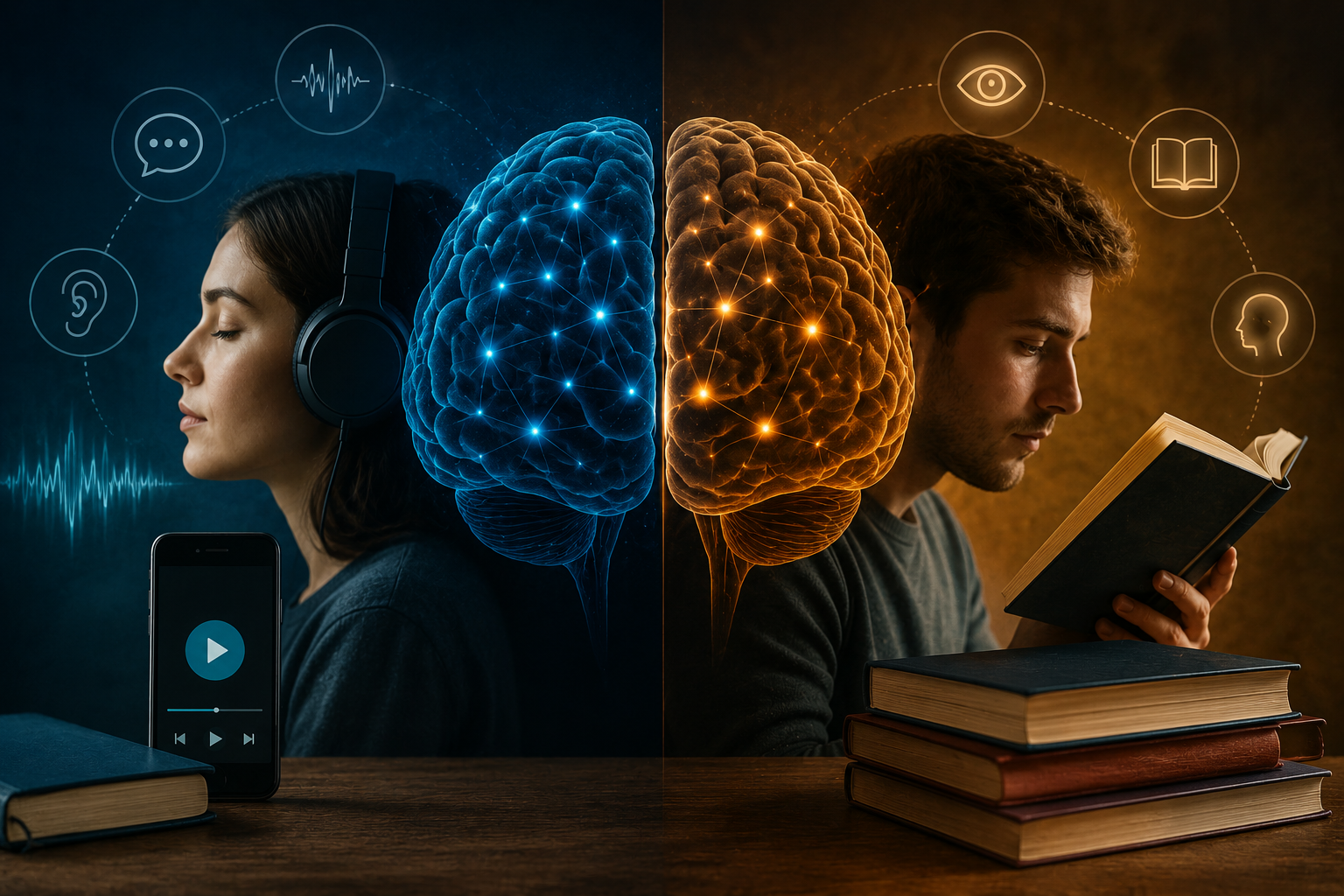
Whether audiobooks are better than reading is not a question of objective superiority, but rather a matter of how your brain processes, retains, and integrates information based on the medium. Both formats utilize different sensory pathways—visual and auditory—that impact neural activity, focus, and comprehension in unique ways. By understanding the distinct mechanics of listening versus reading, you can select the method that best aligns with your cognitive goals, environment, and specific learning objectives.
The Cognitive Mechanics: How the Brain Processes Text vs. Audio
To evaluate whether audiobooks are "better," one must first examine the fundamental difference in input. Reading is an active, multisensory process. When you read, your brain performs a complex sequence of tasks: it recognizes orthographic patterns (the shapes of letters), decodes them into phonemes (sounds), maps those sounds to words, and reconstructs the meaning. This labor-intensive process requires sustained visual attention and internal orchestration. Because the brain is working harder to decode the symbols, this often leads to deeper cognitive engagement and improved focus for many readers.
In contrast, listening to an audiobook is a passive reception of sensory input that bypasses the decoding stage. The voice actor provides the cadence, stress, and intonation, which reduces the cognitive load on the listener. While this makes it significantly easier to consume long-form content, it can occasionally lead to "mind-wandering." Because the brain is not physically tethered to the text, it is easier for listeners to lose their place or drift into unrelated thoughts. However, for narrative fiction, this reduction in cognitive friction can lead to a more immersive experience, as the listener is freed from the mechanical act of decoding.
Retention and Comprehension: Comparing Mediums
The debate often centers on which format facilitates better retention. Academic research generally suggests that the difference in comprehension between listening and reading is marginal when the content is of moderate difficulty. However, the divergence grows when the complexity of the material increases.
For technical, academic, or dense material, reading is almost universally considered superior. The ability to physically regress—to re-read a complex sentence, scan back to a previous paragraph, or pause to analyze a chart—is vital for memory consolidation. With an audiobook, the speed is set by the narrator, and the "spatial" nature of a physical book (where you know roughly where on the page a specific detail was located) provides topographical cues that aid in recall.
Audiobooks, conversely, excel in narrative retention, such as with novels, memoirs, or biographies. The performance element—voice acting, character distinction, and emotive pacing—creates a "theatre of the mind" effect. This can lead to a higher degree of emotional resonance. If your goal is to remember the emotional beats of a story, an audiobook may indeed feel "better." If your goal is to synthesize complex arguments or memorize data, visual reading remains the gold standard.
Situational Utility: When to Choose One Over the Other
The practical "better" often comes down to your current environment. The primary advantage of audiobooks is mobility. They transform dead time—commuting, exercising, doing household chores—into productive or entertaining time. This "stacking" of activities allows for a higher volume of consumption, which can be the difference between finishing a book and never starting it.
Conversely, reading requires dedicated, uninterrupted time. It necessitates a stationary environment where you can engage in deep work. While this might seem like a disadvantage in a fast-paced world, it serves as a form of deliberate practice. The requirement to set aside time for reading fosters discipline and creates a "deep work" state that is increasingly rare in modern life.
| Feature | Visual Reading | Audiobook Listening |
|---|---|---|
| Cognitive Load | Higher (Decoding required) | Lower (Passive reception) |
| Pacing Control | Absolute (Self-paced) | Limited (Narration-paced) |
| Mobility | Low (Requires environment) | High (Multitasking enabled) |
| Retention | Superior for complex data | Superior for emotional narrative |
| Neuro-engagement | Visual/Spatial focus | Auditory/Emotive focus |
Neuro-biological Impacts and Accessibility
For individuals with neurodivergent conditions or specific learning disabilities, the "better" format is often clearly defined. For those with dyslexia, audiobooks can provide an essential bridge to literature that might otherwise be inaccessible. By removing the barrier of visual decoding, audiobooks allow the listener to engage with high-level content, vocabulary, and plot structures that match their intellectual capacity, regardless of their proficiency in decoding orthographic text.
Furthermore, studies have shown that the brain regions activated by listening to stories overlap significantly with those activated by reading the same stories. However, reading is unique in how it requires the integration of visual processing with language areas. For the average adult, alternating between formats—a practice sometimes called "whispersyncing" or simultaneous listening and reading—can actually be an effective strategy for maintaining focus and increasing reading speed.
Addressing Common Myths and Practical Limitations
A frequent misconception is that listening to a book is "cheating" or a "lesser form" of learning. This is an antiquated view. Whether you are consuming information through your eyes or your ears, the brain processes the language, syntax, and narrative in fundamentally similar linguistic centers. The difference lies in the peripheral focus and the intensity of the cognitive effort, not in the quality of the information consumed.
However, there are technical limitations to consider:
- Speed Control: Most audiobook platforms allow for variable playback speeds (e.g., 1.25x or 1.5x). While this allows you to cover material faster, keep in mind that exceeding your brain’s natural processing speed for language can diminish retention.
- Accessibility to Data: Books containing complex figures, tables, or diagrams are rarely optimized for audio. If the text relies heavily on visual reference, the audiobook version will inevitably leave the reader with an incomplete understanding.
- Cost and Format: Audiobooks often require subscription-based models or specific digital files, whereas physical books or e-books (which allow for font resizing and note-taking) can sometimes offer more flexible ways to engage with the text.
How to Choose the Right Format for Your Needs
To determine the best approach, evaluate your primary purpose for consuming the material:
- For Professional Development/Academic Study: Opt for a physical book or a high-quality e-book. You need the ability to highlight, annotate, and backtrack. The physical act of note-taking serves as a secondary encoding process, cementing information in your long-term memory.
- For Fiction and Narrative Non-Fiction: If you find yourself struggling to stay focused during long reading sessions, try an audiobook. If the narrator is high-quality, the performance will keep you engaged in a way that visual text sometimes fails to do when you are tired.
- For Habit Building: If you feel like you aren't "reading enough," do not force yourself to sit in a chair if you don't have the time. Use audiobooks during your commute or while exercising. The goal is to establish a habit of consuming literature; once that habit is solidified, you can branch out into more challenging visual formats.
Frequently Asked Questions
Does listening to audiobooks count as reading? From a neurological and linguistic standpoint, yes. The brain processes the narrative content in the same language-comprehension centers used during visual reading. While the sensory input is different, the cognitive outcome—comprehending the story or argument—is the same.
Can I learn a new language through audiobooks? Audiobooks are excellent for developing listening comprehension and internalizing phonetics, but they are insufficient for learning a language from scratch. You will need visual material to understand grammar rules, orthography, and the structural foundations of the language.
Why do I fall asleep when I listen to audiobooks? This is a common issue often caused by "cognitive relaxation." Because your brain is not required to actively decode symbols, it enters a state of passive reception. If you are tired, this state often transitions into sleep. To counter this, listen while doing low-intensity physical tasks, such as walking or tidying up.
Are physical books better for children than audiobooks? For early literacy, physical books are vital. Children need to see the correlation between spoken words and the letters on the page to develop decoding skills. However, audiobooks can be a powerful supplementary tool for vocabulary building and fostering a love for storytelling.
Is there a limit to how much I can comprehend via audio? Yes. Everyone has a limit to their "auditory working memory." If you find that you have to pause the audiobook frequently to make sense of what was just said, the material is likely too dense for your current level of auditory focus. In such cases, switch to the print version.
Final Recommendation
The "better" option is a moving target. If you are reading to grow your knowledge base, analyze complex structures, or study, prioritize the visual medium. If you are reading to broaden your horizons, engage with narratives, or maximize your limited time, audiobooks are an invaluable tool. For the best of both worlds, consider dual-modality consumption: listen to a biography or a novel while you are on the move, and set aside a dedicated thirty minutes in the evening for reading a dense or technical book. By matching the medium to the intent, you ensure that you aren't just consuming content—you are effectively retaining and utilizing it.