The value of $\arccos\left(\frac{1}{2}\right)$ is $\frac{\pi}{3}$ radians, or $60^\circ$. This result comes from finding the angle within the restricted range of the inverse cosine function whose cosine equals one-half. By examining unit circle geometry, triangle ratios, and function properties, this core mathematical operation becomes clear and straightforward to calculate.
Introduction to Inverse Trigonometric Functions
Trigonometric functions like sine, cosine, and tangent take an angle as an input and output a ratio of side lengths from a right-angled triangle. Inverse trigonometric functions reverse this process. They take a numeric ratio as an input and output the corresponding angle.
When studying expressions like arccos 1 2 explained, students and engineers often encounter notation confusion. The notation $\arccos(x)$ is entirely interchangeable with $\cos^{-1}(x)$. Both represent the inverse cosine function. It is vital to note that the $-1$ superscript here is an operator notation for an inverse function, not an algebraic exponent. It does not mean $\frac{1}{\cos(x)}$.
Understanding how to evaluate this expression requires a solid grasp of both right-triangle trigonometry and circular functions. By breaking down the fundamental properties of the cosine function, we can see why $\arccos\left(\frac{1}{2}\right)$ yields a specific, unambiguous measurement.
The Definition and Range of Arccos
To evaluate any inverse trigonometric function correctly, one must understand the concept of function invertibility. The standard cosine function, $y = \cos(\theta)$, is periodic. It repeats its values infinitely as the angle $\theta$ increases or decreases. Because it fails the horizontal line test, the entire function is not one-to-one and cannot be inverted directly across its entire domain.
To resolve this, mathematicians restrict the domain of the cosine function when defining its inverse. The restricted domain for the standard cosine function used to create $\arccos(x)$ is:
$$[0, \pi] \quad \text{or} \quad [0^\circ, 180^\circ]$$
Consequently, the range of the inverse cosine function $\arccos(x)$ is strictly restricted to the interval $[0, \pi]$ radians, or $[0^\circ, 180^\circ]$.
- Domain of $\arccos(x)$: $[-1, 1]$
- Range of $\arccos(x)$: $[0, \pi]$ radians ($[0^\circ, 180^\circ]$)
When you ask for $\arccos\left(\frac{1}{2}\right)$, you are searching for an angle $\theta$ such that:
$$\cos(\theta) = \frac{1}{2} \quad \text{where} \quad 0 \le \theta \le \pi$$
Even though an infinite number of angles have a cosine of $\frac{1}{2}$, the restricted range ensures that there is only one correct, standardized output.
Geometric Foundations: The Unit Circle and Special Triangles
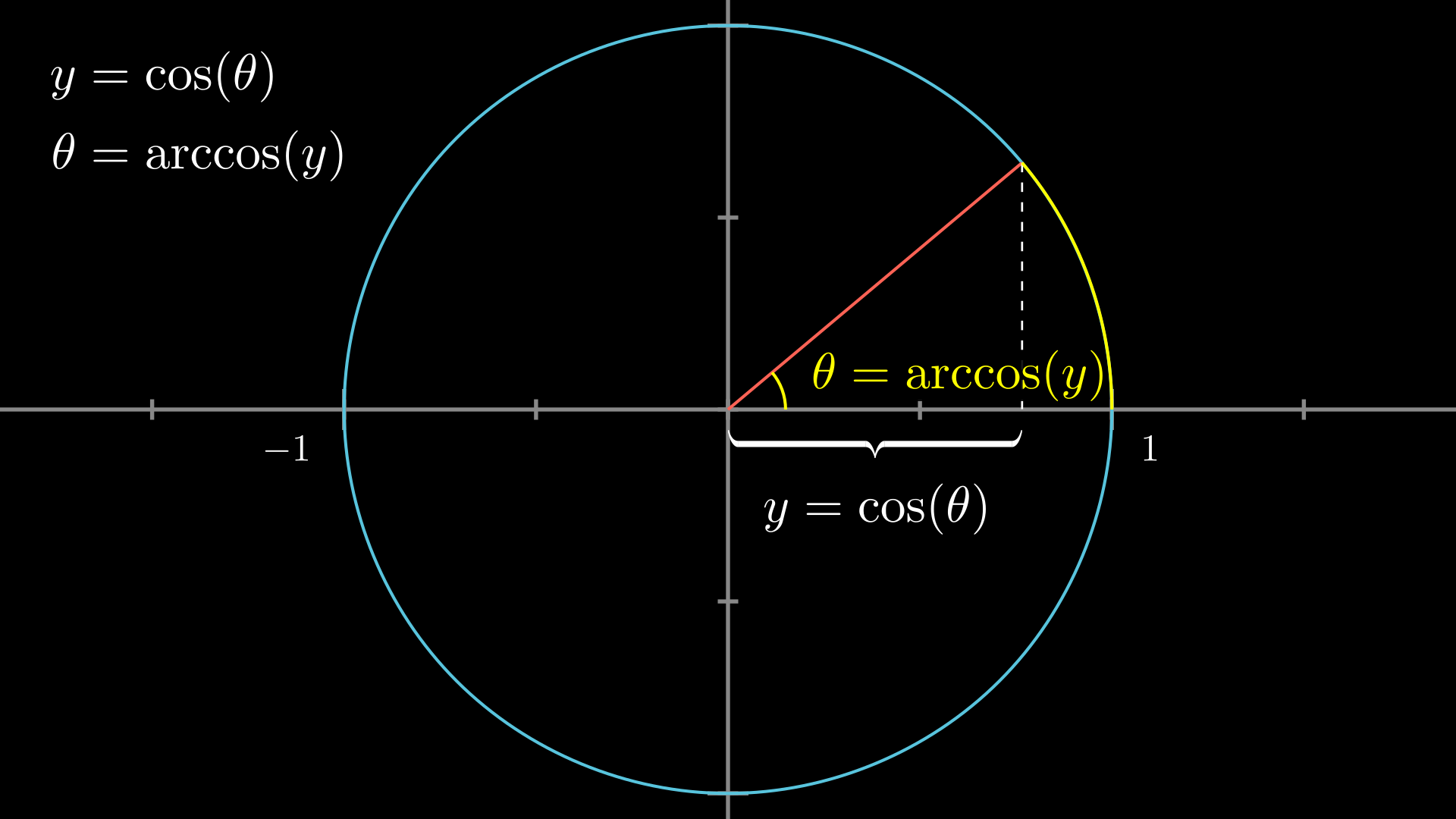
The relationship between angles and ratios can be visualized using the unit circle, a circle with a radius of $r = 1$ centered at the origin of a Cartesian coordinate system. On the unit circle, the coordinates of any point corresponding to an angle $\theta$ are given by $(\cos(\theta), \sin(\theta))$.
Therefore, solving $\arccos\left(\frac{1}{2}\right)$ means finding the angle $\theta$ where the $x$-coordinate on the unit circle equals $\frac{1}{2}$.
Examining the Quadrants
Because the $x$-coordinate is positive ($\frac{1}{2}$), the terminal side of the angle must lie in a quadrant where $x > 0$. On the Cartesian plane, $x$ is positive in Quadrant I and Quadrant IV.
However, recall the restricted range of the inverse cosine function: $[0, \pi]$ (Quadrants I and II). The only quadrant that satisfies both the positive $x$-value requirement and the restricted range of $[0, \pi]$ is Quadrant I.
The $30^\circ-60^\circ-90^\circ$ Right Triangle
Geometry provides a direct way to find the exact angle through the properties of a special right triangle. Consider an equilateral triangle where all sides have a length of 2 units, and all interior angles measure $60^\circ$ ($\frac{\pi}{3}$ radians).
If you draw an altitude straight down from the top vertex to the base, it bisects the base into two equal segments of length 1 and splits the top angle into two equal angles of $30^\circ$ ($\frac{\pi}{6}$ radians). This construction creates two congruent $30^\circ-60^\circ-90^\circ$ right triangles.
For the $60^\circ$ angle in this triangle:
- The side adjacent to the $60^\circ$ angle has a length of $1$.
- The hypotenuse has a length of $2$.
By definition, the cosine of an angle in a right triangle is the ratio of the adjacent side length to the hypotenuse length:
$$\cos(60^\circ) = \frac{\text{Adjacent}}{\text{Hypotenuse}} = \frac{1}{2}$$
Flipping this relationship around gives us the inverse operation:
$$\arccos\left(\frac{1}{2}\right) = 60^\circ = \frac{\pi}{3}$$
Step-by-Step Evaluation Process
Working through the evaluation of $\arccos\left(\frac{1}{2}\right)$ involves a systematic series of logical checks.
| Step | Action | Description | Mathematical Result |
|---|---|---|---|
| 1 | Check Domain | Verify the input value falls within $[-1, 1]$. | $\frac{1}{2} = 0.5$ (Valid) |
| 2 | Translate to Equation | Rewrite the inverse expression as a standard trigonometric equation. | $\cos(\theta) = \frac{1}{2}$ |
| 3 | Identify Quadrants | Locate where cosine is positive within the restricted range $[0, \pi]$. | Quadrant I |
| 4 | Recall Special Triangles | Match the ratio $\frac{1}{2}$ to standard reference angles. | $\theta = \frac{\pi}{3}$ or $60^\circ$ |
| 5 | Verify Range | Confirm the resulting angle lies strictly within $[0, \pi]$. | $\frac{\pi}{3}$ is within $[0, \pi]$ |
Following these structured steps prevents common errors, such as choosing an angle from Quadrant IV (like $-\frac{\pi}{3}$ or $300^\circ$), which would violate the mandatory range restriction of the inverse cosine function.
Radians vs. Degrees: Expressing the Answer
In mathematics, angles can be measured in multiple units, most commonly degrees and radians. Depending on the academic context or application field, you may need to provide your answer in either format.
- In Degrees: $\arccos\left(\frac{1}{2}\right) = 60^\circ$
- In Radians: $\arccos\left(\frac{1}{2}\right) = \frac{\pi}{3}$ radians
To convert between these two units, use the conversion factor $\pi \text{ radians} = 180^\circ$:
$$\text{Radians} = \text{Degrees} \times \left(\frac{\pi}{180^\circ}\right)$$
Applying this to $60^\circ$:
$$60^\circ \times \frac{\pi}{180^\circ} = \frac{60\pi}{180} = \frac{\pi}{3}$$
Calculators set to degree mode will output $60$, while calculators set to radian mode will output approximately $1.04719755$, which is the decimal equivalent of $\frac{\pi}{3}$.
Common Pitfalls and Misconceptions
When learning about inverse trigonometric functions, students frequently run into specific conceptual traps. Recognizing these pitfalls helps ensure accurate problem-solving.
Confusing Inverse Cosine with Reciprocal Cosine
As noted earlier, $\cos^{-1}(x)$ is standard notation for arccos($x$). It does not mean $\frac{1}{\cos(x)}$, which is the secant function, $\sec(x)$.
- $\cos^{-1}\left(\frac{1}{2}\right)$ asks: What angle has a cosine of $\frac{1}{2}$? (Answer: $60^\circ$)
- $(\cos(x))^{-1}$ or $\frac{1}{\cos(x)}$ asks for the secant of angle $x$. If $x = 60^\circ$, this evaluates to $\frac{1}{0.5} = 2$.
Selecting Angles Outside the Range
Because the unit circle is periodic, $\cos(60^\circ) = \frac{1}{2}$, but $\cos(420^\circ) = \frac{1}{2}$ and $\cos(-300^\circ) = \frac{1}{2}$ as well. However, because the definition of $\arccos(x)$ restricts outputs to the interval $[0, \pi]$, none of these alternative coterminal angles are considered the principal value of $\arccos\left(\frac{1}{2}\right)$. The only correct mathematical output is $\frac{\pi}{3}$.
Confusing Sine and Cosine Values
It is very common to mix up the exact values for sine and cosine of standard angles like $30^\circ$, $45^\circ$, and $60^\circ$. Remembering the simple coordinate patterns on the unit circle or using finger-counting tricks can help, but verifying with basic triangle ratios (SOH CAH TOA) ensures accuracy.
Frequently Asked Questions
What is the exact value of arccos(1/2)?
The exact value of $\arccos\left(\frac{1}{2}\right)$ is $\frac{\pi}{3}$ radians, or $60^\circ$. This represents the unique angle within the restricted interval $[0, \pi]$ whose cosine ratio equals $0.5$.
Why is the range of arccos restricted?
The cosine function is periodic and repeats its values infinitely, meaning it fails the horizontal line test and is not one-to-one. To define a valid inverse function that yields a single, predictable output for every input, mathematicians restrict the domain of the original cosine function to $[0, \pi]$, which makes the inverse function strictly monotonic and well-defined.
How do I evaluate arccos(1/2) on a scientific calculator?
To evaluate this on a standard scientific calculator, ensure your mode is set correctly to either Degrees or Radians depending on your requirements. Press the second-function key (2nd or Shift) followed by the cosine key (cos) to access $\cos^{-1}$, enter 0.5 (or 1/2), and press equals. The calculator will return $60$ (for degrees) or roughly $1.047$ (for radians).
Is arccos(1/2) the same as secant?
No. $\arccos\left(\frac{1}{2}\right)$ is an inverse trigonometric function looking for an angle, whereas the secant function $\sec(x)$ is the multiplicative reciprocal of the cosine function ($\frac{1}{\cos(x)}$). Evaluating $\sec(60^\circ)$ yields $2$, whereas evaluating $\arccos\left(\frac{1}{2}\right)$ yields $60^\circ$.
What is the difference between arcsin(1/2) and arccos(1/2)?
While $\arccos\left(\frac{1}{2}\right)$ evaluates to $60^\circ$ ($\frac{\pi}{3}$ radians) because the adjacent-to-hypotenuse ratio is $\frac{1}{2}$, $\arcsin\left(\frac{1}{2}\right)$ evaluates to $30^\circ$ ($\frac{\pi}{6}$ radians) because the opposite-to-hypotenuse ratio is $\frac{1}{2}$ for a $30^\circ$ angle in a standard right triangle.
Practical Next Actions and Applications
Mastering evaluations like arccos 1 2 explained builds a strong foundation for advanced mathematical coursework, including vector calculus, differential equations, and physics.
- Practice with other special ratios: Try evaluating $\arccos(0)$, $\arccos(1)$, and $\arccos\left(\frac{\sqrt{3}}{2}\right)$ to reinforce your understanding of unit circle coordinates.
- Apply to vector math: Use inverse cosine functions to find the angle between two vectors using the dot product formula: $\cos(\theta) = \frac{\mathbf{u} \cdot \mathbf{v}}{|\mathbf{u}| |\mathbf{v}|}$.
- Check your work: Always verify your inverse trigonometric outputs by plugging the resulting angle back into the standard trigonometric function to ensure it returns the original ratio.