Understanding archery arrow dimensions is essential for safety, accuracy, and equipment longevity. The primary dimensions include arrow length (measured by AMO standards), shaft diameter (ID and OD), static spine (stiffness), and weight (measured in grains per inch or GPI). These metrics determine how an arrow reacts to the bow’s energy and its flight stability in various environmental conditions.
The Foundation of Arrow Geometry: Understanding Length and Safety
In the world of modern archery, "length" is perhaps the most critical dimension for beginner and intermediate shooters to master. However, measuring an arrow is not as simple as placing a ruler from tip to tail. The industry adheres to the Archery Trade Association (ATA) standards, formerly known as the Archery Manufacturers Organization (AMO).
How to Measure Arrow Length
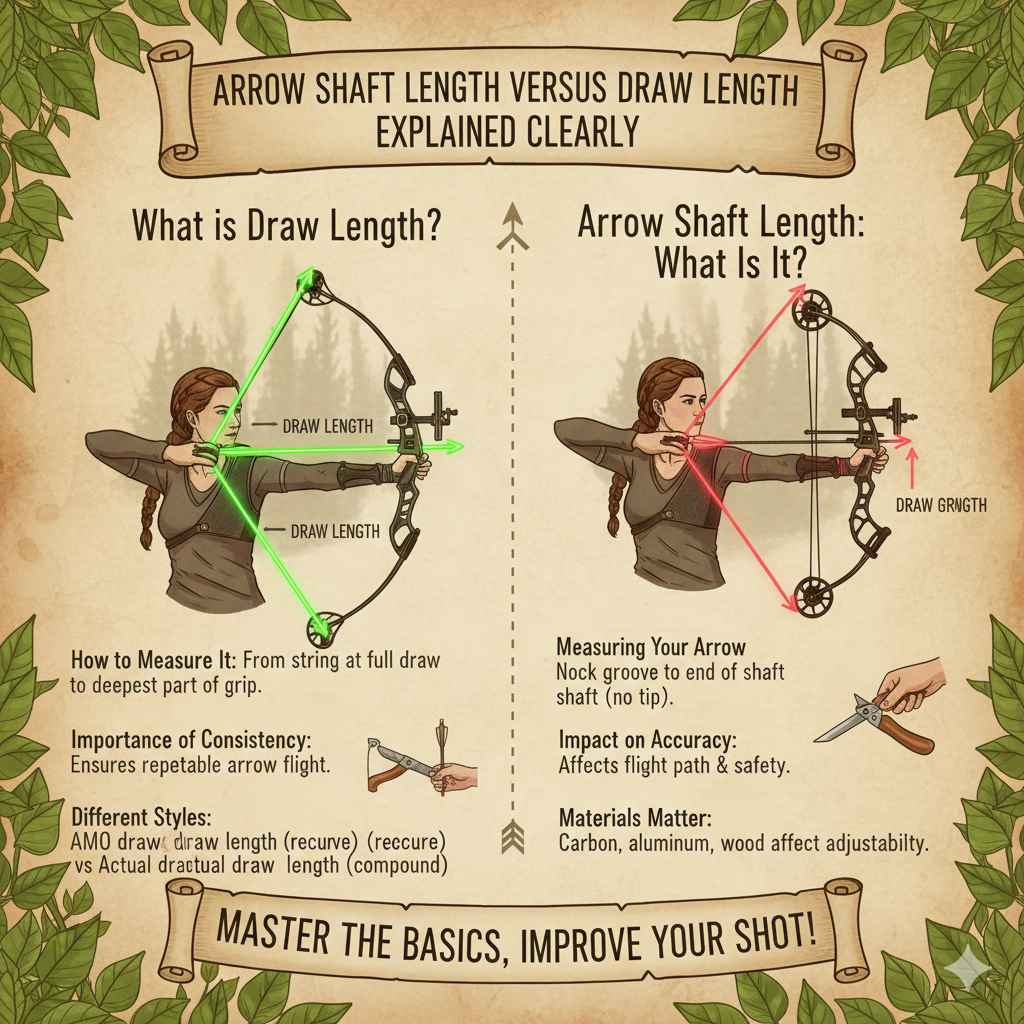
The official measurement of an arrow's length is the distance between the "throat" of the nock (the deepest part of the groove where the string sits) and the end of the shaft. It is important to note that this measurement does not include the insert or the point/broadhead.
When selecting arrow length in 2026, the standard practice remains ensuring the shaft extends at least one inch beyond the arrow rest at full draw. For bowhunters, this "safety margin" is often increased to ensure that a sharp broadhead does not make contact with the riser or the archer’s hand, which could lead to catastrophic equipment failure or injury.
The Relationship Between Length and Stiffness
The length of an arrow directly impacts its "dynamic spine," or how much it flexes when shot. A longer shaft will always be more flexible than a shorter shaft of the same material and thickness. Therefore, when you change your arrow length, you are effectively changing the mechanical behavior of the arrow. This is why experienced archers often buy "raw shafts" and cut them down incrementally to fine-tune the arrow’s flight to their specific bow setup.
Arrow Shaft Diameter: ID vs. OD
Arrow diameter has become a focal point of technical innovation. Traditionally, arrows were relatively thick, but modern carbon manufacturing allows for incredibly thin profiles. There are two primary measurements to track: Inside Diameter (ID) and Outside Diameter (OD).
Inside Diameter (ID) Standards
The ID is the most important dimension for component compatibility. If you buy a 5mm shaft, you must buy 5mm nocks and inserts. The industry has standardized around several key ID sizes:
- 4mm (.165" - .166"): Often called "micro-diameter." These are preferred by long-range target shooters and western bowhunters for reduced wind drift and high penetration.
- 5mm (.204"): Known as "X" or "small" diameter. This is a versatile middle ground for hunting and 3D archery.
- 6mm (.231" - .244"): The standard diameter for most entry-level and general-purpose hunting arrows.
- 9.3mm: The maximum diameter allowed for many indoor target competitions (often referred to as "23-series" arrows).
Outside Diameter (OD) and Aerodynamics
The OD varies based on the wall thickness of the carbon or aluminum. A thicker wall usually results in a stiffer, heavier arrow. For the archer, the OD determines how much surface area is exposed to crosswinds. In 2026, micro-diameter arrows (4mm) are the gold standard for outdoor competition because their smaller OD significantly reduces "wind planing," allowing for tighter groups at distances of 50 to 70 meters.
Decoding Arrow Spine: Static and Dynamic Stiffness
The "spine" of an arrow refers to its resistance to bending. If an arrow is too weak (too much flex), it will erraticly oscillate and may even shatter upon release from a high-poundage bow. If it is too stiff, it will not "paradox" (bend) around the riser correctly, leading to poor clearance and inaccurate flight.
Static Spine Measurement
Static spine is a laboratory measurement. To determine it, a 1.94 lb (880g) weight is hung from the center of a 28-inch span of the arrow shaft. The amount of deflection (sag) in inches is the spine rating.
- A 500 spine arrow deflects 0.500 inches.
- A 300 spine arrow deflects 0.300 inches.
- Crucial Rule: The lower the number, the stiffer the arrow.
Dynamic Spine: The "In-Flight" Reality
Dynamic spine is how the arrow actually behaves when the bow’s energy is transferred to it. It is influenced by:
- Draw Weight: Higher poundage requires a stiffer spine.
- Point Weight: A heavier tip (e.g., a 150-grain broadhead vs. a 100-grain field point) will make the arrow act "weaker" or flex more.
- String Speed: Modern "super-cam" bows transfer energy more violently, requiring stiffer shafts than older, round-wheel bows.
Weight Metrics: GPI, Total Grains, and FOC
Arrow weight is measured in grains (there are 7,000 grains in one pound). Weight is divided into two categories: the weight of the shaft itself and the total finished weight.
Grains Per Inch (GPI)
The GPI is a linear measurement of the shaft's density. For example, a shaft rated at 9.0 GPI that is 30 inches long will have a raw weight of 270 grains. High-GPI arrows are favored by hunters seeking deep penetration (kinetic energy and momentum), while low-GPI arrows are favored by 3D shooters who want a "flat" trajectory to compensate for distance-judging errors.
Calculating Total Arrow Weight
To find the total weight, you must sum all components:
- Shaft: (Length × GPI)
- Nock: Typically 7–12 grains.
- Vanes/Fletching: Typically 6–10 grains per vane.
- Insert/Outsert: 10–60 grains depending on material (aluminum vs. brass).
- Point/Broadhead: Standard weights are 100, 125, or 150 grains.
Front of Center (FOC)
FOC is the percentage of the arrow’s total weight that is located in the front half of the shaft.
- Formula:
[((Center of Gravity / Total Length) - 0.5) × 100] - Ideal FOC: For target archery, 7–11% is standard. For hunting, 12–18% is often preferred to ensure the arrow "pulls" itself through the air and maintains stability upon impacting a target.
Precision Tolerances: Straightness and Weight Sorting
When you purchase premium arrows in 2026, you are paying for consistency. Manufacturers grade their shafts based on how closely they adhere to their dimensional specs.
- Straightness Tolerance: This is measured in thousandths of an inch over a 28-inch span.
- Economy (.006"): Perfectly fine for beginners or hunters shooting under 30 yards.
- Mid-Grade (.003"): The standard for most serious amateurs.
- Match Grade (.001"): Necessary for long-range target shooting where the slightest wobble is magnified over 70+ meters.
- Weight Tolerance: This ensures every arrow in a dozen weighs nearly the same. A tolerance of +/- 0.5 grains is considered elite, ensuring that your vertical point of impact does not change from shot to shot.
Summary of Common Arrow Dimensions
The following table summarizes the typical dimensional profiles for different archery applications as of 2026.
| Use Case | Common ID | Typical Spine | Typical GPI | Preferred FOC |
|---|---|---|---|---|
| Indoor Target | 9.3mm (23 Series) | 350 - 500 | 8.0 - 11.0 | 7% - 10% |
| Outdoor Target (FITA) | 4mm (.166") | 400 - 600 | 5.5 - 7.5 | 10% - 12% |
| Whitetail Hunting | 5mm or 6mm | 300 - 400 | 8.5 - 10.5 | 12% - 15% |
| Big Game (Elk/Moose) | 4mm or 5mm | 250 - 340 | 10.5 - 13.0 | 15% - 19% |
| Beginner/Youth | 6.5mm | 600 - 800 | 6.0 - 7.0 | 8% - 10% |
Component Dimensions: Compatibility and Fit
Choosing the right shaft is only half the battle; the components must match the dimensions perfectly.
Nock Throat Size
Nocks come in two primary throat sizes: Large Groove (S) and Small Groove (G).
- Large Groove (.098"): Typically used for compound bows with thicker factory strings or center servings.
- Small Groove (.088"): Preferred for recurve bows or custom compound strings with fewer strands. If the nock dimension doesn't match your string diameter, you will experience "nock pinch" (too tight) or "dry-fire-like" conditions (too loose).
Insert and Outsert Systems
Because micro-diameter (4mm) arrows have walls too thin to hold a traditional internal insert, they often use outserts or half-outs (half-in/half-out). These components increase the effective length of the arrow and significantly boost the FOC, but they require precise installation to maintain perfect alignment with the shaft.
Common Pitfalls in Arrow Selection
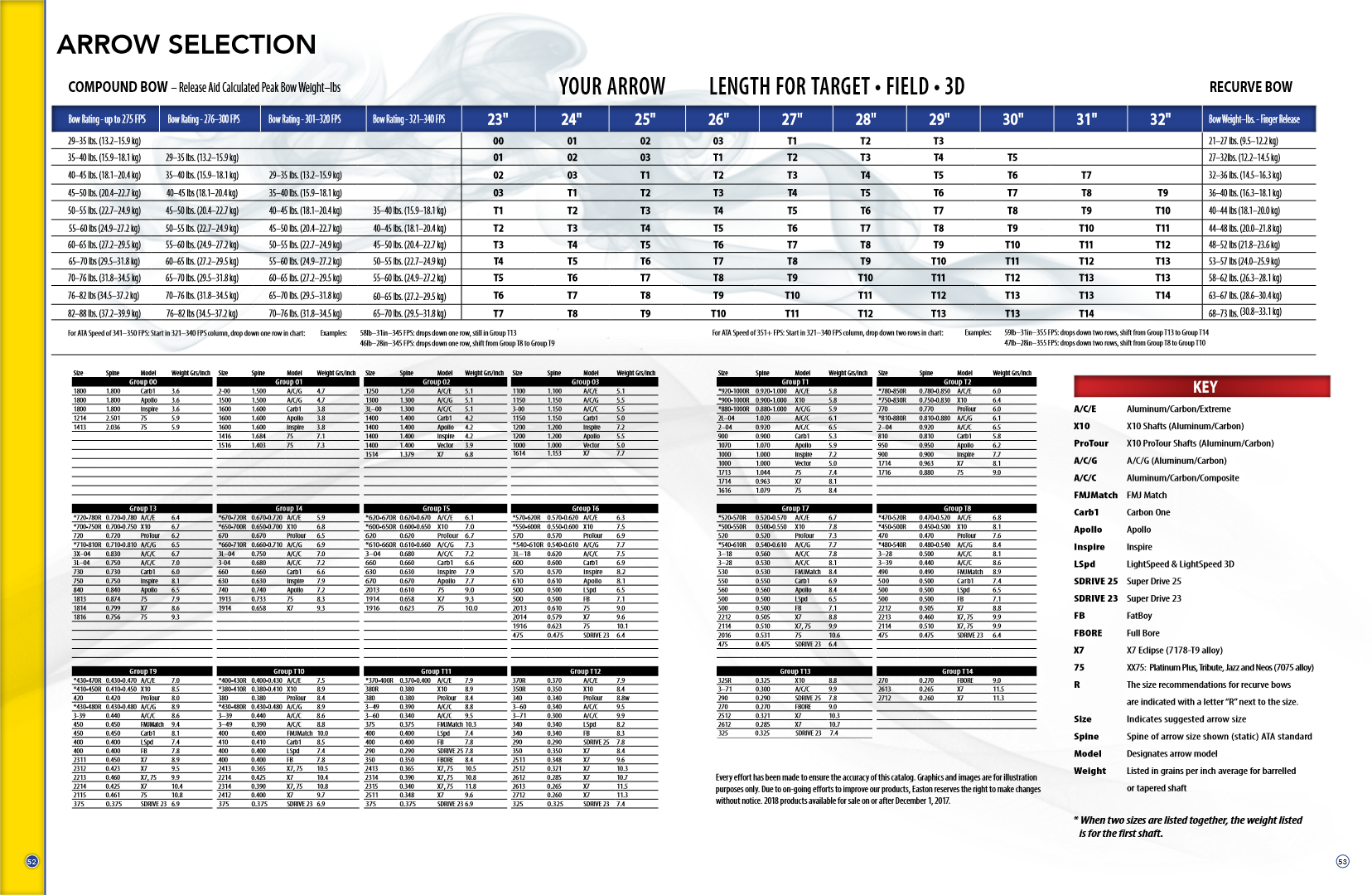
- Ignoring the Spine Chart: Never guess your spine. Every manufacturer provides a specific chart based on your draw weight and arrow length. Using a 500 spine arrow on a 70lb bow is dangerous.
- Over-cutting Shafts: Once carbon is cut, it cannot be added back. When testing new dimensions, cut your arrows slightly long and test flight before final trimming.
- Mixing Brands: Even if two brands say "400 spine," their actual dimensions (OD and GPI) will differ. Never mix brands or models within the same quiver if you expect consistent accuracy.
Frequently Asked Questions
Does arrow length include the point or broadhead?
No. According to the ATA (Archery Trade Association) standard, arrow length is measured from the throat of the nock to the end of the shaft. The point or broadhead is considered an accessory and is not included in the "shaft length" dimension.
Why is a 300 spine arrow "stiffer" than a 500 spine?
The number represents the amount of deflection (in inches) when a weight is applied. A 300 spine only sags 0.300 inches, whereas a 500 spine sags 0.500 inches. Therefore, the smaller the number, the more resistant the arrow is to bending.
How do I know which diameter to choose?
Diameter selection depends on your goal. For maximum penetration and least wind drift, choose a 4mm or 5mm diameter. For general target practice or if you are on a budget, a 6mm or 6.5mm arrow is more than sufficient and often features more affordable, standard components.
What happens if I use an arrow that is too short?
If the arrow is shorter than your draw length, it can fall off the rest at full draw. If you release the string at that moment, the arrow can be driven into your hand or the bow’s riser, causing serious injury and destroying the bow.
How does FOC affect arrow flight?
A higher Front of Center (FOC) percentage acts like the feathers on a shuttlecock, pulling the arrow straight. It improves stability in the wind and helps the arrow track straight through an animal during hunting. However, too much FOC can cause the arrow to "nose dive" at long distances.
Practical Recommendation for 2026
For the majority of archers, a 5mm (.204 ID) carbon shaft remains the most balanced choice for 2026. It offers a significant reduction in wind drift compared to old-school standard diameters while maintaining a wide range of compatible components. Before finalizing your arrow dimensions, always consult the manufacturer’s specific spine chart and consider purchasing a "test" arrow to verify flight patterns before committing to a full dozen.