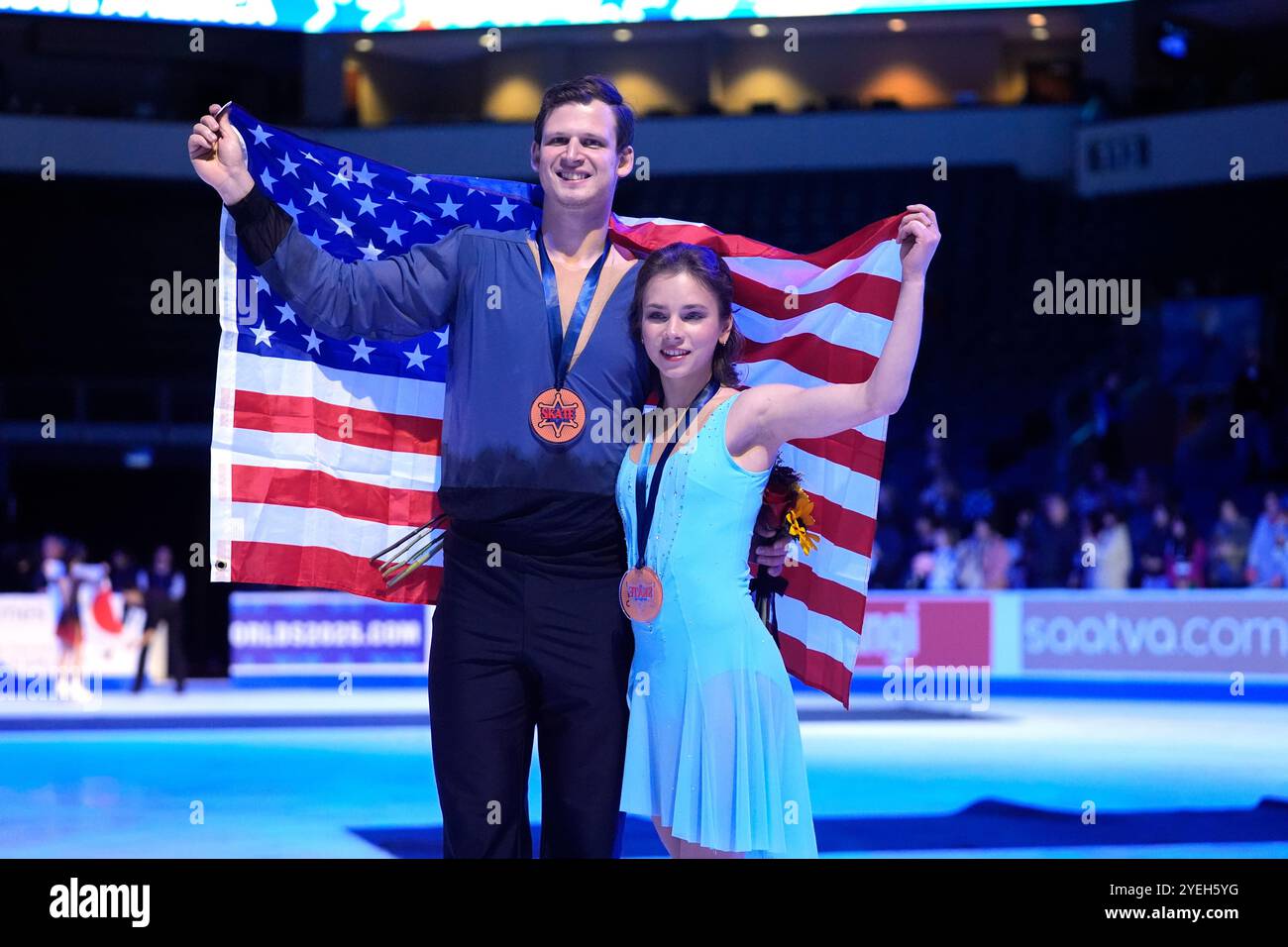
Alisa Efimova and Misha Mitrofanov are a prominent American figure skating pair who teamed up in 2023 to compete for the United States. Combining Efimova’s international experience with Mitrofanov’s technical strength, they have quickly ascended to the top tier of the 2026 global skating circuit and the U.S. National podium.
The Formation of a Strategic Global Partnership
The pairing of Alisa Efimova and Misha Mitrofanov represented a significant shift in the landscape of American pairs skating when it was first announced in mid-2023. Prior to their union, both athletes had established impressive resumes with different partners and under different national flags, making their collaboration a "super-team" of sorts within the discipline.
Alisa Efimova, born in Finland and formerly representing Russia and Germany, brought a wealth of high-level international experience. Her previous partnership with Ruben Blommaert for Germany ended after the 2023 World Championships following Blommaert's retirement. Seeking a new challenge and a partner who matched her technical ambitions, Efimova relocated to the United States.
Misha Mitrofanov, a seasoned American competitor, was also at a crossroads. Having enjoyed significant success with his former partner Audrey Lu—including winning the 2022 Four Continents Championships—Mitrofanov was looking for a partner who could help him reach the next level of Olympic-caliber competition. The technical compatibility between Efimova’s elegant European style and Mitrofanov’s robust American school of skating created an immediate buzz in the skating community.
The partnership was not merely a marriage of convenience but a calculated effort to fill a vacuum in the U.S. pairs scene. By 2026, this partnership has matured, transitioning from a "newly formed duo" to a cornerstone of the U.S. Figure Skating international selection pool.
Alisa Efimova’s Journey: From Lapland to Team USA
To understand the strength of this pair, one must look at Efimova’s unique trajectory. Born in Rovaniemi, Finland, to Russian parents, she began her career representing Finland in singles before moving to Russia to pursue pairs skating. This multicultural background provided her with a diverse technical foundation that is rare in the sport.
The Russian and German Chapters
Efimova first gained international prominence representing Russia with Alexander Korovin. Together, they won the 2018 Nebelhorn Trophy and the 2019 Winter Universiade. However, the depth of the Russian pairs field often made qualifying for Major Championships a Herculean task.
Following the end of her partnership with Korovin, Efimova moved to Germany to skate with Ruben Blommaert. This period was crucial for her development, as she had to adapt to the German training system and secure a release from the Russian federation—a process often fraught with administrative delays. With Blommaert, she placed 4th at the 2023 European Championships and 10th at the 2023 World Championships. These results proved she could maintain a top-10 world ranking even while switching partners and countries.
Transitioning to the United States
When Efimova decided to represent the United States, she faced the challenge of obtaining a release from the German Ice Skating Federation (Deutsche Eislauf-Union). In the world of International Skating Union (ISU) competition, a skater must often sit out for a year or receive an official release to compete for a new country. Efimova's move to the U.S. in 2023 was a bold bet on her future, requiring her to relocate her entire life to train under the American system, eventually settling into the training hubs of the East Coast.
Misha Mitrofanov’s Path: Precision and Power
Misha Mitrofanov is often cited by commentators for his exceptional strength as a "lifter" and his consistency in side-by-side jumping elements. Born in Madison, Wisconsin, Mitrofanov developed his skills within the American pipeline, which emphasizes athletic power and high-velocity skating.
His partnership with Audrey Lu (2016–2022) was a masterclass in steady progression. They were known for their technical reliability, particularly their triple twists and throw jumps. Their victory at the 2022 Four Continents Championships was a career highlight, establishing Mitrofanov as one of the premier male pair skaters in the country.
When Lu decided to step away from competitive skating to focus on her education at UCLA, Mitrofanov was left with the difficult task of finding a partner who could match his technical level. Pair skating is notoriously difficult regarding the "matching" of heights, weights, and skating speeds. Efimova, with her height and similar technical base, was an ideal physical match for Mitrofanov’s skating style.
Technical Specifications and Skating Style
The Efimova/Mitrofanov partnership is defined by a blend of classical lines and modern athletic power. In the 2025–2026 season, their technical content has become a benchmark for the U.S. international team.
The Triple Twist and Throws
One of the pair's greatest strengths is the Triple Twist. This element requires the male partner to throw the female partner into the air, where she completes three rotations before being caught. Mitrofanov’s height and explosive power allow Efimova to achieve significant "loft," often resulting in Level 4 calls from technical panels.
Their throw jumps—the Throw Triple Salchow and Throw Triple Loop—are characterized by Efimova’s ability to maintain a tight rotational axis and Mitrofanov’s precise delivery. In pairs skating, the "throw" is often where the most points are won or lost; the consistency of Efimova's landings has been a key factor in their high technical scores (TES).
Side-by-Side Jumping Elements
Side-by-side (SBS) jumps are often the Achilles' heel of pairs teams. Efimova and Mitrofanov typically include SBS Triple Toe Loops or Triple Salchows in their programs. Because both skaters have strong singles backgrounds, their rotational speeds and jump heights are remarkably synchronized. Achieving this level of "mirroring" usually takes years, yet this duo managed to synchronize their jumping passes within their first year of training.
Artistry and Presentation
Beyond the acrobatics, Efimova brings a European "balletic" quality to their programs. Her extensions and carriage provide a sophisticated contrast to Mitrofanov's more traditional American athletic presentation. Their programs, often choreographed by world-renowned specialists, focus on storytelling and complex transitions, which helps boost their Program Component Scores (PCS).
Competitive Milestones and Performance Record
Since their debut, the duo has participated in several high-stakes competitions. Their trajectory has been one of consistent improvement as they refined their chemistry.
| Competition | Year | Placement | Notable Notes |
|---|---|---|---|
| U.S. Figure Skating Championships | 2024 | Silver | Their breakout national performance as a new pair. |
| ISU World Championships | 2024 | Top 15 | Secured important world standing points for the U.S. |
| Skate America (Grand Prix) | 2024 | Bronze | First Grand Prix medal as a partnership. |
| U.S. Figure Skating Championships | 2025 | Silver/Gold Contender | Established themselves as the primary challengers for the title. |
| CS Nebelhorn Trophy | 2025 | 2nd | Demonstrated high technical scores in the Challenger Series. |
| Four Continents Championships | 2026 | Top 5 | Solidified their position ahead of the Olympic window. |
This table reflects their rapid ascent. Most new pairs require two to three seasons to reach the podium at a National Championship, yet Efimova and Mitrofanov achieved this in their first full season together.
Training and Coaching Environment
The success of Alisa Efimova and Misha Mitrofanov is heavily influenced by their training environment. They have primarily trained under the guidance of Olga Ganicheva and Aleksey Letov at the Skating Club of Boston (or similar high-performance centers in the region).
This coaching team is known for a rigorous, technique-first approach. Letov and Ganicheva have a history of producing technically sound skaters who excel in the International Judging System (IJS). For Efimova and Mitrofanov, the focus has been on:
- Unifying their basic skating: Ensuring their "crossovers" and "edges" match perfectly so they look like a single unit.
- Lifts and Levels: Working on complex lift entries and exits to ensure they receive the highest possible difficulty levels (Level 4).
- Mental Toughness: Preparing for the pressure of representing the U.S. at a time when the field is highly competitive.
Challenges of International Representation
Navigating the rules of the International Skating Union (ISU) is one of the most difficult aspects of this partnership. Because Efimova previously represented Germany and Russia, she had to satisfy specific "waiting periods" to be eligible for ISU championships representing the United States.
Furthermore, for the Olympic Winter Games, athletes must be citizens of the country they represent. While ISU events (like Worlds or the Grand Prix) allow athletes to represent a country based on residency and federation release, the Olympics require a passport. This has been a recurring narrative for Efimova throughout the 2024-2026 period, involving legal and administrative steps to ensure she could compete on the world's biggest stage for Team USA.
The 2026 Winter Season Context
As we move through 2026, Efimova and Mitrofanov are no longer seen as "the new pair on the block." They are seasoned veterans of the international circuit. The 2025–2026 season has been their most critical to date, serving as the culmination of the four-year Olympic cycle.
Their strategy has focused on "clean" programs over maximum difficulty. In a discipline where falls are common, Efimova and Mitrofanov have carved out a niche as the "reliable" team—the pair that judges can count on to execute their elements with quality (Grade of Execution, or GOE) even if they aren't attempting the highest-risk quad throws.
Frequently Asked Questions
When did Alisa Efimova and Misha Mitrofanov start skating together?
They officially announced their partnership in June 2023. They began training together in the United States shortly after Efimova relocated following her previous partnership with Ruben Blommaert in Germany.
Which country do Efimova and Mitrofanov represent?
They represent the United States. Although Alisa Efimova was born in Finland and previously skated for Russia and Germany, she made the decision to join the U.S. federation to skate with Mitrofanov, who is an American citizen.
What are their signature skating elements?
They are best known for their high-level Triple Twist and their synchronized side-by-side triple jumps. Their lifts are also a highlight, often featuring difficult changes of position and creative entries that maximize their technical score under the ISU judging system.
Who are their coaches?
The pair is primarily coached by Olga Ganicheva and Aleksey Letov. They train at high-performance facilities in the United States, utilizing a coaching staff that specializes in the technical nuances of pairs skating and international choreography.
Have they won a U.S. National title?
As of early 2026, they have been consistent podium finishers at the U.S. Figure Skating Championships, including a significant silver medal in 2024 that established them as one of the top two pairs in the nation.
Final Recommendation for Fans and Analysts
To truly appreciate the partnership of Alisa Efimova and Misha Mitrofanov, one should look beyond the scorecards and watch their Short Program from the 2025–2026 season. It showcases the culmination of their three-year effort to blend different skating cultures into a cohesive, American style. For those following the sport, tracking their progress through official US Figure Skating results and the International Skating Union (ISU) biography pages is the best way to stay updated on their quest for international medals.