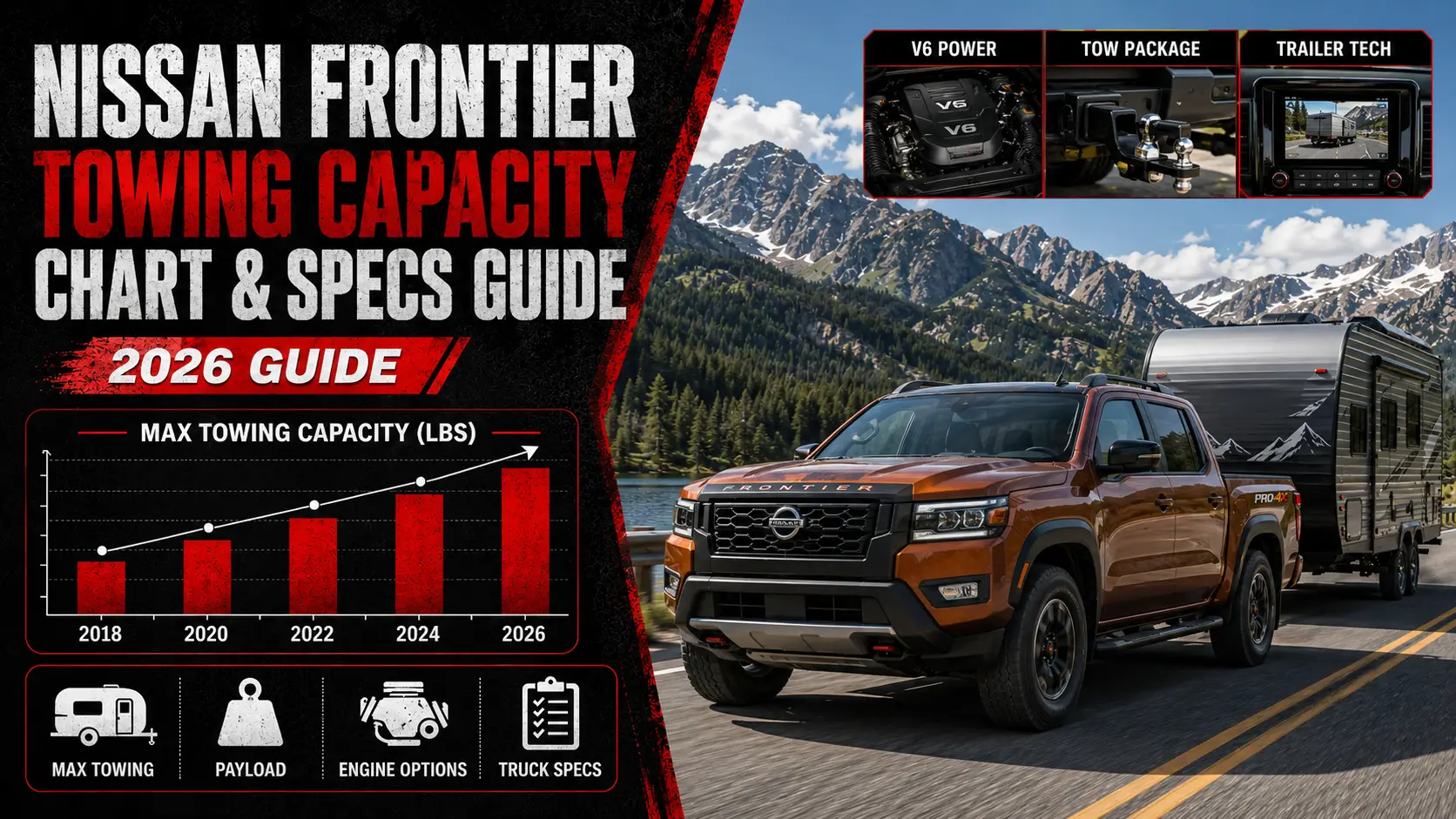
The 7,000 lb towing capacity of the Nissan Frontier SV 4x4 provides a robust benchmark for midsize truck capability, driven by a standard 3.8-liter V6 engine and a reinforced boxed ladder frame. Achieving this maximum rating requires proper configuration, including the factory towing package, correct tongue weight management, and careful adherence to Gross Combined Weight Ratings.
When evaluating a midsize truck for hauling trailers, boats, or utility equipment, maximum towing capacity serves as one of the most critical figures for prospective buyers. The Nissan Frontier SV 4x4 bridges the gap between daily drivability and heavy-duty utility, offering a maximum towing rating that reaches up to 6,710 to 6,800+ pounds depending on the specific model year, cab configuration, and bed length, often referenced broadly in the 7,000-pound class. To understand how this capability functions in real-world scenarios, it is necessary to examine the mechanical underpinnings, configuration prerequisites, payload limitations, and safe operational guidelines that govern modern midsize trucks.
The Mechanical Foundation of the Nissan Frontier SV 4x4
The capability of any truck to pull heavy loads starts with its powertrain and structural integrity. For modern generations of the Nissan Frontier, the engineering revolves around a high-output powertrain paired with a heavy-duty chassis designed to absorb dynamic loads without twisting or fatiguing prematurely.
Under the hood, the SV 4x4 trim features a 3.8-liter direct-injected V6 engine. This powerplant generates 310 horsepower and 281 lb-ft of torque, mated to a 9-speed automatic transmission. Unlike older generations that relied on a 5-speed transmission, the modern 9-speed setup keeps the engine operating within its optimal power band, which is crucial when pulling heavy trailers up steep grades or accelerating from a dead stop on an on-ramp.
The backbone of this truck is a full-length, fully boxed ladder frame constructed from high-strength steel. The SV 4x4 configuration adds a transfer case, skid plates, and an electronically controlled part-time four-wheel-drive system (with 2WD, 4HI, and 4LO modes). While the extra hardware of the 4x4 system adds curb weight—which slightly reduces maximum payload capacity compared to rear-wheel-drive variants—it provides exceptional traction when launching a boat from a slippery ramp or pulling a loaded utility trailer through muddy job sites.
Decoding the 7,000 lb Rating: Configuration and Limitations
A common point of confusion among truck buyers is assuming that every single Nissan Frontier SV 4x4 can automatically tow the maximum advertised limit. Towing capacity is not a blanket specification for a model nameplate; it is determined by the exact weight, wheelbase, cab size, bed length, and optional equipment of the individual vehicle identification number (VIN).
To achieve a towing capacity approaching or meeting the 7,000-pound threshold, several factory specifications must align:
- Cab and Bed Configuration: Crew Cab configurations with standard beds or King Cab setups influence the payload and towing distribution differently. Generally, lighter configurations with fewer heavy luxury accessories yield higher maximum towing numbers.
- Axle Ratio: The final drive ratio dictates how easily the transmission can turn the wheels under load. Factory towing packages often incorporate optimized axle ratios to maximize pulling torque.
- Factory Tow Package: A Class IV receiver hitch, pre-wired 7-pin trailer wiring harness, and a dedicated trailer sway control system are fundamental prerequisites.
It is also vital to distinguish between towing capacity and Gross Combined Weight Rating (GCWR). The GCWR represents the absolute maximum allowable combined weight of the loaded truck, the loaded trailer, all occupants, fuel, and cargo inside the cab and bed. Exceeding the GCWR places excessive strain on the brakes, transmission, and cooling systems, regardless of whether the trailer weight itself is under the 7,000-pound limit.
| Metric / Specification | Nissan Frontier SV 4x4 Standard Parameter |
|---|---|
| Engine Type | 3.8L V6 Direct-Injection |
| Horsepower | 310 hp @ 6,000 rpm |
| Torque | 281 lb-ft @ 4,400 rpm |
| Transmission | 9-Speed Automatic |
| Drivetrain | Part-Time 4WD (2HI, 4HI, 4LO) |
| Max Towing Capacity | Up to ~6,710 - 6,800+ lbs (Config Dependent) |
| Hitch Type Required | Class IV Receiver Hitch |
Real-World Towing Performance and Capabilities
Operating a midsize truck near its maximum towing limit requires an understanding of how weight affects vehicle dynamics. When properly equipped with a weight-distributing hitch and properly adjusted trailer brakes, the Nissan Frontier SV 4x4 handles mid-sized loads—such as travel trailers, car haulers, livestock trailers, and large utility setups—with stability and confidence.
The 9-speed automatic transmission features a dedicated Tow/Haul mode. Engaging this mode alters the shift mapping, holding gears longer to prevent "gear hunting" when driving up hills and utilizing engine braking to reduce wear and tear on the physical brake pads during prolonged descents. Trailer Sway Control (TSC), standard on modern trims, monitors vehicle movement and automatically applies selective braking if the trailer begins to sway dangerously due to crosswinds or passing semi-trucks.
However, physics dictates that pulling a heavy trailer impacts fuel economy and acceleration. Drivers should anticipate significantly lower miles per gallon (MPG) when towing near capacity, as well as longer stopping distances. Maintaining a safe following distance and monitoring transmission fluid temperatures via the digital instrument cluster are essential practices for long-distance towing trips.
Crucial Safety and Compliance Factors
Towing safely involves strict adherence to legal weight ratings and vehicle maintenance schedules. Overloading a truck not only creates a safety hazard for other motorists but can also void manufacturer warranties and lead to roadside citations by commercial vehicle enforcement officers.
When loading the Nissan Frontier SV 4x4 for a towing excursion, consider the following parameters:
- Tongue Weight: The downward force exerted by the trailer coupler onto the hitch ball should ideally be 10% to 15% of the total loaded trailer weight. For a 6,500-pound trailer, that means 650 to 975 pounds resting on the rear of the truck. This weight counts directly against the truck's payload capacity.
- Payload Capacity: Check the yellow Tire and Loading Information placard located on the driver-side door jamb. This sticker provides the exact, calculated payload limit for that specific vehicle as it left the factory. Subtract the weight of all passengers, cargo, aftermarket accessories (like heavy steel bumpers or bed covers), and the trailer tongue weight from this figure to ensure you do not exceed the Gross Vehicle Weight Rating (GVWR).
- Braking Systems: Trailers weighing over 1,500 to 3,000 pounds (depending on state regulations) typically require independent trailer brakes. Ensure the trailer is equipped with functioning electric or surge brakes and that the truck has a compatible aftermarket or factory-integrated trailer brake controller installed.
Frequently Asked Questions
Can all Nissan Frontier SV 4x4 models tow 7,000 lbs?
No. Towing capacity varies based on cab style, bed length, 4x4 equipment, and optional packages. While some configurations approach or exceed 6,700 to 6,800 pounds, you must check the specific towing guide for your model year or consult the safety certification label on your specific truck door jamb.
What is included in the Nissan Frontier towing package?
A standard towing package typically features a Class IV receiver hitch bolted directly to the frame, a 7-pin wiring harness for trailer lights and electric brakes, and pre-wiring for a trailer brake controller. Some models also include Trailer Sway Control integrated into the vehicle's electronic stability program.
How does 4x4 affect the towing capacity of the Frontier?
Adding four-wheel drive increases the overall curb weight of the truck due to the inclusion of the front differential, transfer case, and drive shafts. Because the GCWR remains relatively constant, the increased weight of the truck itself slightly reduces the maximum available payload and towing capacity compared to a rear-wheel-drive (4x2) equivalent.
Do I need a weight-distributing hitch for a 6,000 lb trailer?
Yes. For any heavy trailer approaching the upper limits of a midsize truck's capacity—typically anything over 5,000 pounds—a weight-distributing hitch is strongly recommended. It helps level the vehicle, restores proper weight distribution to the front steering axle, and improves overall steering and braking control.
What causes trailer sway and how does the Frontier prevent it?
Trailer sway is typically caused by improper cargo loading (too much weight at the rear of the trailer), excessive speed, or sudden crosswinds. The Nissan Frontier features standard Trailer Sway Control, which detects lateral oscillations and automatically applies individual wheel brakes and modulates engine power to bring the trailer back into alignment.
Conclusion and Next Actions
The Nissan Frontier SV 4x4 offers a compelling blend of rugged off-road capability and everyday utility, capable of handling demanding towing tasks when operated within its engineered limits. Before hooking up a heavy trailer, always verify your specific vehicle's ratings via the door jamb sticker and owner's manual. Ensure your trailer is loaded with proper tongue weight distribution, inspect all lighting connections, verify that trailer brakes are fully operational, and engage Tow/Haul mode for a safer, more controlled driving experience.