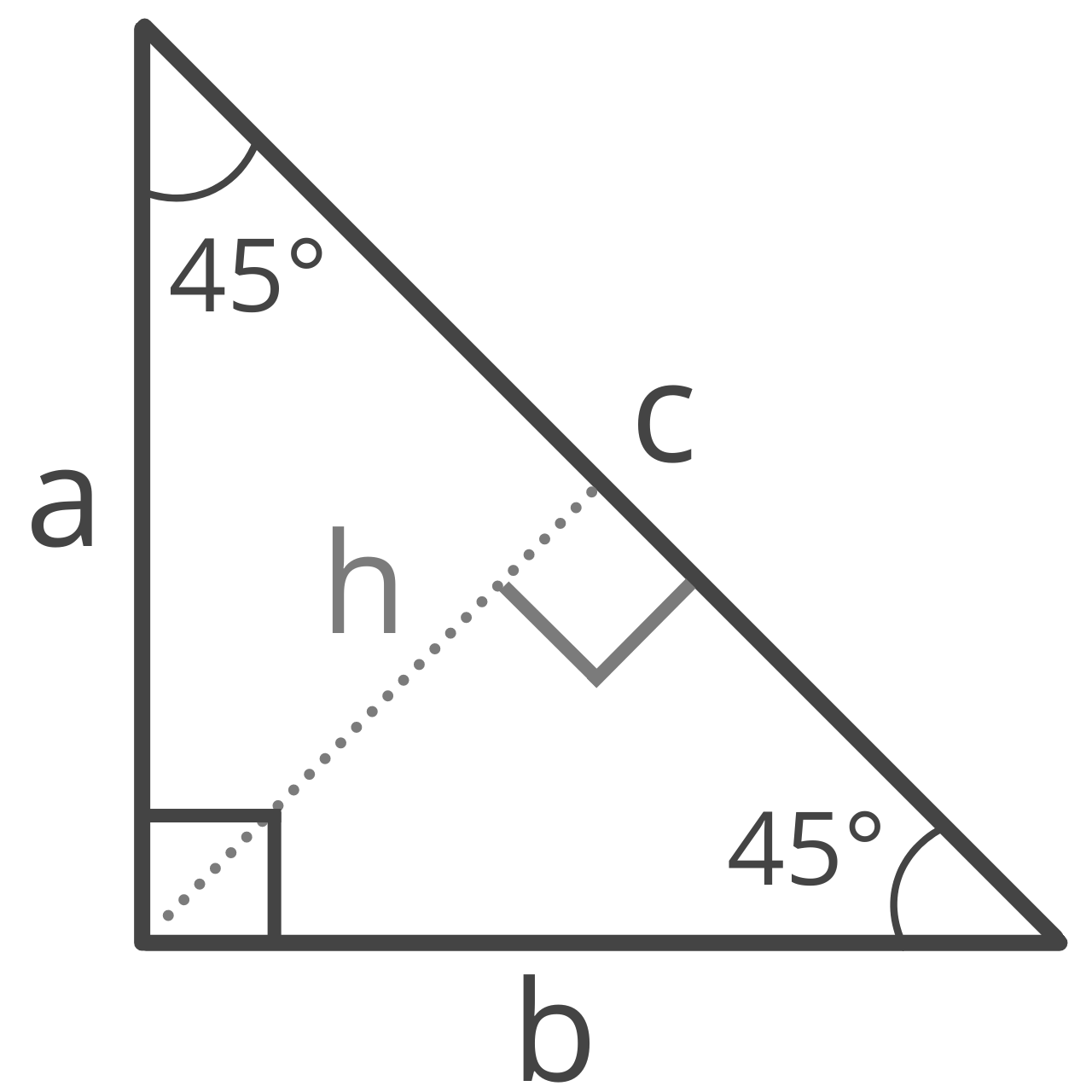
Finding the area of a 45-45-90 right triangle requires using its unique geometric properties—where the two legs are of equal length and the hypotenuse is $\sqrt{2}$ times the length of either leg—allowing you to calculate the area using either the standard base-and-height formula or specialized shortcut methods derived from the Pythagorean theorem.
Introduction to the 45-45-90 Triangle
In geometry, the 45-45-90 triangle is a specific type of isosceles right triangle. It features one right angle measuring 90 degrees and two acute angles measuring 45 degrees each. Because the base angles are equal, the two sides opposite those angles (the legs) are also equal in length. This symmetry makes the 45-45-90 triangle one of the most fundamental shapes in both basic geometry and advanced trigonometry.
Understanding how to calculate the area of this triangle goes beyond simply plugging numbers into a formula. By recognizing the special ratio between its sides ($1:1:\sqrt{2}$), you can determine the area even when you are given only the hypotenuse or restricted to perimeter measurements. This guide explores the core principles, step-by-step calculation methods, common edge cases, and practical real-world applications of finding the 45-45-90 triangle area.
Core Geometric Properties of the 45-45-90 Triangle
Before calculating area, you must understand the fixed relationships governing the sides of a 45-45-90 triangle. These properties dictate how different inputs (legs versus hypotenuse) convert into measurements suitable for area formulas.
Side Length Ratios
In any 45-45-90 triangle, if the length of each leg is represented by variable $s$, the length of the hypotenuse ($h$) is always equal to:
$$h = s\sqrt{2}$$
Conversely, if you know the hypotenuse ($h$), you can find the length of either leg ($s$) by dividing the hypotenuse by the square root of two, or multiplying by $\frac{\sqrt{2}}{2}$:
$$s = \frac{h}{\sqrt{2}} = \frac{h\sqrt{2}}{2}$$
Symmetry and Altitude
Because the triangle is an isosceles right triangle, the two legs serve as both the base and the perpendicular height (altitude) when calculating area. You do not need to drop an external perpendicular line from a vertex to find the height; one leg stands vertically perpendicular to the other.
Standard Area Formulas
Depending on what information is provided in your problem statement, you can use several distinct formulas to find the area of a 45-45-90 triangle.
1. Using the Two Legs ($s$)
When you know the lengths of the two legs, the formula is identical to the standard right triangle area formula:
$$\text{Area} = \frac{1}{2} \times \text{base} \times \text{height}$$
Since the base and height are both equal to leg $s$:
$$\text{Area} = \frac{1}{2}s^2$$
2. Using the Hypotenuse ($h$)
When a problem provides only the length of the hypotenuse, you can bypass finding the individual legs by applying a direct formula derived from substituting $s = \frac{h}{\sqrt{2}}$ into the standard area equation:
$$\text{Area} = \frac{1}{2} \left(\frac{h}{\sqrt{2}}\right)^2 = \frac{1}{2} \left(\frac{h^2}{2}\right) = \frac{h^2}{4}$$
This formula states that the area of a 45-45-90 triangle is always equal to one-quarter of the squared hypotenuse.
Step-by-Step Calculation Methods
Applying these formulas requires systematic execution. The following workflows break down how to handle different starting parameters.
Method A: Calculating Area Given the Legs
If a woodworking project, architectural drawing, or math problem specifies that the legs of a 45-45-90 triangle measure 6 inches each:
- Identify the variable: $s = 6$.
- Square the leg length: $6^2 = 36$.
- Multiply by one-half (or divide by 2): $\frac{36}{2} = 18$.
- Apply the correct squared units: 18 square inches ($\text{in}^2$).
Method B: Calculating Area Given the Hypotenuse
If a structural brace forms a 45-45-90 triangle with a hypotenuse of 10 meters:
- Identify the variable: $h = 10$.
- Square the hypotenuse: $10^2 = 100$.
- Divide by 4 using the hypotenuse-based area formula: $\frac{100}{4} = 25$.
- Apply the correct squared units: 25 square meters ($\text{m}^2$).
Alternatively, you can solve this by finding the legs first:
- Calculate the leg: $s = \frac{10}{\sqrt{2}} \approx 7.071$.
- Square the leg: $7.071^2 \approx 50$.
- Multiply by one-half: $\frac{50}{2} = 25$.
Comparison of Calculation Approaches
| Given Parameter | Direct Formula | Working Steps | Best Used When |
|---|---|---|---|
| Two Legs ($s$) | $\text{Area} = \frac{1}{2}s^2$ | Square leg, divide by 2. | Working with cut dimensions, grid-based layouts, or basic geometry problems. |
| Hypotenuse ($h$) | $\text{Area} = \frac{h^2}{4}$ | Square hypotenuse, divide by 4. | Measuring diagonal spans, roof trusses, or structural bracing spans. |
| Perimeter ($P$) | $\text{Area} = \frac{P^2}{2(2+\sqrt{2})^2}$ | Convert perimeter to legs, then apply leg formula. | Dealing with physical fencing, framing material limits, or total boundary lengths. |
Advanced Scenarios: Area from Perimeter
Occasionally, problems provide the total perimeter ($P$) rather than individual side lengths. Because the perimeter of a 45-45-90 triangle is the sum of both legs and the hypotenuse ($P = s + s + s\sqrt{2} = 2s + s\sqrt{2}$), you must solve for $s$ before finding the area.
- Factor out the leg length from the perimeter equation: $$P = s(2 + \sqrt{2})$$
- Isolate $s$: $$s = \frac{P}{2 + \sqrt{2}}$$
- Rationalize the denominator or substitute $s$ directly into the area formula: $$\text{Area} = \frac{1}{2} \left( \frac{P}{2 + \sqrt{2}} \right)^2$$
This multi-step approach prevents compounding rounding errors by keeping calculations in exact radical form until the final step.
Common Mistakes and Troubleshooting
When calculating the area of a 45-45-90 triangle, professionals and students alike encounter a few recurrent pitfalls.
Confusing Legs and Hypotenuse
The most frequent error is treating the hypotenuse as one of the legs in the standard $\frac{1}{2}bh$ formula. Because the hypotenuse is always the longest side and lies opposite the 90-degree angle, using it as a leg will drastically inflate your calculated area. Always verify which side is designated as $s$ and which is designated as $h$.
Incorrect Radical Simplification
When converting between legs and hypotenuse, forgetting to multiply or divide by $\sqrt{2}$ leads to incorrect dimensions. Remember that moving from legs to a hypotenuse involves multiplication by $\sqrt{2}$, while moving from a hypotenuse to legs involves division by $\sqrt{2}$.
Forgetting Unit Squaring
Area is always expressed in square units (e.g., $\text{cm}^2$, $\text{ft}^2$). Failing to square the unit of measurement alongside the numerical value during final presentation compromises technical accuracy.
Practical Applications in Design and Construction
Understanding the 45-45-90 triangle area is vital across multiple technical disciplines:
- Architecture and Carpentry: Designing gable roofs, miter cuts, and diagonal wall bracing frequently relies on creating equal-leg right triangles to distribute load evenly.
- Tiling and Landscaping: Cutting square paving stones or tiles along their diagonals yields two identical 45-45-90 triangles, where knowing the area helps estimate material waste and adhesive requirements.
- Computer Graphics: 2D and 3D rendering engines frequently process geometric clipping and pixel mapping using triangular meshes based on standardized right triangles.
Frequently Asked Questions
Can you find the area of a 45-45-90 triangle with only one side length given?
Yes. Because the 45-45-90 triangle possesses fixed proportions ($1:1:\sqrt{2}$), knowing the length of any single side allows you to determine all other sides. From there, you can apply either the leg-based or hypotenuse-based area formula to complete your calculation.
Why is the hypotenuse always multiplied by the square root of two?
This rule derives directly from the Pythagorean theorem ($a^2 + b^2 = c^2$). Since both legs in a 45-45-90 triangle are equal ($s$), the equation becomes $s^2 + s^2 = c^2$, which simplifies to $2s^2 = c^2$. Taking the square root of both sides yields $c = s\sqrt{2}$.
What is the difference between finding the area of a 45-45-90 triangle versus a 30-60-90 triangle?
While both are special right triangles, a 30-60-90 triangle has three unequal sides following a $1:\sqrt{3}:2$ ratio, requiring you to distinguish between a short leg, a long leg, and a hypotenuse. A 45-45-90 triangle has two equal legs, simplifying the base-and-height calculations considerably.
How do I calculate the area if the triangle is oriented vertically or upside down?
Triangle orientation does not affect its geometric properties or area. As long as the internal angles are 45, 45, and 90 degrees, the two perpendicular sides function as the base and height regardless of how the shape is rotated on a Cartesian plane.
Is it acceptable to use decimal approximations for $\sqrt{2}$?
You can use decimal approximations (such as 1.414) for practical field measurements in construction or woodworking. However, for academic or engineering precision, you should keep calculations in exact radical form until the final rounding step.
Final Recommendation
When approaching any 45-45-90 triangle area problem, begin by identifying which side dimension—leg or hypotenuse—has been provided. If you have the legs, apply $\frac{1}{2}s^2$ for a direct, single-step solution. If you have the hypotenuse, use $\frac{h^2}{4}$ to save time and minimize intermediate rounding errors. Always verify your units before finalizing your square-unit measurements.