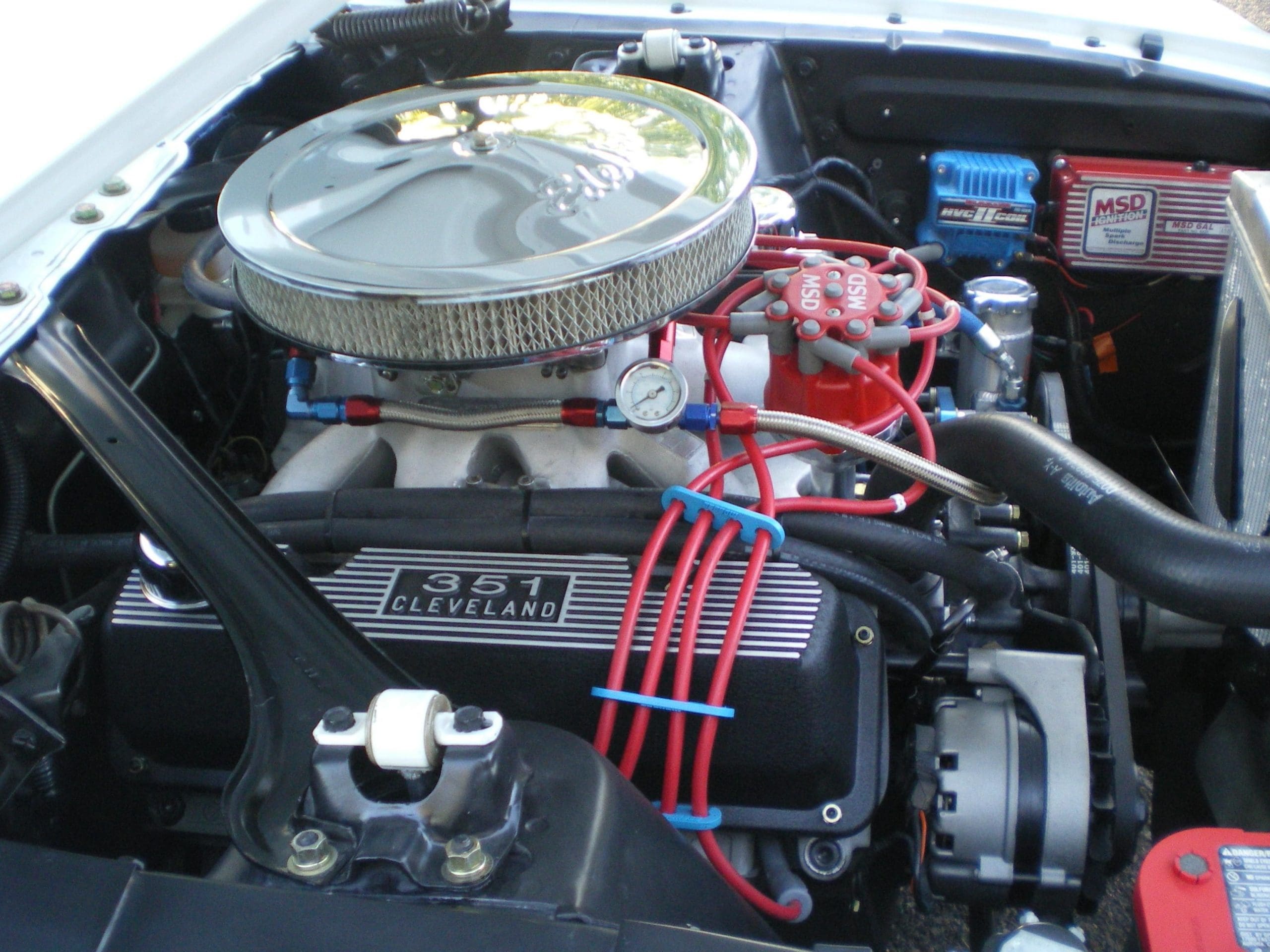
The Ford 351 Modified (351M) is a V8 engine produced between 1975 and 1982, sharing the tall-deck block architecture of the Ford 400. While originally designed for low-emission utility, it offers significant performance potential through "destroking" reversals, Cleveland-style cylinder head swaps, and modern aftermarket stroker kits that capitalize on its robust internal volume.
Understanding the 351 Modified Identity
The "351 Modified" or 351M often suffers from an identity crisis among automotive enthusiasts. To understand the engine, one must first understand its lineage within the Ford 335 engine family. In the early 1970s, Ford had two distinct 351-cubic-inch engines: the 351 Windsor (351W) and the 351 Cleveland (351C). When production of the 351 Cleveland ended in the United States after 1974, Ford needed an engine to fill the mid-displacement gap for its heavier vehicles and trucks.
Rather than redesigning an engine from scratch or ramping up 351W production for all platforms, Ford engineers took the existing 400-cubic-inch block—which featured a taller deck height than the Cleveland—and installed a shorter-stroke crankshaft. This "modified" version of the 400 became the 351M. The term "Modified" officially refers to the fact that it was a modified version of the 400, though many enthusiasts colloquially (and incorrectly) suggest it stands for "Mid-block."
By 2026, the 351M has transitioned from a discarded "smog-era" motor into a sought-after platform for torque-heavy builds. Because it shares the same block as the 400, it possesses a massive 10.297-inch deck height, providing ample room for long connecting rods and high-displacement stroker assemblies that far exceed the physical limitations of the 351 Windsor or Cleveland.
Technical Specifications and Architecture
The 351M is built on a "thin-wall" casting technique, which was advanced for the mid-70s. This allowed Ford to reduce the overall weight of the engine block while maintaining structural integrity. However, because it was designed for heavy-duty use in trucks and full-size sedans like the LTD and Mercury Marquis, it still carries significant mass compared to a modern aluminum V8.
Core Dimensions
- Bore: 4.00 inches
- Stroke: 3.50 inches
- Cylinder Spacing: 4.38 inches
- Deck Height: 10.297 inches
- Main Bearing Diameter: 3.00 inches
- Connecting Rod Length: 6.58 inches
The defining characteristic of the 351M is its bellhousing bolt pattern. Unlike the 351 Windsor and 351 Cleveland, which use the "Small Block Ford" pattern, the 351M utilizes the larger pattern found on the 385-series engines (the 429 and 460 V8s). This makes it natively compatible with heavy-duty transmissions like the C6 automatic and the NP435 manual, which were standard in Ford F-Series trucks and Broncos of that era.
The Oiling System
The 335-series engines, including the 351M, utilize a "priority main" oiling system. In this configuration, oil is delivered to the main bearings first before reaching the camshaft and valvetrain. While this is generally a high-performance design trait, the 351M can suffer from oil pressure drops at high RPM if the tolerances are not precisely machined. In a 2026 performance build, it is standard practice to use restricted pushrods or modified oil bypass springs to ensure the crank remains lubricated during spirited driving.
The Performance Paradox: Why the 351M Got a Bad Reputation
If the 351M shares so much DNA with the high-performance 351 Cleveland, why did it spend decades being called a "boat anchor"? The answer lies in the era of its birth. Emerging during the height of the 1970s emissions crisis, the 351M was crippled by factory settings designed to meet federal air quality standards rather than produce horsepower.
- Low Compression: Factory 351M engines typically featured compression ratios around 8.0:1. This was achieved through massive 76cc to 78cc combustion chambers and "dished" pistons that sat deep in the bore at Top Dead Center (TDC).
- Retarded Cam Timing: To reduce NOx emissions, Ford retarded the camshaft timing by several degrees from the factory. This killed off-the-line torque and made the engine feel sluggish.
- Restrictive Induction: Most 351Ms came equipped with a 2-barrel Motorcraft carburetor and an intake manifold with small runners. While excellent for low-speed throttle response and fuel atomization, these components choked the engine above 3,500 RPM.
- Weight-to-Power Ratio: A stock 351M often produced as little as 145 to 160 net horsepower. When placed in a 5,000-pound Ford F-250 4x4, the performance was underwhelming.
Modern builders have realized that these "flaws" are external to the block's potential. By swapping the timing set, increasing compression, and upgrading the induction, the 351M transforms into a high-torque powerhouse.
Transforming the 351M: Key Modification Paths
For owners looking to improve a 351M today, there are three primary paths ranging from budget-friendly "wake-up" mods to full-scale performance builds.
The "400 Crank" Swap
Because the 351M uses the 400 block, the most cost-effective way to gain power is to "un-destroke" it. By swapping in a stock 400 crankshaft and 400-specific pistons, you gain 49 cubic inches of displacement instantly. This is a "bolt-in" modification because the connecting rods are identical between the two engines. This conversion is the single most popular modification for 351M owners because it provides a massive increase in torque without requiring expensive aftermarket parts.
Cylinder Head Upgrades
The 351M shares the same cylinder head bolt pattern and water jacket locations as the 351 Cleveland. This opens up a world of possibilities:
- Australian 302 Cleveland Heads: These are a "holy grail" for 351M/400 builders. They feature small 2V runners for high port velocity (great for torque) but have "closed" combustion chambers that naturally raise the compression ratio to approximately 9.5:1 or 10.0:1.
- Aftermarket Aluminum Heads: Companies like Trick Flow and Edelbrock produce Cleveland-style heads that bolt directly to the 351M. These heads offer superior airflow, modern heart-shaped combustion chambers, and a significant weight reduction (often 50-60 lbs total).
- Stock Head Porting: If keeping the original heads, "cleaning up" the exhaust ports is vital. The 351M factory exhaust ports have a notorious "smog bump" that obstructs flow. Removing this bump can improve exhaust scavenging significantly.
Induction and Ignition
To support more displacement or better heads, the factory 2-barrel intake must go. Edelbrock’s Performer 400 intake remains the industry standard for this engine, allowing the use of a 4-barrel carburetor or modern EFI throttle body. When combined with a straight-up (non-retarded) timing set and an HEI or Pertronix electronic ignition conversion, the engine’s power band moves from a 3,000 RPM ceiling to a much more usable 5,500 RPM.
Technical Comparison: 351W vs. 351C vs. 351M
Understanding which 351 you have is critical for ordering parts, as very few components interchange across all three.
| Feature | 351 Windsor (351W) | 351 Cleveland (351C) | 351 Modified (351M) |
|---|---|---|---|
| Engine Family | 90-Degree / Small Block | 335 Series | 335 Series |
| Deck Height | 9.502" | 9.206" | 10.297" |
| Bellhousing | Small Block Ford | Small Block Ford | 385 Series (Big Block) |
| Tappet Diameter | 0.875" | 0.875" | 0.875" |
| Thermostat Location | Intake Manifold | Cylinder Block | Cylinder Block |
| Main Bearing Size | 3.00" | 2.75" | 3.00" |
| Standard Application | Passenger Cars/Trucks | Performance Cars (Mustang) | Trucks / Heavy Sedans |
Cost Analysis for a 2026 Build
Building a 351M in 2026 involves navigating a market where vintage iron is becoming more expensive, but precision machining is more accessible.
- Basic Refresh ($1,500 - $2,500): This includes a "straight-up" timing set, a 4-barrel intake, a 600 CFM carburetor, and long-tube headers. This level of modification usually yields a 50-70 horsepower gain and significantly better throttle response.
- The 400 Displacement Conversion ($3,500 - $5,000): This involves a full teardown, a 400 crank (often sourced from salvage or refurbished), new pistons, and a mild RV camshaft. At this level, the engine becomes a "stump-puller" ideal for towing or off-roading.
- High-Performance Stroker ($8,000+): Using an aftermarket 4.250-inch stroke crank, this kit turns the 351M into a 434-cubic-inch monster. Combined with aluminum heads and a custom roller cam, these builds can easily exceed 500 horsepower and 550 lb-ft of torque, rivaling the performance of a 460 Big Block while weighing less.
Troubleshooting Common 351M Issues
Despite its durability, the 351M has specific quirks that owners should monitor, especially when increasing performance.
Cracked Water Jackets
Early castings of the 351M and 400 (pre-1977) were susceptible to internal cracking in the lifter valley, which could lead to coolant mixing with oil. While most of these defective blocks failed decades ago, it is essential to have any 351M block "Magnafluxed" (magnetic particle inspected) before investing in expensive machine work.
Rear Main Seal Leaks
The 351M uses a two-piece rear main seal. If not installed with a tiny offset from the block’s mating surface, it is prone to weeping. Modern viton seals have largely solved this issue, but proper installation technique remains critical.
Fuel Pump Eccentric Wear
The mechanical fuel pump is driven by an eccentric on the front of the camshaft. Over hundreds of thousands of miles, this eccentric can wear down, leading to fuel starvation at high speeds. During a cam swap, always inspect the eccentric or consider moving to an electric fuel pump for consistent pressure.
Frequently Asked Questions
Is the 351M considered a "Big Block"?
Technically, no. The 351M belongs to the 335 engine family, which is often categorized as a "mid-block" or a "small block with big block features." However, because it uses the 460-style bellhousing and has a physically large footprint, many people treat it as a big block for the purposes of engine bay fitment and transmission selection.
Can I put 351 Cleveland heads on a 351M?
Yes, they are a direct bolt-on in terms of the head bolt pattern. However, you must use a 351M/400 specific intake manifold because the 351M’s 10.297" deck height makes the engine much wider than a standard Cleveland. A 351C intake will not be wide enough to reach both heads on a 351M block.
Why did Ford stop making the 351M in 1982?
The 351M was phased out in favor of the 351 Windsor. The Windsor was lighter, more compact, and easier to adapt for the emerging fuel injection technologies of the 1980s. Additionally, the 351M's design was inherently less efficient for the stricter CAFE (Corporate Average Fuel Economy) standards that took effect in the early '80s.
What is the best transmission for a modified 351M?
For automatic lovers, the Ford C6 is the most durable choice, though it lacks an overdrive gear. For those seeking better fuel economy on the highway, a ZF 5-speed manual swap from a later-model F-250 (which shares the big-block bolt pattern) is a popular 2026-era modification.
Is the 351M a good engine for a daily driver?
In stock form, it is reliable but thirsty, often averaging 8-12 MPG. With modern modifications—specifically a wideband-tuned EFI system and an overdrive transmission—a 351M can become a very capable and dependable daily driver with much better manners and power delivery.
Recommendation for Next Actions
If you currently own a vehicle with a 351M, your first step should be a compression test and a leak-down test. Because these engines often suffered from "heat soak" and poor maintenance in their later years, verifying the health of the rings and valves is paramount before adding performance parts.
If the engine is healthy, the most impactful first modification is replacing the factory timing set with a multi-keyway performance timing set installed at "0" or "straight up" timing. This single change, which costs less than $150 in parts, can recover 15-20 lb-ft of torque that was hidden by the factory's emissions-mandated retardation. From there, upgrading to a 4-barrel aluminum intake and a modern electronic distributor will provide the most significant "seat-of-the-pants" improvement for the lowest investment.