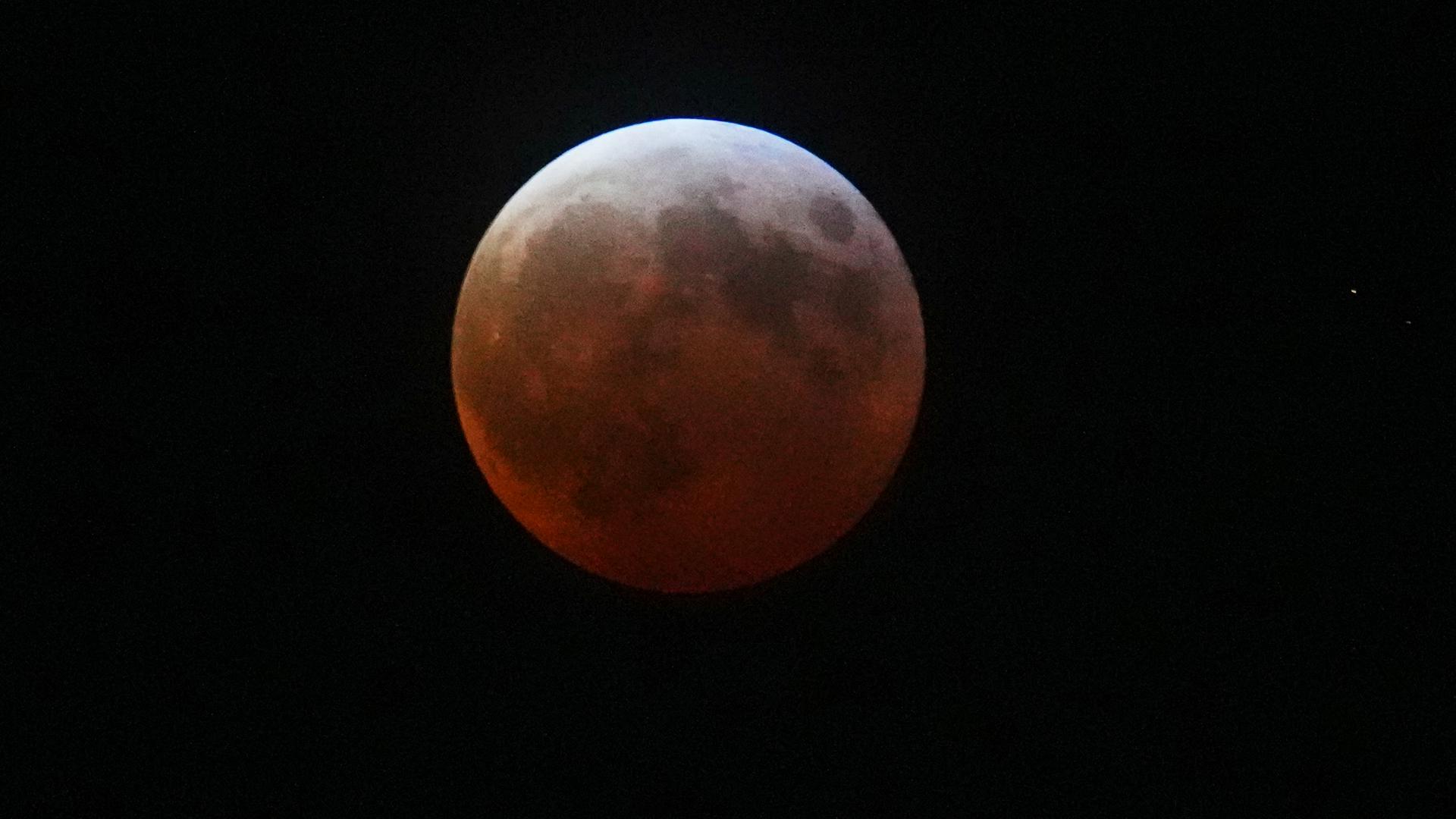
The total lunar eclipse of January 20–21, 2019, commonly known as the Super Blood Wolf Moon, featured a specific umbral magnitude of 1.1953. This significant astronomical event was visible across the Americas, Greenland, Iceland, and parts of Western Europe and Africa, marking a rare convergence of a perigee full moon and a total lunar shadow crossing.
A lunar eclipse occurs when the Earth moves between the Sun and the Moon, casting its shadow across the lunar surface. While partial eclipses are common, a total eclipse with a magnitude of 1.195 indicates a deep immersion into the Earth's umbra, the darkest part of the shadow. From our perspective in 2026, this event remains one of the most documented and scientifically significant eclipses of the early 21st century, particularly due to a rare meteorite impact captured during totality.
Understanding Lunar Magnitude 1.195
In astronomical terms, the "magnitude" of a lunar eclipse is not a measure of brightness, but rather a geometric calculation of how much of the Moon’s diameter is covered by the Earth’s umbral shadow. A magnitude of 1.0 signifies that the Moon is just barely fully engulfed. The January 2019 eclipse reached a magnitude of 1.1953, meaning that at the point of greatest eclipse, the Moon was deep within the umbra, approximately 19.5% deeper than the minimum required for a total eclipse.
The depth of this magnitude directly influences the visual appearance of the Moon. When the Moon passes through the center of the umbra, it often takes on a darker, more somber red or brown hue. However, at 1.195, the Moon passed slightly north of the umbra's center. This resulted in a gradient effect where the southern limb of the Moon appeared noticeably brighter and more orange than the northern limb, which sat deeper in the shadow.
The Mathematics of the Umbra
The Earth's shadow consists of two parts: the penumbra (the outer, lighter shadow) and the umbra (the inner, dark core). The magnitude is calculated using the radii of the Moon and the umbral shadow. For the January 2019 event, the Moon's apparent diameter was relatively large—about 33.1 arcminutes—because it was near perigee (its closest point to Earth). Despite this larger size, the Earth’s umbra was significantly larger, ensuring that the 1.195 magnitude provided a totality duration of approximately 62 minutes.
The Super Blood Wolf Moon Nomenclature
The January 2019 eclipse gained massive public interest due to its evocative "Super Blood Wolf Moon" title. This name was not merely for marketing; it described three distinct astronomical and cultural phenomena occurring simultaneously.
The "Super" Component: Perigee Syzygy
The term "supermoon" refers to a full moon that occurs near perigee. On January 21, 2019, the Moon was only 357,344 kilometers (222,043 miles) from Earth. This proximity made the Moon appear roughly 7% larger and 15% brighter than an average full moon before and after the eclipse phases. In the context of the eclipse, this meant the lunar disk was more imposing in the sky, making the transition into the shadow more dramatic for observers.
The "Blood" Component: Rayleigh Scattering
The reddish color of a total lunar eclipse is caused by Rayleigh scattering—the same physical phenomenon that makes the sky blue and sunsets red. As sunlight passes through the Earth’s atmosphere, the shorter blue wavelengths are scattered away, while the longer red wavelengths are refracted (bent) into the Earth's shadow. This filtered light is then projected onto the lunar surface. The "blood" moniker refers to this coppery-red glow.
The "Wolf" Component: Cultural Origins
The "Wolf Moon" is the traditional name for the first full moon of January in the Old Farmer’s Almanac, believed to have originated from Native American and early Colonial American folklore. It was said that wolves howled more frequently during this month due to the scarcity of food in winter.
Chronology and Phases of the January 2019 Eclipse
The event was a global spectacle, particularly for the Western Hemisphere. Unlike solar eclipses, which require specialized eye protection and are only visible along a narrow path, a lunar eclipse is safe to view with the naked eye and is visible from any location where the Moon is above the horizon during the event.
The following table outlines the key phases of the January 20–21, 2019 eclipse in Universal Time (UTC):
| Eclipse Phase | Time (UTC) | Description |
|---|---|---|
| P1: Penumbral Start | 02:36:30 | The Moon begins to enter Earth's outer shadow; subtle dimming. |
| U1: Partial Start | 03:33:54 | The first "bite" of the dark umbra appears on the lunar limb. |
| U2: Totality Start | 04:41:17 | The Moon is completely engulfed in the Earth's umbra. |
| Greatest Eclipse | 05:12:16 | The moment the Moon is deepest in the shadow (Magnitude 1.195). |
| U3: Totality End | 05:43:16 | The Moon begins to exit the umbra; the "diamond ring" effect. |
| U4: Partial End | 06:50:39 | The dark umbra completely leaves the lunar surface. |
| P4: Penumbral End | 07:48:00 | The Moon exits the outer shadow; the eclipse concludes. |
The Historic Meteorite Impact
One of the most remarkable aspects of the January 2019 eclipse was a fluke of cosmic timing. At 04:41:43 UTC, just moments after the total phase began, a meteorite struck the lunar surface. This resulted in a brief but distinct "lunar flash" that was visible to the naked eye through telescopes and captured by thousands of amateur and professional photographers worldwide.
Scientific Discovery and Verification
The impact occurred in the Mare Humorum region, near the crater Byrgius. Scientific analysis later conducted by the Moon Impacts Detection and Analysis System (MIDAS) and researchers at the University of Huelva in Spain confirmed the event. The meteorite was estimated to have a mass of about 45 kilograms (100 lbs) and was traveling at roughly 61,000 kilometers per hour (38,000 mph).
This was the first time a lunar impact had been successfully recorded during a total lunar eclipse. The dark background of the eclipsed Moon provided the perfect contrast for the flash, which would have been impossible to see against the glare of a normal full moon. This event provided scientists with valuable data on the frequency of impacts on the lunar surface and the physics of high-velocity collisions in a vacuum.
Atmospheric Science: Why the 2019 Red was Unique
The specific shade of red during a 1.195 magnitude eclipse is determined by the state of Earth's atmosphere at the time. If the atmosphere is filled with volcanic ash or smoke from massive wildfires, the Moon can appear almost black (a 0 or 1 on the Danjon Scale).
In January 2019, the Earth's stratosphere was relatively clean. There had been no major volcanic eruptions in the preceding months that had injected significant aerosols into the upper atmosphere. Consequently, the eclipse was characterized by a bright, vibrant orange-red color. Analysts rated the 2019 eclipse as a 2 or 3 on the Danjon Scale, a five-point scale used to categorize the appearance and luminosity of the Moon during a total eclipse.
The transparency of the atmosphere allowed for high levels of refracted sunlight to reach the Moon. Observers noted that while the northern half of the Moon was a deep brick red, the southern portion retained a bright, almost glowing copper-gold appearance.
Observation and Geographical Visibility
The January 2019 eclipse was perfectly positioned for observers in North and South America. For residents on the East Coast of the United States, totality occurred around midnight, making it a prime-time event.
- North America: The entire eclipse was visible from start to finish. Despite freezing temperatures in many regions, the clear winter skies provided excellent viewing conditions.
- South America: Like North America, the continent had a front-row seat to the entire progression.
- Europe and Africa: These regions saw the eclipse during the early morning hours of January 21. For many in Western Europe, the Moon set while still in the partial or total phases, creating "Moonset" photography opportunities.
- Asia and Australia: Most of these regions missed the event entirely, as the Moon was below the horizon when the eclipse occurred.
Equipment Used in 2019
By 2019, digital imaging technology had reached a point where even high-end smartphones could capture the reddish tint of the Moon. However, the best documentation came from DSLR and mirrorless cameras equipped with telephoto lenses (300mm to 600mm). Because the Moon was a "supermoon," its apparent size made it an ideal target for astrophotography.
The Saros Cycle Context
The January 2019 eclipse belonged to Saros Series 134. A Saros cycle is a period of approximately 18 years, 11 days, and 8 hours that can be used to predict eclipses of the Sun and Moon.
Saros 134 is a relatively young series, having begun in 1550. The January 2019 event was the 27th of 72 eclipses in the series. Eclipses in the same Saros cycle share similar geometries. The predecessor to this event occurred on January 9, 2001, and its successor took place on January 31, 2037. Understanding the Saros cycle allows astronomers to track the evolution of the Earth's shadow and the Moon's orbit over centuries, providing a long-term map of celestial alignment.
Scientific Significance and Legacy
While lunar eclipses occur at least twice a year, the 1.195 magnitude eclipse of 2019 holds a special place in the scientific community for several reasons:
- Impact Monitoring: As mentioned, the meteorite flash proved that total eclipses are the best times to monitor the Moon for impact events. This has led to more coordinated observation efforts during subsequent eclipses.
- Atmospheric Probing: By measuring the exact wavelengths of light that reached the Moon during the 2019 totality, scientists were able to "probe" the Earth's atmosphere. This technique is similar to how astronomers study the atmospheres of exoplanets passing in front of distant stars.
- Thermal Studies: During a total eclipse, the lunar surface experiences a rapid temperature drop. The 2019 eclipse allowed researchers to study how different lunar materials (regolith versus solid rock) lose heat, which helps in mapping the physical composition of the Moon's surface.
Frequently Asked Questions
What made the 1.195 magnitude specific to the 2019 eclipse?
The magnitude is a calculation of the Moon's diameter relative to the Earth's umbral shadow. In January 2019, the alignment was such that the Moon's diameter was covered 1.1953 times over by the shadow. This specific value confirmed it was a deep total eclipse rather than a glancing "grazing" total eclipse (which would have a magnitude closer to 1.01).
Is a 1.195 magnitude eclipse rare?
While total lunar eclipses are not rare, the specific combination of a high magnitude (1.195), a supermoon (perigee), and a "Wolf Moon" (January) occurs only a few times a century. The depth of the eclipse varies with every event based on the Moon's orbital tilt and its distance from Earth.
Can you see a meteorite hit the Moon without a telescope?
During the January 2019 eclipse, the impact flash was approximately 7th or 8th magnitude in brightness. While this is technically just below the limit of the average human eye (which is roughly 6th magnitude), many observers using binoculars or small telescopes reported seeing it clearly. It appeared as a tiny, instantaneous white speck against the red surface.
Why did the Moon look orange instead of deep red?
The color is influenced by atmospheric clarity. In 2019, the Earth's stratosphere was relatively clear of volcanic aerosols. This allowed more light to refract through, resulting in a brighter, more orange-red "copper" color. Had there been a major volcanic eruption recently, the 1.195 magnitude would have appeared much darker, potentially even dark chocolate brown.
When is the next eclipse similar to the January 2019 event?
The next total lunar eclipse in Saros series 134 will occur on January 31, 2037. However, total lunar eclipses with similar "supermoon" characteristics occur every few years. Astronomers look for the next "Deep" total eclipse (magnitude > 1.1) to find a visual match for the 2019 event.
Recommendations for Future Observers
For those looking back at the 2019 event from 2026 and preparing for future eclipses, the primary lesson is the value of coordinated observation. If you are planning to view or photograph a future total lunar eclipse:
- Check the Magnitude: A magnitude above 1.1 ensures a long totality and a deep color saturation.
- Monitor the Atmosphere: Pay attention to global volcanic activity in the six months leading up to the eclipse, as this will dictate the "Danjon" color you can expect.
- Record Video: As the 2019 meteorite impact showed, recording video of the Moon during totality can lead to genuine scientific discoveries. High-frame-rate cameras are best for capturing transient lunar phenomena (TLP).
- Use a Tripod: Even with modern image stabilization, a 1.195 magnitude eclipse requires longer exposures (1 to 4 seconds) to capture the faint red glow of the Moon.
The January 2019 Super Blood Wolf Moon was more than just a social media trend; it was a perfect synchronization of celestial mechanics that provided a unique laboratory for atmospheric and planetary science.