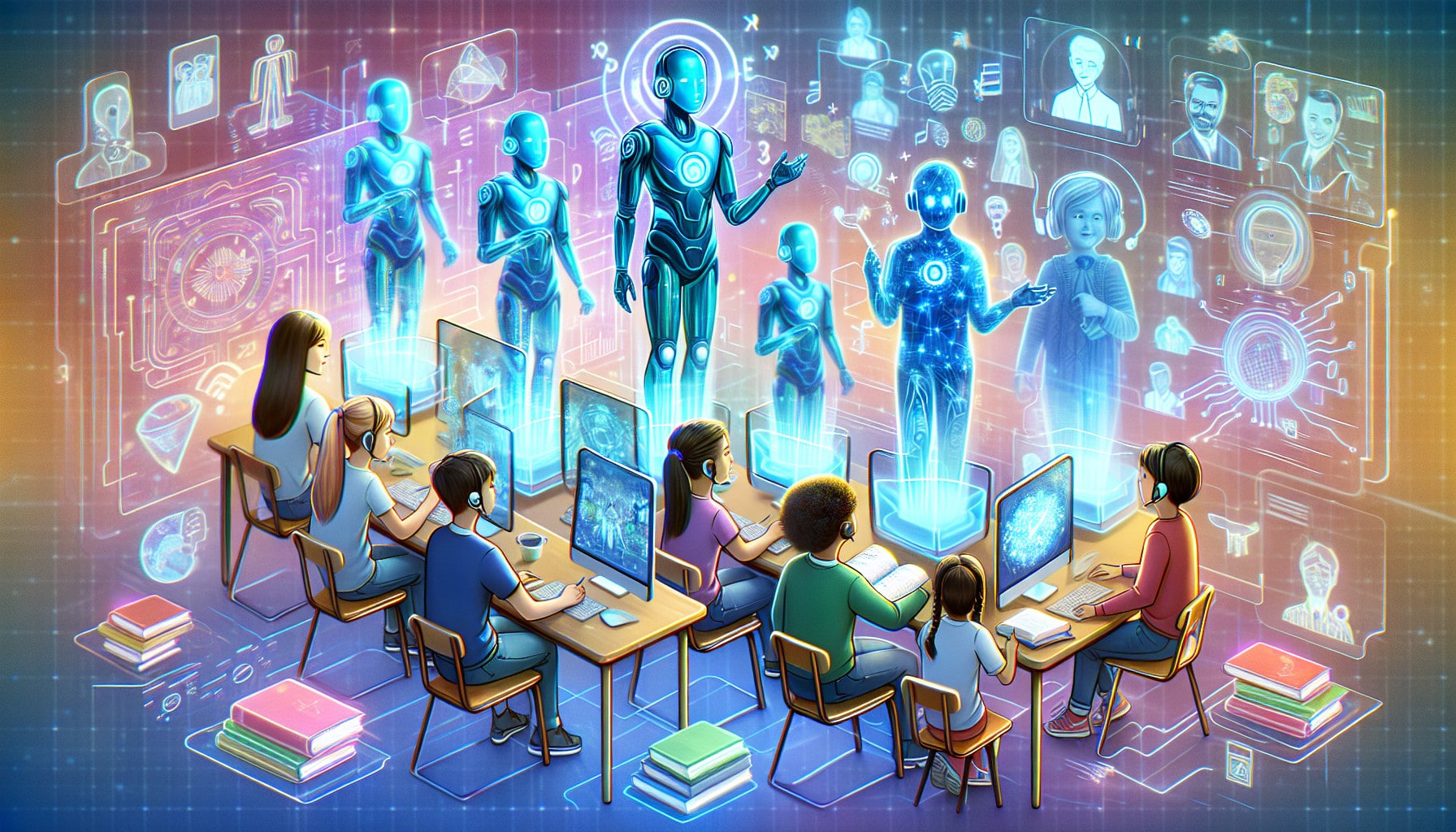
Artificial intelligence tutors are specialized digital systems that utilize large language models, pedagogical frameworks, and real-time data to provide individualized instruction to students. These systems simulate the experience of 1-to-1 human tutoring by adapting to a learner's pace, identifying specific knowledge gaps, and offering scaffolded support across diverse academic subjects.
As we move through 2026, the educational landscape has undergone a fundamental shift. Artificial intelligence (AI) tutors are no longer experimental novelties; they are core components of the global educational infrastructure. Unlike the early generative chatbots of the early 2020s, today’s AI tutors are sophisticated instructional agents capable of multimodal interaction, emotional intelligence, and rigorous factual accuracy. They have become the primary tool for solving the "2-sigma problem"—the educational phenomenon where students tutored one-on-one perform significantly better than those in a traditional classroom setting.
The Technical Foundation of Modern AI Tutors
To understand the efficacy of artificial intelligence tutors in 2026, one must look at the underlying architecture that separates a "tutor" from a standard large language model (LLM). While early versions often hallucinated facts or simply provided answers, modern tutors are built on three primary pillars:
1. Retrieval-Augmented Generation (RAG) and Grounding
Modern AI tutors do not rely solely on their internal training data. They use Retrieval-Augmented Generation to access verified, up-to-date textbooks, peer-reviewed journals, and curriculum-specific databases. This "grounding" ensures that when a student asks a physics question, the AI is pulling from verified laws of motion rather than statistically predicting the next likely word. This has virtually eliminated the hallucination issues that plagued early educational AI.
2. The Socratic Layer
A defining feature of a true AI tutor is its refusal to simply "give the answer." Developers have implemented a Socratic instructional layer—a set of logical constraints that force the AI to guide the student through the problem-solving process. If a student asks for the solution to a calculus problem, the AI might respond by asking the student to identify the first derivative of the function, providing hints only when the student shows signs of struggle.
3. Affective Computing and Multimodal Feedback
By 2026, AI tutors have integrated affective computing, allowing them to analyze a student’s tone of voice, facial expressions (via webcam, with privacy consent), and typing patterns. If the system detects frustration or cognitive overload, it can adjust its tone, offer a break, or switch to a simpler explanation. Multimodal capabilities mean these tutors can "see" a student’s handwritten work through a camera and provide real-time corrections.
Key Benefits of AI Tutoring Systems
The widespread adoption of AI tutors is driven by their ability to provide high-quality instruction at a fraction of the cost of human tutoring. This democratization of elite-level education has several specific advantages:
- 24/7 Availability: Learning does not always happen between 8:00 AM and 3:00 PM. AI tutors allow students to receive high-level support at midnight or during a commute, ensuring that learning momentum is never lost.
- Infinite Patience: Unlike human instructors who may grow tired or frustrated by repetitive questions, AI tutors can explain a single concept in a thousand different ways without fatigue.
- Data-Driven Personalization: These systems track every interaction, building a long-term Learner Profile. They know exactly which concepts from third grade are causing a student to struggle with tenth-grade algebra, allowing for precise remedial intervention.
- Safe Failure Environment: Many students suffer from "math anxiety" or a fear of looking foolish in front of peers. AI tutors provide a private, non-judgmental space where students feel safe making mistakes and asking "obvious" questions.
Comparing Leading AI Tutoring Platforms in 2026
The market for AI tutors has matured into several distinct categories, ranging from K-12 generalists to specialized professional certification coaches.
| Platform | Primary Target | Key Technical Feature | Typical Cost (2026) |
|---|---|---|---|
| Khanmigo (Khan Academy) | K-12 Students | Deep integration with standard curricula and Socratic guardrails. | Often free for schools; ~$15/mo for individuals. |
| Duolingo Max | Language Learners | Real-time roleplay and "Explain My Answer" logic. | $30/month (bundled with Super). |
| Coursera Coach | Professionals | Specialized in technical skills like Python, Data Science, and MBA prep. | Included with Coursera Plus (~$399/year). |
| Squirrel AI | Competitive Testing | Large-scale adaptive testing and granular knowledge mapping. | Varies by region (Enterprise focus). |
| Open-Source (Llama-Edu) | Self-Hosters | Customizable RAG systems for private or niche subjects. | Free (requires hardware/cloud compute). |
Implementation and Access Requirements
Integrating an artificial intelligence tutor into a learning routine requires more than just an internet connection. To maximize the effectiveness of these tools, users should consider the following prerequisites:
Hardware and Connectivity
While most AI tutors are cloud-based, the move toward multimodal interaction (voice and video) requires a stable broadband connection with at least 10 Mbps upload speeds. A device with a functional camera and microphone is essential for the "whiteboard sharing" features that allow the AI to critique handwritten work.
Data Privacy and Security
In 2026, data privacy is a significant concern. Users should ensure their chosen platform is compliant with the Student Data Privacy Act or similar regional regulations like GDPR. Reliable tutors provide "Data Sovereignty" modes where a student's interaction history is encrypted and not used for broader model training.
Integration with Formal Curricula
An AI tutor is most effective when it is synced with what the student is learning in school. Many platforms now allow students to upload their syllabi or link their accounts to Learning Management Systems (LMS) like Canvas or Google Classroom. This prevents the "conflicting method" problem, where an AI might teach a different long-division method than the one required by the student's teacher.
Challenges and Ethical Considerations
Despite the technological leaps, artificial intelligence tutors are not without their limitations and ethical hurdles.
The Social-Emotional Gap
Learning is a deeply social process. While AI can simulate empathy, it cannot provide the genuine mentorship, inspiration, or social pressure that comes from a human teacher. Educators warn against replacing human interaction entirely, suggesting that AI should be a "force multiplier" for teachers rather than a replacement.
The "Answer Engine" Risk
There is a constant battle between developers and students who attempt to "jailbreak" AI tutors to simply do their homework for them. If the guardrails are too weak, the AI becomes a sophisticated cheating tool, leading to a decline in actual cognitive development.
Digital Divide 2.0
While AI tutors are cheaper than human tutors, they still require expensive devices and high-speed internet. There is a growing concern that students in lower-income areas may only have access to "basic" AI models, while wealthier students utilize "premium" models with better reasoning and lower latency, potentially widening the achievement gap.
Common Mistakes When Using AI Tutors
To get the most out of an artificial intelligence tutor, learners must avoid several common pitfalls:
- Treating it like a Search Engine: Asking "What is the answer to question 5?" defeats the purpose. Instead, users should ask, "Can you help me understand the steps to solve this type of problem?"
- Ignoring the "Check Your Work" Feature: Most AI tutors have a mode where the student solves the problem and the AI reviews it. Skipping straight to the AI's explanation reduces long-term retention.
- Over-Reliance: Students who use AI for every single task may find their "independent" problem-solving skills atrophying. It is recommended to use the tutor only when stuck or when reviewing new concepts.
Frequently Asked Questions
Can an AI tutor replace a human teacher in 2026?
No. In 2026, AI tutors are viewed as assistants that handle the repetitive, drill-based aspects of learning and provide 24/7 support. Human teachers remain essential for social-emotional learning, complex group projects, and high-level mentorship that requires human intuition and life experience.
Are AI tutors accurate in technical subjects like medicine or law?
Specialized AI tutors are highly accurate because they are grounded in specific, vetted databases (like LexisNexis for law or PubMed for medicine). However, they are still prone to occasional errors in logic, and their outputs in professional fields should always be verified by a qualified human.
How much do artificial intelligence tutors cost on average?
Prices vary significantly based on the level of "intelligence" and subject matter. Basic K-12 tutors often cost between $10 and $20 per month. Highly specialized tutors for executive coaching or advanced medical certifications can cost upwards of $100 per month, reflecting the premium data they access.
Is my child’s data safe with an AI tutor?
Most major educational AI companies in 2026 adhere to strict privacy standards. However, it is vital to check if the platform is "FERPA-compliant" (in the US) and whether they offer an opt-out for using your data for model training. Always look for platforms that offer end-to-end encryption of student-tutor dialogues.
Does using an AI tutor count as cheating?
It depends on how it is used. If the tutor is used to explain concepts and provide practice, it is a legitimate study tool. If it is used to generate answers for graded assignments without a student's cognitive input, most institutions define that as academic dishonesty.
Practical Recommendations for Getting Started
If you are looking to integrate an artificial intelligence tutor into your or your child’s education, start by identifying a specific subject gap. Do not attempt to use one generalist AI for everything. Instead, choose a platform that specializes in the target area—such as a dedicated language AI for Spanish or a math-focused AI for SAT prep.
Before committing to a subscription, utilize the free trials that most 2026 platforms offer to test the Socratic guardrails. A good AI tutor should ask you more questions than it answers. Finally, ensure that the tutor has a "Teacher/Parent Dashboard" feature, allowing you to monitor progress and identify areas where the AI identifies a persistent lack of understanding.