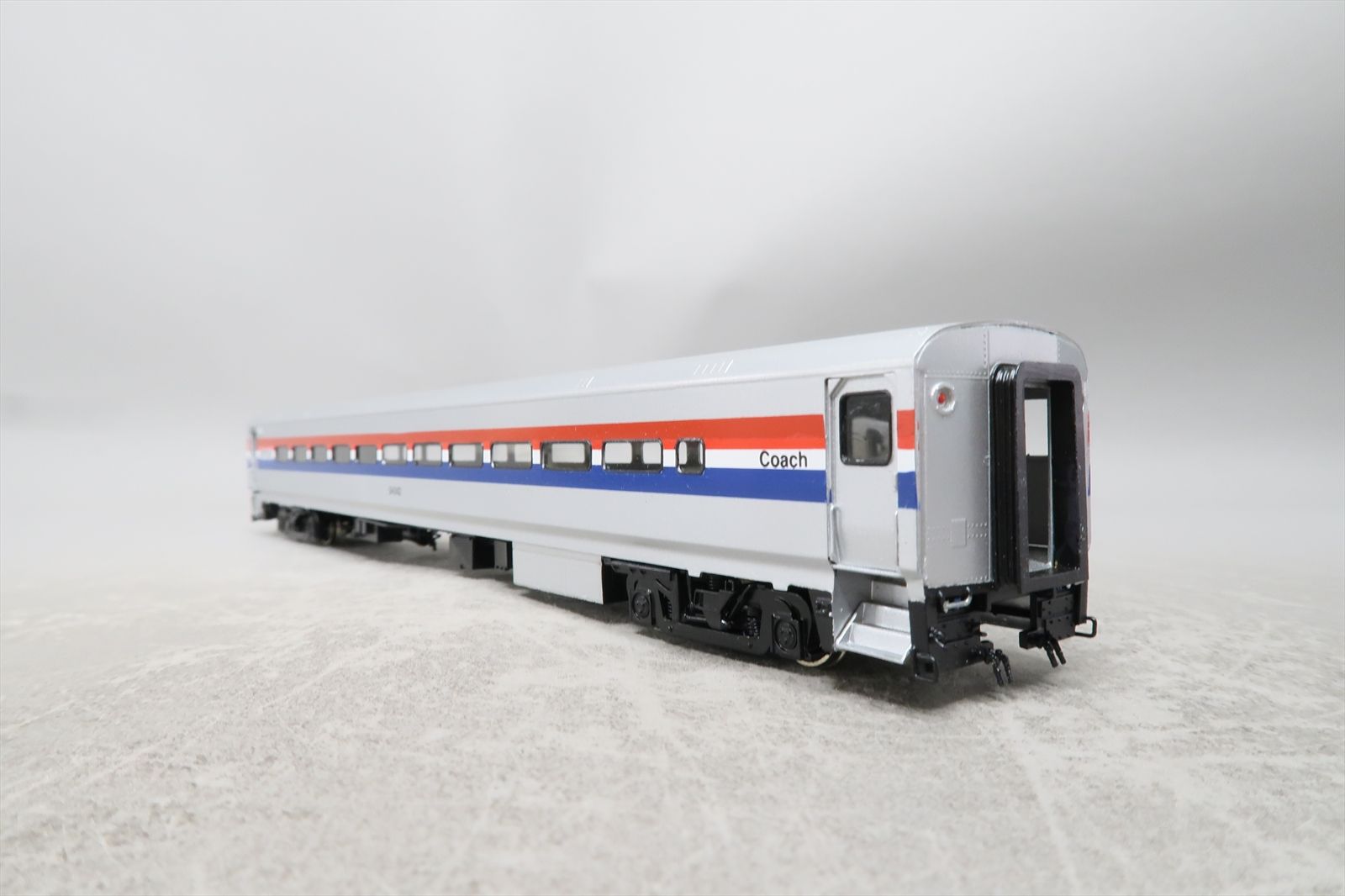
Amtrak Horizon coaches are single-level passenger rail cars primarily used on short-distance regional corridors in the Midwest and West Coast. Introduced in the late 1980s to supplement the Amfleet, these aluminum-bodied cars offer reliable service for state-supported routes, though they are currently being phased out by newer Siemens Venture equipment.
The Origins and Development of the Horizon Fleet
The Amtrak Horizon fleet represents a significant chapter in American rail history, marking a departure from the "tubular" stainless steel designs that dominated the mid-20th century. Developed in the late 1980s, these cars were born out of a necessity to expand capacity on burgeoning regional corridors where the existing Heritage fleet (converted from pre-Amtrak private railroads) was reaching the end of its viable lifespan.
Amtrak turned to Bombardier, the Canadian aerospace and transportation giant, to produce a fleet of cars based on an existing, proven design. The Horizon cars are essentially a long-distance version of the "Comet" commuter cars used by agencies like NJ Transit and Metro-North. By utilizing an established commuter rail platform, Amtrak was able to acquire a fleet of 104 cars relatively quickly and cost-effectively between 1988 and 1990.
The order consisted of 88 coaches and 16 food service (dinette) cars. Unlike the Amfleet cars, which were built by the Budd Company using stainless steel, the Horizon cars were constructed using aluminum. This choice of material offered weight savings but resulted in a different aesthetic—a more boxy, utilitarian appearance characterized by flat sides and large, rectangular windows. This design provided a stark contrast to the rounded, aircraft-inspired silhouette of the Amfleet I and II cars.
Technical Specifications and Engineering
To understand the longevity of the Horizon fleet, one must look at the mechanical underpinnings that have allowed these cars to remain in service for nearly four decades. As of 2026, many of these units have undergone multiple refreshes to maintain operational standards.
Carbody and Dimensions
The Horizon coach is roughly 85 feet long and 10 feet 6 inches wide. Because they are single-level cars, they are compatible with both low-level and high-level platforms, a critical feature for the diverse infrastructure found on Amtrak’s national network. The aluminum shell is reinforced with steel end-frames to meet Federal Railroad Administration (FRA) buff strength requirements, ensuring passenger safety in the event of a collision.
Bogies and Suspension
The cars sit on General Steel Industries (GSI) G70 inboard-bearing trucks. These trucks were a standard for several decades of passenger rail equipment, offering a relatively smooth ride at the 100–125 mph speeds required for corridor service. The suspension system utilizes a combination of coil springs and hydraulic shock absorbers to dampen the vibrations inherent in high-speed rail travel on shared freight corridors.
Electrical and Climate Control
Horizon cars rely on Head-End Power (HEP) provided by the locomotive. This 480V three-phase AC power is distributed throughout the train to run the HVAC (Heating, Ventilation, and Air Conditioning) units, interior lighting, and the modern amenities passengers expect today, such as power outlets. The HVAC systems in Horizon cars were originally designed for the variable climates of the Northeast and Midwest, featuring robust heating elements for harsh winters and powerful compressors for humid summers. Over the years, these systems have been upgraded to use more environmentally friendly refrigerants.
Interior Layout and Passenger Amenities
While the exterior of a Horizon coach is functional, the interior was designed to maximize passenger density without sacrificing the comfort necessary for trips lasting three to five hours.
Seating Configurations
Standard Horizon coaches typically feature a 2-2 seating arrangement. In their original configuration, they could hold between 68 and 72 passengers. Following various ADA (Americans with Disabilities Act) compliance overhauls, the seating capacity in many cars was reduced to approximately 62 to 64 to accommodate wheelchair tie-down areas and larger, accessible restrooms.
The seats themselves are designed for regional travel. They offer a generous "pitch" (the distance between seats), usually around 39 to 41 inches, which significantly exceeds the legroom found in domestic airline economy classes. The seats feature reclining backs, fold-down tray tables, and overhead luggage racks.
The Dinette and Club Cars
A subset of the Horizon fleet was built as "Dinette" cars. These are split-level-style interior configurations where one half of the car contains a galley and table seating for food service, while the other half contains standard coach seating. Some Horizon cars were also converted into "Club" or Business Class cars, featuring a 2-1 seating arrangement for increased shoulder room and additional legroom, catering to business travelers on routes like the Hiawatha or the Wolverine.
Accessibility and Restrooms
In the 2026 operational context, all active Horizon cars have been retrofitted to meet modern accessibility standards. This includes the installation of wider restroom doors, grab bars, and lower-height emergency call buttons. The restrooms utilize a vacuum-flush system, which is more efficient and sanitary than the gravity-flush systems used in older rail equipment.
Comparison of Amtrak Single-Level Equipment
For travelers and enthusiasts, distinguishing between the various types of single-level equipment is essential. The following table compares the Horizon fleet with its predecessor (Amfleet) and its successor (Siemens Venture).
| Feature | Horizon Coach | Amfleet I | Siemens Venture |
|---|---|---|---|
| Manufacturer | Bombardier | Budd Company | Siemens Mobility |
| Production Years | 1988–1990 | 1975–1977 | 2018–Present |
| Body Material | Aluminum | Stainless Steel | Galvanized Steel |
| Maximum Speed | 125 mph | 125 mph | 125 mph |
| Window Style | Large, Rectangular | Small, Oval ("Porthole") | Full-Length Panoramic |
| Primary Use | Midwest/West Corridors | Northeast Corridor | National Corridors |
| Door Type | Manual/Trap | Automatic/Plug | Fully Automated/Slide |
| Ride Quality | Moderate | High (Quiet) | Exceptional (Advanced Air-Ride) |
Operational History and Geographic Reach
The Horizon fleet was primarily intended for the "Amtrak West" and "Amtrak Midwest" divisions. For much of the 1990s and 2000s, they were the backbone of the Chicago hub.
The Midwest Hub
From Chicago Union Station, Horizon coaches served as the primary equipment for routes such as:
- The Lincoln Service: Chicago to St. Louis.
- The Wolverine: Chicago to Detroit/Pontiac.
- The Hiawatha: Chicago to Milwaukee.
- The Illinois Zephyr/Carl Sandburg: Chicago to Quincy.
Their ability to handle high-frequency turnarounds made them ideal for these short-to-medium-haul routes. However, as these routes were selected for "Higher Speed Rail" (HrSR) upgrades, the limitations of the aging Horizon fleet became more apparent, leading to the massive investment in the Siemens Venture fleet.
California and the Pacific Northwest
Horizon cars also found a home on the West Coast. They were frequently used on the San Joaquins (Oakland/Sacramento to Bakersfield) and occasionally supplemented the Amtrak Cascades (Eugene to Vancouver, BC) when the specialized Talgo equipment was unavailable or being serviced. Their versatility allowed Amtrak to shift equipment between regions to meet seasonal demand or cover for maintenance backlogs.
The 2026 Status: Retirement and the Venture Transition
As of 2026, the Amtrak Horizon fleet is in the final stages of its primary service life. The "Interstate Rail Compacts" in the Midwest have largely completed the rollout of the Siemens Venture cars. These newer cars offer significantly improved crash energy management, vastly superior WiFi connectivity, and touchless interior features that the 1980s-era Horizon cars cannot match.
Where Can You Still Find Horizon Coaches?
While no longer the flagship of the Midwest, Horizon cars haven't disappeared entirely. In 2026, they serve three primary roles:
- Peak Capacity "Protects": During high-traffic periods like Thanksgiving or Christmas, Horizon cars are pulled from reserve storage to add capacity to existing trains.
- Special Charters and Extra Services: They are frequently used for state-fair specials or sporting event trains where the newer Venture equipment cannot be spared.
- Secondary Regional Routes: Some California routes continue to utilize refurbished Horizon cars as they wait for the final deliveries of the California-specific Venture orders.
The Refurbishment Legacy
It is worth noting that the Horizon cars in service in 2026 are far from their original 1988 condition. Between 2018 and 2023, Amtrak undertook a comprehensive "refresh" program for the remaining Horizon and Amfleet fleets. This included new seat cushions, faux-leather upholstery (easier to clean), new flooring, and updated interior lighting. This refresh was a bridge measure to ensure passenger comfort until the full replacement by the Siemens fleet was finalized.
Maintenance Challenges and Longevity
The primary challenge in keeping the Horizon fleet operational into 2026 has been the sourcing of spare parts. Because Bombardier moved away from this specific "Comet" design for intercity rail decades ago, Amtrak maintenance crews at facilities like the Beech Grove Shops in Indiana have had to become increasingly creative.
The aluminum carbodies, while resistant to rust, are susceptible to "stress corrosion cracking" around the bolster areas over decades of high-mileage use. Regular ultrasonic testing and structural reinforcements have been necessary to keep the fleet "blue-carded" (certified for service). Furthermore, the aging electrical systems often struggle with the power demands of modern passengers, who may have multiple laptops and mobile devices plugged in simultaneously, occasionally stressing the older HEP distribution blocks.
Frequently Asked Questions
How can I tell if I am on a Horizon coach instead of an Amfleet?
The easiest way to tell is by looking at the windows and the sides of the car. If the car has flat, vertical sides and large rectangular windows, it is a Horizon coach. If the car has a rounded, tubular shape and small, oval-shaped windows, it is an Amfleet coach. Additionally, Horizon cars have vestibules at both ends, whereas Amfleet I cars have vestibules at both ends but Amfleet II cars (for long distance) only have them at one end.
Do Horizon coaches have WiFi?
Yes. As of 2026, all Horizon coaches remaining in active service have been fitted with Amtrak’s "AmtrakConnect" WiFi system. However, because the cars are older, the signal distribution within the aluminum shell can sometimes be less consistent than in the newer Siemens Venture cars, which were built with integrated signal boosters and fiber-optic backbones.
Are Horizon cars safe compared to newer trains?
Horizon cars meet all FRA safety standards required for operation in the United States. While they lack some of the advanced "Crash Energy Management" (CEM) features found in the 2026 Siemens Venture fleet—which include crumple zones designed to absorb impact—they are built with heavy steel end-frames and collision posts that have proven effective over decades of service.
Why did Amtrak choose aluminum for the Horizon cars?
At the time of their construction, aluminum was seen as a way to reduce the weight of the train, which in turn reduces wear on the tracks and lowers fuel consumption for the locomotives. While stainless steel (used in Amfleets) is more durable over a 50-year lifespan, aluminum was a standard choice for the Bombardier Comet platform on which the Horizon was based.
What will happen to the Horizon cars after they are retired?
Most retired Horizon cars are sent to Amtrak’s facility in Beech Grove, Indiana. From there, they are either sold to private excursion railroads, donated to railway museums, or sold for scrap. Because they are single-level and use standard parts, they are highly sought after by "heritage" railroads that operate tourist trains.
Practical Recommendation for Travelers
If you are planning a trip in 2026 and find yourself booked on a route that still utilizes Horizon equipment, such as a peak-capacity Midwest train, you can still expect a comfortable experience. To maximize your comfort:
- Seat Selection: Try to sit in the middle of the car. The ends of Horizon cars, being older, can sometimes experience more "slack action" (the pushing and pulling between cars) and noise from the manual vestibule doors.
- Power Access: While power outlets are available at every seat, the older electrical architecture means they are best suited for charging phones and tablets rather than high-powered gaming laptops.
- Luggage: Horizon cars have very large overhead racks. If you have a standard "carry-on" size suitcase, it will easily fit above your seat, allowing you to keep your belongings close.
As the era of the Horizon coach draws to a close, they remain a testament to a period of pragmatic expansion for Amtrak, serving as a reliable workhorse that helped bridge the gap between the golden age of rail and the high-tech future of the mid-21st century.