Choosing the right life insurance policy depends heavily on your budget, health status, and financial protection goals, as term life insurance covers death from any cause including illness, while accidental death insurance exclusively pays out if the policyholder dies as the direct result of a covered accident.
Navigating the landscape of life insurance products can quickly become overwhelming, especially when comparing policies that sound similar but function in fundamentally different ways. When evaluating financial safety nets for loved ones, consumers often encounter a stark choice between comprehensive protection and specialized, lower-cost coverage. Understanding the mechanics, underwriting requirements, costs, and limitations of accidental death coverage versus traditional term life insurance is essential for building a resilient financial plan. This comprehensive analysis breaks down the mechanics of both products, highlights their distinct trade-offs, and provides the clarity needed to make an informed purchasing decision.
Defining the Core Concepts
To evaluate accidental death insurance versus term life insurance fairly, it is first necessary to establish what each product is designed to achieve. While both are forms of life insurance designed to pay a cash benefit to beneficiaries upon the insured's death, their definitions of a "qualifying death" diverge sharply.
Traditional term life insurance is a form of temporary coverage that remains active for a specified period, typically ranging from 10 to 30 years. If the insured passes away from natural causes—such as cancer, heart disease, stroke, or organ failure—or from an accident while the policy is active, the insurance company pays the full death benefit to the designated beneficiaries. Because it covers nearly all causes of death (with standard exclusions for suicide during the first two policy years, criminal acts, or war), term life is considered comprehensive income-replacement coverage.
Accidental death and dismemberment (AD&D) insurance, or standalone accidental death insurance, is a much narrower product. It does not cover natural causes of death, chronic illnesses, or age-related medical decline. Instead, it pays out only if the insured dies strictly as a result of an accident, such as a motor vehicle crash, a fatal fall, drowning, or machinery accidents. Furthermore, many AD&D policies include a dismemberment clause, meaning they will pay a partial benefit if the insured suffers the loss of limbs, sight, speech, or hearing due to an accident.
Underwriting, Eligibility, and Medical Requirements
The stark difference in risk exposure between these two types of insurance dictates how insurance companies evaluate and approve applicants. The underwriting process is often the most significant hurdle for consumers seeking coverage, and the contrast between term life and accidental death in this arena is profound.
Term Life Insurance Underwriting
Term life insurance requires rigorous medical underwriting. To determine your premium rate, insurance companies typically evaluate:
- Detailed medical history and prescription records
- Family medical history regarding hereditary conditions
- Current lifestyle habits, including smoking, alcohol consumption, and dangerous hobbies
- Results from a paramedical exam, which often includes drawing blood and collecting a urine sample
Because insurers face the statistical certainty that every human eventually passes away—and that many will experience chronic or terminal illnesses before doing so—they must carefully price the policy based on your individual mortality risk. Individuals with pre-existing conditions like diabetes, high blood pressure, or a history of cancer may face higher rates or denial of coverage, though some carriers offer simplified-issue or guaranteed-issue term options at higher price points.
Accidental Death Insurance Underwriting
Accidental death insurance, by contrast, is known for its frictionless application process. Because insurers are only underwriting the risk of an accidental death rather than a medical one, they almost never require a medical exam.
- Applications typically consist of a brief questionnaire regarding age, occupation, and general health.
- Pre-existing medical conditions are generally ignored during the approval process.
- Applicants who have been denied traditional term life insurance due to health issues can almost always qualify for accidental death coverage.
However, this lack of medical scrutiny does not mean everyone qualifies. Insurers carefully evaluate occupational hazards and lifestyle risks. Individuals who work in high-risk environments—such as commercial fishing, deep-sea diving, structural steelwork, or explosives handling—may be denied coverage or face steep surcharges. Similarly, participating in extreme sports like skydiving or auto racing can disqualify an applicant.
Cost Comparison and Financial Value
When comparing the financial outlay of accidental death versus term life insurance, the numbers reveal why accidental coverage appears attractive at first glance, but also why it demands careful consideration.
Accidental death insurance is significantly cheaper than term life insurance. A healthy 40-year-old might secure a $500,000 accidental death policy for a fraction of the cost of a traditional 20-year term life policy of the same face value. Because the statistical probability of dying in an accident is much lower than dying from all causes combined, the insurer's payout risk is statistically suppressed, allowing for lower premiums.
However, financial advisors frequently caution against viewing accidental death insurance as a direct substitute for term life insurance. Statistically, the vast majority of deaths in modern society are attributed to medical causes rather than accidents. According to data from the Centers for Disease Control and Prevention (CDC), leading causes of death include heart disease, malignant neoplasms (cancer), cerebrovascular diseases, and chronic lower respiratory diseases. An accidental death policy provides zero financial protection against any of these outcomes.
| Feature | Term Life Insurance | Accidental Death Insurance |
|---|---|---|
| Causes of Death Covered | All causes (natural, illness, accidents) | Accidents only (fatal crashes, falls, etc.) |
| Medical Exam Required | Usually required (blood, urine, vitals) | Rarely required (simple questionnaire) |
| Approval Odds | Dependent on health and lifestyle | High (health status is generally ignored) |
| Cost | Higher, reflects comprehensive mortality risk | Lower, reflects narrow risk exposure |
| Policy Duration | Fixed terms (10, 15, 20, 25, or 30 years) | Often renewable annually or tied to terms |
| Primary Purpose | Complete income replacement and family security | Supplemental coverage for accidental loss |
Analyzing Claims and Legal Definitions of an "Accident"
The primary operational friction point with accidental death insurance arises during the claims process. While the definition of a natural death under a term life policy is straightforward, establishing whether a death legally qualifies as an "accident" can sometimes result in complex disputes between the beneficiary and the insurance carrier.
Insurance contracts contain strict legal definitions and exclusions regarding what constitutes a covered accident. To qualify for a payout, the death must typically be sudden, unexpected, and violent, caused by external means independent of any internal bodily infirmity.
Common exclusions found in accidental death policies include:
- Deaths resulting from voluntary intoxication (alcohol or illicit drugs)
- Suicide or intentional self-harm
- Death occurring while committing a felony or participating in illegal acts
- Medical complications resulting from surgical or medical treatments (even if unexpected)
- Overdose from prescription medications taken outside of doctor instructions
- Acts of war or military service in a combat zone
If a policyholder suffers a heart attack while driving and subsequently crashes into a tree, a dispute may arise over whether the fatal event was the motor vehicle accident or the underlying cardiac arrest. Term life insurance avoids this ambiguity entirely, as it pays out regardless of whether the heart attack preceded the collision.
Strategic Integration: When to Use Which Policy
Rather than viewing accidental death insurance and term life insurance as mutually exclusive competitors, many financial planners view them through the lens of portfolio risk management and affordability.
When Term Life Insurance is Essential
If you have dependents who rely on your income—such as minor children, a spouse, or aging parents—term life insurance is generally non-negotiable. It ensures that your family can pay off a mortgage, fund college education, and replace lost earnings if you pass away from an illness or an accident. If you are young, healthy, and on a budget, a 20-year or 30-year term policy provides the most robust financial safety net per dollar spent.
When Accidental Death Insurance Makes Sense
Accidental death insurance should rarely serve as a primary life insurance strategy. However, it can fill specific gaps under particular circumstances:
- As a Supplemental Layer: If you already maxed out your traditional life insurance budget but want extra catastrophic protection, a low-cost accidental rider or standalone policy can boost your total payout for specific scenarios.
- Uninsurability Due to Health: If you have severe, chronic health conditions that make traditional term life insurance completely unaffordable or unobtainable, accidental death insurance provides a cost-effective way to leave behind some financial support for final expenses.
- Budgetary Constraints During Transitional Periods: If cash flow is temporarily tight, accidental coverage can offer immediate, basic protection until finances stabilize enough to purchase a proper term policy.
Common Mistakes to Avoid
Navigating insurance purchases requires vigilance against common pitfalls that can leave families financially exposed when a tragedy occurs.
- Confusing AD&D with Comprehensive Coverage: The single most dangerous mistake is assuming that a high-value accidental death policy protects your family from all forms of mortality. Relying solely on accidental coverage leaves beneficiaries unprotected against cancer, heart disease, and other natural causes.
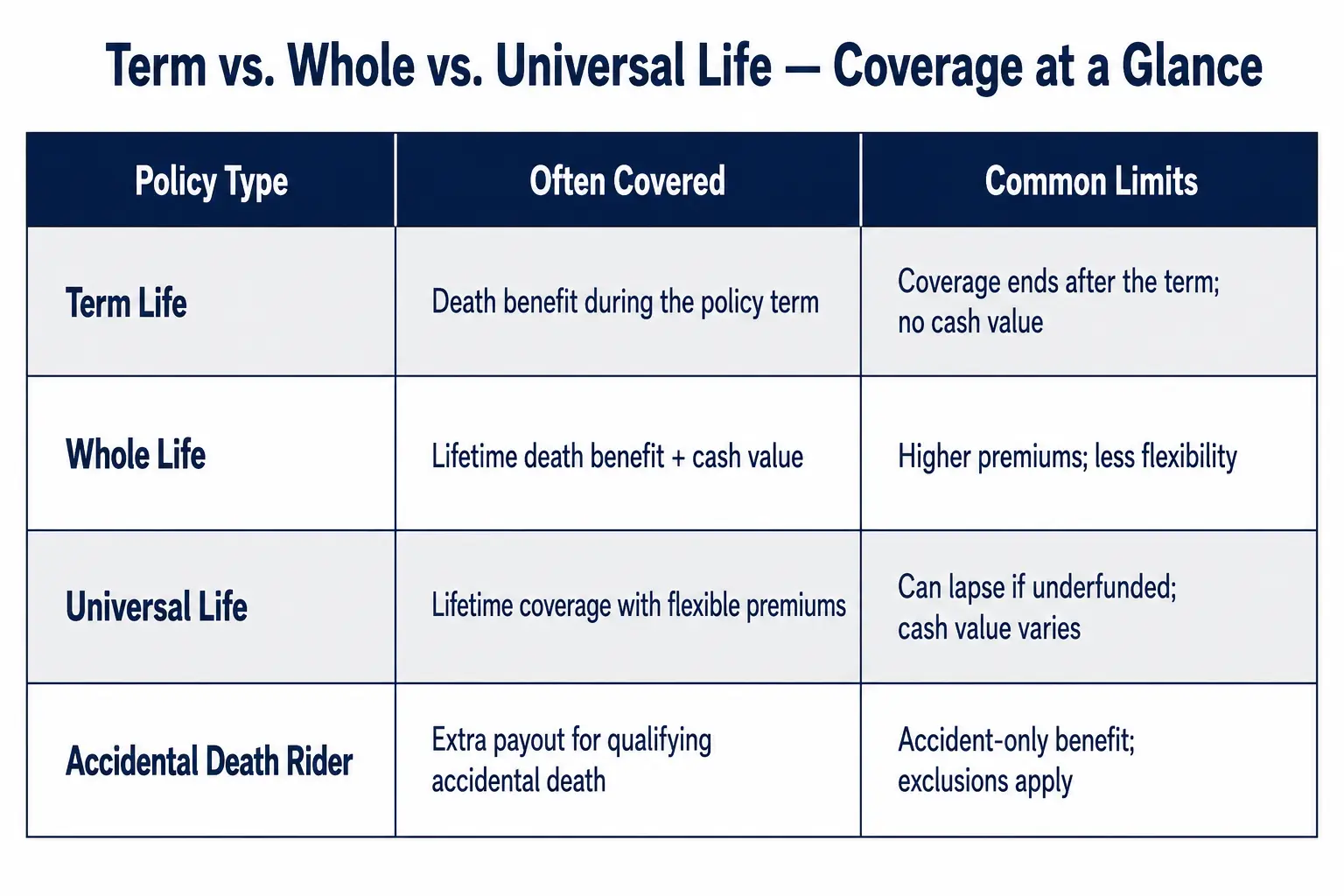
- Ignoring Policy Riders: Many term life policies offer an "Accidental Death Benefit Rider" for a nominal extra fee. This adds accidental coverage to a standard term policy, paying a multiple of the base face value if death occurs accidentally. Homeowners often overlook these riders, which can be cheaper than buying a separate standalone accidental policy.
- Failing to Read Exclusions: Overlooking policy fine print regarding hazardous hobbies, foreign travel, or extreme sports can lead to claim denials. Always review the exact list of exclusions before signing a contract.
- Underinsuring Income: When purchasing term life, consumers often guess at coverage amounts rather than calculating actual debt obligations, future tuition costs, and income replacement needs over the target timeline.
Frequently Asked Questions
Does accidental death insurance cover heart attacks or strokes?
No. Accidental death insurance only covers deaths caused directly by external, violent, and accidental means. Medical events like heart attacks, strokes, aneurysms, and organ failures are classified as natural causes and are excluded from accidental death policies.
Can I be denied accidental death insurance based on my health?
It is rare, but possible. While accidental death insurers do not perform medical exams or disqualify applicants for high cholesterol or diabetes, they will evaluate your age, driving record, dangerous occupations, and participation in high-risk hobbies like aviation or extreme sports.
Is accidental death insurance cheaper than term life insurance?
Yes, accidental death insurance is significantly less expensive than term life insurance. Because the statistical likelihood of dying in an accident is lower than dying from all causes combined, the insurer assumes less risk and charges lower premiums.
Can I have both term life and accidental death insurance at the same time?
Yes. Many consumers purchase a primary term life insurance policy for comprehensive protection and add a standalone accidental death policy—or an accidental death rider—to supplement their overall payout in the event of an accidental tragedy.
What happens if I outlive my accidental death policy?
Just like standard term life insurance, standalone accidental death policies are typically temporary contracts. If you outlive the policy term and do not renew it, the coverage expires, and no cash value or death benefit is returned unless you purchased a specialized return-of-premium variant.
Final Recommendations for Buyers
When building a sound financial plan, prioritize comprehensive protection first. If your budget permits, secure a level-premium term life insurance policy that matches your family's long-term financial obligations, ensuring coverage spans the years your dependents rely on your income most. Utilize accidental death insurance strictly as an affordable supplement if you have uninsurable health conditions, or if you wish to layer extra catastrophic protection on top of a solid term life foundation. Always evaluate your actual risk exposure, review policy exclusions thoroughly, and consult with a licensed fiduciary or insurance professional to tailor a policy structure that protects your family's financial future.