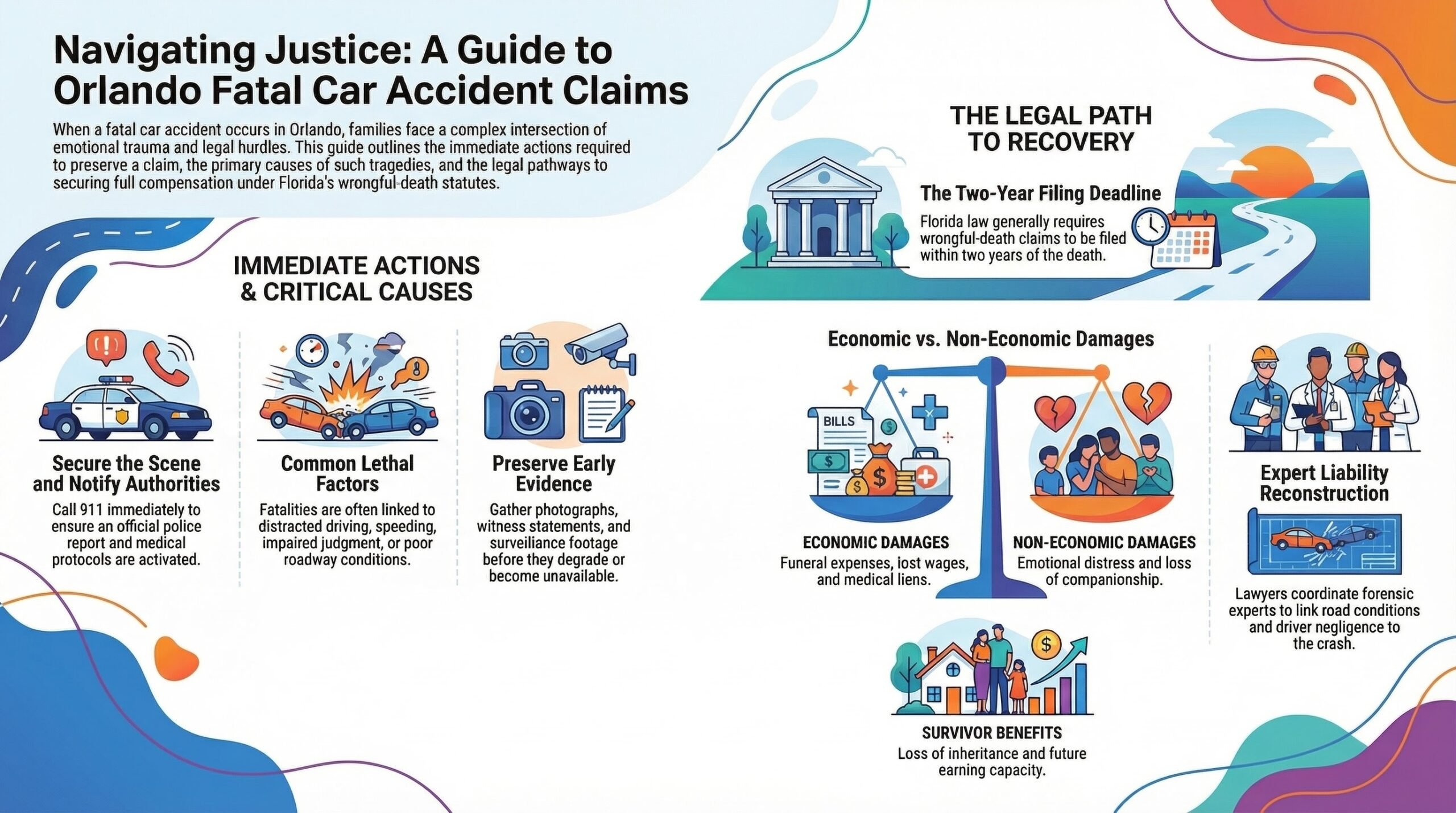
Accident lawyers in Orlando provide essential legal advocacy for victims navigating Florida’s complex no-fault insurance system and recently tightened negligence statutes. These attorneys manage insurance negotiations, investigate liability, and litigate claims to recover costs for medical treatment and lost income. In 2026, understanding the two-year statute of limitations and the 50% fault bar is critical for any successful recovery.
Understanding Orlando’s Legal Landscape after an Accident
Orlando remains one of the most high-traffic regions in the United States, driven by a combination of a massive tourism industry, a burgeoning tech sector, and the infamously congested I-4 corridor. Consequently, the legal environment for accident victims in Central Florida is both fast-paced and strictly regulated by state law. As of 2026, the legal framework for personal injury in Florida has undergone significant maturation following the sweeping tort reforms of 2023.
When you are involved in an accident in Orlando—whether it is a multi-car collision near the attractions or a slip-and-fall in a Downtown business—you are entering a legal system that prioritizes specific filing deadlines and fault thresholds. Orlando accident lawyers specialize in interpreting these rules to ensure that a victim’s right to compensation is not forfeited due to procedural errors or aggressive insurance defense tactics.
The role of legal counsel has become increasingly vital because the "margin for error" for plaintiffs has narrowed. With the 2023 legislative changes now fully integrated into court procedures, the burden of proof and the speed at which evidence must be collected have become more demanding. Orlando lawyers must now be more proactive than ever in the "pre-suit" phase to secure the necessary data from traffic cameras, black boxes, and witness statements.
Florida’s No-Fault Insurance and the 14-Day Rule
Florida operates under a "no-fault" insurance system. This means that regardless of who caused the accident, your own insurance provider is responsible for paying a portion of your initial medical bills and lost wages through Personal Injury Protection (PIP) coverage.
However, there is a critical prerequisite known as the 14-day rule. Under Florida Statute § 627.736, an injured person must seek medical treatment within 14 days of the accident to qualify for PIP benefits. Failure to see a qualified medical professional—such as an MD, DO, or chiropractor—within this window usually results in a total loss of PIP coverage.
Furthermore, to access the full $10,000 PIP limit, a medical professional must determine that the victim suffered an Emergency Medical Condition (EMC). If no EMC is diagnosed, the available PIP benefit is typically capped at $2,500. Orlando accident lawyers work closely with medical providers to ensure that injuries are documented accurately and that the EMC status is addressed early in the treatment process.
The Serious Injury Threshold
Because Florida is a no-fault state, you are generally prohibited from suing the other driver for non-economic damages (like pain and suffering) unless your injuries meet a specific legal threshold. To step outside the no-fault system and file a third-party liability claim, the injury must consist of:
- Significant and permanent loss of a bodily function.
- Permanent injury within a reasonable degree of medical probability.
- Significant and permanent scarring or disfigurement.
- Death.
The Impact of Modified Comparative Negligence (50% Bar Rule)
One of the most significant shifts in Florida law, which remains a cornerstone of accident litigation in 2026, is the move from a "pure" comparative negligence system to a modified comparative negligence system.
Under the old rules, a victim could be 90% at fault for an accident and still recover 10% of their damages. Today, Florida follows a 50% bar rule. If a jury determines that you are more than 50% responsible for the accident that caused your injuries, you are legally barred from recovering any damages from the other party.
This change has fundamentally altered how Orlando accident lawyers approach their cases. Defense attorneys and insurance adjusters now work aggressively to shift just enough blame—even 51%—onto the plaintiff to eliminate their liability entirely. Your lawyer’s job is to utilize accident reconstruction experts, forensic evidence, and eyewitness testimony to keep your percentage of fault as low as possible. If you are found to be 20% at fault, your total award will be reduced by 20%, but you will still receive the remaining 80%.
Common Types of Accident Claims in Orlando
Orlando’s unique economy and geography lead to specific types of accident claims that require specialized legal knowledge.
Tourist and Theme Park Accidents
With millions of visitors frequenting Walt Disney World, Universal Orlando, and SeaWorld annually, accidents involving out-of-state tourists are frequent. These cases involve complex "long-arm jurisdiction" issues, where an Orlando lawyer must coordinate with defendants who live in other states or countries. Additionally, premises liability claims against major theme parks require navigating the parks' internal security protocols and medical response records.
Commercial Trucking and Logistics
Orlando serves as a primary hub for distribution along the Florida Turnpike and I-4. Accidents involving semi-trucks and delivery vehicles are common. These cases differ from standard car accidents because they involve federal Department of Transportation (DOT) regulations. Lawyers must act quickly to send "spoliation letters" to trucking companies to prevent the destruction of electronic logging device (ELD) data and maintenance records.
Rideshare Accidents (Uber and Lyft)
As a high-traffic destination, Orlando has a dense population of rideshare drivers. Accidents involving Uber or Lyft are governed by a tiered insurance system. The amount of coverage available—ranging from $50,000 to $1 million—depends on whether the driver had the app on, was waiting for a ride, or was currently transporting a passenger.
| Feature | Personal Injury Protection (PIP) | Third-Party Liability Claim |
|---|---|---|
| Fault Requirement | No-fault (Paid regardless of blame) | Must prove the other party was negligent |
| Medical Coverage | 80% of reasonable expenses up to $10k | 100% of proven medical damages |
| Lost Wages | 60% of lost earning capacity | 100% of provable lost income |
| Pain & Suffering | Generally not covered | Recoverable if injury is permanent/severe |
| Fault Threshold | Not applicable | Recovery barred if plaintiff is >50% at fault |
| Statute of Limitations | 5 years (Contractual) | 2 years (Negligence) |
The Two-Year Statute of Limitations
In 2026, the strict two-year statute of limitations for negligence claims is the standard operating procedure in Florida. Previously, victims had four years to file a lawsuit, but the 2023 tort reform cut this time in half for most personal injury cases.
This shorter window means that the "wait and see" approach is no longer viable. Building a case involves:
- Discovery: Obtaining police reports, medical records, and cell phone records.
- Expert Consultation: Hiring medical experts or engineers to validate the claim.
- Negotiation: Attempting to settle with the insurance company before a suit is filed.
If these steps are not initiated immediately, the two-year deadline can pass quickly, permanently extinguishing the victim’s right to seek compensation. Note that while the negligence window is two years, claims against government entities (such as LYNX buses or city vehicles) may have even shorter notice requirements and different sovereign immunity caps.
Evaluating Damages: What Can You Recover?
An Orlando accident lawyer evaluates your case based on three primary categories of damages. In 2026, the methods for calculating these damages—particularly future medical costs—have become more standardized to prevent "windfall" awards.
Economic Damages
These are tangible financial losses that can be calculated with receipts and invoices. They include:
- Current and future medical bills.
- Rehabilitation and physical therapy costs.
- Lost wages and loss of future earning capacity.
- Property damage (vehicle repair or replacement).
Non-Economic Damages
These are subjective losses that do not have a fixed dollar amount but are no less impactful. They include:
- Pain and suffering.
- Mental anguish and emotional distress.
- Loss of enjoyment of life.
- Loss of consortium (impact on relationship with a spouse).
Punitive Damages
Punitive damages are rare and are not intended to compensate the victim, but rather to punish the defendant for "gross negligence" or intentional misconduct. Examples include accidents caused by a drunk driver with multiple prior offenses or a company that knowingly operated a vehicle with failing brakes.
The Role of an Orlando Accident Lawyer During Litigation
If a fair settlement cannot be reached during the insurance claim phase, your attorney will file a formal lawsuit in the Ninth Judicial Circuit Court of Florida.
The litigation process involves "discovery," where both sides exchange evidence and conduct depositions (sworn testimony). In Orlando, judges often require mediation before a case can proceed to trial. Mediation is a formal meeting where a neutral third party helps both sides reach a compromise. Statistics show that the vast majority of personal injury cases in Central Florida settle during or shortly after mediation, sparing both parties the expense and uncertainty of a jury trial.
If a settlement is still not reached, your lawyer will present your case to a jury. In the 2026 legal environment, this requires a sophisticated presentation of digital evidence, such as 3D accident recreations and high-definition medical imaging, to clearly demonstrate the mechanics of the injury and the extent of the defendant’s liability.
Frequently Asked Questions
How much does an accident lawyer in Orlando cost?
Most Orlando accident lawyers work on a contingency fee basis. This means there are no upfront costs or hourly fees. Instead, the lawyer receives a percentage of the final settlement or court award—typically 33.3% to 40%. If the lawyer does not recover money for you, you generally owe no attorney fees.
What should I do if the insurance company offers an immediate settlement?
Insurance adjusters often contact victims shortly after an accident with a "nuisance settlement" offer. While a quick check may be tempting, these offers usually require you to sign a release waiving your right to future claims. It is essential to consult a lawyer before signing anything, as many injuries—particularly spinal or soft tissue damage—may not manifest fully until weeks after the incident.
Can I still recover money if I was speeding during the accident?
Yes, but Florida's modified comparative negligence rule applies. If the court determines your speeding contributed 20% to the accident and the other driver’s failure to yield contributed 80%, your total compensation will be reduced by 20%. However, if your speeding is found to be more than 50% of the cause of the crash, you will recover nothing from the other driver.
How long will my Orlando accident case take to resolve?
The timeline varies significantly based on the complexity of the injuries. A straightforward case with clear liability might settle in 4 to 6 months. However, if the case involves severe injuries and goes to litigation, it can take 12 to 24 months. Your lawyer must wait until you reach Maximum Medical Improvement (MMI) to accurately calculate the full value of your future medical needs.
Is the 2-year statute of limitations the same for every case?
No. While it applies to most negligence-based accidents, there are exceptions. For example, claims for medical malpractice or wrongful death also have specific (and sometimes shorter or differently triggered) deadlines. Claims against the government (City of Orlando, Orange County) require a "Notice of Claim" to be filed much earlier than the two-year mark.
Recommended Next Actions
If you have been involved in an accident in Orlando, your first priority must be a comprehensive medical evaluation within 14 days to preserve your PIP benefits. Once stabilized, document everything: take photos of the scene, save all medical receipts, and avoid discussing the accident on social media, as insurance companies actively monitor these platforms.
Seek a consultation with a qualified Orlando accident lawyer to review the specifics of your case. Because of the two-year statute of limitations and the complexities of the 50% fault bar, early legal intervention is the most effective way to protect your financial and physical recovery.