Navigating the dissolution of a marriage in California requires obtaining and filing the correct legal documents from the California Courts Judicial Council. To access these California divorce forms in PDF format safely and accurately, individuals must download the official packets from the California Courts Self-Help website or local county superior court portals, ensuring compliance with state mandates and local court rules.
Understanding California Divorce Filings and Official Documentation
Dissolving a marriage within the State of California is a legal process governed by the California Family Code. Whether a case involves uncontested asset division or complex custody disputes, the foundation of every proceeding relies on standard Judicial Council forms. These documents establish jurisdiction, outline financial disclosures, and record final judgments. Understanding the structure of these documents helps petitioners and respondents avoid costly delays, administrative rejections, and unnecessary court appearances.
The Role of Judicial Council Forms
The Judicial Council of California dictates the uniform design, wording, and layout of all family law documents utilized across the state's 58 county superior courts. Individual counties cannot alter the fundamental text of these mandatory state-level forms, though many local jurisdictions require supplementary local forms (such as local cover sheets, status conference questionnaires, or alternative dispute resolution stipulations). Utilizing outdated templates or altered PDFs downloaded from unverified third-party legal document mills frequently results in court clerks rejecting filings.
Mandatory vs. Optional Disclosures
California family law draws a strict legal distinction between mandatory pleadings and optional attachments. Initial filings, such as the Petition (Form FL-100) and Summons (Form FL-110), are strictly mandatory for commencing an action for dissolution of marriage, legal separation, or nullity. Subsequent financial disclosure requirements, governed by California Family Code sections 2100 through 2113, require both parties to exchange comprehensive declarations of income, expenses, assets, and debts using forms such as the Income and Expense Declaration (Form FL-150) and the Declaration of Disclosure (Form FL-140). Failing to complete and file these disclosures accurately carries severe legal penalties, including potential sanctions and the setting aside of judgments.
Where and How to Access Official California Divorce Forms PDF
Securing legally valid, uncorrupted PDF versions of California divorce documents requires navigating authorized government repositories. Because these documents carry legal significance, downloading them directly from official sources protects filers from malicious alterations, outdated legal phrasing, and hidden subscription fees often deployed by predatory commercial websites.
Primary Government Repositories
The single most authoritative source for accessing these documents is the California Courts Self-Help Guide. This state-run portal provides free access to fillable PDF packets categorized by case stage.
Filers can access these materials through two primary pathways:
- The State Self-Help Portal: Ideal for obtaining general, statewide mandatory forms categorized under family law sections.
- Local Superior Court Websites: Each county (e.g., Los Angeles County Superior Court, San Diego Superior Court) maintains localized portals. Local portals are vital because they host mandatory local addenda, fee schedule information, and specific instructions on electronic filing (e-filing) protocols.
Identifying Fillable vs. Static PDF Formats
When downloading California divorce forms, users generally encounter two types of PDF files:
- Static PDFs: These documents act like digital paper. Users must print the blank document and fill out the fields by hand using blue or black ink.
- Fillable PDFs: These documents feature interactive form fields that allow users to type directly into the fields within a compatible PDF reader (such as Adobe Acrobat Reader) before printing or submitting them electronically.
Using fillable PDFs significantly improves legibility, reducing the risk of clerical errors caused by handwriting misinterpretations. However, filers must ensure they use current versions of software to prevent data corruption or formatting shifts during printing.
Step-by-Step Sequence of Essential California Divorce Forms
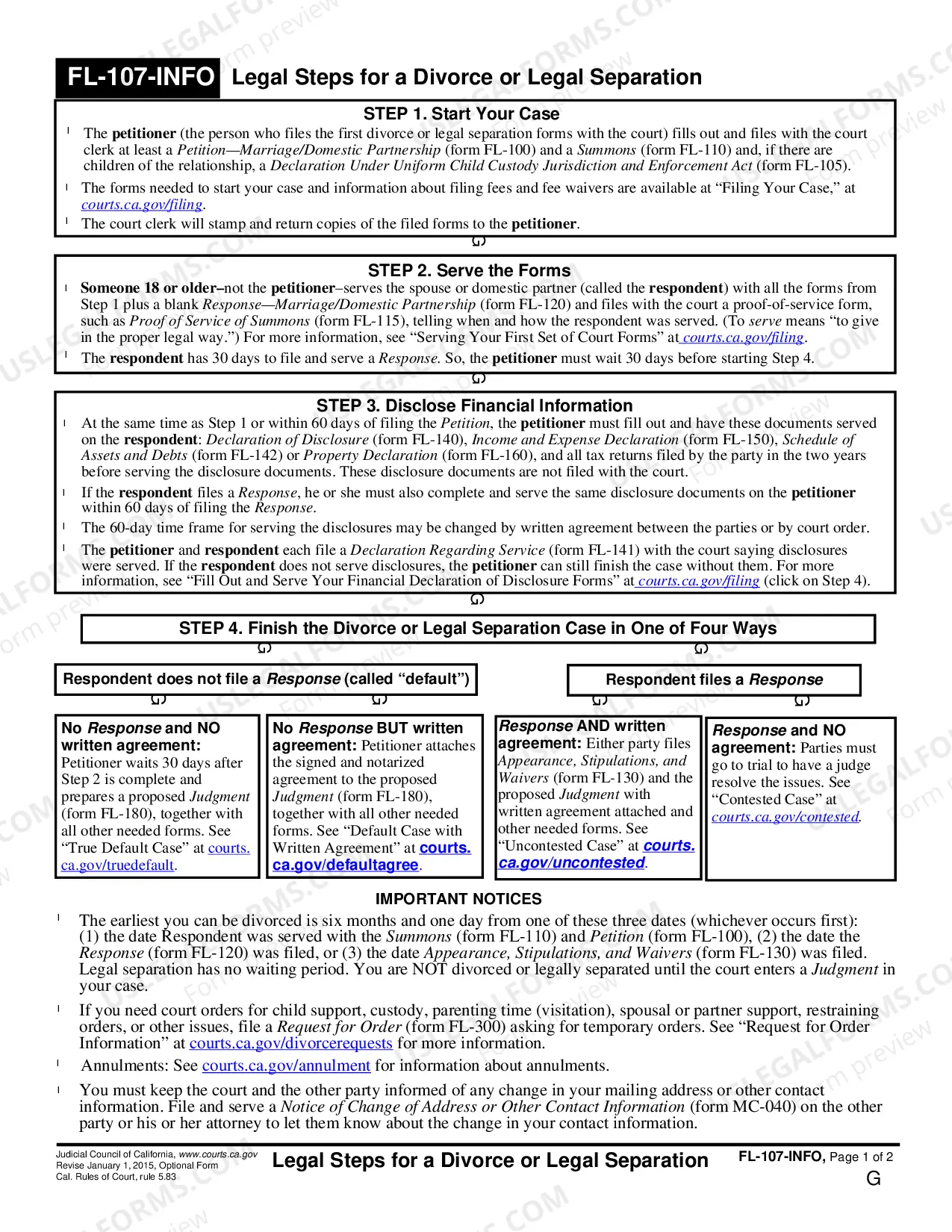
Filing for divorce in California follows a methodical, chronological sequence. Each phase requires specific forms that build upon the previous filings. Understanding this sequence ensures that petitioners do not attempt to file closing judgments before establishing jurisdiction or serving the opposing party.
Phase 1: Initiating the Action (The Petition)
The initial phase establishes the court's jurisdiction over the marriage and outlines the petitioner's requests regarding property division, spousal support, child custody, and visitation.
- FL-100 (Petition — Marriage/Domestic Partnership): The core document that opens the case. It specifies the grounds for divorce (typically irreconcilable differences) and outlines preliminary requests.
- FL-110 (Summons — Family Law): A formal notice to the respondent that a legal action has been filed. It contains standard restraining orders that automatically take effect upon service, prohibiting both parties from removing minor children from the state or disposing of community property without written consent.
- FL-105 (Declaration Under Uniform Child Custody Jurisdiction and Enforcement Act — UCCJEA): Required if the couple has minor children together. This document establishes which state holds jurisdictional authority over child custody and visitation matters.
Phase 2: Service of Process
Once the petition is filed and stamped by the court clerk, the opposing party must be formally notified through legal service of process.
- FL-115 (Notice and Acknowledgment of Receipt): Used when the petitioner mails the paperwork to the respondent, and the respondent voluntarily signs and returns the acknowledgment.
- FL-140 (Declaration of Disclosure): The cover sheet accompanying the formal exchange of financial information.
- FL-142 (Schedule of Assets and Debts) or FL-141 (Declaration Regarding Service of Declaration of Disclosure): Detailed listings of all community and separate assets, debts, and financial obligations.
Phase 3: Response and Financial Disclosures
The respondent typically has 30 days from the date of formal service to file a response, though agreements can alter this timeline.
- FL-120 (Response — Marriage/Domestic Partnership): The respondent's official answer to the petition, allowing them to agree or disagree with the petitioner's initial requests.
- FL-150 (Income and Expense Declaration): A comprehensive financial statement detailing monthly income, tax deductions, living expenses, and debts. Both parties must submit this form when requesting support or attorney fees.
Phase 4: Judgment and Finalization
The final phase concludes the litigation or formalizes an uncontested settlement agreement into a binding court order.
- FL-130 (Appearance, Stipulations, and Waivers): Used in default or uncontested cases to streamline the final judgment process.
- FL-180 (Judgment): The formal legal decree signed by a judge that officially dissolves the marriage and dictates the terms of the settlement.
- FL-190 (Notice of Entry of Judgment): Filed alongside the judgment packet; the court clerk mails this stamped notice to both parties to confirm that the divorce has been officially finalized.
Comparison of Filing Pathways and Form Access Methods
Navigating the acquisition and submission of California divorce forms can be handled through multiple operational models. The table below outlines the primary methods available to litigants, comparing their accessibility, cost structures, and operational scope.
| Access Method & Filing Pathway | Primary Source / Platform | Cost Implications | Technical Complexity | Pros & Cons |
|---|---|---|---|---|
| Self-Representation (Pro Se) via State Portal | California Courts Self-Help Website (court-issued PDFs) | Free downloads; standard county court filing fees apply | Moderate to High (requires self-paced form navigation) | Pros: Maximum cost savings, full control over filings.Cons: High risk of procedural errors, time-intensive. |
| Local Court E-Filing Portals | Individual County Superior Court Websites / Approved Vendors | Free forms + court filing fees + e-filing service provider fees | Moderate (requires digital account setup and PDF uploads) | Pros: Faster processing times, immediate digital receipts.Cons: Vendor fees vary; technical platform requirements. |
| Attorney-Managed Litigation | Private Family Law Practices & Licensed Attorneys | High legal retainer fees, hourly rates, plus court costs | Low for the client (attorney handles form execution) | Pros: Legal expertise, risk mitigation, representation in court.Cons: Substantial financial investment. |
| Commercial Legal Document Assistants (LDAs) | Registered LDA Businesses & Online Document Services | Flat-rate document preparation fees + court costs | Low to Moderate (client provides data; LDA formats PDFs) | Pros: Assistance with form completion without legal advice.Cons: LDAs cannot provide legal strategy or represent clients in court. |
Common Pitfalls and Troubleshooting When Handling PDF Forms
Working with legal PDF forms presents specific technical and procedural hurdles. Overlooking minor formatting details or failing to follow local court filing standards can lead to rejected documents, delayed proceedings, and frustration.
Software Compatibility and Form Field Errors
Many government-issued fillable PDFs are engineered specifically for use within Adobe Acrobat Reader. Opening these files in web-browser built-in PDF viewers (such as Chrome, Safari, or Edge preview tools) or third-party mobile applications can cause interactive script errors, missing data fields, or flattened text layers that refuse to print or save correctly.
Troubleshooting Steps:
- Download the PDF file directly to a local hard drive rather than attempting to fill it out inside a web browser tab.
- Open the downloaded file using the latest official version of Adobe Acrobat Reader (available free across desktop operating systems).
- If form fields appear locked or unresponsive, verify that the document is not a static scan masquerading as a fillable form. Ensure the version stamp in the lower-left or lower-right corner matches current Judicial Council updates.
Common Procedural Mistakes
Beyond technical PDF issues, filers frequently commit substantive errors that stall their cases:
- Omission of Financial Disclosures: Failing to file Form FL-150 or skipping the formal exchange of preliminary declarations of disclosure (Forms FL-140/FL-142) halts final judgment approvals. California law mandates these exchanges even in completely amicable, uncontested divorces.
- Incorrect County Venue: Filing documents in a county where neither spouse has resided for the required statutory period (at least three months in the state and three months in the specific county) results in jurisdictional dismissals.
- Ignoring Local Rules: Relying solely on statewide Judicial Council forms without checking the specific county superior court's local rules often results in rejection due to missing local cover sheets or mandatory local declarations.
Frequently Asked Questions
Are California divorce forms available online for free?
Yes. Official, current California divorce forms in PDF format are available entirely free of charge through the official California Courts Self-Help website and individual county superior court portals. Avoid commercial websites that charge fees simply to download standard state forms.
Can I fill out California divorce forms directly on my computer?
Yes, provided you download the fillable PDF versions of the forms. Using Adobe Acrobat Reader allows you to type information directly into the designated fields before printing or saving the document for electronic filing.
What should I do if my local court requires unique local forms?
While statewide Judicial Council forms are mandatory across all 58 counties, many superior courts require specialized local forms or cover sheets. Check the "Forms and Filing" or "Family Law" section of your specific county's superior court website to download any required local supplements.
How do I know if my downloaded PDF form is the most current version?
Check the revision date printed in the bottom-left or bottom-right corner of the form page (e.g., Rev. January 1, 2024). Cross-reference this date with the active forms list maintained on the official California Courts website to ensure compliance with current state standards.
What is the difference between a petition and a response in a California divorce?
The petition (Form FL-100) is the initial pleading filed by the petitioner to start the divorce case and state preliminary requests. The response (Form FL-120) is filed by the respondent to formally reply to the petition, either agreeing to the terms or contesting specific requests regarding property, support, and custody.
Practical Next Actions and Professional Guidance
Successfully navigating the California divorce process through downloadable PDF forms requires careful attention to detail, adherence to statutory timelines, and respect for local court rules.
- Verify Residency Requirements: Confirm that you or your spouse meet California's jurisdictional residency prerequisites (six months in the state and three months in the county) before filing.
- Download Official Packets: Access uncorrupted, fillable PDF forms exclusively from the California Courts Self-Help website or your local county superior court portal.
- Consult Legal Professionals When Necessary: Family law involves intricate property rights, support calculations, and custody determinations. If your case involves complex assets, business ownership, or disputed child custody, consult a licensed California family law attorney or utilize a certified Legal Document Assistant to review your completed paperwork before filing.
Disclaimer: This article is for informational and educational purposes only and does not constitute legal advice. Family law statutes and local court rules are subject to change. For specific legal guidance regarding a dissolution of marriage, consult a qualified attorney licensed in the State of California.