When flying with Frontier Airlines in 2026, understanding the configuration of their primary workhorse—the Airbus A320—is essential for a comfortable journey. While Frontier is an ultra-low-cost carrier (ULCC) known for its "unbundled" pricing, it offers seven distinct seating choices and strategies ranging from premium "Stretch" rows with extra legroom to standard economy seats and automated assignments for budget-conscious travelers.
The Frontier Airbus A320 fleet, which includes both the A320ceo (Current Engine Option) and the more fuel-efficient A320neo (New Engine Option), typically accommodates between 180 and 186 passengers. Because Frontier utilizes a high-density "slimline" seat design to keep fares low, the experience varies significantly depending on which of the seven seating options you choose. This guide provides a technical and practical breakdown of every seating choice available on the A320 to help you navigate your next flight.
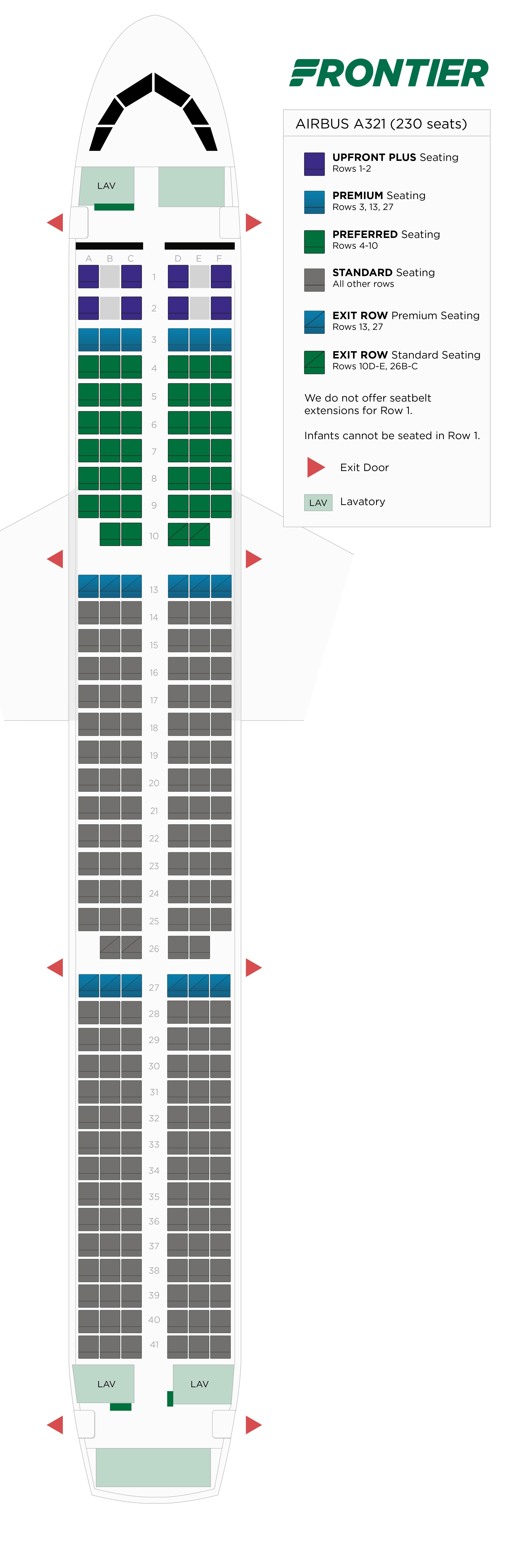
1. Stretch Seating: The Premium Front Rows (Rows 1–4)
The most sought-after real estate on a Frontier Airbus A320 is the "Stretch" seating section, located at the very front of the aircraft. For passengers who find the standard ULCC legroom restrictive, these seats provide a transformed experience.
In the Stretch rows, the seat pitch—the distance from one point on a seat to the same point on the seat in front of it—is significantly increased. While standard seats on Frontier may offer a pitch of 28 to 29 inches, Stretch seats typically offer 33 to 36 inches. This extra space allows taller passengers to sit without their knees touching the seatback in front of them and makes it much easier to use a laptop or enjoy a meal.
Beyond legroom, the first few rows offer the advantage of "first-on, first-off" logistics. These seats are prioritized for Zone 1 boarding, and upon landing, you are among the first to egress the aircraft. In 2026, Frontier continues to market these seats to business travelers and those with tight connections who cannot afford delays during the deplaning process.
2. Stretch Seating: The Emergency Exit Rows (Rows 12–13)
The second category of Stretch seating is found mid-cabin at the overwing emergency exits. On the Airbus A320, these are typically located at rows 12 and 13. These seats offer a similar pitch to the front rows, often providing even more "knee room" due to the safety requirements for clear egress paths.
However, choosing the exit row involves a trade-off. By FAA and international safety regulations, passengers in these rows must be at least 15 years old, physically capable of assisting in an emergency, and willing to perform safety duties. Furthermore, these seats often have fixed armrests that house the tray tables, which can slightly reduce the seat width.
One technical detail often overlooked is that row 12 (the first exit row) may not recline to prevent obstructing the exit behind it, whereas row 13 usually offers the extra space without that limitation. In Frontier’s 2026 "pre-reclined" fleet, this distinction is less about moving parts and more about the fixed angle of the seatback.
3. Preferred Standard Seating (Rows 5–11)
For passengers who want to be near the front of the plane but don't want to pay the full premium for Stretch seating, "Preferred" standard seats are the middle-ground option. These seats are located immediately behind the Stretch section and ahead of the exit rows.
While the legroom (pitch) in these rows is generally identical to the standard seats in the back of the plane (roughly 28–29 inches), the primary value here is location. Being in the forward third of the cabin means less engine noise compared to the very back of the aircraft and a faster exit upon arrival. For families or groups who want to ensure they stay together in the "quiet zone" ahead of the engines, selecting these seats during the booking process is a common strategy.
4. Standard Value Seating (Rows 14–31)
The bulk of the Airbus A320 cabin is comprised of standard seating. These seats represent the core of Frontier’s low-fare model. In 2026, these seats utilize the latest evolution of slimline technology, which uses lightweight materials and a thinner seatback profile to maximize the available space for the passenger’s knees.
Standard seats are the most affordable to reserve in advance. While the 28-inch pitch is among the tightest in the industry, the "pre-reclined" design ensures that the person in front of you cannot further encroach on your space by tilting their seat back. This creates a predictable, albeit snug, environment. These rows are ideal for short-haul flights (under two hours) where the primary goal is cost savings rather than lounge-like comfort.
5. Elite Status Complimentary Selection
For frequent flyers in the "Frontier Miles" program, the seating options expand through loyalty benefits. As of 2026, Frontier's elite status tiers allow for various levels of complimentary seat selection.
- Elite Silver: Often allows for standard seat selection at the time of booking.
- Elite Gold/Diamond: Typically grants access to Stretch seating at the time of check-in (or booking for higher tiers), subject to availability.
This "option" is a strategic one; it allows savvy travelers to book a base fare and then use their status to move into the more expensive Stretch or Preferred rows without paying the individual seat assignment fees. If you fly Frontier more than three or four times a year, the savings from this seating option can quickly outweigh the effort of reaching status.
6. Bundled Seating Options ("The Works" and "The Perks")
Frontier provides "7 seat options" not just through physical location, but through how the seat is purchased. One of the most efficient ways to secure a seat is through Frontier’s bundles.
When a passenger selects "The Works" or "The Perks" bundle, seat selection is included in the price. "The Works" usually allows the selection of any available seat on the aircraft, including Stretch seating, while also providing refundability and a carry-on bag. "The Perks" focuses on the in-flight experience, including a seat and bags but without the refundability. These bundles are often cheaper than adding a Stretch seat and a carry-on bag individually, making it a "seating option" based on financial packaging.
7. Random Assignment (The "Budget" Option)
The final seating option is to not choose a seat at all. If a passenger declines to pay for a seat assignment, Frontier’s automated system will assign a seat during the check-in process (which opens 24 hours before departure).
This is the "true" budget option. While it is the only way to avoid seat selection fees entirely, it carries the risk of being assigned a middle seat or being separated from travel companions. However, if the flight is not full, the algorithm may occasionally place "random" passengers in Preferred or even Stretch seats if those are the only ones remaining. In 2026, Frontier’s system is highly optimized to fill the plane from back to front for weight and balance, so those who check in last are sometimes more likely to end up in the front—though this is never guaranteed.
Comparison of Seating Specifications on Frontier A320
| Feature | Stretch (Front) | Stretch (Exit) | Preferred Standard | Standard Value |
|---|---|---|---|---|
| Row Numbers | 1–4 | 12–13 | 5–11 | 14–31 |
| Seat Pitch | 33"–36" | 35"–38" | 28"–29" | 28" |
| Boarding Zone | Zone 1 | Zone 1 | Varies | Varies |
| Under-seat Storage | Yes | No (Row 12/13 restricted) | Yes | Yes |
| Power Outlets | Usually No | No | No | No |
| Best For | Business/Quick Exit | Maximum Legroom | Families | Budget Travelers |
Technical Deep Dive: The Slimline Seat Design
To understand why seating on a Frontier A320 feels the way it does, one must look at the technical specifications of the seats themselves. Frontier primarily uses seats manufactured by companies like Recaro or Acropala.
The "slimline" philosophy replaces traditional thick foam padding with a tensioned suspension system or thinner, high-density ergonomic foam. This allows Frontier to fit 186 seats on an A320neo while still providing approximately the same amount of "living space" as an older 150-seat configuration with thicker cushions.
Pre-Reclined Philosophy
One of the most controversial but technically efficient aspects of Frontier's A320 seating is the pre-reclined angle. Unlike traditional airline seats that have a mechanical recline button, these seats are fixed at an angle that is slightly more reclined than a standard "upright" position but less than a full recline.
- Engineering Benefit: Removing the recline mechanism reduces the weight of the aircraft by hundreds of pounds, which in turn reduces fuel burn and CO2 emissions—a key metric for Frontier in 2026.
- Passenger Benefit: It eliminates "seat wars." You never have to worry about a passenger in front of you slamming their seat into your knees or laptop screen.
Navigating the Middle Seat (The "Slightly Wider" Factor)
On many Airbus A320 aircraft, there is a subtle engineering trick used to make the middle seat (seats B and E) more bearable. While the window (A, F) and aisle (C, D) seats are typically 18 inches wide, some configurations of the slimline seats make the middle seat 19 inches wide.
This extra inch is designed to compensate for the "shoulder squeeze" that occurs when sitting between two other passengers. If you are traveling as a trio, the middle seat occupant on a Frontier A320 often has more actual cushion width than the passengers on either side.
Strategic Advice for Seat Selection in 2026
When to Pay for Stretch
If your flight is longer than three hours (e.g., Denver to Orlando or Philadelphia to Las Vegas), the investment in a Stretch seat is highly recommended. The physical toll of sitting at a 28-inch pitch for several hours can lead to significant discomfort. Furthermore, the ability to work on a laptop is almost impossible in standard seating due to the proximity of the seatback in front of you.
The "Family Seating" Policy
Frontier has improved its algorithms by 2026 to better accommodate families. While the airline still encourages paid seat assignments to guarantee sitting together, their policy generally attempts to seat at least one adult with children under the age of 14 at no extra cost, provided seats are available at the time of check-in. However, to ensure the entire family is in the same row, pre-selecting standard seats in the back of the plane is the safest and most cost-effective method.
Dealing with the "No Under-seat Storage" Rule
If you choose the front-row Stretch seats (Row 1), be aware that there is no seat in front of you. This means all personal items must be placed in the overhead bins for takeoff and landing. If you prefer to have your bag, snacks, or tablet within reach at all times, Row 2 or Row 3 Stretch seats are a better choice than Row 1.
FAQ: Frontier Airbus A320 Seating
Do Frontier A320 seats have USB ports or power outlets?
In 2026, the majority of Frontier's A320 fleet does not offer in-seat power or USB ports. This is a weight-saving measure to keep ticket prices low. Passengers are encouraged to bring portable power banks to keep their devices charged during the flight.
Can I move to an empty Stretch seat once the flight has taken off?
No. Frontier flight attendants strictly enforce seating assignments. Stretch seats are a premium product; if you move into one without having paid for it, you will likely be asked to return to your assigned seat or pay the upgrade fee on board (which is often more expensive than paying in advance).
Is the exit row (Row 12/13) colder than the rest of the plane?
Technically, yes. Because the exit doors have slightly less insulation than the solid fuselage walls, passengers sitting directly next to the exit may feel a slight draft or cooler temperatures during cruise altitude. It is advisable to bring a light jacket if you select these seats.
Which seats should I avoid on the Frontier A320?
Generally, the last row of the aircraft (usually Row 30 or 31) is considered the least desirable. These seats are located directly adjacent to the lavatories and the rear galley, leading to high foot traffic and potential odors. Additionally, these seats are often the narrowest due to the curvature of the aircraft tail and may have no windows.
What is the difference between the A320ceo and A320neo seating?
From a passenger perspective, the seats are very similar. However, the A320neo is significantly quieter due to its advanced engine technology (LEAP-1A or PW1100G). If you have the choice, the "neo" provides a much more pleasant acoustic environment, especially in the middle and rear of the cabin.
Final Recommendation
For the best balance of cost and comfort on a Frontier Airbus A320 in 2026, the overwing exit row (Row 13) remains the "pro-traveler" choice. It provides Stretch-level legroom at a price point that is often lower than the front-row Stretch seats. If budget is the absolute priority, checking in exactly 24 hours before departure increases your chances of a better "random" assignment before the remaining middle seats are distributed. Regardless of your choice, remember that Frontier’s seats are designed for efficiency; bringing a neck pillow and ensuring your devices are pre-charged will significantly enhance your experience in any of the seven seating options.