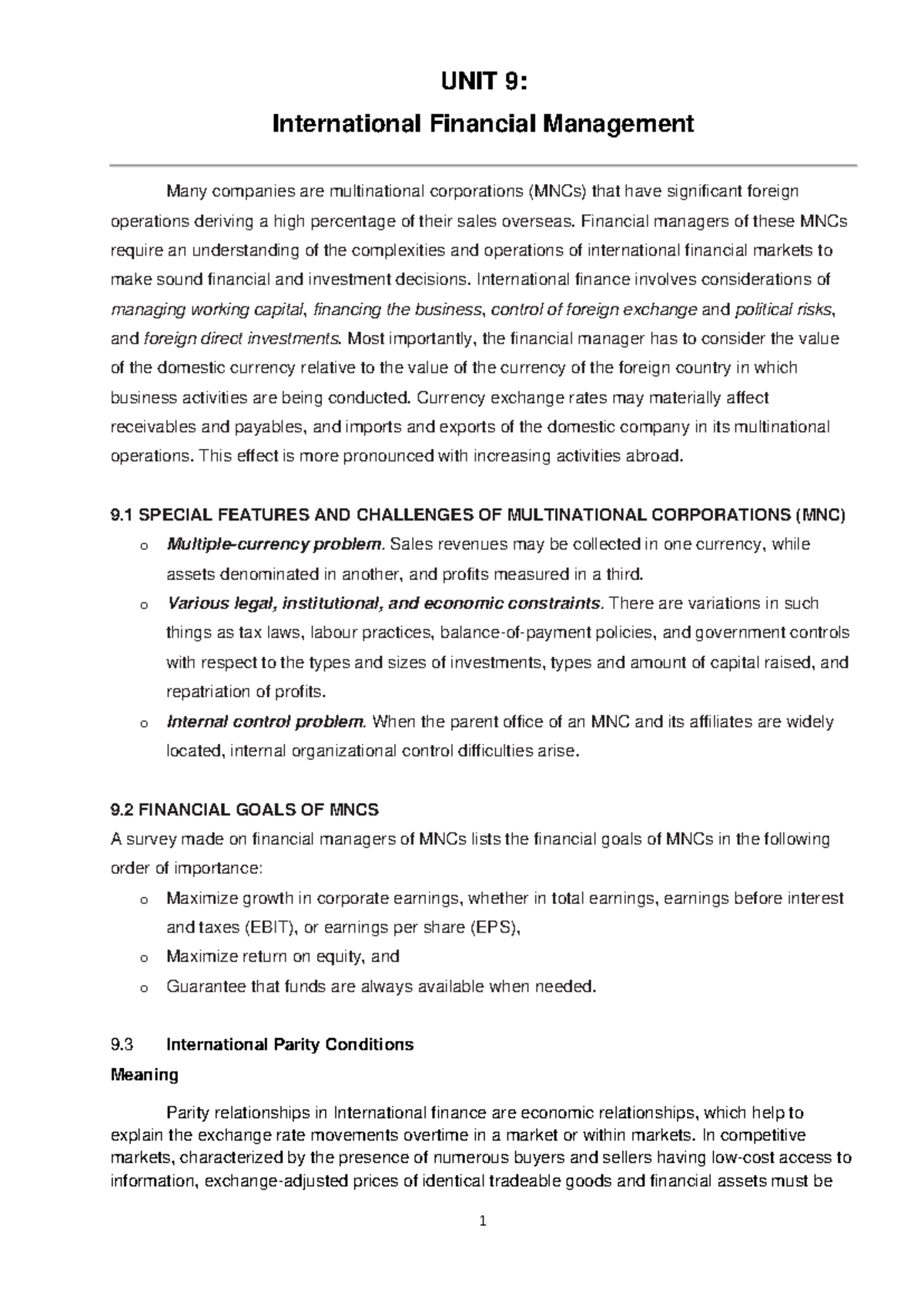
The 462 international financial management course provides advanced undergraduate or graduate students with a rigorous framework for navigating financial decisions within multinational corporations, focusing on foreign exchange markets, multinational capital budgeting, and risk management across borders.
Introduction to International Financial Management 462
In an increasingly globalized business environment, financial managers must look beyond domestic markets to maximize shareholder value. Course 462 in international financial management bridges the gap between domestic corporate finance and the complex global monetary architecture. Designed typically for upper-level undergraduate business majors or specialized finance graduate students, this curriculum explores how macroeconomic variables, sovereign risk, and currency fluctuations impact corporate strategy.
Students enrolled in this course investigate the mechanics of foreign exchange (forex) markets, the pricing of financial derivatives used for hedging, and the unique challenges associated with multinational capital budgeting. Rather than treating international finance as an abstract collection of economic theories, the course emphasizes practical analytical tools. Learners examine how multinational corporations (MNCs) structure cross-border investments, manage working capital across multiple currency zones, and optimize their global tax and capital structures while maintaining regulatory compliance.
Academic Prerequisites and Foundational Requirements
Before registering for a 462-level international finance course, students must complete a specific sequence of foundational business and quantitative prerequisites. These prerequisites ensure that learners possess the mathematical maturity and accounting literacy required to digest complex international valuation models.
Typically, academic institutions require the successful completion of introductory corporate finance, microeconomics, macroeconomics, and statistics. Corporate finance provides the baseline understanding of net present value (NPV), cost of capital, and capital structure. Economics courses offer vital context regarding balance of payments, interest rate parity, and purchasing power parity. Additionally, proficiency in financial accounting is essential, as students must interpret consolidated financial statements that translate foreign subsidiary accounts into a parent company's reporting currency. Quantitative prerequisites ensure students can comfortably manipulate algebraic equations, calculate statistical variances, and execute financial modeling tasks within spreadsheet environments like Microsoft Excel.
Core Curriculum and Key Learning Objectives
The curriculum of a 462 international financial management course is structured around several primary pillars of global finance. Each module builds upon the previous one, guiding students from macro-level market mechanics to micro-level corporate decision-making.
The International Monetary System and Foreign Exchange Markets
The foundational segment of the course examines the architecture of the international monetary system, tracing its evolution from the gold standard to modern floating and pegged exchange rate regimes. Students analyze how central banks intervene in foreign exchange markets and how global macroeconomic indicators influence currency valuations.
Key topics in this module include spot and forward exchange rates, cross-rates, and the mechanics of the foreign exchange market, which operates continuously across global financial hubs. Learners practice calculating forward premiums and discounts and explore the fundamental international parity conditions:
- Purchasing Power Parity (PPP)
- Interest Rate Parity (IRP)
- The International Fisher Effect
Foreign Exchange Exposure and Risk Management
Operating globally exposes firms to various forms of financial risk that domestic companies rarely encounter. Course 462 dedicates significant instructional time to identifying, measuring, and managing these exposures.
- Transaction Exposure: The risk that the cash transactions of a firm will be affected by fluctuations in exchange rates between the transaction date and the settlement date.
- Translation Exposure: The potential for accounting-derived changes in consolidated financial statements caused by shifting exchange rates when foreign subsidiary accounts are translated into the parent currency.
- Economic Exposure (Operating Exposure): The long-term risk that a firm's present value of future cash flows will be altered by arbitrary exchange rate movements affecting its competitive market position.
To mitigate these risks, students learn to construct hedging strategies utilizing financial derivatives. The curriculum covers the practical application of forward contracts, futures contracts, currency options, and currency swaps, analyzing the cost-benefit trade-offs of each instrument.
Multinational Capital Budgeting
Evaluating capital expenditure projects for international subsidiaries is considerably more complex than domestic budgeting due to currency volatility, political risk, and differential inflation rates. The course teaches students how to adapt traditional capital budgeting techniques—such as Net Present Value (NPV) and Internal Rate of Return (IRR)—for cross-border applications.
Students examine whether cash flows should be forecasted in the local currency or the parent currency, how to account for blocked funds or restrictions on profit repatriation, and how to adjust discount rates to reflect country-specific risk premiums. Special attention is given to political risk analysis, evaluating the probability of expropriation, regulatory changes, or sudden shifts in taxation by foreign governments.
| Derivative Instrument | Primary Purpose | Risk Profile | Cost Structure |
|---|---|---|---|
| Forward Contract | Locking in a future exchange rate | Eliminates upside and downside exposure | Typically zero upfront cost; customized |
| Currency Futures | Standardized hedging on organized exchanges | High liquidity, marked-to-market daily | Brokerage commissions and margin requirements |
| Currency Option | Asymmetric protection with participation upside | Limits downside while retaining favorable moves | Requires paying an upfront premium |
| Currency Swap | Long-term exchange of principal and interest | Manages long-term debt obligations | Negotiated OTC cost with financial intermediaries |
Assessment Methods and Practical Skill Development
To ensure students can apply theoretical concepts to real-world scenarios, 462 international financial management courses utilize a diverse mix of assessment methods. Rote memorization of formulas is insufficient; evaluation focuses on critical thinking, quantitative modeling, and strategic communication.
Case studies form the backbone of practical skill development. Students frequently analyze historical and hypothetical business scenarios involving real multinational corporations—such as Ford, Nestlé, or Sony—evaluating their foreign expansion strategies, hedging failures, or capital restructuring decisions. Group projects often require teams to select a multinational firm, track its global financial performance, assess its exposure to specific emerging market currencies, and propose an optimized hedging and capital budgeting strategy.
Examinations typically feature a combination of conceptual multiple-choice questions, qualitative essay prompts, and rigorous quantitative problem sets. Students must demonstrate proficiency in calculating parity relationships, pricing options using simplified models, and adjusting cash flow schedules for international taxation and inflation differentials.
Technology and Quantitative Tools Used in the Course
Modern international financial management relies heavily on advanced computational tools and real-time market data feeds. Course 462 integrates technology to prepare students for professional environments in corporate treasury, investment banking, and global asset management.
Students utilize advanced spreadsheet functions to build dynamic financial models that simulate exchange rate volatility and Monte Carlo scenarios for multinational cash flows. Academic versions of financial databases—such as Bloomberg terminals or Thomson Reuters Eikon (where available at university trading labs)—are often introduced to help learners extract historical exchange rates, sovereign yield curves, and macroeconomic statistics. Understanding how to pull and manipulate this data is a vital skill for modern financial analysts.
Common Challenges Faced by Students
Mastering international financial management requires overcoming specific cognitive and mathematical hurdles. Recognizing these common stumbling blocks helps learners allocate study time effectively.
- Sign Conventions and Currency Notations: Confusing direct and indirect exchange rate quotes frequently leads to calculation errors in multi-step parity problems.
- Complex Multi-Step Math: Failing to correctly sequence inflation adjustments, tax rates, and exchange rate conversions in multinational capital budgeting problems.
- Abstract Economic Theory: Struggling to reconcile textbook parity conditions (which assume frictionless markets) with real-world market anomalies, transaction costs, and capital controls.
- Derivative Pricing Intuition: Misunderstanding the payoff structures of complex options and swaps under volatile market conditions.
Frequently Asked Questions
What are the typical prerequisite courses for 462 international financial management?
Students are generally required to complete intermediate corporate finance, introductory microeconomics and macroeconomics, and basic business statistics before enrolling. These courses provide the necessary foundation in financial mathematics, valuation, and economic theory.
Does this course focus more on accounting or economic theory?
Course 462 strikes a balance between corporate finance theory and practical treasury management. While it incorporates economic principles regarding exchange rates and trade balances, its primary focus is on corporate decision-making, risk mitigation, and valuation.
Are coding skills like Python or R required for this course?
Advanced programming languages are rarely mandatory for a standard 462-level course. Advanced proficiency in Microsoft Excel—including data tables, lookup functions, and financial formulas—is the primary technical requirement.
How does international capital budgeting differ from domestic budgeting?
International capital budgeting must account for additional variables, including foreign exchange risk, differential inflation rates, cross-border tax implications, political instability, and restrictions on the repatriation of profits to the parent company.
What career paths benefit most from studying international financial management?
The curriculum directly supports careers in corporate treasury, international banking, global asset management, foreign exchange trading, multinational management consulting, and strategic financial planning for global enterprises.
Conclusion and Next Steps
The 462 international financial management course equips students with the sophisticated analytical tools and strategic mindset required to operate within the global economy. By mastering foreign exchange mechanics, exposure management, and cross-border capital allocation, learners bridge the gap between regional business practices and global financial markets. To prepare effectively, review foundational corporate finance concepts, brush up on spreadsheet modeling techniques, and familiarize yourself with current macroeconomic indicators influencing global trade before the term begins.