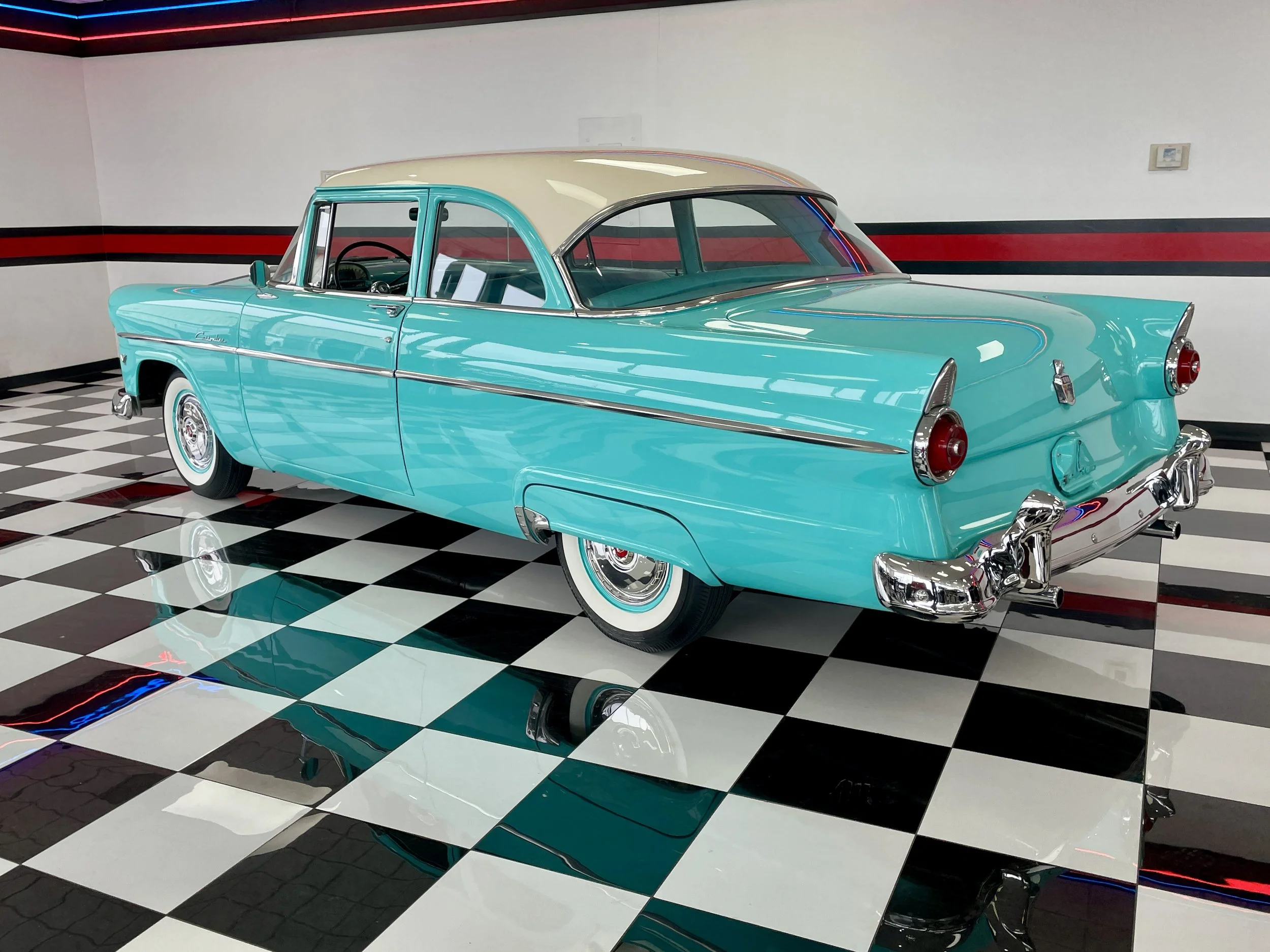
The 1955 Ford Customline represents a pivotal moment in American automotive history, serving as the mid-range offering in Ford’s refreshed post-war lineup. Positioned between the entry-level Mainline and the premium Fairlane, the Customline offered a balance of sophisticated styling, reliable V8 performance, and family-oriented practicality that defined the mid-1950s driving experience.
The Evolution of the 1955 Ford Customline
By 1955, Ford had reached a stage of aggressive competition with Chevrolet and Plymouth. The 1955 model year marked a significant departure from the bulbous, heavy-handed designs of the late 1940s and early 1950s. Ford introduced a "swept-back" aesthetic that emphasized length and modernity, distancing the brand from the "pontoon" fender era.
The Customline was essentially the "sweet spot" for many buyers. While the Mainline was stripped-down for fleet use and the Fairlane offered chrome-laden luxury, the Customline provided a dignified appearance with enough amenities to satisfy the average suburban family. It featured distinctive "Customline" script badging on the rear fenders and a slightly upgraded interior trim package compared to its base-model sibling.
Design and Exterior Aesthetics
The 1955 redesign was masterminded under the direction of Ford design chief Frank Hershey. The car featured a flatter hood, a more prominent front grille, and an iconic wrap-around windshield—a hallmark of the era that improved visibility and signaled futuristic design.
The Customline was available in several body styles, most notably the two-door sedan, the four-door sedan, and the popular Ranch Wagon. The side profile of the 1955 Customline was clean, typically featuring a chrome molding that ran from the front fender to the rear, helping to visually elongate the vehicle. The tail fins were subtle by the standards of the late 50s, serving as a functional transition rather than a stylistic excess.
Powertrain and Mechanical Specifications
The 1955 model year is legendary for the maturation of the Ford Y-block V8 engine. While the inline-six remained an option, the "Power-Building" V8 was the enthusiast’s choice.
- The 223 cu in (3.7 L) Mileage Maker I6: This was the workhorse engine, providing adequate power for city driving and excellent fuel economy for the period. It featured overhead valves, a significant improvement over the older flathead designs.
- The 272 cu in (4.5 L) Y-Block V8: This was the centerpiece of the 1955 Ford engine lineup. It provided substantial torque and a smooth power delivery that made the Customline feel more like a luxury vehicle than a mid-priced sedan.
Drivers could choose between the three-speed manual transmission, the three-speed manual with overdrive, or the "Ford-O-Matic" two-speed automatic transmission. The Ford-O-Matic, while simplistic by modern standards, became the industry benchmark for domestic automatic shifting during the mid-50s.
Technical Comparison of 1955 Ford Model Trim Levels
Understanding the Customline requires a comparison with the rest of the 1955 Ford hierarchy. The distinctions between these models were primarily focused on trim, upholstery quality, and available power accessories.
| Feature | Mainline | Customline | Fairlane |
|---|---|---|---|
| Market Position | Entry/Fleet | Mid-Range | Premium/Luxury |
| Chrome Exterior | Minimal | Moderate | Extensive |
| Interior Fabric | Durable/Simple | Upgraded Cloth/Vinyl | Deluxe Patterned |
| V8 Availability | Optional | Standard/Optional | Standard |
| Primary Audience | Business/Economy | Family/Value | Status/Comfort |
Practical Ownership Considerations in 2026
For the modern collector or hobbyist, the 1955 Customline remains a highly accessible entry point into the classic car market. Unlike the rarer "Crown Victoria" models, Customline sedans are generally more affordable, making them excellent candidates for restoration or "restomod" projects.
Sourcing and Condition Assessment
When inspecting a 1955 Customline today, structural integrity is the primary concern. Rust in the rocker panels, trunk floor, and lower quarter panels is common. Because these vehicles used unibody-adjacent frame structures, any significant rot in the frame rails should be considered a disqualifying factor for a casual buyer, as it requires professional fabrication to resolve.
Mechanical Maintenance and Reliability
The Y-block engine is famously robust, but it requires specific care regarding the oiling system. Modern owners often recommend installing an upgraded oil pump and ensuring the oil galleries are free of sludge. Parts availability remains excellent, as many components are shared across the 1955–1957 Ford spectrum. Numerous aftermarket suppliers specialize in reproduction trim, interior soft goods, and mechanical rebuild kits.
Daily Driving vs. Preservation
While these cars were built to be driven daily in 1955, a restored version in 2026 is often treated as a weekend cruiser. If you intend to use a Customline for local travel, consider these updates:
- Conversion to 12-Volt Electrical: Most 1955 Fords came with a 6-volt system. Converting to 12 volts improves lighting and makes it easier to use modern navigation devices or charge phones.
- Modern Radial Tires: Moving from the original bias-ply tires to period-correct-looking radial tires drastically improves steering feel and stopping distance.
- Brake Upgrades: The original drum brakes are adequate for parades, but disc brake conversion kits are widely available and highly recommended for modern road safety.
Frequently Asked Questions
What is the difference between a 1955 Ford Customline and a Fairlane?
The primary difference is the trim level. The Fairlane featured more extensive exterior chrome moldings, higher-grade interior fabrics, and often featured unique two-tone paint schemes. The Customline was designed to offer the same mechanical performance with a more understated, budget-friendly aesthetic.
Is the 1955 Ford Customline difficult to restore?
Generally, no. The mechanical systems are straightforward, and the electrical systems are simple. The biggest challenge in restoration is sourcing high-quality exterior chrome trim, as re-plating original parts can be expensive. However, because these cars were produced in high volumes, donor parts and reproduction items are readily available.
What should I prioritize when buying a 1955 Customline for the first time?
Prioritize a solid, rust-free chassis over engine performance. A worn-out engine can be rebuilt or replaced relatively easily, but correcting deep structural rust requires specialized equipment and significant labor costs. Always inspect the floor pans and the area around the windshield for signs of water ingress.
Can I drive a 1955 Ford Customline on modern highways?
Yes, but with caveats. If the car is maintained well, it can handle highway speeds. However, these vehicles lack modern safety features such as crumple zones, headrests, and three-point seatbelts. It is advisable to install modern seatbelts and ensure the braking and suspension systems are fully overhauled before attempting long-distance travel.
Are replacement parts for the Y-block engine easy to find?
Yes. The Ford Y-block has a dedicated following among classic car enthusiasts. Companies specializing in performance parts and internal engine components produce everything from camshafts to aluminum intakes, ensuring that keeping a 1955 engine running is not an issue.
Final Recommendation
If you are considering the 1955 Ford Customline as an addition to your collection, focus on finding a well-preserved four-door sedan or a two-door "business" coupe. These models offer the most authentic experience of the mid-50s Ford philosophy. Before finalizing any purchase, ensure the vehicle's title matches the VIN plate found on the driver-side door pillar. Given the age of the vehicle, perform a thorough inspection of the cooling system and fuel lines to ensure they are compatible with modern ethanol-blended fuels, which can damage original rubber components.