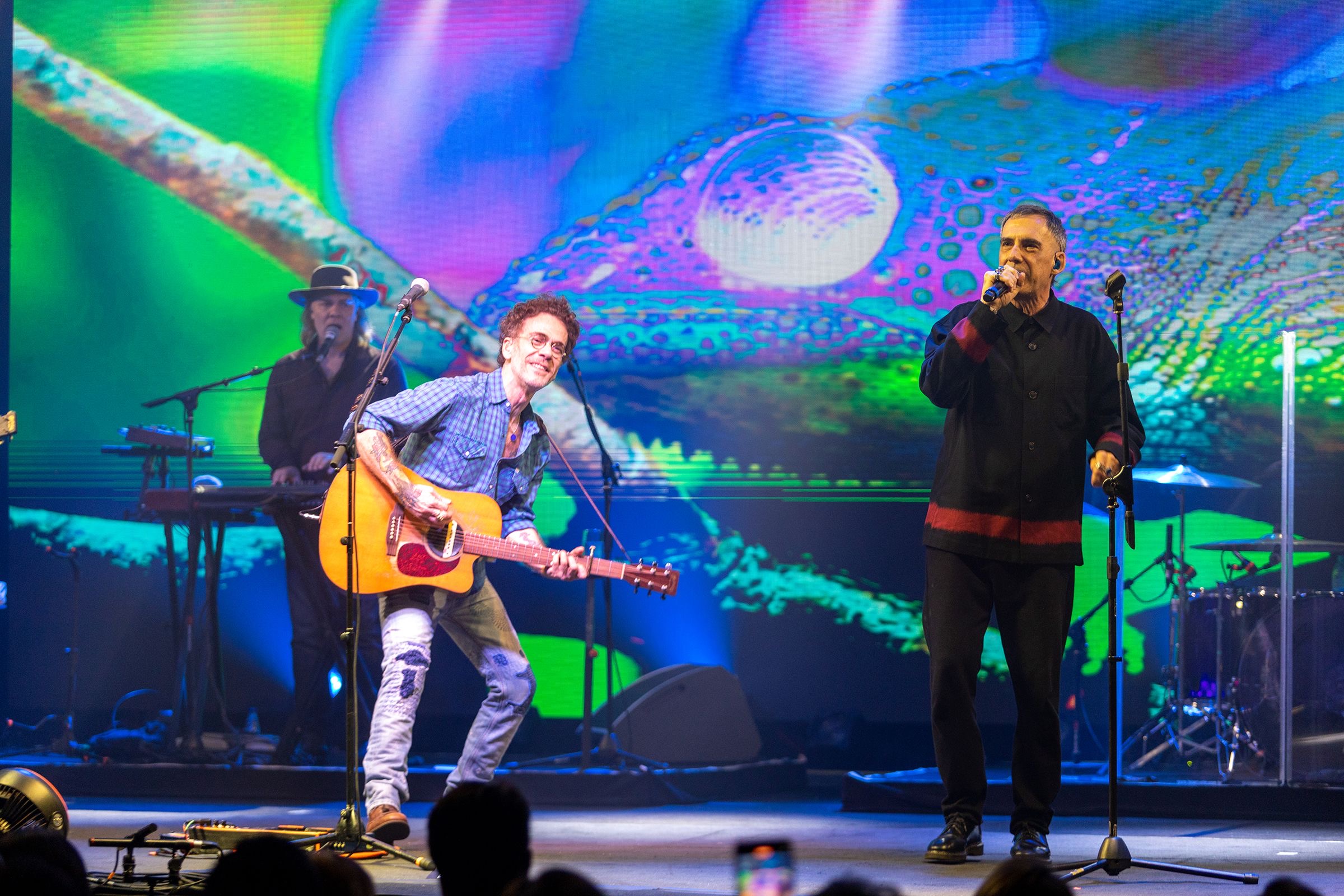
Arnaldo Antunes is a seminal Brazilian musician, poet, and visual artist known for his radical fusion of concrete poetry with rock and pop music. From his beginnings with the rock band Titãs to his global success with Tribalistas and his extensive solo career, he remains a central figure in Brazilian contemporary culture.
For over four decades, Arnaldo Augusto Nora Antunes Filho has occupied a unique space in the Brazilian artistic landscape. He is not merely a singer who writes lyrics or a poet who occasionally sings; he is a multidisciplinary creator who views words as plastic objects, sounds as visual structures, and silence as a vital compositional element. In 2026, as his body of work continues to influence new generations of "tropicalist" descendants, understanding his contribution requires looking beyond the charts to the intersection of linguistics, avant-garde art, and popular music.
The Formative Years and the Birth of an Avant-Garde Identity
Born in São Paulo in 1960, Arnaldo Antunes grew up in an environment where the boundaries between artistic disciplines were already beginning to blur. In the late 1970s, while studying Linguistics and Literature at the University of São Paulo (USP), he was deeply influenced by the Noigandres group—specifically the concrete poetry movement led by Haroldo de Campos, Augusto de Campos, and Décio Pignatari.
This academic background is essential to understanding his later work. Concrete poetry emphasizes the "verbivocovisual" aspects of the text: the meaning (verbal), the sound (vocal), and the spatial arrangement on the page (visual). Antunes took these high-art concepts and sought to inject them into the burgeoning rock scene of São Paulo. His early experiments with the group Aguilar e Banda Performática served as a laboratory for his future endeavors, combining performance art with raw, experimental soundscapes.
The Titãs Era: Rock, Rebellion, and Linguistic Deconstruction
In 1982, Antunes became a founding member of Titãs, a band that would become one of the pillars of "Rock Brasil" in the 1980s. While the band began as a diverse, somewhat chaotic collective, it was the 1986 album Cabeça Dinossauro that defined their legacy and Antunes’s role within it.
During his decade with Titãs, Antunes provided a distinct, visceral energy. His deep baritone voice and his penchant for repetitive, mantra-like lyrics gave the band a philosophical weight that set them apart from their peers. Songs like "Igreja," "Família," and "O Pulso" demonstrate his ability to deconstruct social institutions through minimalist but powerful phrasing.
His departure from the band in 1992 was a pivotal moment for Brazilian music. While Titãs was at the height of its commercial power, Antunes felt the constraints of the rock band format. He needed a vehicle that could accommodate his more experimental desires—projects where the visual layout of a lyric was as important as the melody.
The Solo Path: From "Nome" to "O Real Resiste"
If his time with Titãs was about collective energy, his solo career has been an exercise in relentless individual curiosity. His debut solo project, Nome (1993), remains a landmark in Brazilian multimedia art. It was not just an album; it was a book, a video, and a CD. In Nome, Antunes utilized computer animation to make letters dance and transform, creating "videopoemas" that anticipated the digital art revolutions of the following decades.
His solo discography is characterized by a constant oscillation between the "strangeness" of avant-garde experimentation and the accessibility of Brazilian Pop (MPB). Albums like Ninguém (1995) and O Silêncio (1996) explored the physical properties of sound and the concept of nothingness. However, by the early 2000s, Antunes began to embrace a more melodic, song-focused approach, collaborating with legendary producers like Liminha and artists like Marisa Monte.
In the 2020s, and continuing into his current status in 2026, Antunes has returned to a more political and minimalist stance. His 2020 album O Real Resiste (The Real Resists) served as a stark, piano-driven critique of the "fake news" era and political volatility, proving that even as an elder statesman of the scene, his blade remains sharp.
Tribalistas: A Global Phenomenon in Brazilian Pop
No discussion of Arnaldo Antunes is complete without mentioning Tribalistas, the trio formed with Marisa Monte and Carlinhos Brown. Their self-titled debut in 2002 became a cultural phenomenon, selling millions of copies and winning a Latin Grammy.
The success of Tribalistas can be attributed to the "perfect balance" of its members:
- Marisa Monte: Provided the soaring melodies and sophisticated pop sensibilities.
- Carlinhos Brown: Brought the rhythmic innovation and Afro-Brazilian percussion of Bahia.
- Arnaldo Antunes: Anchored the project with his conceptual depth and rhythmic, spoken-word-influenced delivery.
The group represented a modern "Tropicália," a synthesis of different Brazilian regions and styles into a unified, optimistic sound. Their 2017 reunion and subsequent world tour reaffirmed their status as a global brand of Brazilian excellence, proving that Antunes’s "difficult" poetry could, when paired with the right melodies, reach the widest possible audience.
Visual Arts and Concrete Poetry: Beyond the Microphone
Arnaldo Antunes is as much a presence in art galleries as he is on concert stages. His visual work often involves "calligraphies"—handwritten texts where the ink bleeds, repeats, and forms shapes that transcend the literal meaning of the words.
His books, such as Psia (1986), Tudos (1990), and As Coisas (1992), are staples of contemporary Brazilian literature. In these works, he often uses the "word-object" technique. For example, he might write the word "water" in a way that mimics a falling drop, or repeat a word until it loses its meaning and becomes a rhythmic texture.
In 2026, his visual installations are frequently exhibited in major institutions like the Museu de Arte de São Paulo (MASP). These exhibitions often combine audio fragments, large-scale projections, and physical objects, creating an immersive environment that Antunes calls "the expanded poem."
Artistic Philosophy: Simplicity, Repetition, and Silence
The underlying philosophy of Antunes’s work is often misunderstood as "weirdness" for its own sake. In reality, his approach is deeply rooted in three pillars:
- Reductive Simplicity: He often strips a concept down to its most basic linguistic unit. By removing the "ornaments" of traditional songwriting, he forces the listener to confront the essence of the message.
- Rhythmic Repetition: Influenced by both indigenous chanting and minimalist classical music, he uses repetition to create a trance-like state. This is evident in songs like "Cabelo" and "Fora de Si."
- The Plasticity of the Word: For Antunes, a word is a physical thing. It has weight, color, and shape. This "objectification" of language allows him to play with puns and visual layouts that create multiple layers of meaning.
Comparative Overview: Eras of Arnaldo Antunes's Career
The following table outlines the distinct phases of Antunes's trajectory, highlighting the shift in focus and medium over time.
| Era | Period | Primary Project/Focus | Notable Characteristics |
|---|---|---|---|
| Rock Genesis | 1982–1992 | Titãs | Post-punk influence, social critique, aggressive delivery, collective songwriting. |
| Multimedia Avant-Garde | 1993–1999 | Nome, O Silêncio | Integration of computer graphics, video-poetry, experiments with silence and noise. |
| Pop Synthesis | 2000–2010 | Tribalistas, Saiba | Consolidation of melodic MPB, high commercial success, acoustic textures. |
| Eclectic Maturity | 2011–2020 | RSTUVXZ, O Real Resiste | Blending of rock and samba (RSTUVXZ), political minimalism, return to piano/voice. |
| Legacy & Retrospective | 2021–2026 | Tours, Visual Exhibits | Focus on lifetime achievements, archival releases, and multidisciplinary art installations. |
Practical Guidance: How to Experience Arnaldo Antunes
For those unfamiliar with his vast catalog, navigating his work can be daunting. Depending on your interest—whether it is music, literature, or visual art—there are specific entry points that offer the best "onboarding" experience.
For the Music Listener
Start with the Tribalistas (2002) album for an accessible introduction to his collaborative spirit. From there, move to his solo album Saiba (2004), which bridges his experimental side with beautiful, melodic songwriting. If you prefer rock, the Titãs album Cabeça Dinossauro (1986) is essential.
For the Reader and Poetry Lover
His book As Coisas (1992) won the prestigious Jabuti Prize and is an excellent example of his ability to find wonder in everyday objects. For a more visual experience, look for Tudos, which showcases his concrete poetry roots.
For the Art Enthusiast
Search for his "videopoemas" online or visit his official digital archives. His work with calligraphy is particularly striking when viewed in large formats, as it reveals the physical labor behind his linguistic deconstructions.
Legacy and Cultural Impact in 2026
As of 2026, Arnaldo Antunes is regarded as a bridge between the historical Brazilian avant-garde and the modern digital era. He successfully navigated the transition from the vinyl and paper age to the era of streaming and interactive media without losing his artistic soul.
His influence is seen in a new generation of Brazilian artists—such as Tulipa Ruiz, BaianaSystem, and various "indie-MPB" acts—who view the mixing of genres and media as a natural state of being. Antunes proved that an artist can be intellectually rigorous and commercially successful simultaneously. He remains the "anti-star" who is loved by the masses, a poet who occupies the mainstream without ever being tamed by it.
Frequently Asked Questions
Why did Arnaldo Antunes leave Titãs?
Antunes left the band in late 1992 because he felt a need for greater creative freedom. While the split was amicable—he continued to co-write songs with the band for years—he wanted to explore multimedia projects (like Nome) and experimental sounds that did not fit the "eight-man rock band" format. He sought a more intimate and varied artistic expression that spanned beyond rock music.
Is Arnaldo Antunes considered a "Tropicalista"?
While he was not part of the original 1960s Tropicalismo movement (he was a child at the time), he is often considered a "Post-Tropicalista." Like Caetano Veloso and Gilberto Gil, he believes in the "anthropophagic" idea of devouring foreign influences (like international rock and concrete poetry) and transforming them into something uniquely Brazilian.
What is the significance of the "Tribalistas" name?
The name "Tribalistas" refers to a "tribe" of three distinct artists who come together without hierarchy. It suggests a return to a more communal, organic, and "tribal" way of making music, contrasting with the highly processed and individualistic nature of modern pop music. The name also echoes the idea of a global tribe connected by culture.
What is "Concrete Poetry" in the context of his music?
In his music, concrete poetry manifests as lyrics that focus on the sound and rhythm of words rather than traditional narrative storytelling. For example, he might use alliteration, repetition of syllables, or words that sound like the objects they describe. This makes the lyrics "tactile" and focuses the listener's attention on the physical properties of language.
How has his work changed by 2026?
By 2026, his work has moved into a "curatorial" phase. While he still creates new art, there is a significant focus on integrating his past works into new digital and physical environments. He has become a mentor figure in the Brazilian art scene, emphasizing the importance of "resistance through art" in an increasingly automated and AI-driven cultural landscape.
Summary and Next Steps
Arnaldo Antunes is a rare example of a "total artist" whose work functions as a single, coherent ecosystem across music, literature, and visual media. Whether he is screaming with a rock band or whispering over a minimalist piano, his focus remains the same: the power of the word to transform our perception of reality.
Next Action: To truly appreciate his impact, listen to the track "O Pulso" from Titãs and then watch the video for "Nome" (available on most digital archives). Observing this transition from raw rock energy to digital linguistic experimentation provides the clearest insight into his artistic genius.