An anoxic brain injury claim is a complex personal injury or medical malpractice action that arises when complete oxygen deprivation causes severe, permanent brain damage due to another party’s negligence. Successfully litigating these cases requires establishing a breach in the standard of care, proving direct medical causation through expert witness testimony, and detailing lifetime care costs.
Professional Disclaimer
The information provided in this article is for educational and informational purposes only and does not constitute formal legal or medical advice. Personal injury and medical malpractice laws vary significantly by jurisdiction and are subject to strict statutory deadlines. Consult a qualified attorney and licensed medical professional regarding specific legal rights and medical conditions.
Understanding Anoxic Brain Injuries from a Legal Perspective
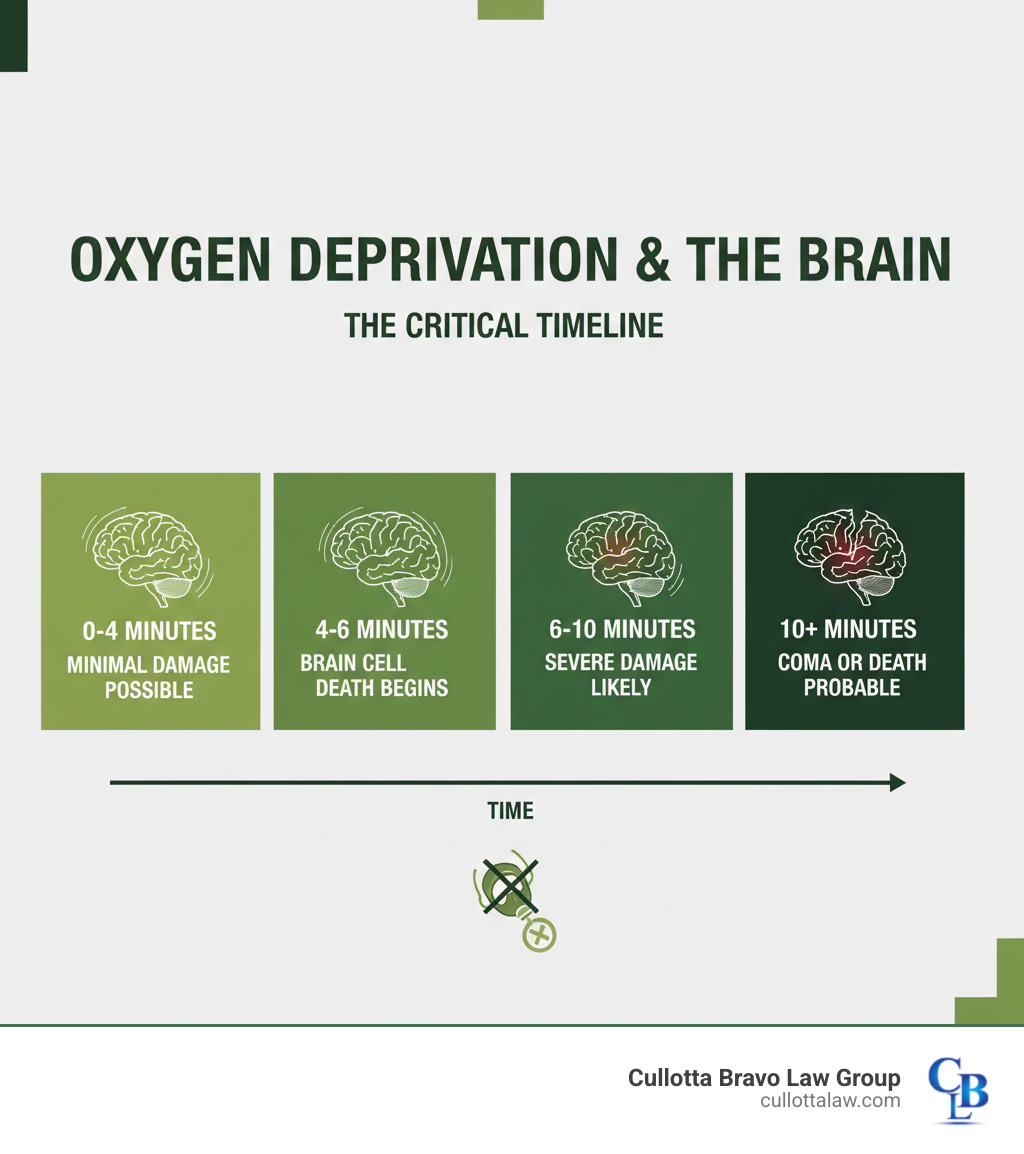
An anoxic brain injury—also referred to as cerebral anoxia—occurs when the brain is entirely deprived of oxygen. The brain consumes approximately 20 percent of the body's oxygen supply. When blood flow or oxygen delivery stops, brain cells begin dying within four to minutes, rapidly producing diffuse cellular destruction.
In legal proceedings, establishing the precise mechanism of oxygen deprivation is critical because it dictates which legal theories and standards of liability apply. Courts and legal teams distinguish between three distinct types of oxygen-deprivation injuries:
- Anoxic Anoxia: Occurs when there is an absolute lack of oxygen in the environment or respiratory system, preventing oxygen from reaching the bloodstream (e.g., suffocation, airway obstruction, or drowning).
- Anemic Anoxia: Occurs when the blood cannot carry sufficient oxygen to the brain, even if blood flow is maintained (e.g., severe carbon monoxide poisoning or acute anemia).
- Stagnant (Ischemic) Anoxia: Occurs when blood flow to the brain is compromised or stopped entirely, preventing oxygenated blood from reaching cerebral tissue (e.g., cardiac arrest, stroke, or surgical shock).
In civil litigation, anoxic brain injuries are among the most catastrophic personal injury claims due to their devastating neurological consequences. Survivors often experience lifelong cognitive impairment, motor dysfunction, executive functioning deficits, speech disorders, and full dependency for daily activities. Consequently, these cases involve significant financial stakes, complex evidentiary rules, and intensive expert testimony.
Common Causes and Theories of Liability
Anoxic brain injury litigation typically falls under medical malpractice, premises liability, workplace negligence, or product liability. Identifying the precise cause determines the defendant, the applicable duty of care, and the necessary evidentiary thresholds.
| Medical Malpractice | Premises Liability | Product Liability |
|---|---|---|
| • Anesthesia mismanagement• Intubation delays• Fetal distress delays• Surgical blood loss | • Near-drowning incidents• Confined space hazards• Carbon monoxide leaks• Toxic chemical exposures | • Defective oxygen delivery devices• Malfunctioning ventilators |
Medical Malpractice
Medical negligence is the leading cause of actionable anoxic brain injuries. Healthcare providers are held to the professional standard of care expected of a reasonably competent practitioner in the same specialty and under similar circumstances. Common instances of medical negligence leading to cerebral anoxia include:
- Anesthesia Errors: Failure to monitor vital signs during surgery, inappropriate medication dosing, or failing to recognize inadequate ventilation.
- Airway Management Failures: Delayed, improper, or unverified endotracheal intubation, leading to prolonged hypoxemia during emergency procedures or surgery.
- Obstetric Negligence: Failure to monitor fetal heart rates during labor, failing to recognize signs of fetal distress (such as umbilical cord prolapse or placental abruption), or delaying an emergency Cesarean section, resulting in hypoxic-ischemic encephalopathy (HIE) in newborns.
- Post-Operative Negligence: Failure to detect respiratory depression induced by opioids or sedatives in recovery units.
General Negligence and Premises Liability
Outside of medical settings, anoxic brain injuries occur due to hazardous conditions on commercial, residential, or public properties:
- Near-Drowning Incidents: Inadequate lifeguarding, missing safety equipment, or non-compliant fencing at private or commercial swimming pools.
- Carbon Monoxide Poisoning: Defective gas lines, unmaintained heating systems, or lack of mandated carbon monoxide detectors in rental units or hotels.
- Structural Safety Hazards: Confined spaces in industrial facilities lacking proper ventilation standards under safety regulations enforced by the Occupational Safety and Health Administration (OSHA).
Establishing Liability and Causation in Anoxia Litigation
To recover damages in an anoxic brain injury lawsuit, a plaintiff must establish four fundamental elements of tort law: duty of care, breach of duty, causation, and quantifiable damages. While establishing duty and breach is straightforward in many tort cases, proving causation in anoxia litigation presents unique medical and legal challenges.
- Duty of Care
- Legal Breach
- Causation
- Damages
The Dual Requirement of Causation
Plaintiffs must establish both cause-in-fact (actual cause) and proximate cause (legal cause):
- Cause-in-Fact (But-For Causation): The plaintiff must demonstrate that "but for" the defendant’s act or omission, the oxygen deprivation and subsequent brain damage would not have occurred. In complex medical cases involving multiple potential causes, courts often apply the substantial factor test, requiring proof that the defendant’s conduct was a material element in bringing about the harm.
- Proximate Cause: The plaintiff must show that the resulting injury was a foreseeable consequence of the defendant's breach. For example, if a medical team delays intubation during respiratory arrest, it is entirely foreseeable that prolonged oxygen deprivation will cause permanent cerebral tissue damage.
Common Defense Tactics and Counterarguments
Defendants in anoxic brain injury claims often mount aggressive defenses focused on pre-existing conditions or alternative causes of oxygen loss. Typical defense positions include:
- Pre-existing Medical Vulnerability: Arguing that the patient suffered an unavoidable, sudden cardiac event or idiopathic event unrelated to medical care.
- The "Unavoidable Complication" Defense: Claiming that the oxygen deprivation resulted from a known, non-negligible risk of a procedure for which the patient gave informed consent.
- Timing of Injury: Claiming that the brain damage occurred prior to the defendant’s intervention (e.g., arguing in a birth injury suit that HIE occurred weeks before labor rather than during delivery).
Essential Medical Evidence and Expert Witness Testimony
Because judges and juries lack medical expertise, anoxic brain injury cases rely heavily on objective diagnostic imaging and expert testimony. Under procedural rules across U.S. federal and state courts—such as the Daubert standard (Daubert v. Merrell Dow Pharmaceuticals, Inc.) or the Frye standard— scientific evidence and expert methodologies must be peer-reviewed, widely accepted, and methodology-driven.
| Diagnostic Evidence in Anoxia Claims | Description |
|---|---|
| Magnetic Resonance Imaging (MRI) | Identifies deep gray matter lesions, basal ganglia damage, and cortical necrosis. |
| Diffusion Tensor Imaging (DTI) | Maps white matter tract disruption and micro structural damage missed by standard MRI. |
| Electroencephalogram (EEG) | Measures abnormal electrical activity, continuous seizure activity, or diffuse slowing. |
| Arterial Blood Gas (ABG) Tests | Documents profound metabolic acidosis, pH levels, and carbon dioxide retention. |
Objective Diagnostic Evidence
Attorneys must assemble a comprehensive medical record incorporating precise neuroimaging and physiological data:
- Magnetic Resonance Imaging (MRI): High-field MRI scans (specifically T2-weighted, FLAIR, and Diffusion-Weighted Imaging) reveal characteristic patterns of anoxic damage, such as selective vulnerability in the basal ganglia, hippocampus, and cerebral cortex.
- Diffusion Tensor Imaging (DTI): Advanced neuroimaging that tracks the movement of water molecules along white matter tracts, providing objective evidence of microscopic axonal injury when standard structural MRIs appear ambiguous.
- Electroencephalography (EEG): Demonstrates background slowing, suppression, or epileptiform activity resulting from cerebral cortex damage.
- Arterial Blood Gas (ABG) Logs: Objective laboratory records showing severe hypoxemia (low $PaO_2$) or hypercapnia ($PaCO_2$), establishing the timing and severity of respiratory failure.
Required Expert Witnesses
Litigating an anoxia case typically requires a multidisciplinary panel of medical and scientific experts:
- Standard of Care Experts: A board-certified specialist in the same field as the defendant (e.g., Anesthesiology, Obstetrics, Pulmonology) who testifies regarding the expected clinical standard and how it was breached.
- Causation Experts: Neuroradiologists, pediatric neurologists, or adult neurologists who interpret scans and physiological data to prove when and how the anoxic event occurred.
- Life Care Planners: Certified experts who construct detailed, individualized plans outlining the victim's lifelong medical, therapeutic, housing, and attendant care needs.
- Forensic Economists: Financial experts who calculate the present value of future medical expenses, lost earning capacity, and lifetime inflation-adjusted care costs.
Comparative Analysis of Anoxic Brain Injury Legal Claims
The procedural rules, burden of proof, damage potential, and legal standards differ significantly depending on the legal theory under which an anoxic brain injury claim is filed.
| Legal Claim Category | Primary Basis of Liability | Burden of Proof | Key Evidentiary Focus | Damage Caps & Limitations |
|---|---|---|---|---|
| Medical Malpractice | Breach of professional standard of care by healthcare provider | Preponderance of evidence; mandatory medical expert testimony | Electronic Medical Records (EMR), monitor telemetry, expert testimony | Subject to statutory non-economic damage caps in many jurisdictions |
| Premises Liability | Failure to maintain safe conditions on property (e.g., pool safety, CO leaks) | Preponderance of evidence; proof of actual or constructive notice | Property inspection reports, maintenance logs, building code violations | Generally no statutory caps; subject to policy limits of commercial/homeowner insurance |
| Product Liability | Defective medical device, oxygen system, or safety equipment | Strict liability or negligence; proof of design, manufacturing, or warning defect | Device engineering records, FDA recall data, failure analysis | Varies by state; strict liability theories reduce need to prove negligence |
| Workers' Compensation | No-fault system for injuries occurring within scope of employment | Proof that injury arose out of and in the course of employment | Incident reports, OSHA filings, treating physician notes | Statutory recovery limits; generally precludes non-economic pain and suffering damages |
Calculating Compensatory Damages and Future Care Costs
Anoxic brain injuries frequently result in severe, permanent disability requiring around-the-clock supportive care. As a result, damage awards in these cases are among the highest in civil litigation. Damages are categorized into economic and non-economic damages.
| Economic Damages (Quantifiable) | Non-Economic Damages (Subjective) |
|---|---|
| • Past & Future Medical Bills• 24/7 Attendant Care Costs• Lost Earning Capacity• Home & Vehicle Modifications | • Physical Pain and Suffering• Loss of Quality / Enjoyment of Life• Emotional Distress & Mental Anguish• Loss of Consortium (Spousal Impact) |
Economic Damages
Economic damages represent direct, quantifiable financial losses incurred by the victim and their family:
- Lifetime Care and Medical Expenses: Includes past hospital bills and future expenses detailed in a formal Life Care Plan (LCP). Essential costs include ongoing physician consultations, rehabilitation therapy (physical, occupational, speech), specialized medication, durable medical equipment (wheelchairs, ventilators, feeding tubes), and home modifications.
- 24-Hour Attendant Nursing Care: For severe anoxic injuries, the single largest cost driver is continuous skilled nursing or home health aide care, which can exceed hundreds of thousands of dollars annually over a multi-decade life expectancy.
- Loss of Earning Capacity: Calculated by combining past income records with economic projections regarding lost future earnings, promotional trajectories, and lost employment benefits, adjusted for inflation and present value.
Non-Economic Damages
Non-economic damages compensate the victim and family for intangible, non-financial losses:
- Pain and Suffering: Compensation for physical discomfort and continuous neurological impairment.
- Loss of Enjoyment of Life: Compensates for the victim's loss of cognitive capacity, independence, and ability to engage in recreational or social activities.
- Loss of Consortium: Claim brought by a spouse or immediate family members for the loss of companionship, affection, marital relations, and parental guidance.
Many states enforce statutory caps on non-economic damages, particularly in medical malpractice litigation. Attorneys must analyze local statutory thresholds to assess maximum recoverable compensation.
Procedural Considerations, Timelines, and Legal Pitfalls
Successfully pursuing an anoxic brain injury claim requires strict adherence to procedural rules, discovery protocols, and statutory deadlines.
Statutes of Limitations and the Discovery Rule
A statute of limitations sets a strict deadline by which a lawsuit must be formally filed. If the deadline is missed, the right to recover damages is permanently forfeited.
- Standard Limitation Periods: State statutes typically require filing personal injury or medical malpractice lawsuits within one to three years from the date of the negligent act.
- The Discovery Rule: In many jurisdictions, the statutory clock does not begin ticking until the plaintiff discovered—or reasonably should have discovered—the injury and its potential negligent cause.
- Tolling for Minors and Incapacitated Persons: When an anoxic brain injury leaves an adult legally incompetent, or when the victim is a newborn (e.g., birth asphyxia), statutes of limitations are often "tolled" (paused) under state laws, extending the window to file suit. However, special procedural rules for minor claims must be evaluated immediately.
Preserving Electronic Medical Records and Telemetry
Modern hospitals operate using Electronic Medical Record (EMR) systems and digital physiological monitoring. In anoxia claims, immediate action must be taken to preserve critical metadata:
- Audit Trails: EMR audit trails track every instance a medical record was accessed, viewed, edited, or deleted, helping reveal post-incident alterations.
- Fetal Heart Rate & Telemetry Strip Preservation: Digital continuous strip monitoring provides definitive timelines regarding when fetal or adult cardiac/respiratory distress occurred and how long medical staff failed to respond. Plaintiffs' attorneys must issue immediate spoliation letters demanding the preservation of all continuous electronic monitoring data.
Recommended Action Plan for Victims and Families
If a family member has suffered an anoxic brain injury due to suspected negligence, taking deliberate, organized steps early on helps preserve essential evidence and protect legal rights:
Step 1: Secure Complete Medical Records (Including EMR Audit Trails & Diagnostics)
Step 2: Establish Legal Guardianship or Conservatorship
Step 3: Issue Spoliation Letters to Preserve Digital Evidence & Telemetry Logs
Step 4: Retain an Experienced Brain Injury Attorney & Independent Experts
Step 5: Draft a Comprehensive Life Care Plan for Long-Term Needs
Obtain Complete Medical Records Immediately: Request unredacted copies of all medical charts, nursing notes, surgical logs, anesthesia records, diagnostic imaging files (DICOM format), and lab results.
Document the Timeline of Events: Write down a detailed narrative of events, including conversation logs with medical personnel, names of attending staff, and exact times key changes in medical status were observed.
Establish Legal Guardianship or Conservatorship: Because an anoxic brain injury frequently leaves the victim legally incapacitated, a court-appointed legal guardian or conservator must be designated to make legal and medical decisions, including filing a lawsuit on the victim's behalf.
Consult a Qualified Brain Injury Attorney: Retain specialized legal representation with demonstrated experience handling complex brain injury and medical malpractice litigation.
Avoid Social Media and Early Settlement Offers: Do not make public statements on social media or accept early settlement offers from insurance carriers before the full scope of long-term medical needs and financial damages is thoroughly evaluated.
Frequently Asked Questions
What is the primary difference between anoxic and hypoxic brain injuries in legal claims?
An anoxic brain injury involves a total, complete deprivation of oxygen to the brain, while a hypoxic brain injury involves a partial reduction in oxygen supply. Legally, both require demonstrating that oxygen loss was caused by a breach of duty. However, anoxic cases generally cause more rapid, widespread cellular damage, which can simplify proving causation while significantly increasing long-term care damage calculations.
How do attorneys prove when an anoxic brain injury occurred during surgery?
Attorneys establish timing by cross-referencing electronic anesthesia logs, pulse oximetry data, arterial blood gas results, and surgical telemetry with EMR audit trails. Neuroradiology experts examine post-incident MRI scans; specific patterns (such as diffusion restriction in high-metabolic regions like the basal ganglia) help pinpoint the timeframe of oxygen deprivation relative to surgical events.
What happens if the victim of an anoxic brain injury cannot communicate or testify?
When an anoxic injury deprives a victim of communicative or cognitive capacity, the court appoints a legal representative—typically a family member—as a guardian ad litem or conservator. Legal claims proceed using objective evidence, witness testimony, hospital records, and expert medical analysis without requiring direct testimony from the injured party.
Are there statutory caps on financial recovery in anoxic brain injury lawsuits?
Economic damages (medical expenses, lost wages, life care costs) are generally uncapped in civil suits. However, many states enforce statutory caps on non-economic damages (pain and suffering), particularly in medical malpractice claims. The applicability of these caps varies by state law and whether the claim is framed as medical malpractice, product liability, or general negligence.
How long do anoxic brain injury lawsuits take to resolve?
Due to the technical medical evidence, numerous expert depositions, and extensive economic valuations involved, anoxic brain injury lawsuits typically take between 18 months and several years to reach a trial verdict or negotiated settlement.