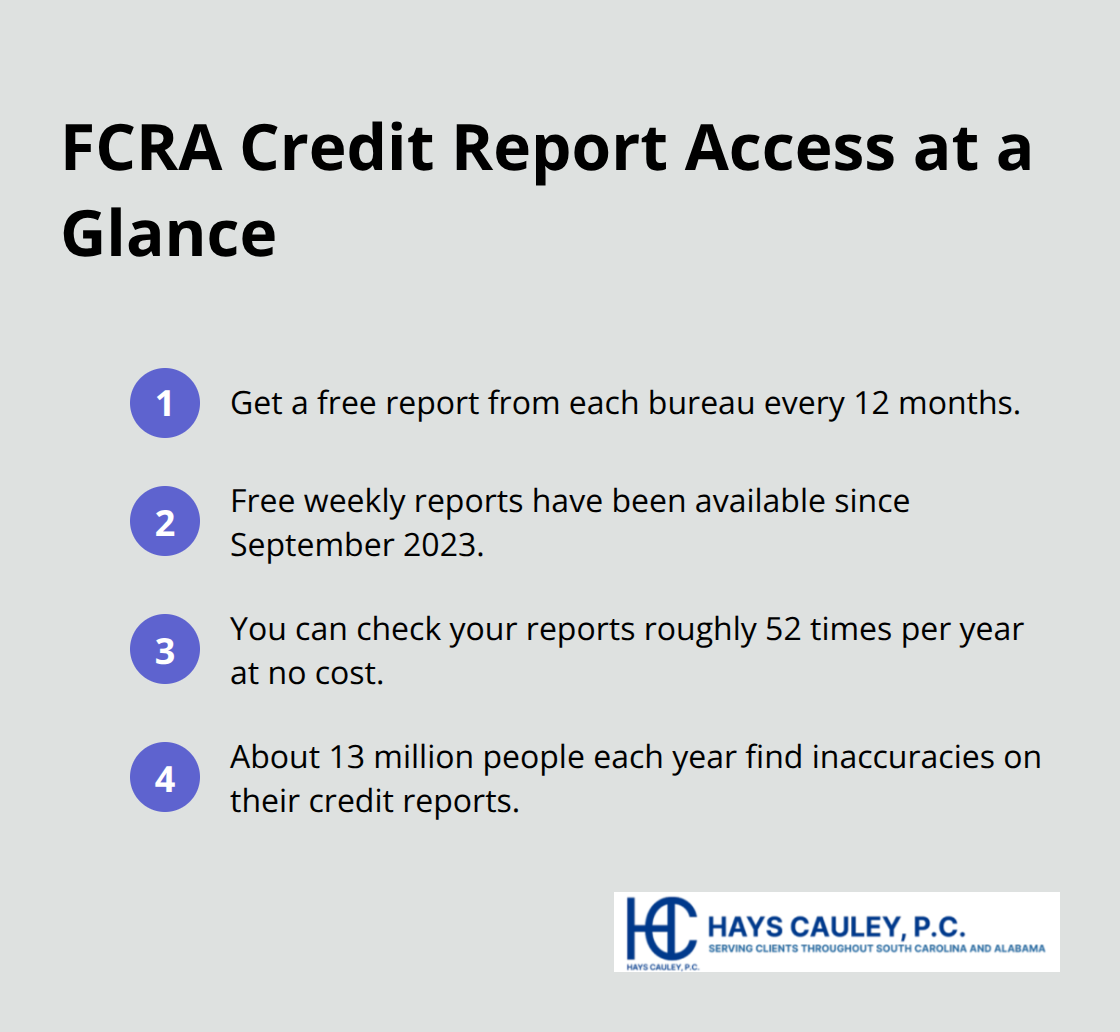
To access your free credit report, the only federally authorized source is AnnualCreditReport.com. Under the Fair Credit Reporting Act (FCRA), you are entitled to a free copy of your credit file from each of the three major bureaus—Equifax, Experian, and TransUnion—every twelve months, though weekly access has remained the standard through 2026.
Understanding Your Legal Right to Free Credit Reports
The foundation of consumer credit transparency in the United States is the Fair Credit Reporting Act (FCRA). This federal legislation ensures that the information processed by consumer reporting agencies is handled with fairness, accuracy, and privacy. One of the most critical provisions of the FCRA is the right for consumers to see what information is being collected about them.
In 2026, credit transparency is more vital than ever. Your credit report serves as your financial resume, influencing your ability to secure mortgages, auto loans, apartment rentals, and even certain employment opportunities. Because lenders rely on this data to assess risk, the law mandates that you have a pathway to verify the data's integrity without financial barriers.
While the original statute guaranteed one free report every twelve months, the landscape shifted significantly in the early 2020s. Following the COVID-19 pandemic, the three major credit bureaus—Equifax, Experian, and TransUnion—voluntarily extended weekly free reports to help consumers manage financial volatility. This "temporary" measure was eventually made permanent, a standard that remains in full effect in 2026.
The Official Method for Accessing a Free Credit Report
Despite the proliferation of "free credit score" apps and financial monitoring services, there is only one central portal established by the credit bureaus to comply with federal law: AnnualCreditReport.com.
Using this portal is the most efficient way to request your reports simultaneously or individually. It is important to distinguish this site from commercial competitors that may require a subscription or "freemium" sign-up.
Accessing Your Report Online
The online process is the fastest method, typically providing immediate access to your file in a downloadable PDF format.
- Visit the Official Site: Navigate to AnnualCreditReport.com.
- Complete the Request Form: You will need to provide your legal name, date of birth, Social Security number, and current address. If you have moved within the last two years, you must also provide your previous address.
- Select the Bureaus: You can choose to view reports from Equifax, Experian, and TransUnion all at once, or stagger them throughout the year.
- Security Verification: This is the most technical phase. Each bureau will ask "out-of-wallet" security questions. These are generated from your credit history and may include previous loan amounts, former employers, or past addresses. If you cannot answer these correctly, you will be required to request your report via mail for security reasons.
- Review and Save: Once verified, you can view the report. It is highly recommended to save a digital copy or print it immediately, as the session will expire, and you may need to re-verify to see it again.
Accessing Your Report by Phone or Mail
If you prefer not to use the online portal or if you have failed the automated identity verification, you have two alternative pathways.
- By Phone: Call 1-877-322-8228. You will go through an automated verification process. Your reports will be processed and mailed to you within 15 days.
- By Mail: You must download and complete the Annual Credit Report Request Form from the Federal Trade Commission (FTC) website or the official portal. Mail the completed form to: Annual Credit Report Request Service P.O. Box 105281 Atlanta, GA 30348-5281
Free Credit Report vs. Free Credit Score
A common point of confusion for consumers is the distinction between a credit report and a credit score.
Your credit report is a detailed log of your credit history. It includes account opening dates, payment histories, credit limits, and public records like bankruptcies. However, the free report provided under the FCRA does not necessarily include your credit score (such as a FICO or VantageScore).
Credit scores are proprietary mathematical models that interpret the data in your report. While many banks and credit card issuers now provide free credit scores as a perk of membership, the bureaus are not legally required to include them in the free annual disclosure. If you require your score through the official portal, you may be asked to pay a nominal fee, though most consumers in 2026 find their scores through their primary financial institutions or third-party monitoring apps.
Special Situations That Grant Additional Free Reports
Beyond the standard weekly access, federal law provides specific circumstances where you are entitled to additional free reports, regardless of how many you have already accessed.
- Adverse Action: If a lender denies you credit, insurance, or employment based on your credit report, they must provide you with an "Adverse Action Notice." You have 60 days from receiving this notice to request a free report from the bureau used in the decision.
- Identity Theft and Fraud: If you have placed a fraud alert on your file or have reason to believe your file contains inaccurate information due to fraud, you are entitled to a free report to investigate the claim.
- Unemployment: If you are currently unemployed and intend to apply for employment within the next 60 days, you are entitled to one free report per year from each bureau.
- Public Assistance: Consumers receiving public welfare assistance are entitled to a free annual report.
- State Law Protections: Some states provide additional free reports under state-specific statutes.
Summary of Access Methods
| Method | Speed of Delivery | Best For | Security Requirements |
|---|---|---|---|
| Online | Immediate | Most users; quick verification | Digital identity verification (KBA) |
| Telephone | 15 days via mail | Users without internet access | Automated IVR verification |
| 15 days via mail | Users who fail online KBA | Physical form and signature | |
| Third-Party Apps | Immediate | Monthly monitoring | Account creation; data sharing |
How to Review Your Report for Errors and Fraud
Accessing the report is only the first step; the technical value lies in the audit. When you receive your report, you should systematically check for the following data points:
- Personal Information: Ensure your name, aliases, and Social Security number are correct. Check that previous addresses listed are places you actually lived.
- Account Status: Verify that all listed accounts belong to you. Look for "closed" accounts that may still be listed as "open," or late payments that you know were paid on time.
- Credit Inquiries: Review "hard" inquiries. If you see inquiries from companies you did not authorize or apply with, it could be a sign of attempted identity theft.
- Public Records: Check for any erroneous entries regarding bankruptcies or civil judgments. In 2026, most tax liens and civil judgments no longer appear on consumer credit reports, so their presence should be scrutinized.
Protecting Yourself from "Free" Credit Report Scams
The term "free credit report" is a frequent target for phishing and deceptive marketing. Many websites use similar-sounding URLs to trick consumers into signing up for "trial" memberships that eventually charge monthly fees.
Remember that AnnualCreditReport.com is the only site mandated by the government. The Federal Trade Commission (FTC) warns that official entities will never:
- Email you out of the blue asking for your Social Security number.
- Require you to purchase a product to get your report.
- Use pop-up ads to direct you to the reporting portal.
If you are redirected to a site asking for credit card information for a "verification fee," you are likely on a predatory site. Exit the browser and re-type the URL manually.
Troubleshooting Common Access Issues
In some cases, you may find yourself unable to access your report. This is often due to a "thin file"—meaning you do not have enough credit history for the bureau to generate a report—or a mismatch in data.
If the system cannot verify your identity, it is often because the information you provided does not match what the bureau has on file. This can happen if you recently changed your name or if a creditor reported your address incorrectly. In these instances, the "Mail-In" method is the only way to resolve the issue, as it allows you to provide physical photocopies of your ID and utility bills to prove your identity.
Furthermore, if your credit file is frozen, you do not need to lift the freeze to access your own report through AnnualCreditReport.com. The freeze prevents third-party lenders from seeing your data, but it does not block your own legal right to access it.
FAQs
Can I get a free credit report without a Social Security Number?
While it is difficult, it is possible if you have an Individual Taxpayer Identification Number (ITIN). However, the online portal is heavily optimized for SSN verification. If you use an ITIN, you will likely need to request your report via the mail-in process and provide secondary identification documents.
Does checking my own credit report lower my score?
No. When you access your own credit report, it is recorded as a soft inquiry. Unlike hard inquiries, which occur when a lender reviews your credit for a loan application, soft inquiries have zero impact on your credit score.
How often should I check my report in 2026?
Because reports are now available weekly, a good strategy is to check one of the three bureaus every month on a rotating basis. This allows you to spot potential identity theft or reporting errors within 30 days of them occurring, without the redundancy of checking all three every single week.
What should I do if I find an error?
You must file a dispute with the credit bureau that produced the report. Under the FCRA, bureaus generally have 30 to 45 days to investigate your claim. You should also contact the creditor who provided the inaccurate data (the "furnisher") to ensure they update their internal records.
Is my data safe on the official website?
AnnualCreditReport.com uses high-level encryption and is managed by the three bureaus under federal oversight. While no digital platform is 100% immune to risk, it is the most secure and legally compliant method for accessing this sensitive information.
Final Recommendation
Regularly monitoring your credit is a cornerstone of modern financial health. For 2026, the recommended practice is to visit AnnualCreditReport.com and download a copy of your report from at least one bureau every quarter. This ensures you maintain a clear view of your financial standing, protects you against the long-term damage of identity theft, and ensures that your credit score is based on accurate, verified data. If you are preparing for a major purchase like a home or car, review all three reports at least six months in advance to allow time for any necessary disputes.