An absentee franchise is a business model where the owner invests capital and oversees strategic performance while hiring a day-to-day manager to handle daily operations, staffing, and customer service. This approach appeals to investors seeking diversification, professionals maintaining full-time careers, and entrepreneurs scaling multiple business units without being tied to a single storefront.
Understanding the Absentee Franchise Model
The concept of an absentee franchise challenges the traditional image of small business ownership, which typically depicts the owner behind the register or managing staff seven days a week. Instead, this ownership structure splits the enterprise into two distinct tiers: strategic governance and tactical execution.
In a true absentee model, the owner has zero daily operational duties. They review financial statements, approve major capital expenditures, monitor key performance indicators (KPIs), and manage the general manager. Conversely, a semi-absentee franchise model requires the owner to dedicate a limited number of hours per week—usually between 10 and 20—focusing on high-level tasks like local marketing oversight, bookkeeping, and staff check-ins, while the manager handles the remaining operational load.
Understanding this division of labor is essential for prospective investors. Many first-time buyers confuse "absentee" with "hands-off" or "maintenance-free." No business is entirely self-running, especially during its launch phase. Even in a mature absentee franchise, the owner remains ultimately responsible for the financial health, legal compliance, and strategic direction of the business. If the general manager resigns, the owner must be prepared to step in temporarily or manage a rapid recruitment process to prevent operational disruption.
Evaluating Franchise System Suitability
Not every franchise system is compatible with an absentee or semi-absentee ownership structure. Franchisors enforce strict guidelines regarding who can operate their units, and some require a hands-on owner-operator to protect their brand equity, customer service standards, and local market reputation.
To determine if a franchise system supports absentee ownership, investors must analyze several operational factors:
- Standardized Systems: The franchise must possess highly documented, repeatable processes. If success relies heavily on the owner's personal charisma or specialized technical skills, absentee ownership will likely fail.
- Management-Friendly Industry: Certain sectors—such as fitness centers, vending operations, home-cleaning services, and coin-operated laundries—naturally lend themselves to layered management.
- Unit Economics: The business model must generate sufficient revenue and profit margins to absorb the salary of a competent general manager while still delivering an attractive return on investment to the owner.
- Franchisor Approval: Prospective buyers must review the Franchise Disclosure Document (FDD), specifically Item 12 and Item 15, to verify whether the franchisor permits passive or semi-absentee operation.
Franchise Models Comparison Matrix
| Franchise Type | Typical Operational Involvement | Management Reliance | Initial Capital Requirements | Risk Profile |
|---|---|---|---|---|
| Hands-On Owner-Operator | 40–60+ hours/week | Low (Owner is manager) | Moderate | High time commitment; lower payroll costs. |
| Semi-Absentee Franchise | 10–20 hours/week | Moderate (Shared duties) | Moderate to High | Balanced; requires strong oversight and management retention. |
| True Absentee Franchise | 2–5 hours/week | High (Relies on General Manager) | High | Higher financial risk; vulnerable to manager turnover. |
Financial Realities and Cost Considerations
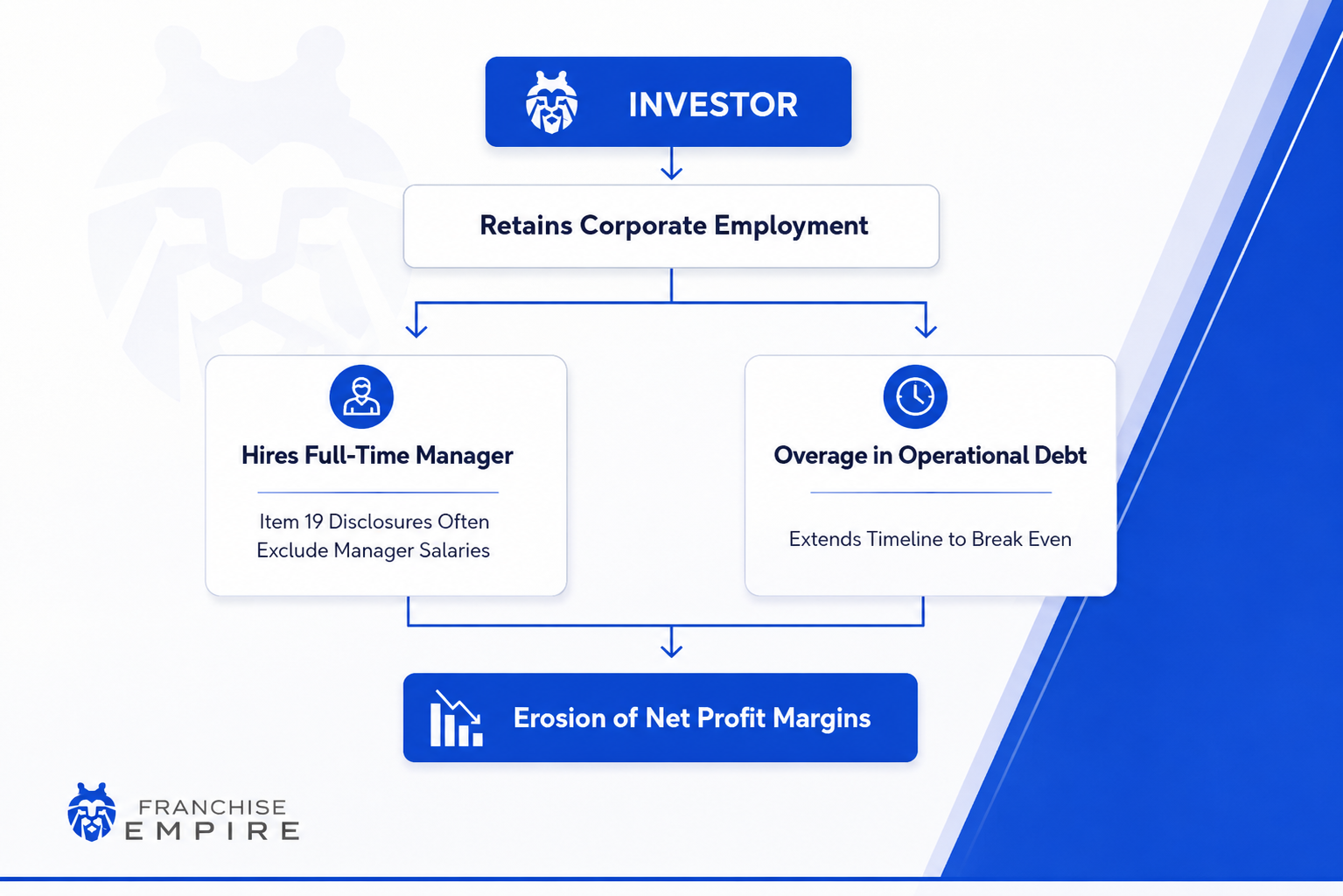
Investing in an absentee franchise requires careful financial planning. Beyond the standard franchise fees, equipment costs, and working capital required for any business startup, absentee ownership introduces a major recurring expense: executive payroll.
Hiring an experienced general manager means paying a competitive salary, and often performance-based bonuses, to attract talent capable of running the business without direct supervision. If the unit's gross revenue cannot comfortably support this compensation structure alongside standard operating expenses and debt service, the investment will underperform.
Furthermore, total startup costs for absentee-friendly franchises can be substantial. For example, service-based franchises may require lower upfront capital, while brick-and-mortar concepts like fitness centers or quick-service restaurants demand significant investments in real estate build-out and commercial equipment. Investors must calculate their break-even point factoring in management overhead from day one.
Operational Hurdles and Risk Mitigation
The primary vulnerability of an absentee franchise is management dependency. When a business relies on a general manager for day-to-day survival, the departure or underperformance of that individual poses an existential threat to the enterprise.
To mitigate these operational risks, successful absentee owners implement rigorous internal controls and structural safeguards:
- Robust Hiring Pipelines: Owners should never rely on a single manager without a backup plan. Establishing relationships with local staffing agencies and maintaining an active recruitment pipeline ensures quick replacements.
- Key Performance Indicators (KPIs): Tracking daily sales, labor percentages, inventory shrinkage, and customer satisfaction scores remotely via cloud-based software allows owners to spot anomalies before they escalate.
- Independent Audits: Implementing surprise cash counts, third-party bookkeeping reviews, and inventory audits prevents internal fraud and ensures adherence to company policy.
- Incentive Compensation: Structuring bonus programs tied to net profit margins or customer retention aligns the manager's financial success with the owner's return on investment.
Frequently Asked Questions
Can I run an absentee franchise while keeping my full-time job?
Yes, many professionals use semi-absentee or absentee franchises as a vehicle for portfolio diversification. However, you must ensure you have adequate time outside your primary career to review financials, handle administrative approvals, and communicate with your general manager.
How do I find a trustworthy general manager for my franchise?
Finding the right manager involves casting a wide net through professional networks, industry boards, and job platforms. Look for candidates with multi-unit management experience in the same industry, and conduct thorough background checks, reference verifications, and structured behavioral interviews.
Do franchisors allow absentee ownership for first-time buyers?
Some franchisors restrict absentee ownership to experienced multi-unit operators who have already proven their capabilities with an active, hands-on location. Other brands actively welcome executive investors with strong corporate backgrounds. Review the Franchise Disclosure Document or consult franchise development representatives to confirm specific brand policies.
What happens if my general manager quits unexpectedly?
In a true absentee model, a sudden resignation requires the owner to step in temporarily to cover shifts or manage daily administrative tasks until a replacement is hired. Having documented operational manuals and cross-trained assistant managers minimizes disruption during these transition periods.
Are absentee franchises more profitable than hands-on franchises?
Not necessarily. While absentee owners save time, they incur higher labor costs due to management salaries. Profitability depends heavily on unit volume, operational efficiency, and the ability of the hired management team to drive sales and control expenses.
Next Actions for Prospective Investors
Before committing capital to an absentee franchise, conduct a thorough self-assessment of your risk tolerance, financial capacity, and management oversight style. Request the Franchise Disclosure Document from target franchisors, pay careful attention to itemized startup costs and operational restrictions, and speak with existing franchisees in the system to verify whether their stated profit margins accommodate management overhead. Consulting with a franchise attorney or a certified public accountant experienced in multi-unit business structures will help ensure your investment strategy aligns with your long-term wealth accumulation goals.