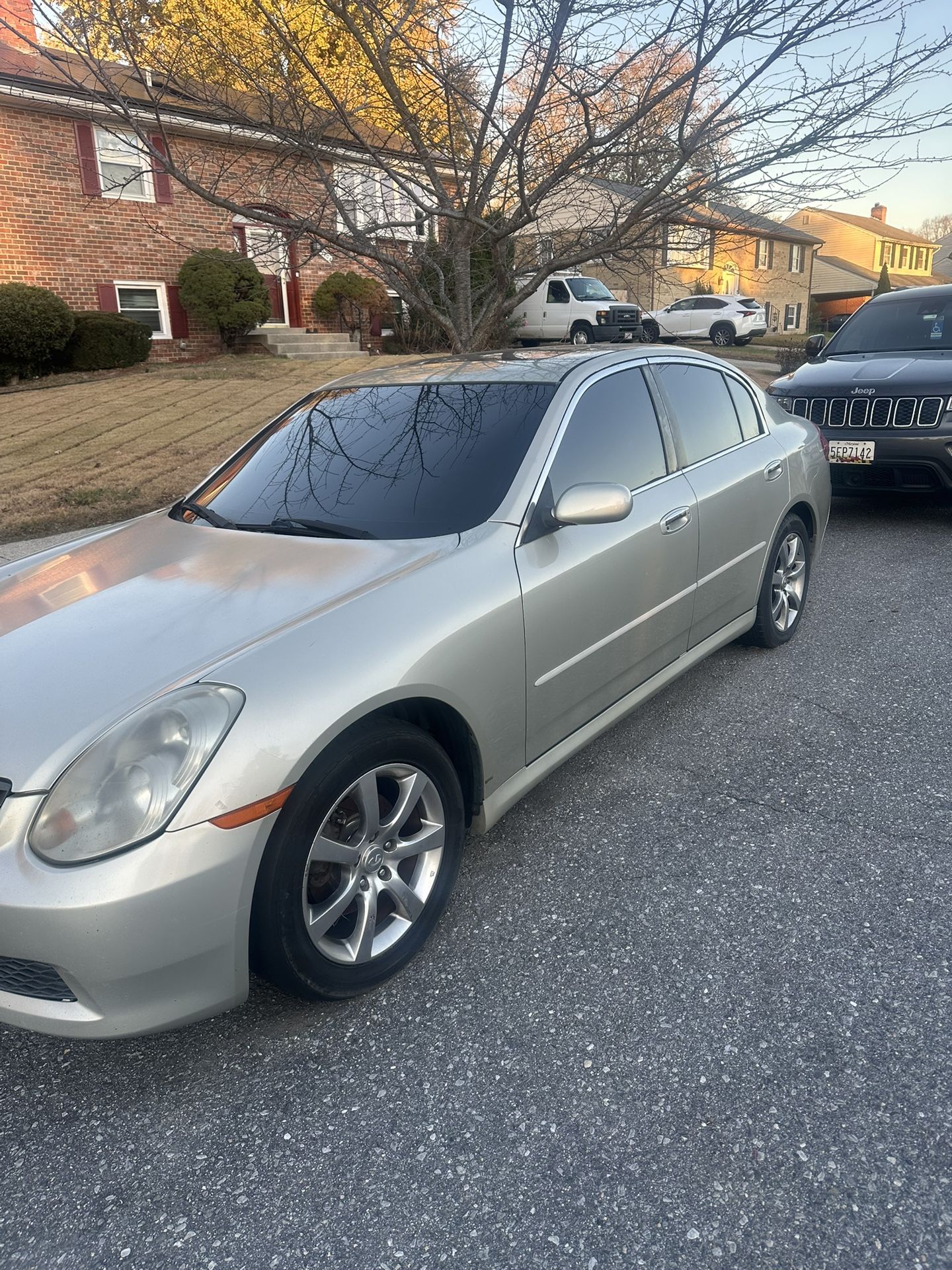
The 2005 Infiniti G35x combines a rear-wheel-drive performance chassis with an intelligent all-wheel-drive system, powered by a 298-horsepower VQ35DE V6 engine. It delivers sports-sedan dynamics, robust acceleration, and year-round traction, making it a compelling option for drivers seeking enthusiast engagement without sacrificing daily usability.
Decoding the 2005 Infiniti G35x Identity and Lineage
When Nissan’s luxury division launched the G35 for the North American market, it disrupted the entry-level luxury sport sedan segment. Built on the front-midship (FM) platform—shared with the legendary Nissan 350Z—the G35 was engineered from the asphalt up to prioritize balance, weight distribution, and mechanical responsiveness.
For the 2005 model year, Infiniti introduced a series of substantial mid-cycle refinements. While the rear-wheel-drive (RWD) sedan received an output bump to 298 horsepower for its manual transmission variants, the all-wheel-drive G35x variant retained its automatic transmission configuration while benefiting from the updated interior architecture, revised suspension tuning, and enhanced exterior styling cues. The "x" designation stands for ATTESA E-TS (Advanced Total Traction Engineering System for All Electronic Torque Split), a torque-transfer technology originally developed for the Nissan Skyline GT-R.
Understanding this vehicle requires looking past standard luxury badges. The G35x is fundamentally a sports car disguised as a four-door sedan. Its longitudinal engine placement pushes the bulk of the motor's weight behind the front axle centerline, resulting in an optimal weight distribution that minimizes understeer during aggressive cornering maneuvers.
Powertrain Dynamics: The Heart of the VQ35DE V6
At the center of the 2005 Infiniti G35x driving experience is the naturally aspirated 3.5-liter V6 engine, designated as the VQ35DE. In the G35x automatic configuration, this powerplant is factory-rated at 260 horsepower and 258 lb-ft of torque. While this is slightly lower than the high-revving manual RWD variants of the same model year, the power delivery remains punchy, linear, and eager to rev.
Engine Specifications and Performance Metrics
- Displacement: 3,498 cc (3.5 Liters)
- Valvetrain: DOHC, 4 valves per cylinder with continuous valve timing control (CVTCS)
- Horsepower: 260 hp at 6,000 RPM
- Torque: 258 lb-ft at 4,800 RPM
- Redline: 6,600 RPM (Automatic transmission variants)
- Block/Head Material: Aluminum alloy block and cylinder heads
The VQ35DE is celebrated for its robust bottom end, melodic exhaust note, and immediate throttle response. Unlike modern turbocharged engines that rely on forced induction to build low-end torque, the G35x delivers power progressively. Peak torque arrives close to 4,800 RPM, rewarding drivers who enjoy sweeping through the upper half of the tachometer.
Paired exclusively to the G35x is a 5-speed automatic transmission featuring a manual shift mode (Sequential Shift Control). While it lacks the lightning-fast gear changes of modern dual-clutch transmissions or the gear spread of contemporary eight-speed units, it is a sturdy, mechanically dependable unit capable of holding power reliably.
The ATTESA E-TS All-Wheel-Drive System
The defining characteristic that sets the G35x apart from its standard rear-wheel-drive sibling is its intelligent all-wheel-drive system. In dry road conditions, the system directs 100 percent of the engine's power to the rear wheels, preserving the pure, unadulterated handling characteristics of a traditional rear-drive sport sedan.
However, the moment slip is detected at the rear wheels—whether due to rain, snow, loose gravel, or aggressive cornering acceleration—an electromagnetic clutch pack continuously and seamlessly varies torque split. Up to 50 percent of available power can be instantly transferred to the front wheels to maintain directional stability.
| Driving Condition | Front Wheel Torque Split | Rear Wheel Torque Split | System Priority |
|---|---|---|---|
| Dry Cruising | 0% | 100% | Pure rear-wheel-drive feel and efficiency |
| Wet / Slippery Straightline | Variable (Up to 50%) | Variable (Down to 50%) | Maximum traction and straight-line stability |
| Aggressive Cornering Entry | 0% - 20% | 80% - 100% | Neutral handling and minimal push |
| Hard Acceleration in Snow | 50% | 50% | Maximum launch grip and controlled tracking |
This predictive and reactive capability means drivers do not have to manually engage a four-wheel-drive mode. The car analyzes inputs from multiple sensors—including wheel speed, steering angle, and lateral G-forces—adjusting traction parameters in milliseconds.
Chassis, Suspension, and Handling Performance
A powerful engine is irrelevant if the chassis cannot manage the forces involved. The 2005 Infiniti G35x utilizes a sophisticated four-wheel independent suspension layout:
- Front Suspension: Independent double-wishbone design with a stabilizer bar, offering precise steering feedback and excellent camber control during hard cornering.
- Rear Suspension: Multi-link setup with a stabilizer bar, designed to maintain tire contact patch integrity over uneven pavement and under heavy acceleration loads.
Because the G35x incorporates front axle components to drive the front wheels, its ride height is marginally higher than the lowered stance of the rear-wheel-drive sport suspension models, and its front spring and damper rates are specifically calibrated to handle the added mechanical weight of the front differential and drive axles.
Steering is managed via a vehicle-speed-sensitive power-assisted rack-and-pinion system. It provides a reassuringly heavy steering feel at highway speeds while lightening up during low-speed parking maneuvers. Brake performance is anchored by four-wheel ventilated disc brakes with Anti-lock Braking System (ABS), Electronic Brake-force Distribution (EBD), and Brake Assist.
Interior Ergonomics and Cabin Amenities
Stepping inside the 2005 model year reveals the comprehensive interior overhaul Infiniti performed to elevate cabin quality compared to the 2003 and 2004 production runs. The center console layout was redesigned, replacing the polarizing aluminum trim of early models with softer-touch materials, cleaner switchgear, and a more integrated dash aesthetic.
The driver-focused cockpit places instrumentation directly in the line of sight, with gauges that tilt alongside the steering column adjustment to ensure the instrument cluster is never obscured by the steering wheel rim. Front seats offer supportive side bolstering, making long highway journeys comfortable while keeping the driver firmly planted during spirited cornering.
Key cabin features often found in well-equipped 2005 G35x models include:
- Leather-appointed seating surfaces with power adjustments for both driver and front passenger.
- Automatic climate control with rear passenger vents.
- Available Bose premium audio system featuring a 6-disc in-dash CD changer.
- Power sunroof and auto-dimming rearview mirror with integrated digital compass.
Cabin space is generous for a compact executive sedan. Rear legroom is adequate for adults, though the central floor tunnel—housing the driveshaft running to the rear differential—does compromise foot space for a middle-rear passenger. Trunk capacity measures at 14.8 cubic feet, offering deep storage dimensions despite the lack of folding rear seats in early AWD iterations due to structural chassis bracing.
Fuel Economy and Real-World Ownership Costs
Purchasing or maintaining a performance-oriented sedan from the mid-2000s requires a realistic assessment of ongoing running costs. The 2005 Infiniti G35x is a heavy vehicle—weighing approximately 3,750 pounds—and relies on a displacement-heavy V6 engine, which directly impacts fuel consumption.
- EPA Fuel Economy Ratings: Approximately 16 mpg city / 23 mpg highway. Real-world mixed driving typically yields around 17 to 19 mpg depending on driving style and traffic density.
- Fuel Requirement: Premium unleaded fuel (91 octane or higher) is strictly recommended by the manufacturer to prevent engine knock and maintain optimal power output.
- Insurance Costs: Because the G35 chassis has historically attracted younger enthusiast demographics, insurance premiums can lean higher than average for standard family sedans, though the four-door body style and AWD safety profile help moderate rates compared to coupe equivalents.
Common Mechanical Issues and Maintenance Guide
While the VQ35DE engine is widely regarded as mechanically bulletproof when properly maintained, vehicles from this era exhibit specific known issues that prospective buyers and current owners should monitor closely.
1. Valve Cover Gasket Leaks
Over time, the rubber spark plug tube seals and valve cover gaskets harden due to persistent engine heat cycles. This results in oil pooling inside the spark plug wells, which can eventually cause misfires. Replacing the valve cover assemblies and gaskets is a standard maintenance procedure for high-mileage units.
2. Camshaft and Crankshaft Position Sensors
The OEM sensors on early VQ35 engines are prone to electronic failure as they age. When these sensors fail, the engine may experience extended cranking times, enter "limp mode," or stall unexpectedly. Replacements should ideally be sourced directly from Nissan/Infiniti, as aftermarket sensors frequently trigger persistent check-engine codes.
3. Suspension Bushing Wear
The front compression rod bushings (often referred to as lower control arm bushings) are fluid-filled rubber components that degrade over time. When these fail, drivers may notice braking vibrations, vague steering response, or uneven front tire wear. Upgrading to solid aftermarket polyurethane bushings provides a permanent fix.
4. Window Regulator Failures
Power window motors and regulators on G35 models manufactured between 2003 and 2006 are notorious for premature failure. If a window begins moving sluggishly or fails to drop when opening the door, the regulator assembly requires replacement.
Comparing the G35x to Key Competitors
To understand the value proposition of the 2005 G35x, it must be evaluated against its primary period rivals, particularly the benchmark German sports sedans of the era.
| Vehicle Model | Engine Type | Drivetrain | Primary Strength | Primary Weakness |
|---|---|---|---|---|
| 2005 Infiniti G35x | 3.5L V6 (260 hp) | Intelligent AWD | Robust reliability, direct steering feel, great value | Heavy fuel consumption, dated interior tech |
| 2005 BMW 330xi (E46) | 3.0L Inline-6 (225 hp) | Permanent AWD (xDrive) | Exceptional chassis balance, steering precision | Complex cooling system, high maintenance costs |
| 2005 Audi A4 3.0 Quattro | 3.0L V6 (220 hp) | Quattro Permanent AWD | Interior build quality, stable winter composure | Understeer-heavy handling, complex front multi-link suspension |
| 2005 Lexus IS 300 | 3.0L Inline-6 (215 hp) | Rear-Wheel Drive | Bulletproof 2JZ-derived engine, tight dimensions | Cramped rear seat, no factory AWD option for this generation |
While the BMW 330xi offers sharper out-of-the-box steering precision, it demands significantly higher maintenance outlays for cooling system components and oil leaks. The Audi A4 excels in interior material luxury and heavy snow capability, but its front-heavy weight distribution compromises agility. The G35x strikes a middle ground: delivering sports-car heritage, straightforward mechanical architecture, and dependable everyday traction.
Frequently Asked Questions
Is the 2005 Infiniti G35x good in deep snow?
Yes, when equipped with a quality set of dedicated winter tires, the G35x is exceptionally capable in deep snow and ice. The ATTESA E-TS all-wheel-drive system rapidly transfers torque to the front wheels the moment rear wheel slip is detected, providing secure launches from dead stops and stable highway tracking in adverse weather conditions.
Can the 2005 Infiniti G35x run on regular 87 octane gasoline?
No. The engine is tuned with a high compression ratio (10.3:1) and calibrated for premium fuel. Running regular 87 octane fuel can cause engine knock (detonation), which triggers the knock sensor, retards ignition timing, and noticeably reduces both power output and fuel efficiency.
Does the G35x have the same horsepower as the rear-wheel-drive G35 sedan?
Not quite. The 2005 rear-wheel-drive manual transmission sedan produces 298 horsepower, while the RWD automatic produces 280 horsepower. The G35x automatic is rated at 260 horsepower due to packaging constraints, exhaust routing adaptations required by the front differential, and powertrain loss tolerances within the ATTESA system.
What are the biggest warning signs of a failing transmission in this car?
The 5-speed automatic transmission (RE5R05A) is generally durable, but look out for harsh shifting, slipping gears, delayed engagement when shifting from Park to Drive or Reverse, and transmission fluid contamination caused by a failing transmission fluid cooler integrated within the main radiator.
Is the 2005 Infiniti G35x difficult to modify or tune?
The VQ35DE engine has an extensive aftermarket support ecosystem. Simple modifications such as cold-air intakes, cat-back exhaust systems, and ECU remaps are straightforward to install. However, forcing induction (adding a turbocharger or supercharger) to the G35x is significantly more complex than on rear-wheel-drive models due to tight under-hood clearance around the front differential and axle shafts.
Final Recommendation
The 2005 Infiniti G35x remains a benchmark entry-level performance sedan for enthusiasts operating on a budget. It bridges the gap between raw, rear-wheel-drive driving dynamics and the practical safety requirements of all-weather capability.
If you are evaluating a pre-owned purchase, prioritize examples with documented service records, verified cooling and suspension health, and minimal structural modification. When properly maintained, the G35x delivers authentic driving power, an unmistakable V6 exhaust note, and dependable mechanical service for thousands of miles.